


Content
TL;DR
- Securitize and Computershare have agreed to support U.S.-listed companies that want to issue equity securities in tokenized form.
- The model uses Issuer-Sponsored Tokens, or ISTs, that can sit alongside existing shares and Direct Registration System holdings.
- Computershare will act as transfer agent for its clients’ ISTs, including corporate actions for tokenized holdings.
- The key shift is that tokenized shares are moving closer to issuer-led equity infrastructure, not just synthetic trading products.
Securitize and Computershare are trying to bring tokenized shares into the core plumbing of U.S. public markets.
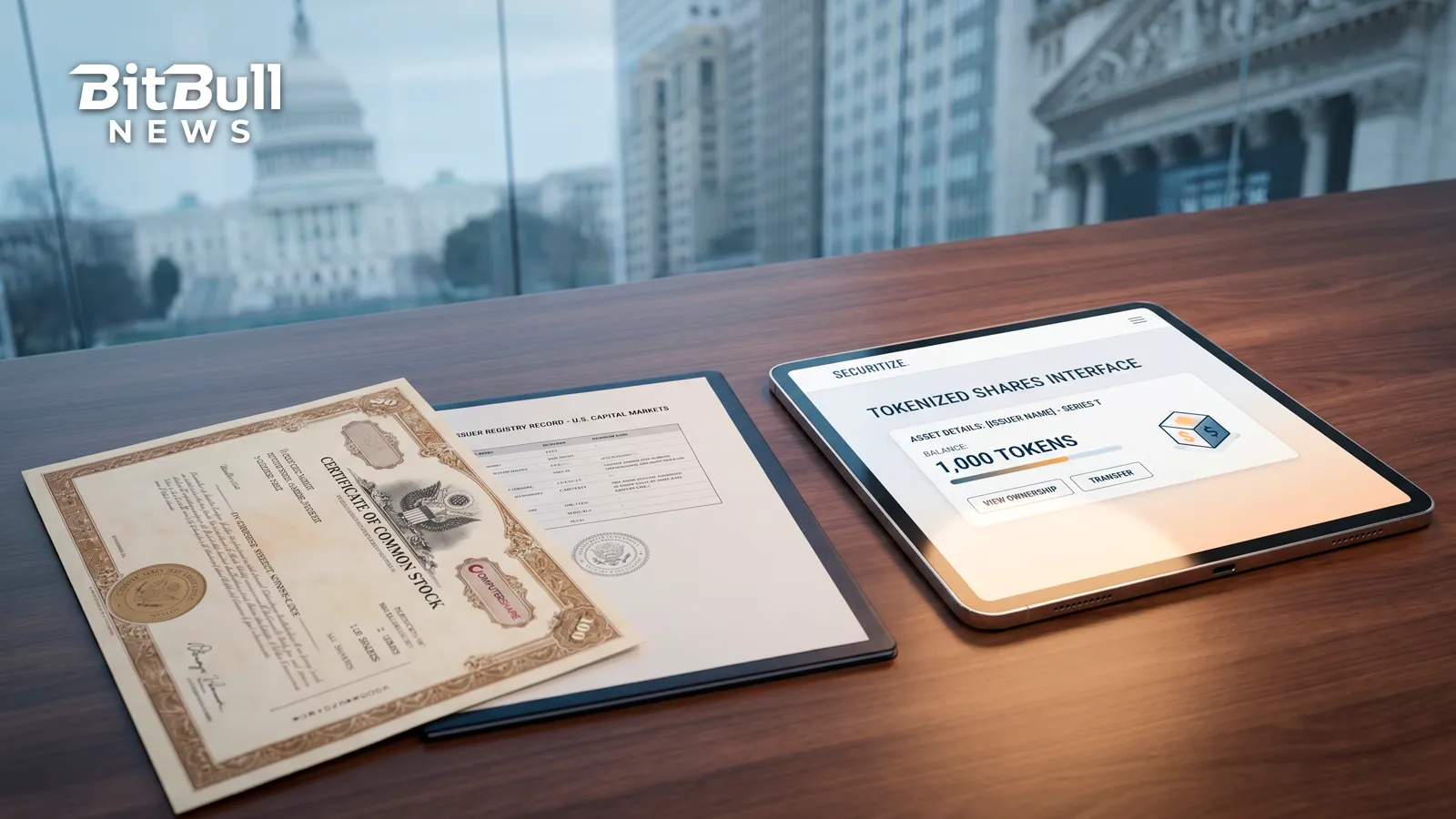
The companies announced an agreement to enable tokenized shares for U.S. issuers, giving Computershare clients a path to issue equity securities in tokenized form. Simply put, this is not about creating another token that tracks a stock price. It is about letting public companies issue direct equity ownership in token form while keeping traditional transfer-agent controls in place.
Tokenized Shares Are Moving Closer To The Issuer
The most important detail is the structure.
Securitize and Computershare say issuers can include Issuer-Sponsored Tokens as part of their issued capital alongside existing shares, including shares held through the Direct Registration System. That matters because ISTs are designed to sit inside the issuer’s capital structure rather than outside it as a derivative-style wrapper.
Securitize CEO Carlos Domingo framed that distinction directly, saying ISTs do not rely on derivative tokens layered on top of underlying shares and do not change the underlying equity. His point is simple: if tokenized equities are going to matter for U.S. public companies, they need to look like real equity infrastructure, not just price exposure dressed up as a token.
That is the big “what changed” here. Tokenized shares are moving from exchange and app distribution toward issuer-controlled issuance and shareholder servicing. That is a more serious market-structure step than another tokenized stock listing.
Computershare Brings The Transfer-Agent Layer
Computershare’s role is what makes the announcement stand out.
The company will act as transfer agent for its clients’ ISTs and process corporate actions for tokenized holdings alongside other directly registered holdings. That means the tokenized version is not floating in a separate crypto-only universe. It remains tied to the systems that track ownership, corporate actions and issuer-shareholder communication.
Computershare North America Issuer Services CEO Ann Bowering said the goal is to let U.S.-listed companies issue tokenized equity while retaining control over their issued capital. She also said the IST model is designed to operate within the existing regulatory environment, with the independence and oversight expected from a transfer agent.
That is where this deal adds real value to the tokenization debate. The market does not only need tokenized assets. It needs tokenized assets that can handle dividends, proxy voting, corporate actions, records and investor communications without breaking the rules public companies already follow.
That same operational layer is becoming more important across tokenized securities infrastructure, where the focus is shifting from trading access to ownership rights, governance and servicing.
What Changed
Before this agreement, much of the tokenized stock conversation focused on access: 24/7 trading, fractional exposure, faster settlement and global distribution.
This deal shifts the focus to issuance and administration. U.S.-listed companies using Computershare can now explore tokenized shares as part of issued capital, not only as a secondary-market product created around existing stock.
That changes the audience. The immediate question is no longer only whether traders want tokenized equities. It is whether issuers want to offer shareholders a digital holding format while preserving direct ownership records and corporate-action flows.
Securitize already tested issuer-led public equity tokenization earlier this month with Currenc Group ordinary shares on Ethereum and Solana. The Computershare agreement turns that direction into a broader pathway for U.S.-listed companies rather than a one-off issuer experiment.
Who It Affects Now
The first group affected is U.S.-listed issuers. Companies now have a clearer route to explore tokenized equity without handing the entire process to crypto-native platforms or creating synthetic exposure products.
The second group is shareholders. ISTs could let investors consolidate digital holdings in a wallet while keeping direct communication and corporate-action flows with issuers. That is important because real ownership is not just a ticker and a price chart. It also includes notices, votes, dividends and records.
The third group is market infrastructure firms. Transfer agents, broker-dealers, custodians, ATS operators and fund administrators will all need to adapt if tokenized securities become part of normal public-market operations.
This is the same broader move showing up in tokenized fund servicing, where large traditional players are building the back-office layer needed to make onchain assets work inside regulated markets.
Why It Matters
This story matters because tokenized equities will not scale if they only offer faster trading or cleaner app interfaces.
Public shares come with ownership records, issuer controls, corporate actions, proxy flows, transfer rules and regulatory expectations. Securitize and Computershare are targeting that harder layer. If it works, tokenized shares could become a format issuers choose directly, not just a product built around them by trading platforms.
The next thing to watch is adoption. The agreement creates a pathway, but the market still needs real U.S.-listed companies to issue ISTs, shareholders to use them and infrastructure providers to support them across wallets, brokerages and trading venues.
The bigger signal is clear: tokenized equities are moving from “can we trade stock-like tokens?” to “can public companies issue and service real shares onchain?” That is a much more important question for the future of capital markets.