



Content
Paxos Labs has launched Amplify Transit, a stablecoin conversion and cross-chain movement layer that processed nearly $30 million on Robinhood Chain during its first two weeks of operation.
Transit went live on July 1, 2026, alongside the Robinhood Chain mainnet. By July 13, the infrastructure had handled almost $30 million in stablecoin movement between Ethereum and the new network, according to the official launch announcement.
The headline number is not the result of liquidity incentives or market-making activity seeded by Paxos Labs. Bhau Kotecha, Head of Paxos Labs, told BitBullNews that the volume came primarily from platforms, users and treasuries moving assets required for operations on Robinhood Chain.
We have not seeded market makers into Transit, and liquidity from partners represents a minimal portion of the total.
Kotecha said.
That distinction matters. Early blockchain volume can be heavily influenced by incentive programs, internal treasury transfers or liquidity placed specifically to support a launch. Paxos Labs describes Transit’s initial activity as demand-led migration rather than manufactured throughput.
USDC And USDG Lead The First Routes
The most active Transit routes currently move USDC and USDG between Ethereum and Robinhood Chain, Paxos Labs confirmed in response to BitBullNews.
Transit also supports PYUSD conversions, giving integrated platforms access to three major dollar-denominated stablecoins through one application programming interface. The system is available around the clock and provides the expected output before settlement begins.
At launch, Transit supports:
- USDC, USDG and PYUSD conversions
- Ethereum and Robinhood Chain
- Cross-chain stablecoin movement
- Conversion between different stablecoins
- Guaranteed output amounts
- Fixed pricing for each route
- Continuous availability, including weekends and holidays
- A single API integration for platforms and protocols
Robinhood Chain is a permissionless, Ethereum-compatible Layer 2 built with Arbitrum technology. Robinhood has positioned the network as infrastructure for trading, lending, tokenized assets and other onchain financial services.
USDG is native to the Robinhood Chain ecosystem and is issued by Paxos Digital Singapore, a Major Payment Institution supervised by the Monetary Authority of Singapore. Paxos documentation states that the stablecoin is backed by cash and cash-equivalent reserves and redeemable for US dollars on a one-to-one basis.
That created an immediate routing requirement. Users and platforms arriving from Ethereum needed a way to move existing stablecoin balances onto Robinhood Chain without separately sourcing liquidity, accepting uncertain execution or managing several bridge and exchange integrations.
The launch of Robinhood Chain surfaced substantial cross-chain friction at scale. The network required immediate interoperability to facilitate value migration from day one.
Kotecha said.
Why Paxos Labs Started With A New Chain
Launching Transit first on a new blockchain may appear counterintuitive. Established networks already hold deeper liquidity, broader stablecoin distribution and larger transaction volumes.
But a new chain exposes the problem Transit is intended to solve more clearly. Assets, applications and users may be ready to enter, while liquidity remains distributed across other networks and stablecoin formats.
Robinhood Chain’s public mainnet arrived with support from infrastructure providers and decentralized finance applications. Its documentation describes the network as an open Layer 2 focused on connecting traditional markets, crypto and tokenized real-world assets.
For Paxos Labs, that made Robinhood Chain a practical first market. USDG was available natively, while users and treasuries held large balances in USDC and other stablecoins elsewhere.
Transit became the conversion layer between those positions.
Given its status as a nascent ecosystem utilizing USDG natively, the network required immediate interoperability.
Kotecha told BitBullNews.
Paxos Labs said several more chains and stablecoins are already in development, with deployments scheduled for the coming months. The company did not disclose which assets or networks will be added next.
The Nearly $30 Million Came From Operational Demand
Paxos Labs did not provide a transaction count or a full breakdown of volume by route. It did, however, identify USDC and USDG movement between Ethereum and Robinhood Chain as the dominant activity.
The company said the flows primarily reflected platforms’ users and treasuries completing necessary migrations. Partner liquidity accounted for only a small share, while Paxos Labs did not place market makers into Transit to create initial volume.
This suggests the early use case is less about speculative bridging and more about balance-sheet positioning.
A platform operating on Robinhood Chain may receive or hold USDG but still need to settle obligations in USDC. A treasury entering the network may hold USDC on Ethereum but require USDG for applications or liquidity venues available on the new chain.
Without an integrated conversion layer, that process can involve several steps:
- Selecting a bridge or cross-chain route
- Moving the original stablecoin to the destination chain
- Finding sufficient liquidity for a swap
- Estimating slippage and fees
- Monitoring separate bridge and exchange transactions
- Reconciling the final amount after settlement
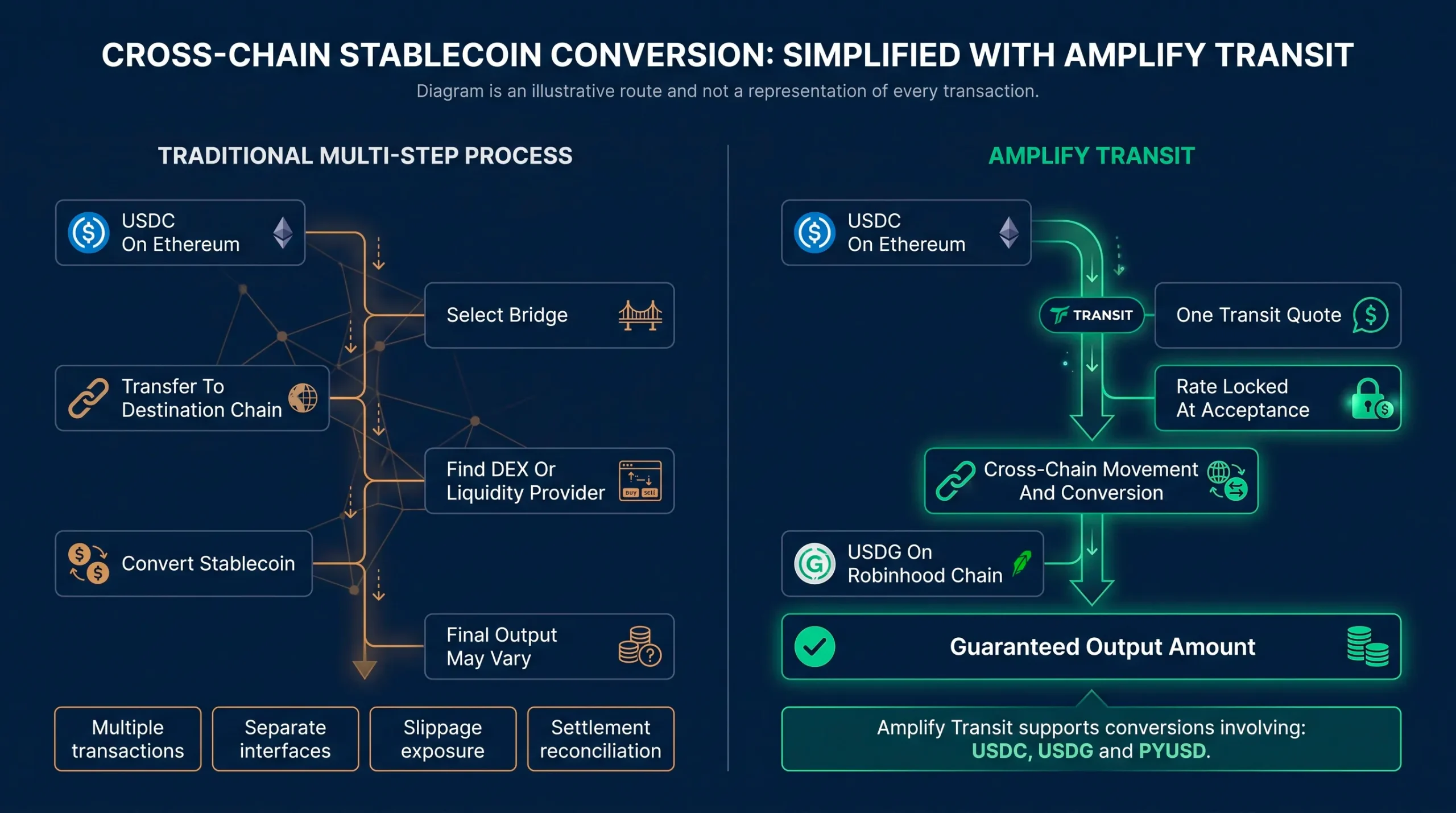
Transit combines the movement and conversion into one quoted transaction. The platform knows the output amount before submitting the transfer.
Fixed Pricing Replaces Open-Market Uncertainty
Transit’s commercial model is built around a consistent basis-point spread for each route. The rate is locked when the transaction is submitted, and the output amount does not change during settlement.
The model applies across a wide transaction range. Paxos Labs said Transit can process conversions from $5 to more than $50 million under the same pricing structure.
The fee is tied to the route rather than calculated as a fixed dollar charge. A platform converting USDC on Ethereum into USDG on Robinhood Chain receives a quoted spread for that route and a guaranteed output amount.
Paxos Labs manages execution through an internal mechanism that aggregates liquidity across a proprietary network and offsets flows moving in opposite directions.
If one group of clients is converting USDC into USDG while another is moving USDG back into USDC, part of the demand can be matched internally. That reduces the amount of external liquidity required and limits repeated exposure to open-market execution.
Our internal mechanism aggregates deep liquidity through a proprietary network while netting out opposing flows.
Kotecha said.
Paxos Labs argues that this structure allows Transit to provide the same level of price certainty for both small transfers and institutional-size conversions. The company did not disclose the identities of its liquidity counterparties or the detailed mechanics used to manage unmatched positions.
Why Guaranteed Output Matters At Institutional Scale
Price certainty becomes harder as transaction size rises.
A small stablecoin swap can often clear through a decentralized exchange with limited slippage. A transfer worth tens of millions of dollars may need several liquidity pools, market makers or routes, and the final result can differ from the amount shown when the transaction started.
That creates problems for platforms that promise their own users a specific conversion rate. It also complicates treasury accounting, margin management and settlement reconciliation.
Transit places that execution complexity behind the platform’s interface. The integrating company receives a firm output quote and remains in control of the price or fee presented to its users.
According to Paxos Labs, this allows exchanges, wallets, fintech companies, treasuries and protocols to preserve their customer relationships and commercial margins rather than directing users to a third-party bridge interface.
Transit Is Not Positioned As Another Bridge Aggregator
Transit enters a market already served by bridges, intent-based protocols, liquidity aggregators and stablecoin-specific transfer systems.
LI.FI, for example, connects applications to bridges, decentralized exchanges, solvers and other liquidity sources. Its routing layer searches across those providers to identify an execution path based on price, speed, gas costs and reliability.
Across uses an intent-based model. Users specify the outcome they want, while relayers and settlement infrastructure handle the route required to complete it.
Circle’s Cross-Chain Transfer Protocol takes a different approach. CCTP burns native USDC on the source chain and mints the corresponding amount on the destination chain. It avoids wrapped USDC and traditional bridge liquidity pools, but remains centered on moving USDC rather than converting between separate stablecoins.
Transit is designed around a narrower commercial promise: convert major stablecoins across chains at a known rate, including when the input and output assets are different.
| Model | Main Function | Multiple Stablecoins | Guaranteed Quoted Output | Typical Role |
|---|---|---|---|---|
| Amplify Transit | Cross-chain transfer and conversion | Yes | Yes | Embedded stablecoin execution |
| LI.FI | Routing across bridges and DEXs | Depends on routes | Not Transit’s fixed-output model | Aggregation |
| Across | Intent-based cross-chain execution | Depends on integration | Route-dependent | Intent settlement |
| Circle CCTP | Native USDC burn and mint | No, USDC only | Native USDC transfer model | Single-asset movement |
Its main distinctions are:
- Locked Execution: The output amount is established when the quote is accepted.
- Cross-Stablecoin Conversion: Transit can convert between USDC, USDG and PYUSD rather than only moving one asset between chains.
- Institutional Transaction Range: Paxos Labs says the model works from single-digit dollar amounts to transactions exceeding $50 million.
- Route-Based Pricing: The spread is determined by the route rather than negotiated separately for every transaction size.
- Embedded Distribution: Platforms can integrate Transit through an API while retaining their own interface, fees and customer relationship.
- Internal Flow Netting: Opposing conversions can be offset through Paxos Labs’ liquidity mechanism.
Paxos Labs does not describe Transit as a replacement for every bridge or aggregator. In some cases, it can sit behind those products as a specialized stablecoin conversion route.
Morpho, Jumper, Across And Arcus Add Transit As A Routing Option
Morpho, Jumper, Across and Arcus have incorporated Transit while building on Robinhood Chain, according to the launch announcement.
Paxos Labs said those integrations were driven primarily by Transit’s commercial structure and its ability to quote larger stablecoin conversions with predictable output.
The arrangements do not make Robinhood a counterparty to the individual technical integrations.
Paxos Labs has provided foundational support for the Robinhood Chain ecosystem since its inception. However, Robinhood itself is not a counterparty to these specific technical integrations.
Kotecha said.
Transit operates as autonomous infrastructure, while the integrating platforms decide when and how to use it as a routing option.
The Across integration is particularly instructive. Across already operates its own cross-chain intent and settlement infrastructure, yet it can still use Transit when a route requires stablecoin conversion at a guaranteed rate.
That points to Transit’s intended place in the stack. It is not only a consumer-facing transfer product. It can function as an execution component inside other cross-chain systems.
Paxos Labs Says Routing Remains Stablecoin-Neutral
USDG’s connection to the wider Paxos ecosystem raises an obvious commercial question: whether Transit favors USDG over USDC or PYUSD.
Paxos Labs said the system follows the parameters selected by the platform and user. It does not automatically direct transactions toward USDG.
Transit maintains routing neutrality by executing conversions between USDC, USDG and PYUSD according to the specific parameters defined by the platform and the user.
Kotecha said.
The company argues that neutrality is necessary because institutional partners rarely manage a single stablecoin. Their balances can reflect exchange liquidity, payment requirements, counterparties, supported chains and treasury policies.
PYUSD is issued by Paxos Trust Company and designed for payment and settlement use cases, while USDG is issued through Paxos Digital Singapore. USDC remains a separate product issued by Circle.
Transit’s value depends on supporting that mixed environment rather than keeping all activity inside one issuer’s assets.
Transit Becomes The Movement Layer Of Amplify
Transit forms part of Amplify, Paxos Labs’ infrastructure suite for platforms working with stablecoins and other digital assets.
The wider stack is organized around three functions:
- Mint: Infrastructure for launching branded stablecoins
- Move: Stablecoin and cross-chain conversion through Transit
- Monetize: Yield and balance utility through Amplify Earn
Paxos Labs says platforms can access those services through a single integration rather than assembling separate providers for issuance, movement and yield.
Transit is the connective layer in that model. Issuance gives platforms a stablecoin, but the asset still needs to reach users, applications and liquidity across multiple networks.
And as the stablecoin market becomes more diverse, moving one dollar token is no longer enough. Platforms need to convert between stablecoins with different issuers, distribution channels and network footprints.
What The First Two Weeks Actually Show
Nearly $30 million is not enough to establish Transit as a dominant cross-chain venue. But the composition of the volume gives the launch more weight than the headline figure alone.
Paxos Labs says the activity was primarily organic, that it did not seed market makers, and that partner liquidity made up only a minimal share. The dominant routes connected Ethereum with a newly launched network where USDG had immediate utility.
That is the exact environment Transit was built to address: a platform or blockchain adds stablecoins, but users arrive with balances held in different assets and on different networks.
The next test will be expansion. Paxos Labs must show that the pricing model holds as Transit adds chains, stablecoins and larger volumes with more varied flow patterns.
For now, Robinhood Chain provides an early proof point. Stablecoin interoperability is shifting from a bridge-selection problem toward an embedded execution service in which platforms expect a known price, a guaranteed output and one integration that works behind their own products.