



Content
IRACE has appointed crypto entrepreneur and institutional business development executive Scott Gralnick as Global Head of Institutional Growth, giving him a worldwide mandate across asset managers, investment funds, financial institutions and digital asset companies.

The appointment adds a crypto-native commercial operator to a leadership team built largely around institutional banking and custody. Gralnick will focus on client acquisition, strategic partnerships and the expansion of IRACE’s pipeline as the company develops a regulated operating model spanning traditional and digital markets.
A Crypto-Native Commercial Hire For An Institutional Bank
IRACE emerged from the rebranding of FundBank Group, an established banking provider to the asset management industry. The company is building on that infrastructure to combine banking, custody, liquidity management and execution within a single institutional platform.
Its existing traditional-asset banking services are already operational. Digital-asset capabilities will be introduced as the group receives the required regulatory approvals across its target jurisdictions.
Gralnick’s appointment addresses a specific part of that strategy: connecting institutional-grade controls with the commercial relationships and product expectations that developed inside the crypto sector.
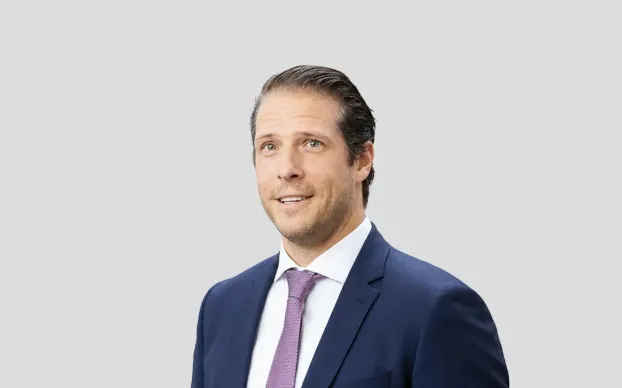
Institutional custody gives IRACE the governance, controls and regulatory infrastructure institutional clients require. Scott brings the other half.
the company told BitBullNews.
IRACE pointed to his experience founding and selling two ventures, leading institutional growth at Marinade Finance, and working across security, stablecoins, tokenization and blockchain market infrastructure.
A Global Mandate Across Traditional And Digital Asset Markets
Gralnick will lead IRACE’s institutional growth strategy globally rather than taking responsibility for one product, country or client category.
His coverage will include:
- Asset managers and investment funds
- Banks and other financial institutions
- Digital asset companies
- Institutional service providers
- Technology and infrastructure partners
- Strategic relationships across traditional and crypto-native markets
The role will sit across IRACE’s commercial, banking, product and custody functions. That structure matters because the company does not want its digital-asset business to operate as an isolated division disconnected from its existing institutional platform.
Gralnick’s immediate priorities will include deepening relationships with investment managers, service providers and strategic partners while expanding the company’s global pipeline.
IRACE stressed that this will remain a company-wide effort. Its institutional proposition will be delivered jointly by banking, custody, digital-asset and commercial specialists rather than being placed under a single executive.
Why Portis, Halborn, And Marinade Matter
Gralnick has spent more than a decade working across several stages of the digital-asset industry’s development.
He co-founded Portis, an Ethereum-based non-custodial wallet designed to make Web3 applications accessible without the usual technical friction. ShapeShift acquired Portis in April 2020, after which Gralnick became ShapeShift’s Director of Global Partnerships.
The Portis product and team later moved from ShapeShift to Kraken as ShapeShift transitioned toward a decentralized autonomous organization. That sequence clarifies earlier descriptions suggesting that Kraken directly acquired Portis: the original corporate acquisition was completed by ShapeShift, followed by the team’s later move to Kraken.
Gralnick subsequently worked in partnerships at blockchain security company Halborn and led institutional growth at Marinade Finance, where his remit included institutional staking and strategic relationships.
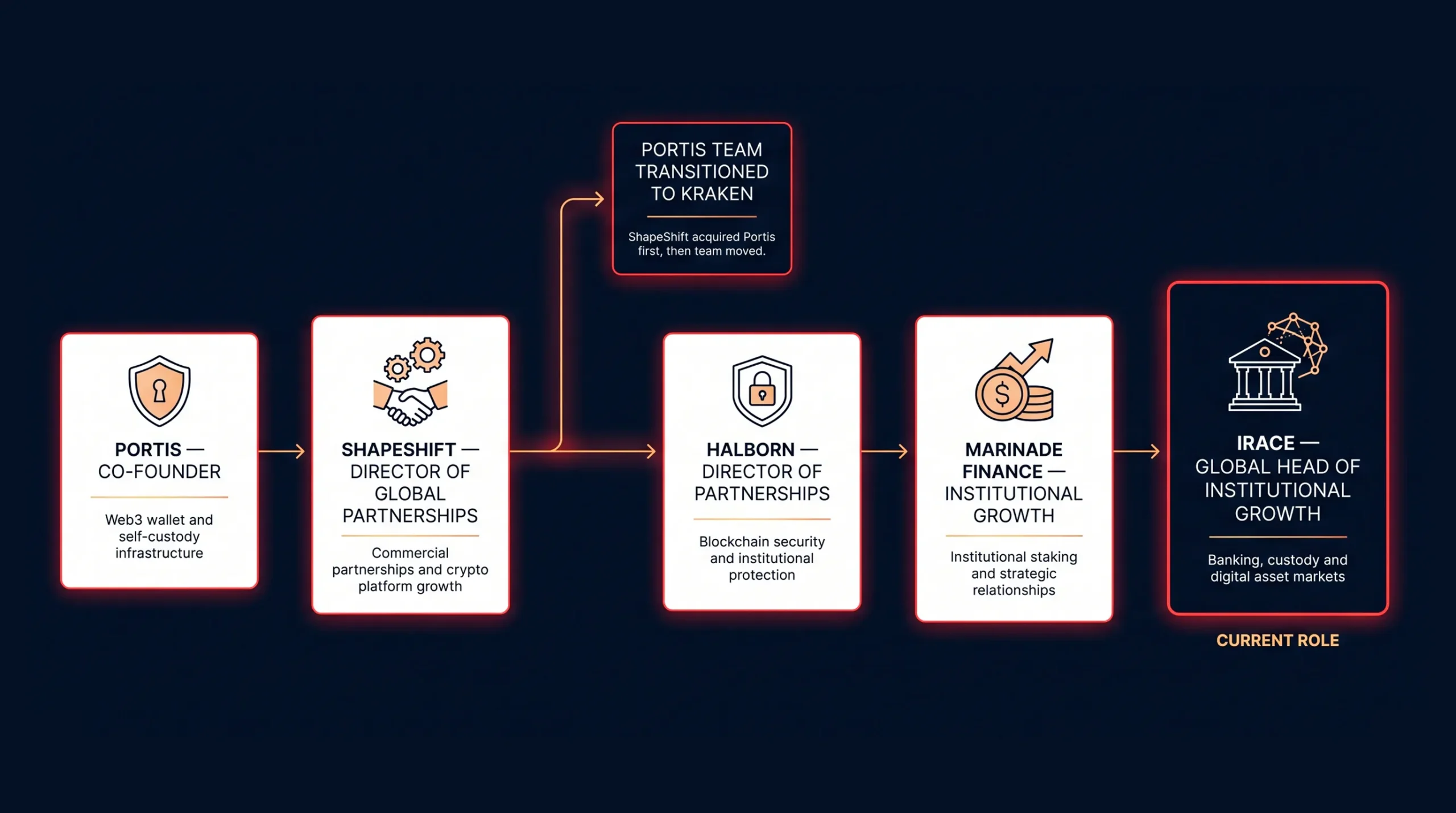
Those roles gave him exposure to both sides of institutional adoption: making blockchain products usable and protecting the capital entering them.
Portis showed me that mainstream users would trust self-custody once the friction disappeared. Halborn showed me how much institutional money was already quietly moving through this industry and how seriously it needed to be protected.
Gralnick told BitBullNews.
One Regulated Operating Model Instead Of Three Separate Vendors
IRACE’s commercial argument is based on reducing the number of separate relationships institutions must manage when moving between fiat money, stablecoins and digital assets.
Large financial firms have often approached digital assets through a collection of separate providers: one for banking, another for custody, and others for trading, settlement or liquidity. Each relationship introduces its own onboarding process, reporting standards, control framework and operational dependencies.
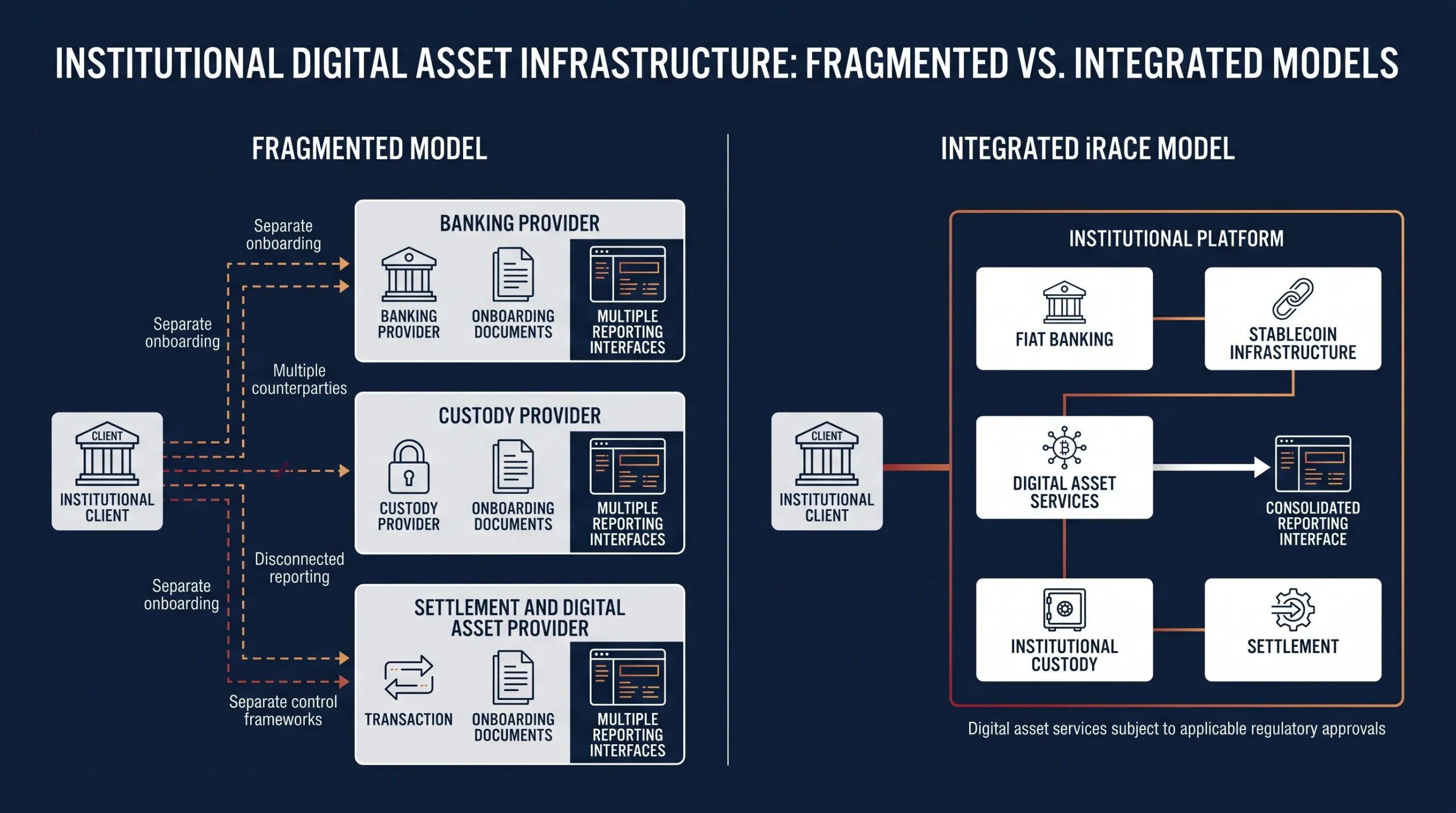
Gralnick believes that fragmentation, rather than a lack of institutional demand, is now one of the main constraints on adoption.
Custody, banking and settlement need to work as one system, not three vendors stitched together.
he said.
In his view, many institutions still treat digital assets as a separate operating track that can be attached to existing systems. But the harder question is whether the underlying banking and settlement infrastructure can support both markets consistently.
IRACE is positioning itself as the regulated relationship between those two environments. Gralnick described that combination as the main reason he joined the company.
Every other player that I saw only had one half of this right, but not both.
he said.
Custody companies may understand institutional controls without having deep relationships among crypto-native builders, he argued. Crypto platforms can move quickly, but they do not always provide an integrated banking relationship across fiat currencies, stablecoins and digital assets.
IRACE’s task is to prove that these services can be delivered through one credible institutional framework.
The First 90 Days Will Start With Listening
Gralnick’s first three months will focus on clients, partners and IRACE’s internal teams across its operating jurisdictions.
Rather than beginning with a fixed commercial playbook, he plans to assess where the company can create the most immediate value and how consistently its different business units are working together.
The first 90 days will be about listening, understanding our clients and partners, and spending time with the teams across our jurisdictions.
he said.
The first-year scorecard will also extend beyond the number of new accounts opened. Gralnick said success should be judged by the quality of IRACE’s institutional relationships, the strategic value of its partnerships and the level of trust the company earns as a banking provider.
The larger target is clear: clients should see IRACE as one institution capable of supporting both their established banking requirements and their digital-asset operations.
Regulatory Approvals Will Set The Service Rollout
IRACE’s traditional banking platform is already serving asset managers and institutional clients, but its digital-asset expansion remains tied to regulatory approvals.
The group previously confirmed that it was pursuing approvals connected to the US Office of the Comptroller of the Currency, the European Union’s Crypto-Asset Service Provider framework and Virtual Asset Service Provider requirements in relevant jurisdictions.
Asked which market would receive digital-asset services first, IRACE did not name a jurisdiction or provide a firm launch date.
We’re working with the appropriate regulators to explore and finalize relevant approvals, and we hope to have more to share in the coming weeks.
the company told BitBullNews.
The measured response keeps the commercial appointment separate from the regulatory process. Gralnick can build relationships and prepare the institutional pipeline, but the scope and timing of individual services will depend on the permissions granted in each market.
Tenet Bank Relationships Will Feed The Institutional Pipeline
Some of the relationships developed through Tenet Bank will fall within Gralnick’s remit when they match IRACE’s institutional growth strategy.
IRACE announced its Cayman Islands partnership with Tenet as part of the FundBank rebrand. Tenet serves entrepreneurs, startups, Web3 developers and institutional clients operating in digital assets and financial technology, giving the wider group access to a more crypto-native client base.
Gralnick will work with those relationships where they present opportunities for institutional banking, custody or infrastructure services.
But IRACE does not plan to treat the Tenet pipeline as a separate commercial channel. The company said relevant opportunities will be handled across its banking, product, custody and commercial teams as part of the same institutional offering.
What The Appointment Says About IRACE’s Strategy
IRACE has already assembled senior executives with backgrounds in institutional custody, banking and asset servicing. Gralnick adds a different type of experience: founding products, building partnerships and selling infrastructure inside the crypto market itself.
That combination says more about the company’s intended clients than the job title alone.
IRACE is not building solely for traditional asset managers experimenting with tokenized products. Nor is it targeting only crypto companies seeking bank accounts. Its stated market sits between the two: institutions whose operations increasingly involve cash, securities, stablecoins and blockchain-based assets at the same time.
The new appointment gives IRACE an executive responsible for translating that operating model into relationships and revenue. Gralnick’s work will test whether a platform rooted in institutional banking can also meet the speed, technical expectations and partnership culture of crypto-native companies.
And that is the commercial question behind the wider IRACE strategy. Institutions may no longer need to be persuaded that digital assets exist as a serious market. They need banking infrastructure that allows them to participate without building a fragmented operating system around them.