


Content
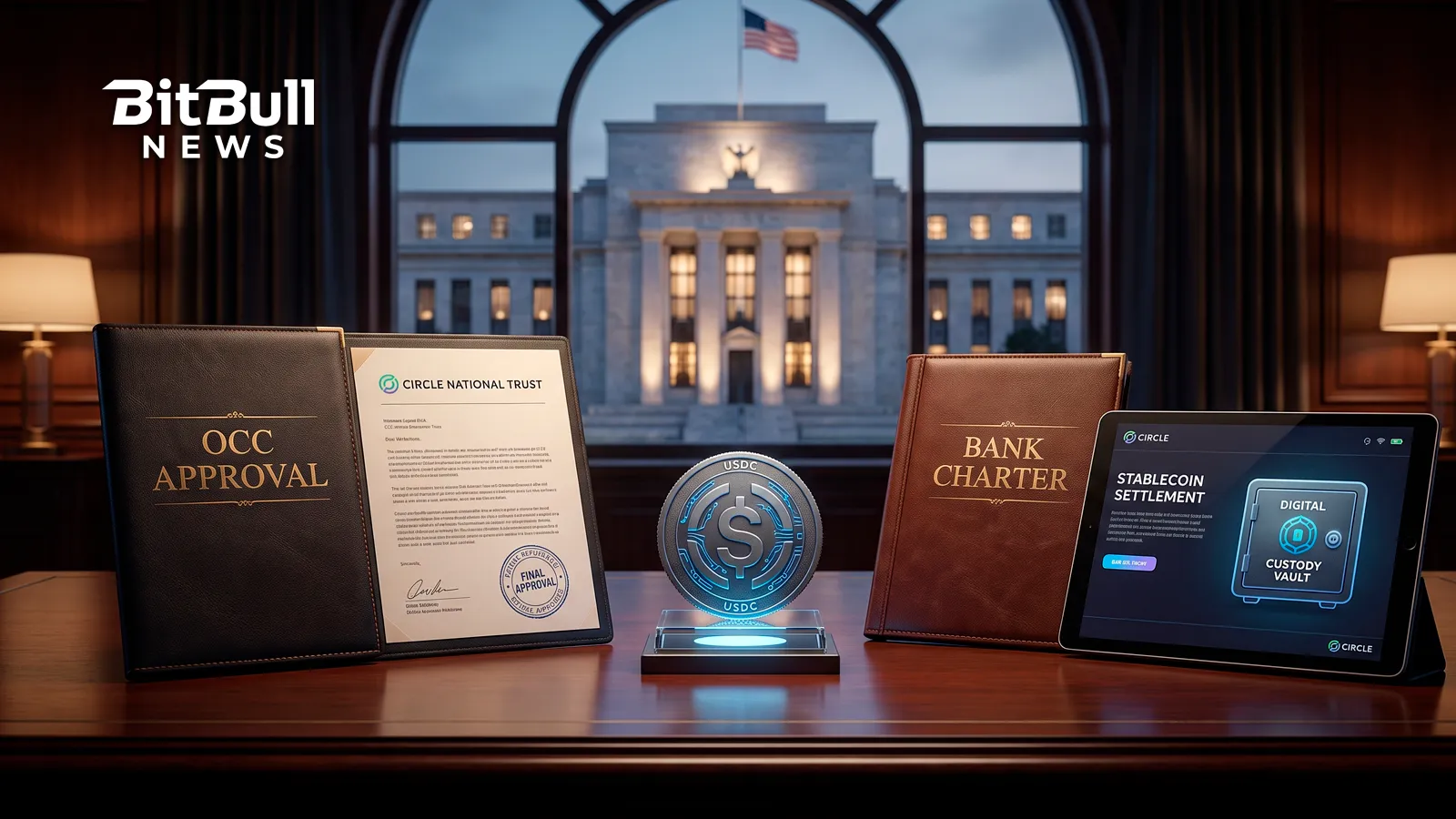
Circle just got its bank. The USDC issuer says the OCC granted final approval to establish First National Digital Currency Bank, N.A. — which will trade as Circle National Trust — putting the company under direct federal supervision for the first time.

Investors liked it. Circle stock (NYSE: CRCL) jumped double digits on the news, a sign the market reads a federal charter as a moat rather than a formality.
But read the fine print before calling Circle a bank. This is a national trust charter, not a commercial banking license — custody and fiduciary services, no deposits, no lending.
What Circle Actually Got
Strip the announcement down and it does one thing. Circle now holds a national trust bank charter, which places its digital-asset custody operation under the OCC — the same federal regulator that supervises the country’s national banks.
The immediate use is custody. Once open, Circle National Trust will provide fiduciary custody of digital assets for Circle and its affiliates, aligning that work with the fiduciary standards national trust banks have followed for decades.
Key Details:
- The OCC granted final approval for First National Digital Currency Bank, N.A., operating as Circle National Trust.
- The charter covers custody and fiduciary services — not deposits or lending.
- At launch it serves Circle and its affiliates, with room to add select institutions later.
- It strengthens USDC through federally regulated custody, with reserve management set as a future capability.
- Circle stock rose sharply, and the charter puts USDC issuance closer to the GENIUS Act’s federal regime.
From State Patchwork To Federal Oversight
The real prize is the regulator itself. A federal charter means one national rulebook instead of the roughly 50 state regimes that crypto firms otherwise juggle — a genuine cost and speed advantage.
Circle has been building toward this for a while. It applied to the OCC on June 30, 2025, and cleared conditional approval in December, timing that tracks the arrival of the GENIUS Act, the first U.S. federal framework for payment stablecoins, signed into law in July 2025.
The Catch: What The Charter Doesn’t Do Yet
Here’s where the headline oversells. Circle National Trust is not a full bank, and even its custody business starts small.
The crown jewel — managing the USDC Reserve under federal oversight — was the core reason Circle filed in the first place. That piece is deferred to a later phase. Day one, the bank mostly custodies assets for Circle itself.
There’s a second wrinkle most coverage skips. USDC issuance doesn’t move to the new federal bank; it stays under Circle’s New York state trust entity, regulated by NYDFS. The federal charter federalizes custody and, eventually, the reserve — not the coin itself.
Why It Matters For USDC
Even with the caveats, the direction is clear. Federally regulated custody — and eventually reserve management under the OCC — hardens the trust story around USDC, the world’s largest regulated stablecoin, with more than $70 billion in circulation.
That trust story is the whole pitch to institutions. Banks and asset managers already treat regulated custody as table stakes, and Circle has leaned into that, expanding institutional custody arrangements with players like BNY. A federal charter gives the same buyers a cleaner compliance answer.
The backdrop is a stablecoin market that keeps drawing serious institutional flow even in cautious conditions. Standard Chartered has warned that U.S. banks could shed as much as $500 billion in deposits to stablecoins by 2028 — which is exactly why the incumbents want in.
The Charter Land Grab
Circle isn’t first through this door. Anchorage Digital took an OCC national trust charter back in 2021. What’s changed is the crowd.
Since the GENIUS Act, the OCC has fielded a rush of applications, with conditional or full trust approvals going to Ripple, Paxos, Fidelity, BitGo and Coinbase, among others. The queue reportedly stretches to names like Morgan Stanley, Charles Schwab and Kraken’s parent. Traditional finance also wants to issue and settle its own stablecoins, which is the sharper threat to USDC’s lead.
Reaching final approval, not just conditional, puts Circle ahead of much of that field. It also fits a broader shift — crypto firms moving from running apps to owning regulated financial infrastructure.
The Analyst’s Take
The milestone is real, and the stock reaction is earned. A federal regulator, fiduciary custody and a path to bring the USDC reserve onshore under the OCC is a stronger foundation than a patchwork of state licenses.
But the part the market cares about most — federal management of the USDC Reserve — is still pending. CEO Jeremy Allaire said federal oversight “sets a new standard for transparency, governance, and scale” for Circle’s infrastructure, yet on day one the bank is mostly custodying for Circle, with outside institutional custody dependent on demand.
So the moat here is regulatory clarity, and it’s narrowing as rivals collect their own charters and banks build competing coins. The next test is execution: open the bank, win real institutional custody mandates, and move the reserve under federal supervision. Announcements are cheap now; the field is full of them.