


Content
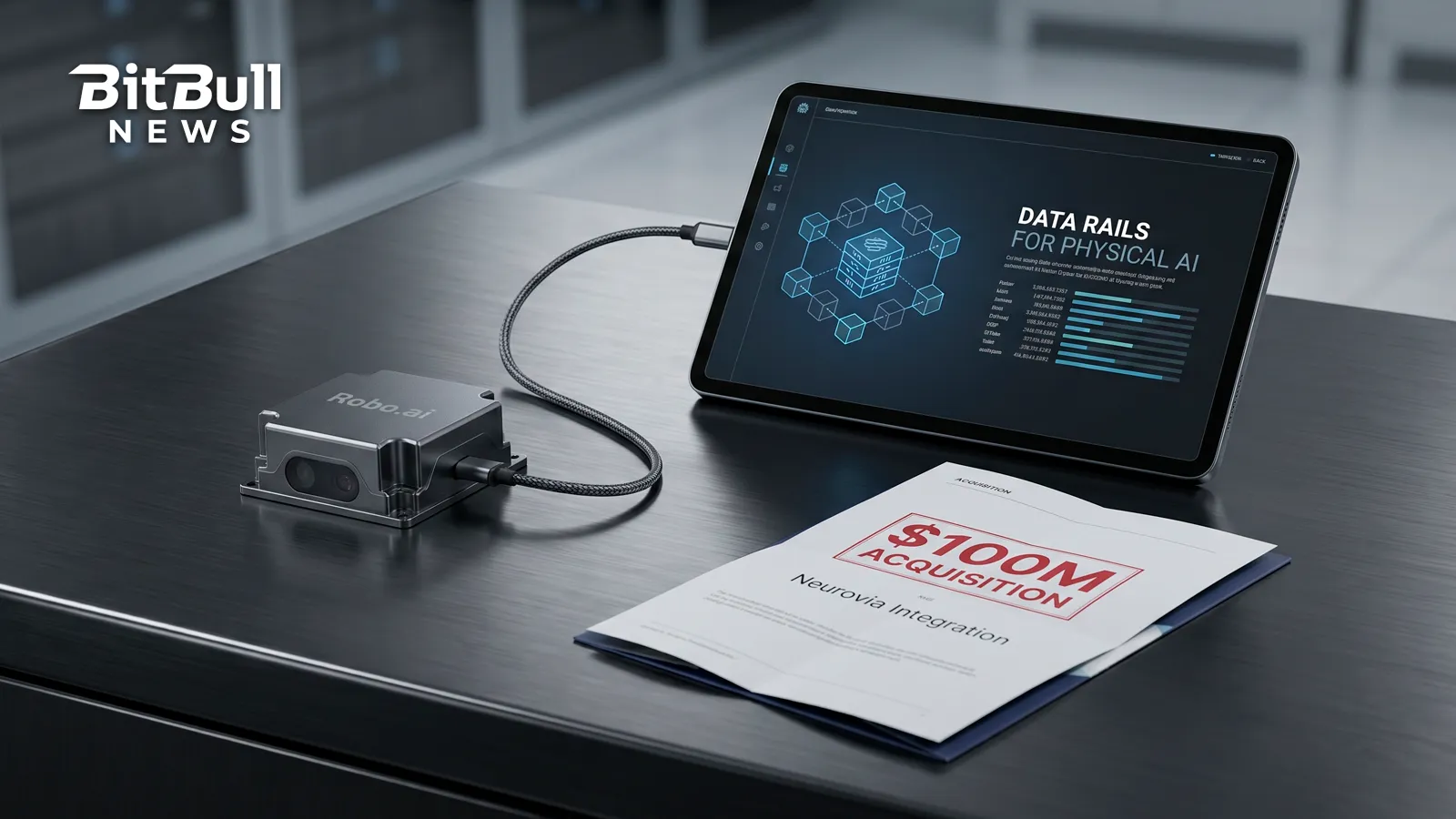
Nasdaq-listed Robo.ai (AIIO) has announced an agreement to acquire Neurovia AI Limited, a data processing and compression technology company, for $100 million in an all-stock deal. The target: become the foundational data infrastructure layer for the emerging machine economy — autonomous vehicles, humanoid robots, drone platforms, and smart cities — with blockchain as the connective tissue underneath it all.
It’s an ambitious bet, and the structure of the deal says as much about Robo.ai’s intentions as the acquisition itself.
What Neurovia Actually Does
Neurovia is an Abu Dhabi-based AI data processing and compression company focused on a specific and increasingly critical bottleneck in physical AI: video data. As AI systems move from software into the physical world — cameras, robots, autonomous vehicles — the volume of real-world data they generate becomes enormous. Neurovia’s technology addresses the compression, real-time transmission, edge processing, and cloud analysis of that data stream.
The company’s own management framed it directly: video data is the primary data inlet in the physical AI era, and the challenge is handling massive, continuous data flows from AI machines with low latency and high reliability. Neurovia’s stack is built around that specific problem.
The Deal Structure And What It Signals
The $100 million consideration is paid entirely in Robo.ai Class B ordinary shares — no cash changes hands. That all-stock structure preserves Robo.ai’s balance sheet for R&D and market expansion, while the equity lock-up terms signal a genuine long-term commitment from the Neurovia team. Shares are subject to a full lock-up for the first three years post-closing, followed by gradual vesting over the subsequent five years — an eight-year total schedule. For a $100 million deal, that’s an unusually long alignment mechanism, and it effectively ties the Neurovia team’s financial outcome to Robo.ai’s performance over nearly a decade.
Closing remains subject to customary conditions.
From Video Codec To AI Infrastructure Platform
Post-acquisition, Robo.ai plans to upgrade its existing video codec business lines into a comprehensive AI video data infrastructure platform. The use cases it names are expansive: robotaxis, autonomous vehicles, unmanned delivery systems, smart cities, AI camera networks, drone platforms, humanoid robots, and smart manufacturing systems.
Each of those verticals shares the same underlying need — efficient, low-latency processing of large volumes of real-world sensor and video data at the edge, with reliable transmission to the cloud. Neurovia’s technology is being positioned as the horizontal infrastructure layer across all of them, rather than a point solution for any single vertical.
Where Blockchain Fits In
The blockchain component of Robo.ai’s stated roadmap is specific and worth noting. The company describes a ten-year plan to build a “closed-loop integration of AI hardware, video data, edge AI, and blockchain.” Concretely, that includes on-chain identities for AI devices, video data assetisation, AI data rights confirmation, and stablecoin payments — all within what it describes as a coordinated global AI machine network.
This positions Robo.ai squarely at the intersection of physical AI and on-chain infrastructure, a space that has seen growing attention as the question of data provenance, machine identity, and autonomous payments becomes more pressing. For readers tracking where blockchain applications are moving beyond pure finance, this is a concrete example of a Nasdaq-listed company building blockchain into its core operating architecture, not as a marketing layer, but as a claimed functional component of device identity and data monetisation.
The Broader Context
Robo.ai is actively expanding across the Middle East and Asia, with a strategic focus on smart cities and sovereign AI infrastructure. The Neurovia acquisition fits that geography — Neurovia operates from Abu Dhabi, and the company’s disclosed use cases align closely with the large-scale smart city and autonomous infrastructure programmes being deployed across the Gulf region.
For anyone watching the convergence of AI infrastructure investment and blockchain-enabled data economies, Robo.ai’s move is a tangible data point. The company is making a direct claim: that in the physical AI era, the entity that controls data compression, transmission, and edge processing infrastructure controls a significant share of the value chain. Whether the execution matches the architecture remains to be seen, but the strategic logic is clearly drawn.