


Content
TL;DR
- Modern Treasury has integrated USDC on Polygon into its Payments API.
- Businesses can now manage compliance, accounts, ledgering, fiat payments and stablecoin payments from one platform.
- The integration supports on- and off-ramps between USD and USDC, near-instant Polygon transfers and reconciliation across fiat and onchain activity.
- The real shift is that stablecoin payments are moving from separate crypto stacks into everyday treasury and payments infrastructure.
Modern Treasury is bringing Polygon-based USDC deeper into business payments.
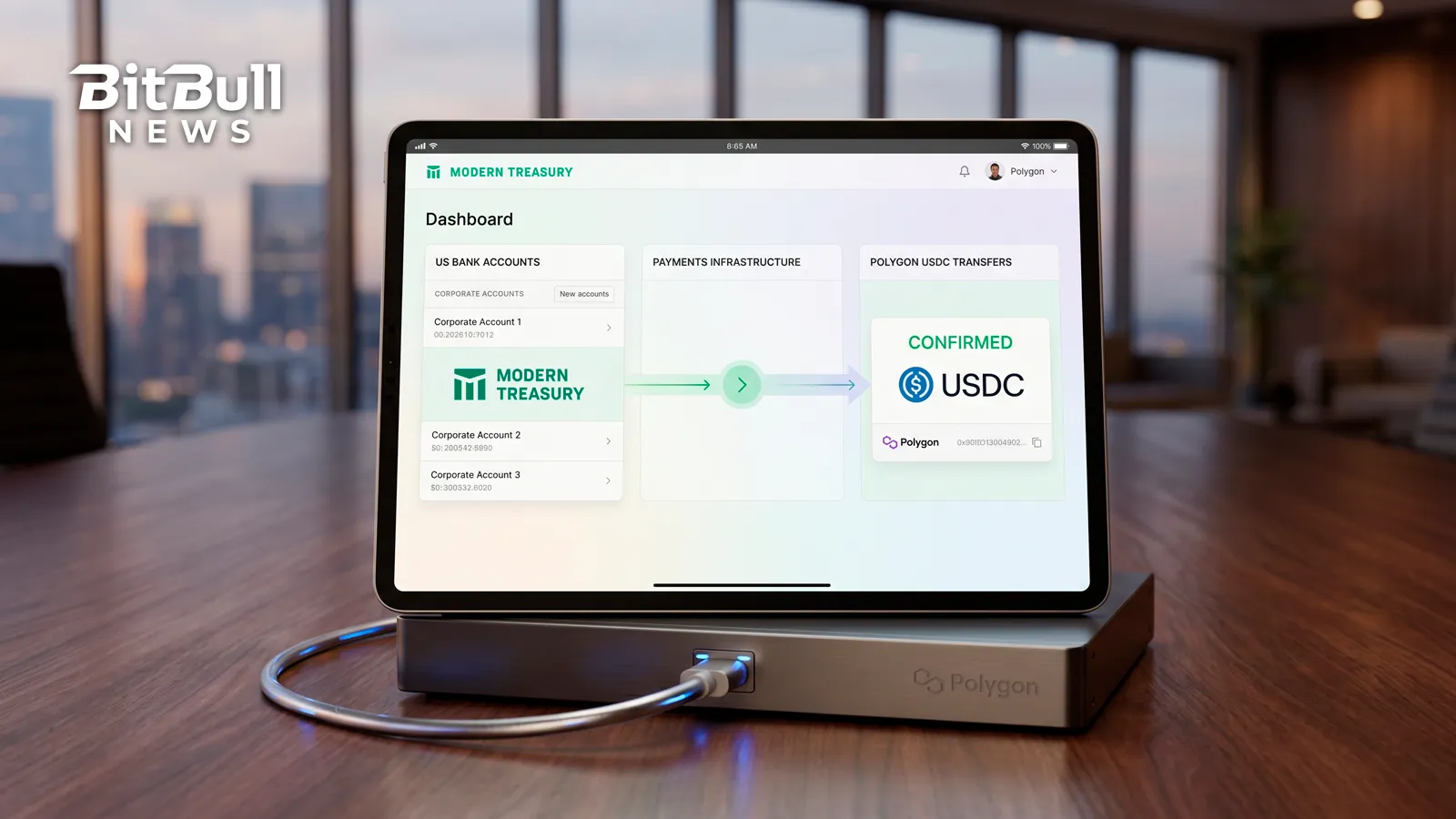
The company has integrated USDC on Polygon into its Payments API, letting teams manage fiat and stablecoin payment flows from the same system. Simply put, Modern Treasury is trying to make stablecoins feel less like a separate crypto workflow and more like another payment rail inside a company’s treasury stack.
Modern Treasury Is Removing The Split Between Fiat And Stablecoins
The key change is operational.
Businesses using Modern Treasury can now convert USD to USDC and back, move funds on Polygon, orchestrate payments across ACH, wires, RTP, FedNow, push-to-card and stablecoin rails, and reconcile fiat and onchain activity through one ledger.
That matters because many companies still treat stablecoin payments as a side system. They use one provider for bank payments, another for wallets, another for compliance, and another for reconciliation. That creates operational drag exactly where stablecoins are supposed to make money movement faster.
Modern Treasury CEO Matt Marcus framed the problem directly, saying adopting stablecoins should not mean adding new systems, new ledgers and new operational overhead. That comment gets to the heart of the launch: stablecoin adoption becomes more realistic when finance teams do not have to rebuild their whole back office around it.
Polygon Gets A Stronger Enterprise Payments Role
Polygon’s role is also important.
The release says more than $2.4 trillion has moved across Polygon to date, with the network operating for five years at 99.999% uptime. It also says Polygon transactions settle in about two seconds, while the average cost of sending USDC is around $0.0008.
Those numbers explain why Modern Treasury chose Polygon for this integration. Enterprise payments need low cost, speed and reliability, but they also need compatibility with existing financial workflows. Polygon gives the blockchain rail; Modern Treasury gives the orchestration, ledgering and compliance layer around it.
Polygon Labs CEO Marc Boiron said stablecoins are becoming core financial infrastructure and that companies need a way to move between traditional finance and onchain payments without adding complexity. That is exactly the market gap this integration is trying to close.
What Changed
Before this integration, a company that wanted to use stablecoins often had to stitch together multiple systems: bank rails, crypto wallets, compliance tooling, accounting and internal ledgers.
Now Modern Treasury is bringing USDC on Polygon into the same infrastructure companies already use for other payment methods. That changes the product category from “crypto payment integration” to “multi-rail money movement.”
This is the same direction visible across the broader stablecoin flow market, where the important question is no longer just which stablecoin has the most supply. It is where stablecoins can move, what workflows they can support and whether businesses can actually operate them at scale.
Who It Affects Now
The first group affected is fintechs and platforms that need faster global payouts, marketplace disbursements or treasury movement without managing separate fiat and crypto systems.
The second group is finance and operations teams. For them, the value is not “using blockchain” as a headline. The value is reconciliation, compliance, account structure and reporting inside one workflow.
The third group is payment infrastructure providers. Modern Treasury’s move raises the bar for platforms that still treat stablecoins as an add-on rather than a native rail.
It also affects Polygon. The network is getting another enterprise payments use case at a time when blockchains are competing to become the default settlement layer for fintechs, banks and global payment companies.
Why It Matters
This story matters because stablecoin payments will not scale through wallets and exchanges alone.
Businesses need systems that connect stablecoins to the boring but essential parts of finance: accounts, ledgers, compliance, reconciliation, payment routing and reporting. Modern Treasury is moving directly into that layer.
The next thing to watch is customer adoption. If businesses use Polygon USDC through Modern Treasury for cross-border payouts, treasury management and real-time fund movement, the integration could become a stronger proof point for stablecoins as business payment infrastructure.
If usage stays limited, it will still show where the market is heading: stablecoins are becoming one more rail inside payment operations, not a separate crypto product finance teams have to manage on the side.