


Content
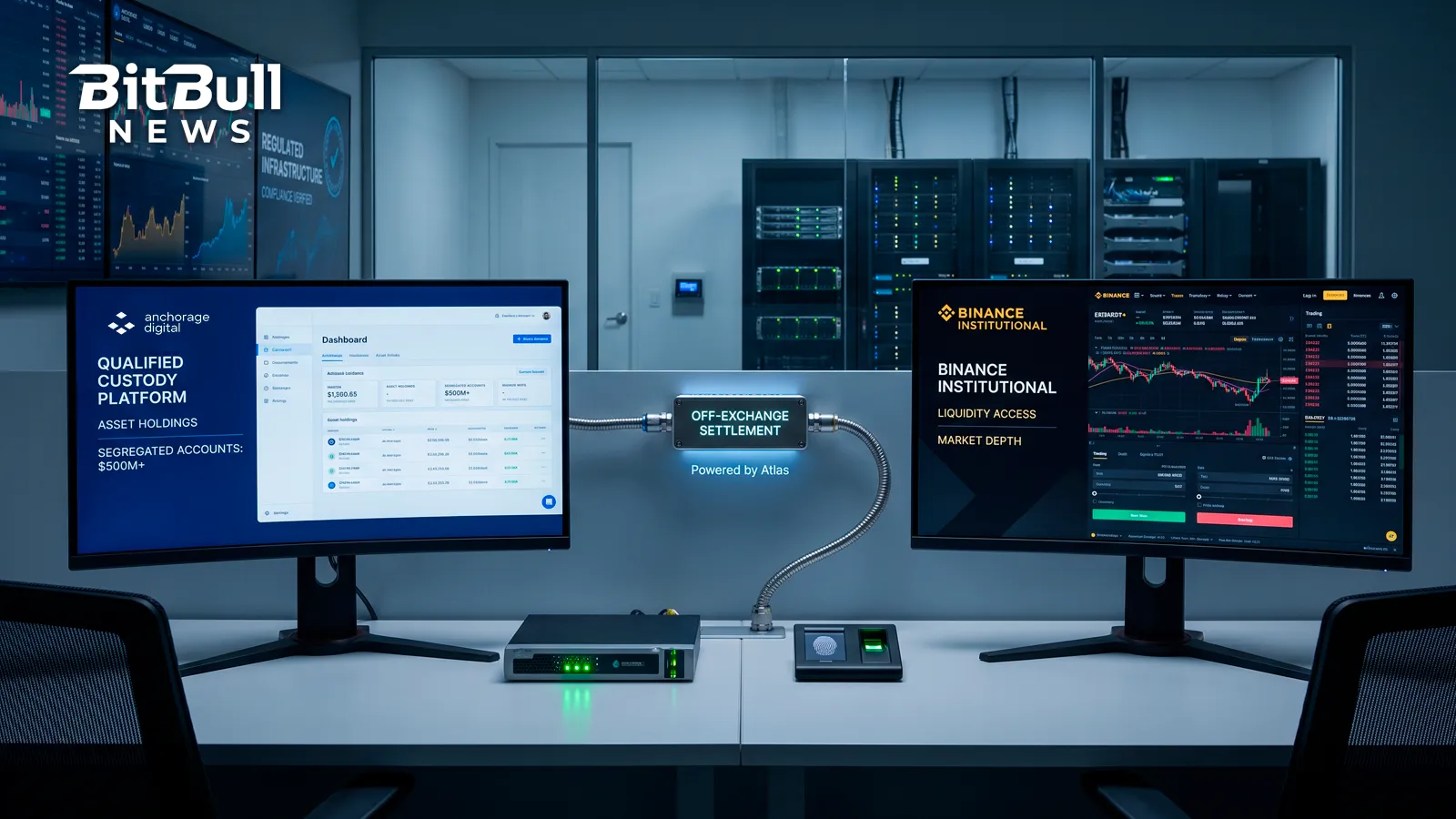
Anchorage Digital has plugged into Binance. The federally regulated crypto bank announced an integration that lets select institutional clients tap Binance liquidity while their assets stay locked in segregated, qualified custody at Anchorage. The connective tissue is Off-Exchange Settlement, powered by Atlas.
It is a small product launch with an outsized message: the plumbing institutions trust in traditional markets is finally being wired into crypto’s biggest exchange.
How Off-Exchange Settlement Works
The pitch is structural. In legacy finance, custody and execution are kept apart by design. Assets sit with a custodian and only move at final settlement, never parked on a trading venue’s balance sheet in a commingled pool.
Off-Exchange Settlement drags that model onto digital assets. Institutions trade where the liquidity is deepest, on Binance, but the underlying assets never leave Anchorage Digital custody until settlement.
For desks burned by the events of recent years, that separation is the whole point.
Why Custody Separation Matters To Institutions
The reasoning here is not subtle, and it predates this deal. Off-exchange and triparty settlement arrangements gained traction across the institutional crypto market after the 2022 collapse of FTX exposed what happens when customer assets and an exchange’s balance sheet share a wallet.
Anchorage frames the launch as meeting demand from firms that want exchange access without exchange counterparty risk. According to the company’s announcement, the goal is to give institutions crypto market structure that reflects the standards they already rely on in traditional finance, in the words of co-founder and CEO Nathan McCauley.
The model separates custody from execution. Assets stay with the qualified custodian; only settlement obligations move through the venue.
The First Build On Atlas
This integration is the first off-exchange settlement implementation inside Atlas, Anchorage Digital’s settlement infrastructure suite. Atlas is built to handle institutional workflows across trading, settlement, lending, and collateral management.
Anchorage already runs custody, trading, staking, governance, settlement, and collateral management for institutional clients. Off-Exchange Settlement extends that stack into risk-mitigating settlement rails, the layer the firm is betting the next wave of institutional adoption will demand.
Collateral Flexibility And Capital Efficiency
The deal slots into Binance’s own institutional push. The exchange has been building out its Triparty Banking and off-exchange collateral management offering, and Anchorage’s OES gives clients another custody-separated route to its order book.
The capital-efficiency angle is where this gets interesting for trading desks:
- Institutions can pledge crypto assets as collateral against trading margin requirements.
- They can also pledge USD accounts as collateral.
- Capital stays productively deployed instead of sitting idle on a venue to satisfy margin.
Catherine Chen, Head of VIP & Institutional at Binance, said the integration gives clients another way to access Binance liquidity while managing custody and collateral through a more familiar framework.
What This Means For The Market
Strip away the corporate language and the trade is straightforward. Binance gets to court the cautious institutional money that has stayed on the sidelines over custody concerns. Anchorage gets distribution into the largest exchange by volume and another proof point for Atlas.
The bigger story is convergence. Crypto market structure keeps inching toward the safeguards that govern equities and FX, and the firms moving size want it that way. Whether the rest of the exchange landscape follows Binance into custody-separated settlement is the question worth watching.
For now, the largest exchange and one of the most heavily regulated US custodians have agreed that keeping the money apart from the matching engine is good for business.