


Content
TL;DR
- Solana Foundation has published a new case study on Noah and Jupiter’s payroll flow built on Solana.
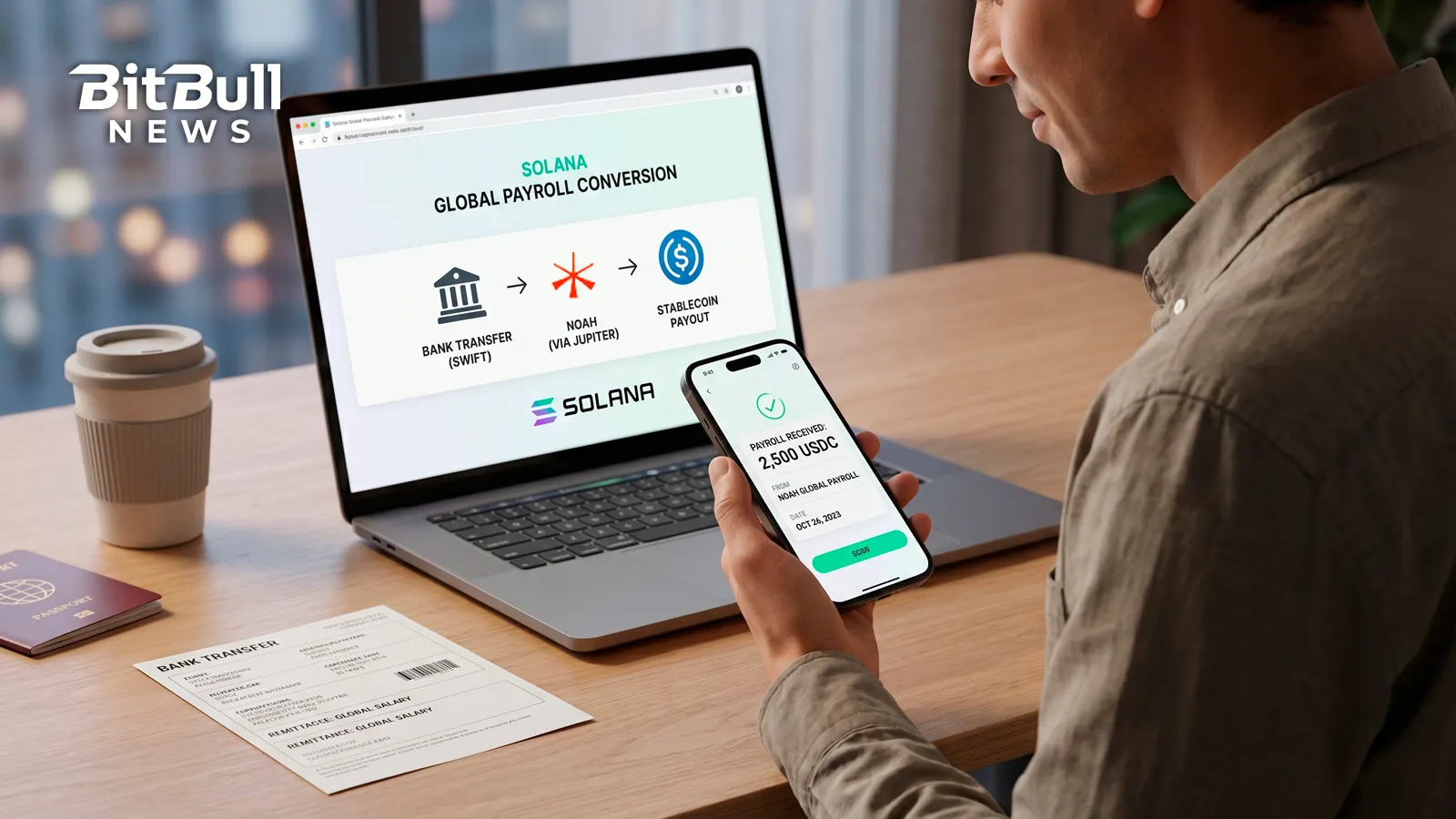
- The model starts with regular bank transfers, then converts funds into stablecoins on Solana and gives recipients access to swaps, yield, or local cash-out options.
- Noah says its infrastructure supports fiat collection through virtual accounts and payouts across 60+ countries through local payment methods.
- Solana and Jupiter are being pitched here as the low-friction settlement and onchain finance layer behind that flow.
Solana Foundation is putting a spotlight on a stablecoin payroll use case instead of another token headline. In a case study published on April 22, it laid out how Noah and Jupiter use Solana to move cross-border payments from standard bank rails into onchain dollars for freelancers and other global workers.
Simply put, the pitch is easy to understand: the paying client sends a normal bank transfer, the worker receives funds on Solana, and then decides what to do next — swap, park funds onchain, or cash out through local rails. That keeps the crypto complexity mostly in the background.
Noah handles the fiat side before funds hit the chain
According to Noah’s docs, its Virtual Account product lets businesses assign customers dedicated bank details such as IBANs or ACH routing numbers, accept fiat deposits, and automatically convert those funds into crypto with settlement to a business account. Solana’s case study says that same setup can plug into payroll-style flows where clients pay through familiar bank rails instead of touching crypto directly.
Noah also says its Global Payout product supports crypto-to-fiat payouts across 60+ countries through local methods such as bank transfers, mobile money, digital wallets, and cash pickup. That is a big part of the story here: this is not just about getting money onchain, but also about giving workers a practical way back out into local currency when they need it.
Solana and Jupiter make the onchain side usable
The Solana case study argues that Solana makes this flow workable because of low fees, fast confirmation, and token features aimed at more structured payment use cases. Solana’s own payments docs describe the network as built for payments with sub-cent fees, embedded memos, predictable fees, and fast confirmations, while its token extension docs show optional features such as Confidential Transfer for privacy-focused transfers.
Jupiter adds the next layer. In the case study, Solana says workers can move straight from settlement into swapping, earning yield, or off-ramping through Jupiter. Jupiter’s developer docs describe the platform as Solana DeFi infrastructure for swaps, lending, limit orders, DCA, and more, which fits the role Solana is describing here.
The real hook is less crypto friction for the payer
One reason this use case stands out is that it does not ask the paying side to behave like a crypto user. The client still sends a standard bank transfer. Noah converts and routes the money, Solana handles settlement, and Jupiter gives the recipient onchain options once funds land. That is a cleaner story than asking every company paying contractors abroad to learn wallets, bridges, and exchange workflows from scratch.
Solana also says the same pattern can stretch beyond freelancer payroll into remittances, B2B trade, and marketplace payouts. That does not prove mass adoption yet, but it does show where the companies think the model can go next.
Why it matters
This is the kind of crypto story that feels more useful than flashy. Instead of selling a new token narrative, it focuses on a real pain point: getting paid across borders without losing time, money, or control in the middle of the process. That makes the story more relevant to workers, platforms, and payment companies than a typical chain marketing post. This last sentence is an inference based on the use case and product descriptions in the cited materials.
It is also worth watching because stablecoin payroll keeps moving from theory into product design. If Noah, Jupiter, or Solana later publish harder usage data — volumes, user counts, enterprise clients, or repeat payout flows — this case study could look like an early signal of where cross-border payroll is heading. That forward-looking view is an inference based on the architecture described in the case study and the supporting product documentation.