


Nasdaq Puts TotalView on the Pyth Data Marketplace, Treating On-Chain Distribution as a Real Channel

Content
The exchange is making one of the market’s most established depth-of-book feeds available through Pyth’s modern distribution layer — and the way it earns money there looks nothing like the subsidised oracle model DeFi grew up on.
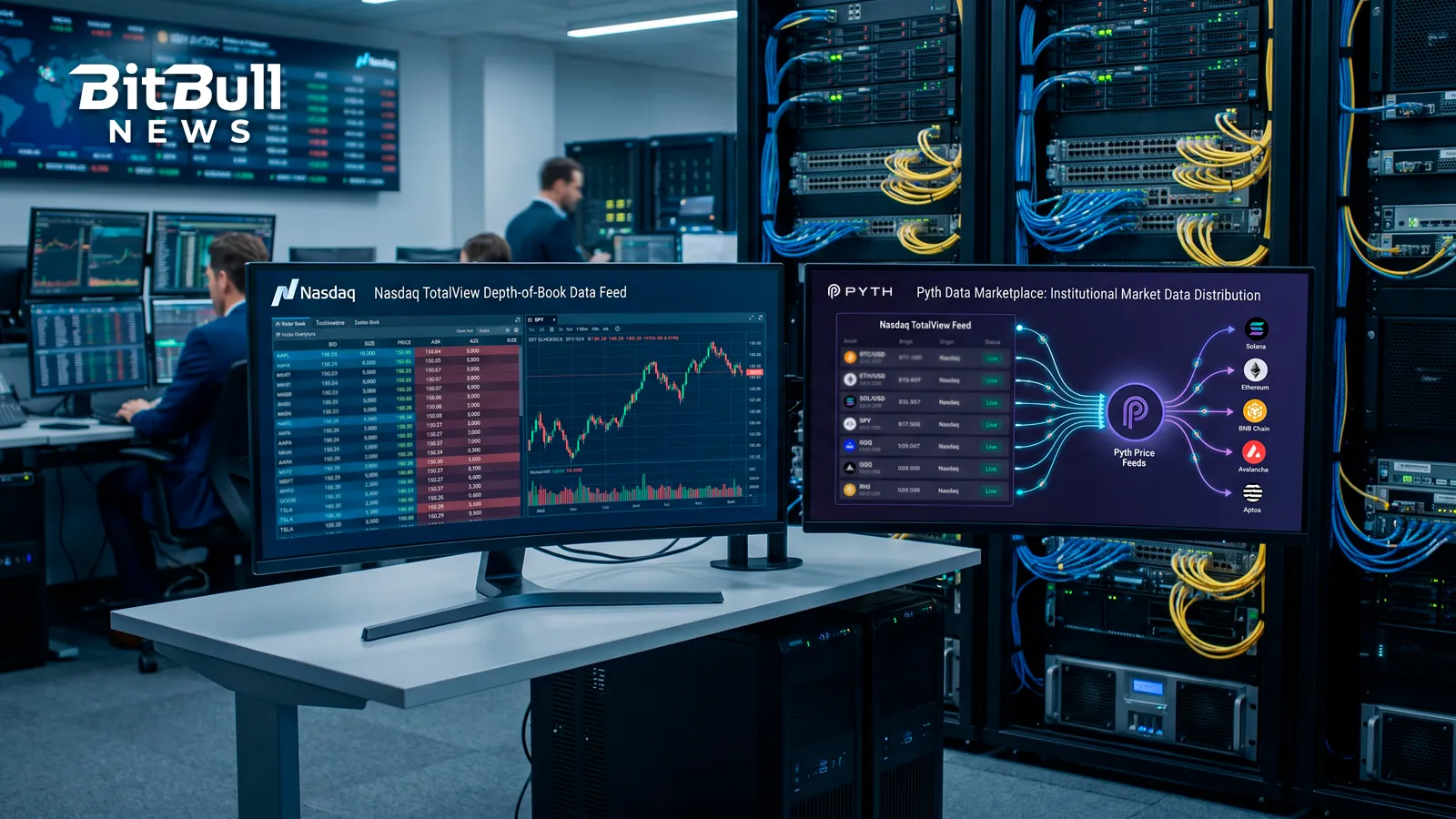
Nasdaq is putting one of its flagship data products on a blockchain network. Pyth Network said the exchange will join its Data Marketplace as a publisher, distributing its TotalView depth-of-book feed through Pyth’s global distribution layer and reaching software-native applications that the exchange’s traditional pipes were never built to serve.
The move lands the marketplace its most recognisable name yet. The U.S. Department of Commerce, Tradeweb, Kalshi, SGX and OTC Markets are already publishing data there; Nasdaq’s TotalView is the addition most likely to make institutional data owners look twice.
For years the market-data business has run on a closed model: exchanges produce the data, vendors package and resell it, and end users reach it through a patchwork of terminals, feed handlers and licensing deals. That arrangement was built for people at desks. A growing share of trading and decision-making now happens inside software that needs data in a different shape.
Market data is increasingly consumed by software rather than people sitting at terminals — trading systems, fintech platforms, and onchain applications that need it machine-readable and easy to integrate.
said Michael James, Head of Institutional Business Development at Douro Labs and a contributor to Pyth Network.
The Pyth Data Marketplace gives data providers a direct channel to those destinations, on their own terms, with attribution and control intact.
What Nasdaq is actually publishing
TotalView is a full depth-of-book product. It shows quote and order information at every price level for Nasdaq, NYSE and regional-listed securities trading on Nasdaq, and it carries the Net Order Imbalance Indicator, which surfaces buy and sell imbalances in real time ahead of the open and close. Routed through the marketplace, that data is meant to drop straight into trading and execution workflows — sharper reads on liquidity, order-by-order depth for model development and backtesting, and a clearer view of short-term opportunities.
Financial data is moving toward a model that’s more direct, programmable, and easier to integrate into the systems where trading and decision-making actually happen
said Mike Cahill, CEO of Douro Labs and a contributor to Pyth Network.
By bringing TotalView into the Pyth Data Marketplace, Nasdaq is extending that data to the new generation of applications being built for modern finance.
A separate business from the price feeds
The marketplace is not the same product that put Pyth on the map. Its price feeds pull data from many first-party contributors and publish a single aggregated price on-chain — the oracle model that exchanges, DEXs and prediction-market platforms lean on. The Data Marketplace works the other way around.
It’s where individual first-party providers distribute their own proprietary datasets directly to the consumers who want them, while retaining attribution and control. James said.
TotalView is the example he reaches for: Nasdaq’s own depth-of-book product, now reaching destinations its traditional channels weren’t built for. It is a distinct line of business, not a feature bolted onto the oracle.
That distinction matters most on the money. The oracle side of crypto data has largely run on subsidies. The marketplace runs on commercial terms set deal by deal.
It is on an individual deal basis between the data provider and the applications that want to access the dataset. James said.
As for where the PYTH token sits in the economics: “a portion of the revenues generated is sent to the DAO, which manages its own independent treasury and token purchase program.”
Control stays with the provider
Depth-of-book products are sensitive to licensing and redistribution, and putting them on a public network raises an obvious question about who can see what. James said the answer is that each provider keeps the keys. Data is distributed provider by provider; every provider makes its dataset available on its own terms, and only approved applications can reach it. The provider decides who gets approved. Distribution moves on-chain, but the gate stays with the data owner.
The bigger play
James was direct about the ambition. Pyth is out to break the legacy distribution model and is “building the house of all financial data, one brick at a time” — starting with a handful of names and expanding from there. He framed the work around three pillars: Pyth Pro, the Data Marketplace and Pyth Indices. Pyth already aggregates data from more than 135 institutions across equities, crypto, FX, commodities and futures.
Against incumbents like Bloomberg and the LSEG, that is still a young challenger. But pulling a venue like Nasdaq onto an on-chain marketplace, alongside a government statistics agency and established trading platforms, is the kind of signal that is hard to write off as an experiment. In James’s telling, Nasdaq joining is “one more brick.”