


Content
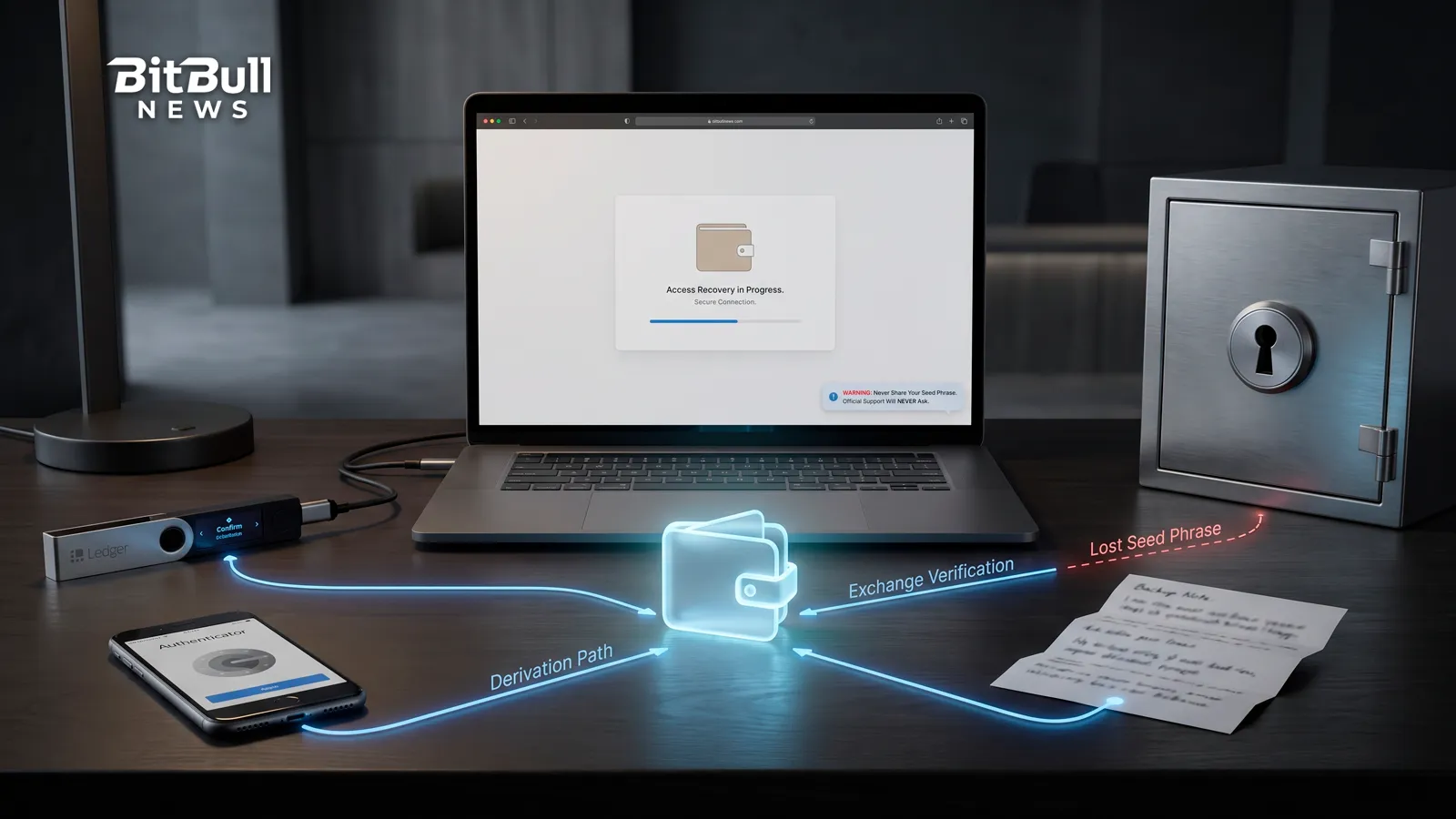
Losing access to crypto feels final, and sometimes it is. But not every “lost” wallet is actually gone. A surprising number of cases are recoverable — a forgotten derivation path, a wallet restored on the wrong app, an exchange account you can still verify your way back into.
The honest split is this: if you still hold the secret, you probably have a path back. If the secret itself is gone with no backup, no one on earth can restore it. This guide walks through both sides, in the order you should work through them — and warns you about the people who prey on exactly this moment.
First: What Can And Can’t Be Recovered
Before you spend hours (or money) chasing a recovery, be clear on which category you’re in. It saves you from false hope and from scammers who sell it.
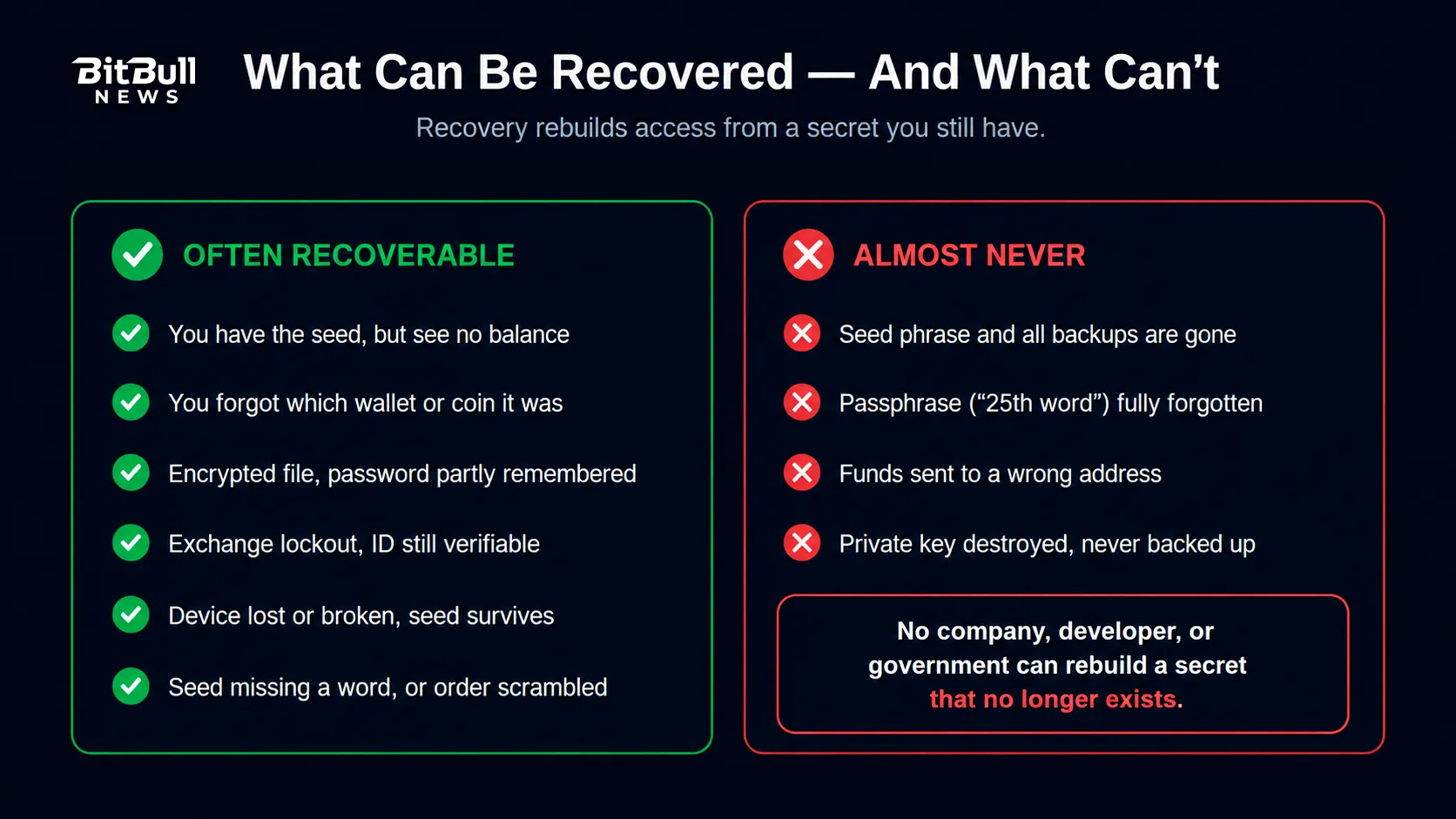
Often recoverable:
- You have the seed phrase, but the wallet shows a zero balance or the wrong addresses.
- You have the seed but forgot which wallet app or coin it belonged to.
- You have an encrypted wallet file and remember some of the password.
- You’re locked out of an exchange account, but you can still pass identity verification.
- You lost or broke the device, but the recovery phrase survives.
- Your seed is missing a word or two, or the word order is scrambled.
Almost never recoverable:
- The seed phrase and every backup are gone, with no copy anywhere.
- You forgot a wallet passphrase (the “25th word”) entirely, with no hint.
- You sent funds to a wrong or non-existent address.
- The private key was destroyed and never backed up.
The dividing line is simple. Recovery is about rebuilding access from a secret you still possess. Nobody can reconstruct a secret that no longer exists — not a company, not a “specialist,” not law enforcement.
Start Here: Work Through The Basics
Most “lost” crypto turns up in these steps. Do them before anything else.
- Search everywhere for the backup. Old notebooks, safes, envelopes, book pages, drawers, safety deposit boxes, and with anyone you may have given a copy to. Paper backups hide in ordinary places.
- Check your old devices. Retired phones and laptops, plus backups of them, may still hold a wallet app that’s simply been forgotten.
- Identify the wallet. Which app or hardware device did you use? Which coin? Knowing this narrows the recovery path enormously.
- Find the address, if you can. An old receipt, an exchange withdrawal record, or an email confirmation may give you the address. With it, you can check on a block explorer whether the funds are still sitting there.
That last point matters. Confirm the coins actually exist at that address before spending effort on recovery. Sometimes the funds were moved long ago, and there’s nothing to chase.
If You Have The Seed Phrase But See No Balance
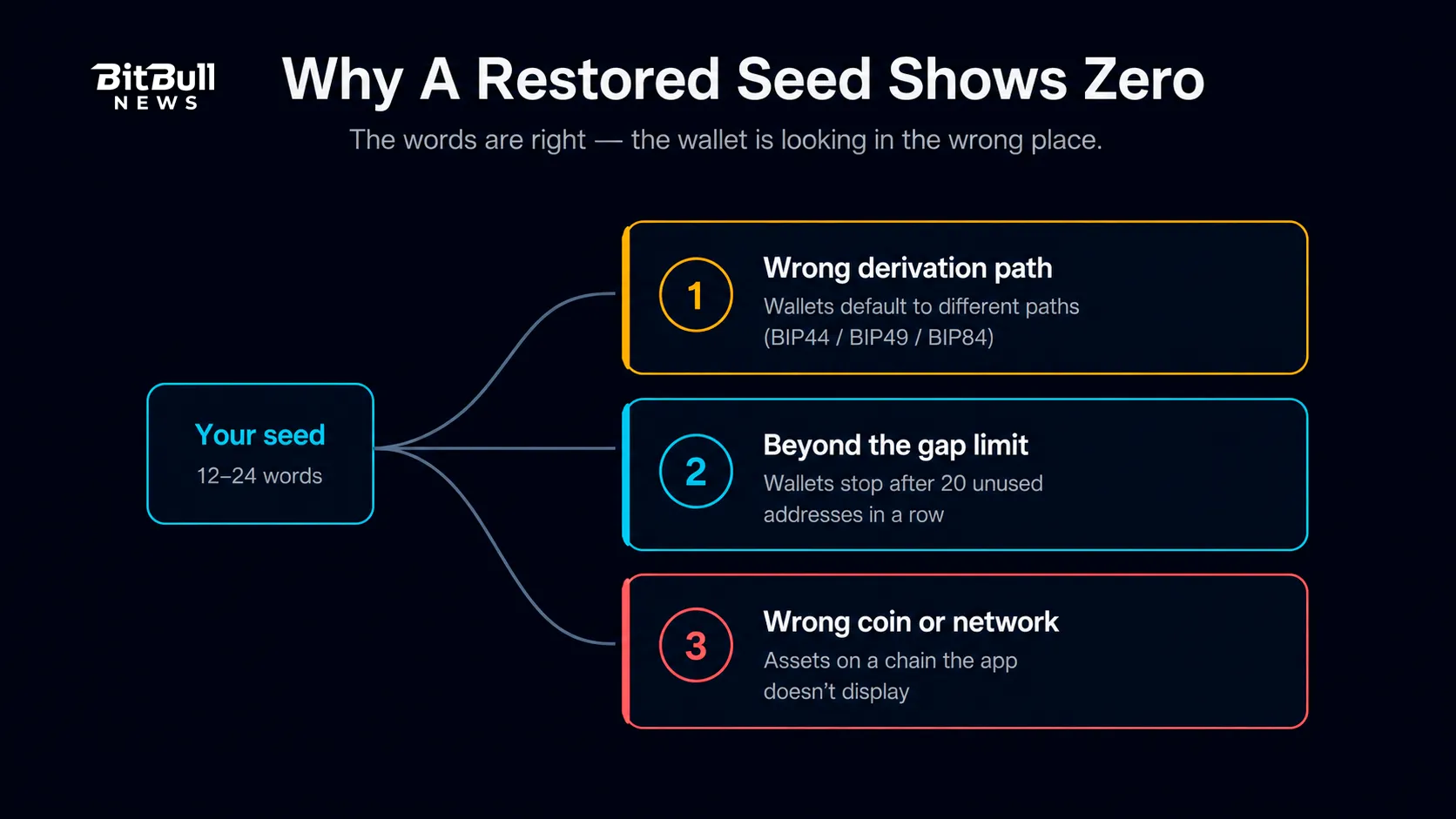
This is the most common “lost” crypto that isn’t lost at all. The words are right — the wallet is just looking in the wrong place.
Check The Derivation Path
A single seed phrase can generate an unlimited number of addresses. Which ones your wallet displays depends on its derivation path, a standardized route through that key tree defined by BIP44 and its relatives.
Different wallets default to different paths. Restore a seed created in one app into another, and you can land on a completely different set of addresses — all empty, even though your funds sit safely on an address the app never checked.
What to do: restore your seed into a wallet that lets you choose the derivation path, then try the common schemes (BIP44, BIP49, and BIP84 for Bitcoin, or the standard Ethereum path). Your balance often reappears on the first or second try.
Check The Account And Address Gap
Wallets also scan a limited number of addresses before giving up. The standard stopping point, per BIP44, is a gap limit of 20 — twenty unused addresses in a row and the wallet assumes there’s nothing beyond.
If you generated many addresses, or used a later account index, funds can sit past that boundary. Raising the gap limit or checking additional accounts in a capable wallet can surface them.
Check The Right Coin And Chain
A seed can control assets on several chains at once. Money sent on a network your current app doesn’t display simply won’t show up. Confirm you’re looking at the right coin, and on the right network.
If Your Seed Phrase Is Incomplete Or Wrong
A damaged phrase isn’t automatically a dead phrase.
Missing a word or two. BIP39 draws every word from a fixed 2,048-word list and builds a checksum into the phrase. That structure means a phrase with one or two gaps can often be reconstructed by testing candidates until one validates and reveals a funded address. The more words you’re missing, the faster this becomes impractical.
Wrong word order. The order is part of the secret, but a small number of words in an uncertain sequence can sometimes be brute-forced through the valid permutations.
A word that doesn’t exist in the list. Misspellings and misreadings (“dice” vs “die,” bad handwriting) are common. Compare each word against the official BIP39 list — the real word is usually one small edit away.
Warning: Do this work offline, on a clean machine, and never paste your seed into a website that offers to “check” or “validate” it. Those tools exist to steal phrases.
If You Forgot A Wallet Password Or Passphrase
Two different things get confused here, and the difference decides whether recovery is possible.
- A wallet password protects a local file or app on your device. It’s an encryption key over a file you still have, so if you remember part of it, a targeted search over your likely variations can work.
- A BIP39 passphrase (the “25th word”) isn’t stored anywhere. It combines with the seed to derive a completely separate wallet. If it’s fully forgotten with no hint, those funds are unreachable — the math offers no back door.
For a partly remembered password, open-source tools exist that test candidate variations against your wallet file. They work best when you can feed them a realistic list of what you might have used: your usual patterns, common substitutions, remembered fragments. Run them locally, on your own machine, and never upload your wallet file to a stranger.
If You Lost The Device, Not The Secret
This one’s usually straightforward. A hardware wallet is not your funds — your recovery phrase is.
Buy a replacement device (only from the manufacturer), restore from your recovery phrase, and your accounts come back. The same applies to a phone or laptop wallet: reinstall the app, restore the seed, and you’re in.
If you still have access to the old wallet and merely fear losing it, move the funds to a fresh wallet with a backup you control. Don’t wait.
If You’re Locked Out Of An Exchange Account
Custodial accounts follow completely different rules, and here the news is better. The exchange holds the keys, so it can restore your access.
Use the platform’s official account-recovery flow: password reset, 2FA reset, and identity verification. Expect to prove who you are with documents. Contact support only through the address or form on the exchange’s real website — never through a link someone sends you.
If the exchange itself has collapsed or frozen withdrawals, that’s an insolvency matter rather than a technical one, and it usually runs through official claims or bankruptcy processes.
Recovery Scams: The Trap Waiting For You Right Now
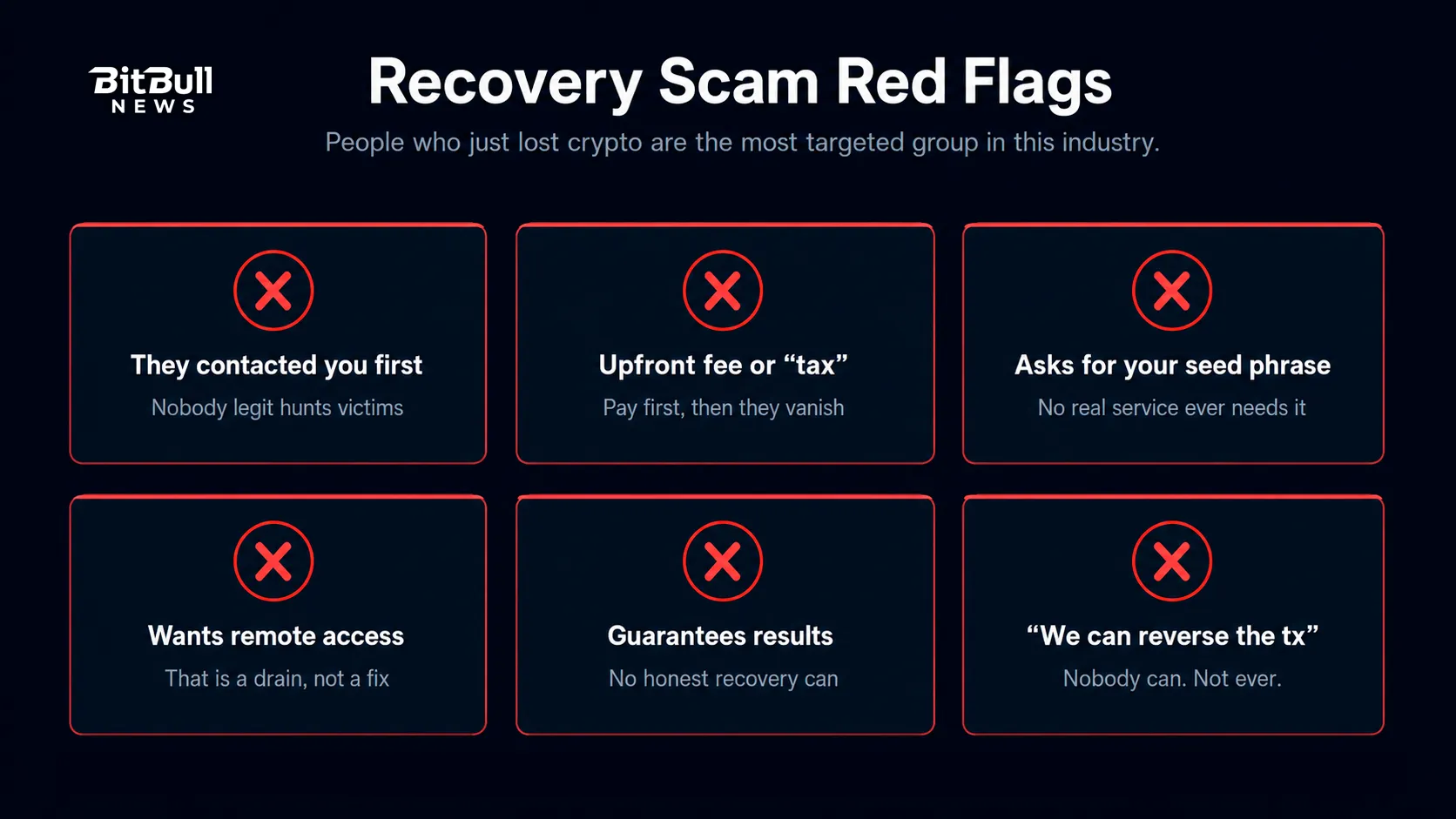
People who’ve just lost crypto are the single most targeted group in this industry. Scammers monitor forums, social media, and comment sections for anyone who mentions a loss, then arrive with exactly the offer you want to hear.
Treat all of these as fraud:
- Anyone who contacts you first promising to recover your funds.
- Any service demanding an upfront fee, deposit, or “tax” before recovering anything.
- Anyone who asks for your seed phrase, private key, or remote access to your machine.
- “Blockchain investigators,” “certified recovery agents,” or fake officials who guarantee results.
- Anyone claiming they can reverse a blockchain transaction. No one can. Not the network, not a developer, not a government.
Ethereum’s own scam guidance makes the same point: no legitimate party needs your recovery phrase, and confirmed transactions don’t get undone.
Legitimate password-recovery specialists do exist for encrypted wallet files, but they never ask for your seed phrase, never promise a guaranteed outcome, and typically charge only on success. If any of those three break, walk away.
When Funds Were Sent To The Wrong Address
Be direct with yourself here. A confirmed transaction to a valid address you don’t control is not recoverable. The coins now belong to whoever holds that key.
There are narrow exceptions worth checking:
- You sent to an exchange’s address on the wrong network, or without a required memo or tag. Contact that exchange’s official support immediately. Some can retrieve it, though many can’t and some charge a fee.
- You sent to a contract or bridge that has its own recovery process. Check the project’s official documentation.
Outside cases like these, the transaction is final. Anyone telling you otherwise is selling something.
Report It — Then Protect What’s Left
If theft or fraud is involved rather than simple loss, document everything: transaction hashes, addresses, URLs, screenshots, and messages.
In the US, file with the FBI’s IC3 and the FTC, and notify any exchange involved. Elsewhere, report to your national cybercrime or consumer-protection authority. Recovery is rare, but reports do feed investigations that occasionally freeze funds at cash-out points.
Then secure whatever remains. Move it to a new wallet, revoke any lingering token approvals, and rebuild your backups properly.
Make Sure This Never Happens Again
Every recovery story ends the same way: the fix was always a better backup.
- Write your seed phrase offline, on paper or metal — never as a photo, file, or cloud note.
- Keep more than one copy, in separate secure locations.
- Record the wallet name and derivation path alongside the phrase. It costs nothing and removes the single most common recovery headache.
- Test your recovery with a small amount before you trust it with real value.
- Plan for the people who’d need access if something happened to you.
Bitcoin’s own wallet guidance puts it plainly: a backup that lives in one place, on one medium, is a backup waiting to fail. Five minutes of preparation today beats any recovery attempt tomorrow.
FAQ
- Can Anyone Recover A Lost Seed Phrase?
No. If the phrase and every backup are gone, the funds are unreachable permanently — no company, developer, or government can rebuild it. Anyone claiming otherwise is running a scam. - Why Does My Wallet Show Zero After Restoring My Seed?
Usually the wallet is checking the wrong derivation path, the wrong account, or the wrong chain. Restore the seed in a wallet that lets you select the path, try the common schemes, and confirm you’re viewing the right coin and network. - Can I Get Back Crypto Sent To The Wrong Address?
Almost never. Blockchain transactions are final, and the coins belong to whoever controls that address. The rare exception is sending to an exchange or a contract with its own recovery process, so contact their official support quickly. - Are Crypto Recovery Services Legitimate?
A few genuine specialists help crack forgotten passwords on encrypted wallet files. But most “recovery services” — especially any that contact you first, demand an upfront fee, or ask for your seed phrase — are fraud, targeting people who just suffered a loss. - What If I’m Missing Just One Word Of My Seed Phrase?
That’s often recoverable. BIP39 uses a fixed word list and a checksum, so a single missing word can usually be found by testing valid candidates offline. Never use an online tool that asks you to enter your phrase. - I Lost My Hardware Wallet — Are My Coins Gone?
No, as long as you still have the recovery phrase. Buy a replacement device from the official store and restore from your phrase. The device is just a signer; the phrase is what actually holds your access. - Can Police Or A Court Reverse A Crypto Transaction?
No. No authority can undo a confirmed blockchain transaction. Reporting still matters, because investigations occasionally freeze stolen funds when they reach an exchange, but the transaction itself stands.