


Content
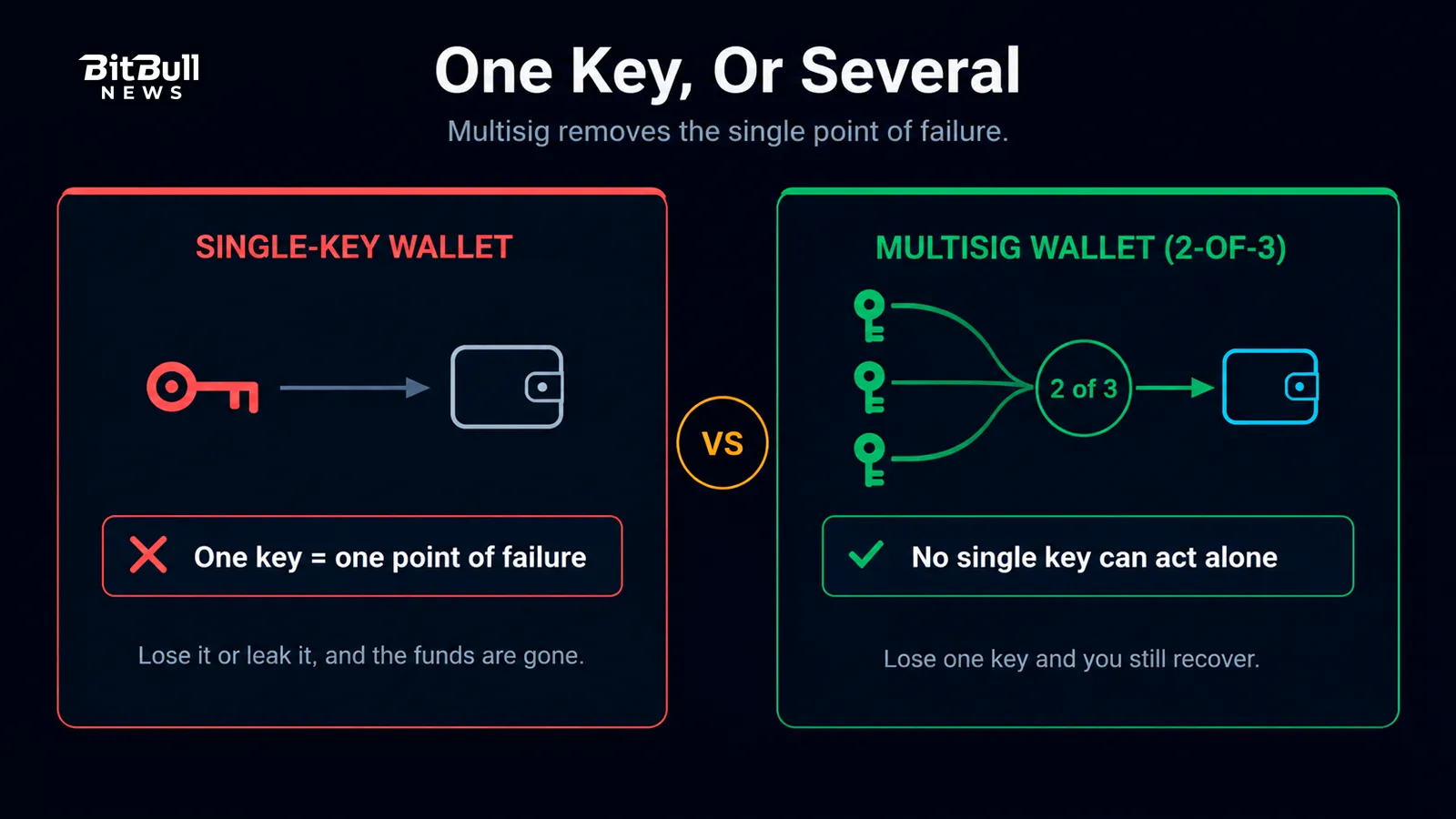
A normal crypto wallet has one key. Whoever holds it can move the funds — which also means one leak, one theft, or one lost backup can wipe you out.

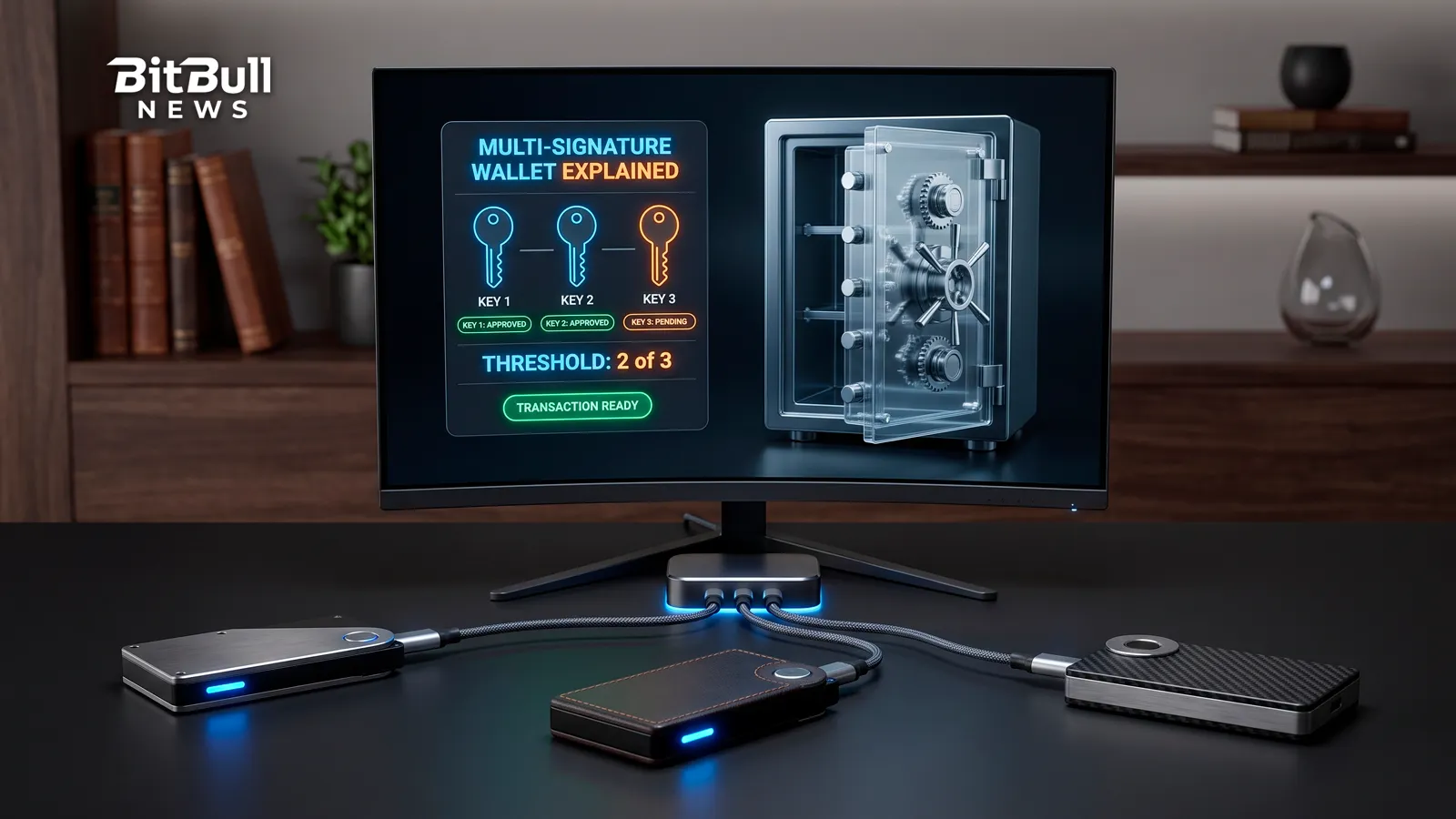
A multi-signature wallet removes that single point of failure. Instead of one key, it needs several, and it only releases funds when enough of them approve. Think of a safety deposit box that won’t open unless two separate key-holders show up. This guide breaks down how multisig works, when it’s worth the extra effort, and the trade-offs to weigh first.
What A Multi-Signature Wallet Is
A multi-signature wallet — “multisig” for short — requires more than one private key to authorize a transaction. You set it up with a group of keys and a rule for how many must sign before funds can move.
Compare that to a standard single-key wallet. One key controls everything, so if someone copies it or you lose it, the money is gone. Multisig spreads that control across several keys, usually held on different devices, in different places, or by different people.
The result is simple but powerful: no single key can move your funds alone.
How M-Of-N Works
Every multisig is described by two numbers, written as M-of-N.
- N is the total number of keys in the setup.
- M is how many of them must sign to approve a transaction.
A 2-of-3 wallet has three keys and needs any two to move funds. A 3-of-5 needs three of its five. A 2-of-2 needs both keys, every time.
The keys are independent. You might keep one on a hardware wallet at home, one in a safe across town, and hand one to a trusted family member — so no single location holds enough to act alone.
How A Multisig Transaction Actually Happens
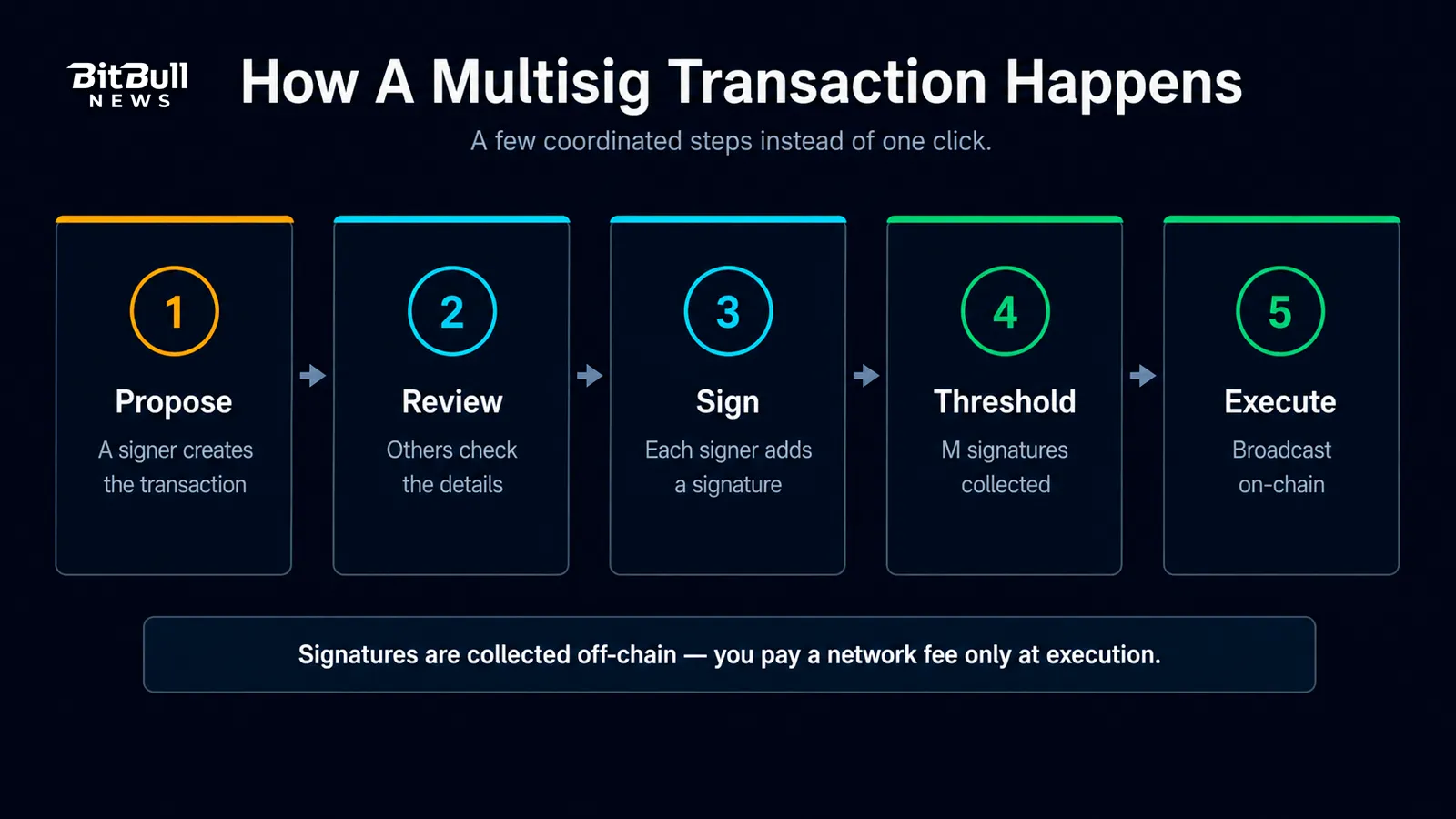
Moving funds from a multisig takes a few coordinated steps instead of one click.
- Propose. One signer creates the transaction — where the funds go and how much.
- Review. The other signers check the details independently.
- Sign. Each signer adds their signature, often from their own device.
- Reach the threshold. Once M signatures are collected, the transaction becomes valid.
- Execute. A final broadcast sends it on-chain.
Good multisig tools collect the early signatures off-chain, so you only pay a network fee when the transaction actually executes.
Multisig On Bitcoin Vs Ethereum
The idea is the same on both, but the plumbing differs.
Bitcoin: Built Into The Protocol
Bitcoin supports multisig natively in its scripting language. Wallets coordinate signing through a shared file format — a partially signed transaction — so each device can add its signature in turn. Bitcoin’s own wallet guidance describes the model with a classic example: an organization gives five members keys and requires any three to approve a withdrawal.
Ethereum And EVM Chains: A Smart Contract
Ethereum doesn’t have multisig at the protocol level. Instead, a smart contract holds the funds and enforces the rules. The best-known implementation is Safe (formerly Gnosis Safe), which stores the owner list and threshold on-chain and has become the default treasury wallet for DAOs and onchain businesses. Signers approve off-chain, and one execution transaction settles it.
Why People Use Multisig
Multisig earns its complexity in a handful of situations.
- Removing single points of failure. A stolen or lost key no longer means lost funds, as long as it stays below the threshold.
- Shared control. Businesses, partnerships, and DAOs can require several people to sign off, enforcing real checks and balances on the money.
- Stronger personal security. One person can hold all the keys themselves — say 2-of-3 across a hardware wallet, an offsite backup, and a second device — so no single compromised device drains them.
- Inheritance and continuity. Keys can be distributed so a trusted person can help recover funds if something happens to you.
- Escrow. A neutral third key can settle disputes between two parties.
Choosing Your Threshold
Your M-of-N choice is a balance between security and convenience.
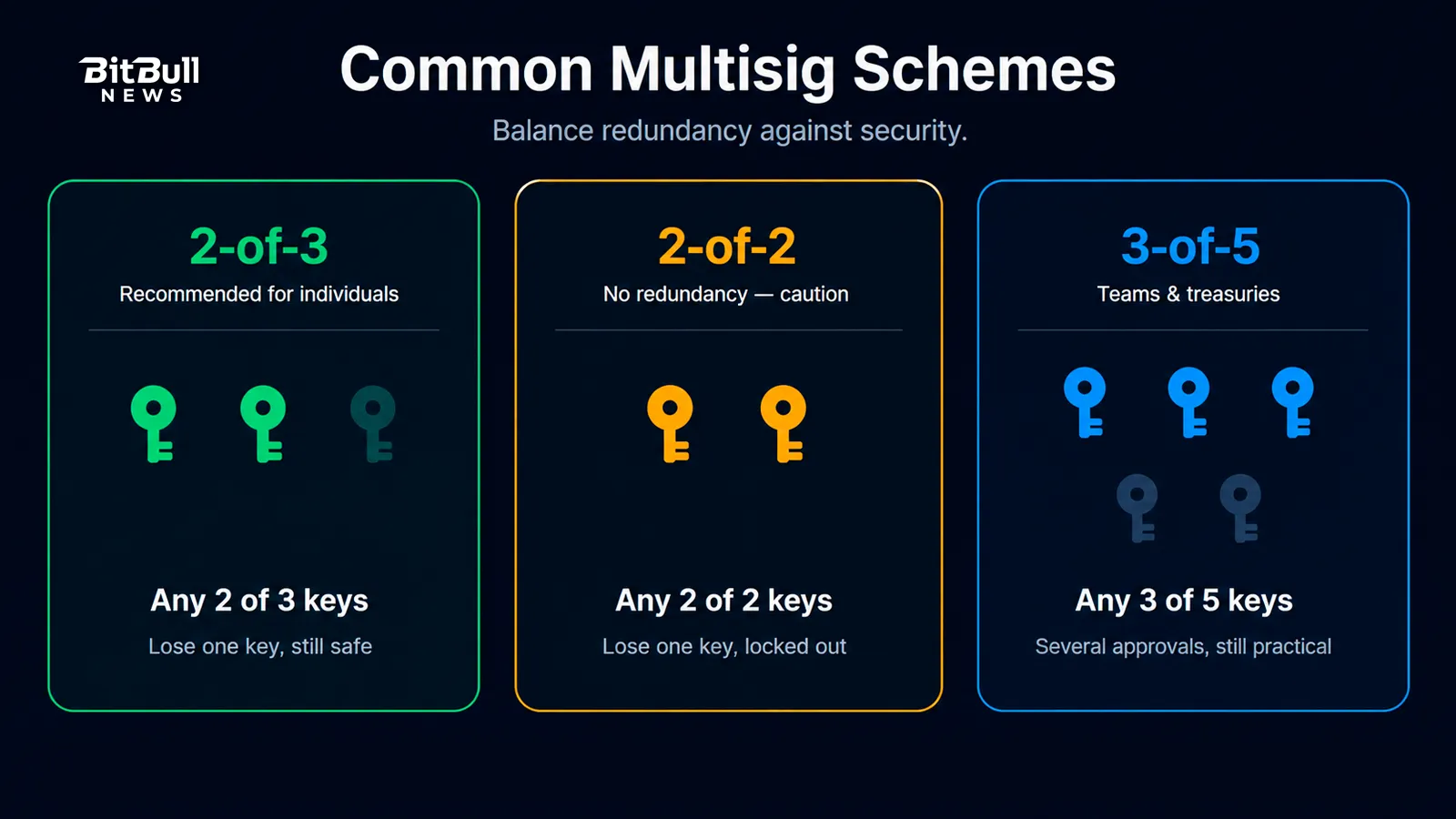
- 2-of-3 is the sweet spot for most individuals. Lose one key and you still recover with the other two, while a thief needs to compromise two separate keys to steal anything.
- 2-of-2 offers no redundancy. Lose either key and you’re locked out permanently, so use it only if you fully understand that risk.
- 3-of-5 suits teams and treasuries that want several approvals without grinding daily operations to a halt.
Set the threshold too high and a single unavailable signer can freeze normal activity. Set it too low and you weaken the whole point. Match it to how often you transact and how many keys you can realistically keep safe.
The Trade-Offs You Should Know
Multisig adds safety, but it also adds moving parts.
- More complexity. Setup and every transaction take coordination, not one tap.
- Higher fees. Bitcoin multisig transactions carry more signature data, and an Ethereum Safe costs gas to deploy and operate.
- A different kind of recovery. You must back up every key and the wallet’s configuration — the owner list and threshold on Ethereum, or the wallet descriptor on Bitcoin. Keys alone may not be enough to rebuild the wallet.
- Mistakes are hard to undo. Add a wrong owner address and you usually can’t fix it except by using the multisig itself to remove it, which still needs a valid threshold of correct signers.
- Per-key hygiene still matters. Each key deserves the same care as a normal seed, and a hardware wallet for every signer is the standard recommendation.
Multisig Vs Shamir Backup Vs MPC
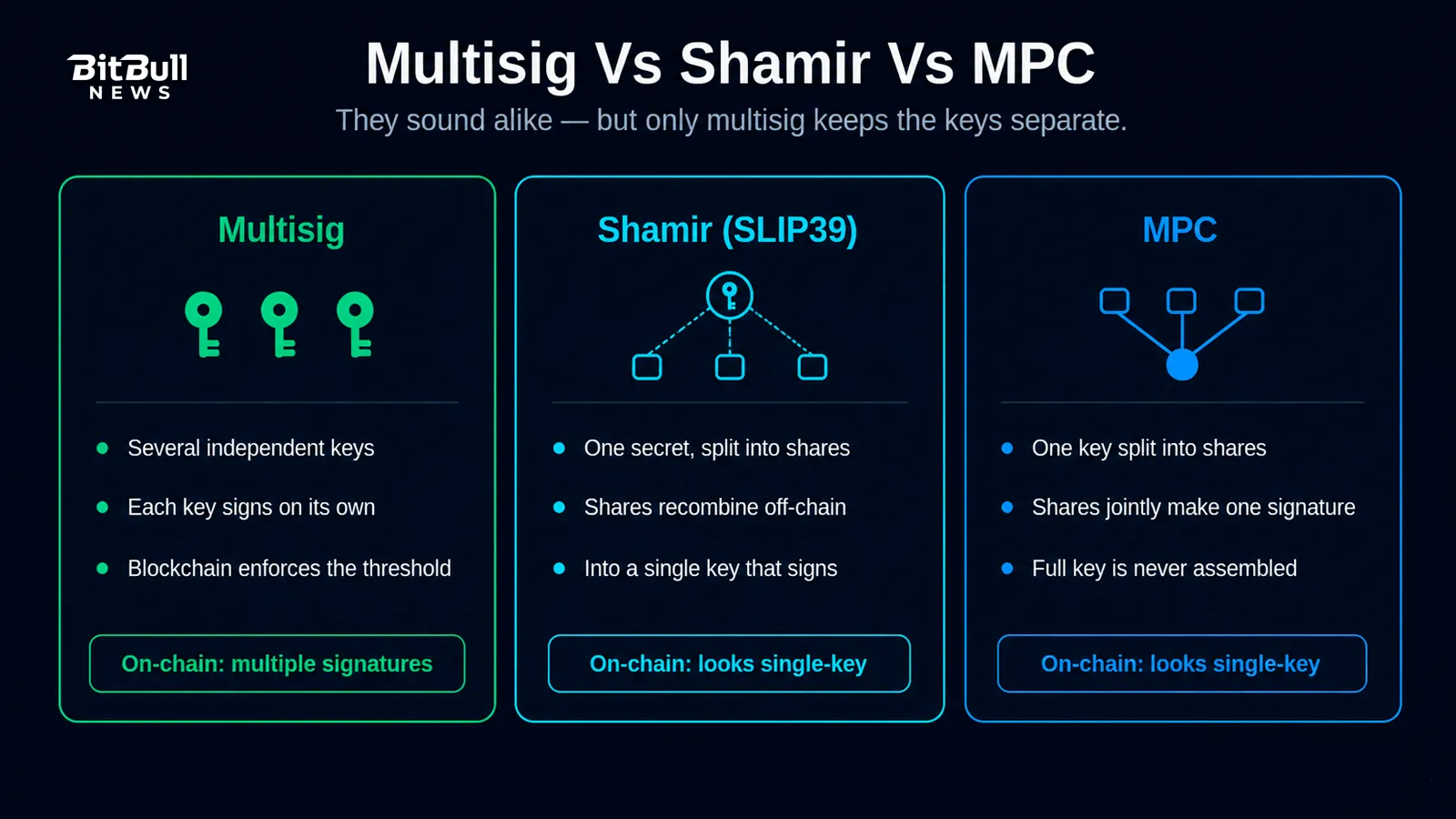
Beginners often mix up three things that sound similar but work very differently.
- Multisig uses several independent keys. Each one signs, and the blockchain itself enforces the threshold. The keys never combine.
- Shamir Backup (the SLIP39 standard) takes a single secret and splits it into shares. You recombine the shares off-chain into one key to sign. On-chain, it looks like an ordinary single-key wallet.
- MPC (multi-party computation) splits a key into shares that jointly produce one signature without ever assembling the full key. It also looks single-key on-chain and is common in institutional custody.
The short version: multisig is redundancy enforced by the blockchain, while Shamir and MPC recombine into a single signing key behind the scenes.
How To Get Started Safely
If multisig fits your situation, set it up deliberately.
- Pick a model. 2-of-3 is a sensible default for individuals.
- Use a hardware wallet for each key, and keep them physically separate.
- Use reputable multisig software. On Bitcoin, tools like Sparrow, Nunchuk, or Electrum; on EVM chains, Safe.
- Triple-check every owner address before you finalize the setup.
- Back up every key and the wallet configuration, stored in more than one secure place.
- Test first. Send a small amount, then practice a full recovery before you move real value in.
Multisig changes the math of self-custody. Instead of “one mistake and it’s gone,” several independent things have to fail at the same time. For anyone holding meaningful value — or managing money with other people — that’s a serious upgrade, as long as you’re ready for the extra responsibility of looking after more than one key.
FAQ
- Do I Need A Multisig Wallet As A Regular User?
Not necessarily. For small amounts, a well-secured single-key wallet is fine. Multisig becomes worthwhile once you hold meaningful value or share control of funds with other people. - What’s A Good Multisig Setup For One Person?
2-of-3 is the common choice. You hold all three keys yourself on separate devices or in separate places, so losing one doesn’t lock you out and no single compromised key drains you. - Is Multisig The Same As Shamir Backup?
No. Multisig uses several independent keys, and the blockchain enforces the threshold. Shamir splits one secret into shares that recombine off-chain into a single key, so the failure models are different. - Can I Lose Access To A Multisig Wallet?
Yes, if you lose too many keys to meet the threshold, or lose the wallet’s configuration. That’s why you back up every key and the setup details in more than one place. - Does Multisig Cost More To Use?
Somewhat. Bitcoin multisig transactions are larger, and an Ethereum Safe costs gas to deploy and operate. You trade a little cost and convenience for a big jump in security. - What Software Do I Use To Set Up Multisig?
On Bitcoin, tools like Sparrow, Nunchuk, or Electrum coordinate the signing. On Ethereum and other EVM chains, Safe is the standard. Pair whichever you choose with a hardware wallet for each key.