


Content
Crypto policy moved in two different directions this week.
International coordination accelerated. The United States and United Kingdom published a shared framework for cross-border stablecoins. The European Central Bank selected 36 payment providers for its digital euro pilot. Regulators also moved deeper into the operational details of stablecoin supervision, including weekly and quarterly reporting.
Domestic implementation moved more slowly. The GENIUS Act’s July 18 rulemaking deadline passed without a completed federal rulebook. The CLARITY Act remained short of a Senate floor vote, with ethics safeguards joining market jurisdiction and DeFi treatment as live political issues.
The result is an uneven regulatory structure. Governments agree on the broad architecture: fully backed stablecoins, protected reserves, supervised intermediaries and clearer access to payment and settlement systems. Firms still lack final answers on licensing procedures, reporting formats, capital requirements and cross-border recognition.
Policy Scorecard
| Jurisdiction | Development | Status At July 21 | Market Significance |
|---|---|---|---|
| United States | GENIUS Act one-year rulemaking deadline | Passed Without A Completed Federal Rulebook | Issuers still face proposed rather than final operating standards |
| United States | FDIC stablecoin reporting forms | Proposed For Comment | Weekly and quarterly supervisory reporting moves closer |
| United States And United Kingdom | Joint stablecoin statement | Policy Framework Published | Supports cross-border activity and convergence between private-money regimes |
| United States And United Kingdom | Tokenized-markets recommendations | Regulatory Coordination Planned | Stablecoins and tokenized funds may become eligible market infrastructure and collateral |
| United States | CLARITY Act | Advanced From Committee, No Senate Floor Vote | SEC–CFTC market structure remains unresolved |
| Eurozone | Digital euro pilot participants | 36 Payment Providers Selected | Public digital money moves into operational testing |
| European Union | MiCA post-transition enforcement | Active | Unauthorized providers must stop expansion and wind down EU services |
| United States | FINRA crypto activity request | Responses Due July 24 | Broker-dealer crypto exposure is being mapped before further rule changes |
The scorecard is based on the enacted GENIUS Act, federal rulemaking records, U.S.-UK Treasury documents, Senate materials, ECB disclosures, ESMA guidance and FINRA’s information request.
The GENIUS Deadline Passed Without A Finished Rulebook
Section 13 of the GENIUS Act required each primary federal payment stablecoin regulator, the Treasury secretary and each state payment stablecoin regulator to promulgate implementing regulations within one year of enactment. The law was enacted on July 18, 2025, making July 18, 2026 the statutory rulemaking deadline.
As of July 21, the main federal frameworks reviewed by BitBullNews remained at the proposal stage.
The OCC had proposed licensing, reserve, liquidity, capital, risk-management, custody and foreign-issuer rules. The FDIC had proposed prudential standards for stablecoin issuers affiliated with institutions under its supervision. The NCUA had separate proposals covering applications and operating standards for credit-union subsidiaries. Treasury, FinCEN and OFAC had proposed anti-money-laundering and sanctions requirements.
That is substantial progress, but it is not the same as a completed rulebook.
| Selected GENIUS Workstream | Responsible Authority | Public Status At July 21 | Main Issues Covered |
| Federal Issuer Licensing And Prudential Standards | OCC | Proposed | Licensing, reserves, capital, liquidity, custody and foreign issuers |
| Bank-Affiliated Issuer Standards | FDIC | Proposed | Reserves, redemption, capital, risk management and custody |
| Credit-Union Issuer Applications | NCUA | Proposed | Application process and approval standards |
| Credit-Union Operating Standards | NCUA | Comment Period Closed July 17 | Operational, liquidity and risk-management requirements |
| AML And Sanctions Programs | Treasury, FinCEN And OFAC | Proposed | BSA treatment, monitoring and sanctions compliance |
| Weekly And Quarterly Reporting | OCC And FDIC | Proposed | Reserve composition, financial condition and supervisory data |
| State Implementation | Individual State Regulators | Fragmented | State licensing and supervision subject to federal comparability requirements |
The table covers major publicly available workstreams rather than every rule required by the statute. State implementation cannot be reduced to one national status because individual states use separate legislative and regulatory processes.
The Missed Deadline Does Not Make The Act Disappear
The rulemaking delay does not repeal the GENIUS Act or immediately activate every requirement.
The law takes effect on the earlier of two dates:
- Eighteen months after enactment, which falls on January 18, 2027.
- One hundred and twenty days after primary federal regulators issue final implementing rules.
That backstop gives regulators additional time, but it reduces the amount of preparation available to issuers if final rules arrive close to January. A late rulebook would compress licensing, systems development, governance approvals and reserve-management changes into a shorter implementation window.
The legal timetable now contains three separate milestones that should not be confused:
- The July 18, 2026 rulemaking deadline has passed.
- Final regulations have not yet triggered the 120-day implementation route.
- January 18, 2027 remains the outside statutory effective date unless final rules make the law effective earlier.
The practical risk is not that the stablecoin framework has vanished. It is that firms may receive final operational requirements too late for a comfortable transition.
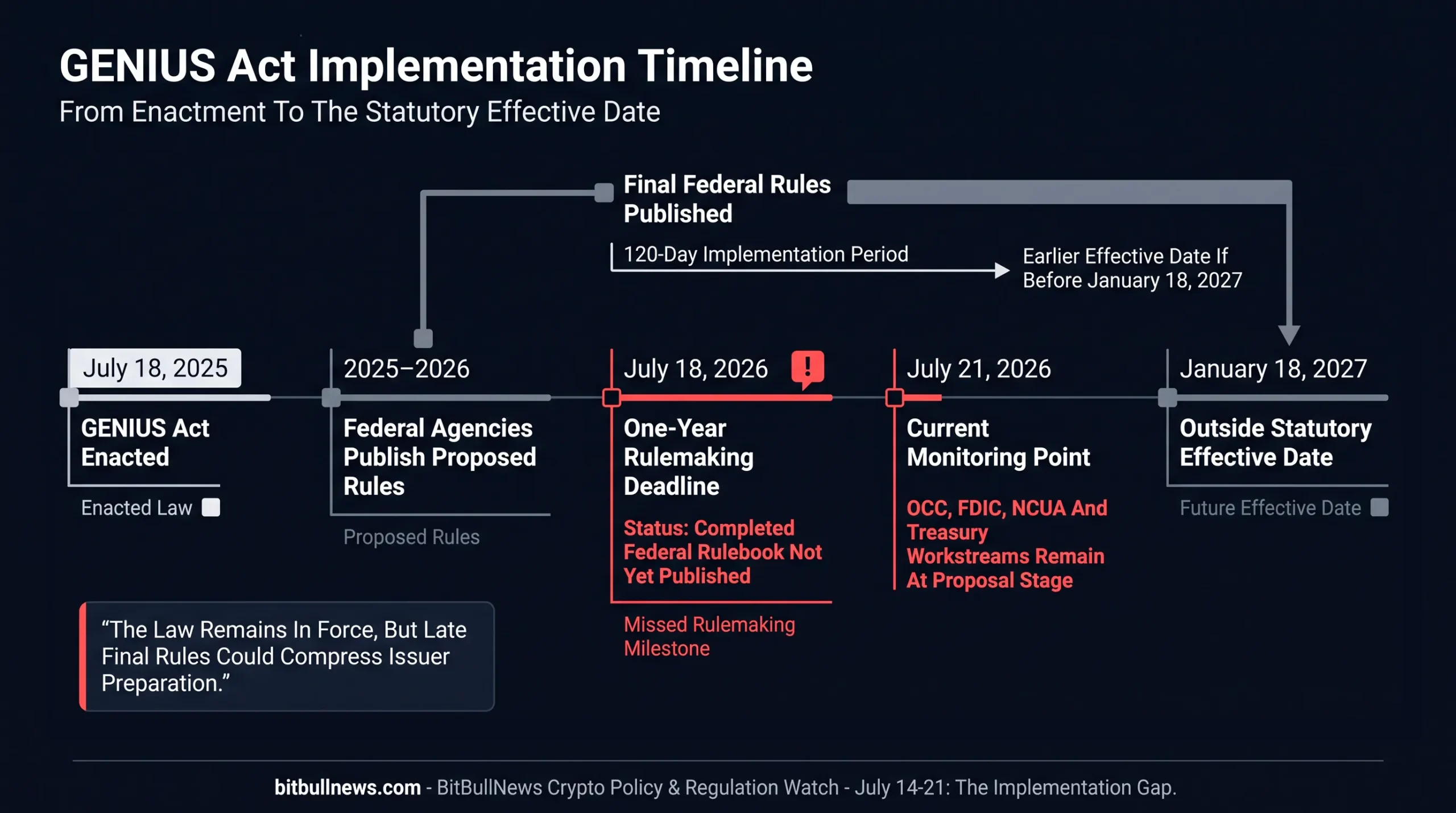
Institutional Timeline Showing GENIUS Act Enactment On July 18, 2025, Proposed Rules Across 2026, The July 18, 2026 Rulemaking Deadline, The Current Implementation Gap And The January 18, 2027 Outside Effective Date. Add An Alternative Path Showing Effectiveness 120 Days After Final Federal Rules.
Reporting Is Becoming The Real Supervisory Infrastructure
The most concrete U.S. development this week came from the FDIC.
On July 17, the agency released proposed forms and instructions for stablecoin issuers under its supervision. The notice appeared in the Federal Register on July 20. The underlying FDIC proposal would require weekly and quarterly reports from covered permitted payment stablecoin issuers.
The OCC is building a similar structure. Its proposal requires confidential weekly reporting for each payment stablecoin and quarterly issuer reporting. The proposed weekly forms include information designed to test compliance with reserve requirements, including aggregate and asset-class-level reserve composition. The OCC expects electronic submission through XML or another structured format.
This is where statutory policy becomes an operating system.
A reserve requirement written into law is only useful if a supervisor can verify it. Weekly reporting would give regulators a recurring view of outstanding stablecoins, reserve composition and liquidity. Quarterly reports would add broader information about financial condition, risk and business operations.
For issuers, the reporting regime will affect technology architecture before the first examination begins. Wallet balances, token supply, custodial records, reserve accounts and general ledgers will need to reconcile on a repeatable schedule.
Manual reporting may work for a pilot. It will not scale for an issuer operating across multiple blockchains, custodians, banking partners and legal entities.
What Issuers Should Build Before Final Rules
Firms preparing for federal authorization should already be able to produce:
- A daily reconciliation between tokens outstanding and eligible reserve assets.
- Reserve data segmented by asset class, custodian, maturity and jurisdiction.
- A complete inventory of issuer-controlled and operational wallet addresses.
- Redemption-liquidity stress tests under large and concentrated outflows.
- Records linking minting and burning activity to verified customer instructions.
- Documented escalation procedures for reserve, peg, custody and sanctions events.
The final forms may change. The supervisory direction is already visible: regulators want structured, frequent and auditable data rather than a monthly attestation produced after the fact. That conclusion is an inference from the OCC and FDIC reporting proposals.
The United States And United Kingdom Back Cross-Border Stablecoins
The U.S. Treasury and HM Treasury published a joint stablecoin statement on July 14. It is one of the clearest government-level endorsements yet of regulated private digital money as a cross-border payment and settlement instrument.
The two governments agreed on several core principles:
| Shared Principle | Policy Position | Institutional Implication |
| Reserve Backing | Stablecoins held out as money should be backed at least one-to-one by high-quality liquid assets | Reserve eligibility and liquidity quality will remain central licensing tests |
| Private-Sector Role | Stablecoins, tokenized deposits and similar instruments should coexist | Governments are not designing a single mandatory form of digital money |
| Cross-Border Use | Regulated stablecoins should support payments, settlement and capital markets | International distribution may become an intended feature rather than an exception |
| Banking Access | Lawful providers should receive fair, risk-based access to financial services | Blanket exclusion should give way to activity- and risk-based assessment |
| Holder Protection | Reserves should be segregated and holders should have clear redemption rights | Insolvency structure becomes as important as reserve quantity |
| Failure Resolution | Holders should have protected claims on reserves ahead of other creditors, subject to local law | Cross-border insolvency coordination will be necessary |
| Reciprocal Market Access | Both governments will explore pathways for stablecoins issued in one jurisdiction to enter the other | A future recognition or comparability channel is possible, but not yet operational |
The statement also warned against prudential rules that create unnecessary domestic ring-fencing or undermine commercial viability. At the same time, it endorsed reserve segregation, timely redemption and protected legal claims for holders. The intended balance is clear: cross-border scale without weakening the reserve and insolvency protections that make a stablecoin credible.
This is not a passporting agreement. It does not automatically authorize a U.S. stablecoin in Britain or a British stablecoin in the United States. The document establishes policy direction and commits the governments to explore formal pathways under their respective laws.
That distinction matters for issuers. The statement is strategically important, but it does not replace licensing, registration, reserve or distribution requirements.
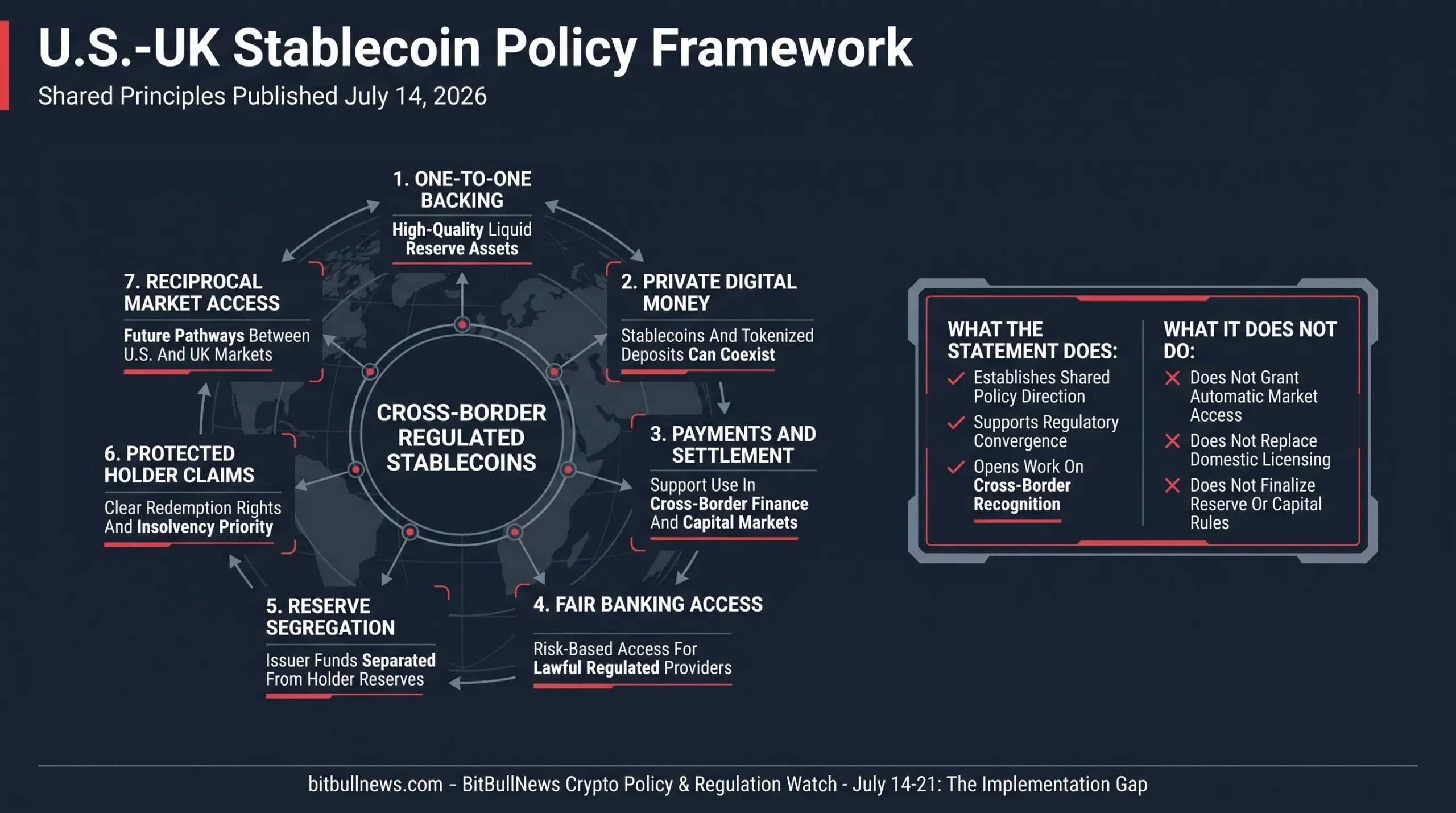
Institutional Policy Matrix Showing The Seven Main U.S.-UK Stablecoin Principles: One-To-One Reserves, Private Digital Money, Cross-Border Use, Banking Access, Reserve Segregation, Holder Priority And Reciprocal Market Access. Separate Existing Policy Commitments From Future Implementation Work.
Tokenized Markets Enter The Cross-Border Agenda
The wider U.S.-UK taskforce recommendations went beyond payment use.
The SEC, CFTC, FCA and Bank of England are expected to seek common approaches to tokenized assets. The listed priorities include settlement finality and the potential eligibility of stablecoins and tokenized money-market funds as margin collateral at central counterparties. A private-sector group will also test cross-border tokenization use cases over a one-year period.
This could matter more to institutional adoption than another consumer payment pilot.
A stablecoin becomes materially more useful when a regulated clearing venue, broker or market utility can accept it for settlement or collateral. At that point, the token is no longer only a crypto exchange asset. It becomes part of the working capital used to support securities and derivatives positions.
Several questions remain unresolved:
- Which issuers and reserve structures would qualify?
- Would collateral receive the same haircut as cash or tokenized Treasury funds?
- How would settlement finality be recognized across ledgers and jurisdictions?
- Who bears loss if a stablecoin issuer, custodian or blockchain fails?
- Can collateral move continuously when the underlying banking and clearing systems do not?
The taskforce does not answer those questions. It moves them into a formal transatlantic regulatory workstream.
CLARITY Remains A Legislative Asset, Not A Law
The Senate Banking Committee advanced the CLARITY Act by a 15–9 vote on May 14. The bill is designed to divide responsibilities between the SEC and CFTC, establish disclosure and intermediary rules, address DeFi activities and create additional customer-property protections.
No Senate roll-call vote on H.R. 3633 appeared in the official vote record through July 21. The bill therefore remained pending rather than enacted at the end of the monitoring period.
The political debate also expanded beyond market jurisdiction.
On July 16, Senate Banking Committee Ranking Member Elizabeth Warren requested updated financial disclosures from President Donald Trump while the Senate considered crypto market-structure legislation. The request explicitly argued that lawmakers need current information when designing ethics and conflict-of-interest safeguards.
The request represents one side of a partisan dispute, not a regulatory finding. Its significance lies in what it reveals about the legislative negotiation: market structure is now tied to governance rules for public officials and their families.
That makes the path to enactment harder to model.
The central issues are no longer limited to whether the SEC or CFTC supervises an asset. Negotiators must also resolve:
- Treatment of decentralized protocols and software developers.
- Stablecoin rewards or yield.
- Illicit-finance obligations.
- Customer-property protections.
- Ethics restrictions and conflicts involving government officials.
- The relationship between agency rulemaking and the future statute.
For market participants, committee approval should not be priced as completed legislation. The bill can still change on the floor, during reconciliation with the House or through negotiations required to secure final passage.
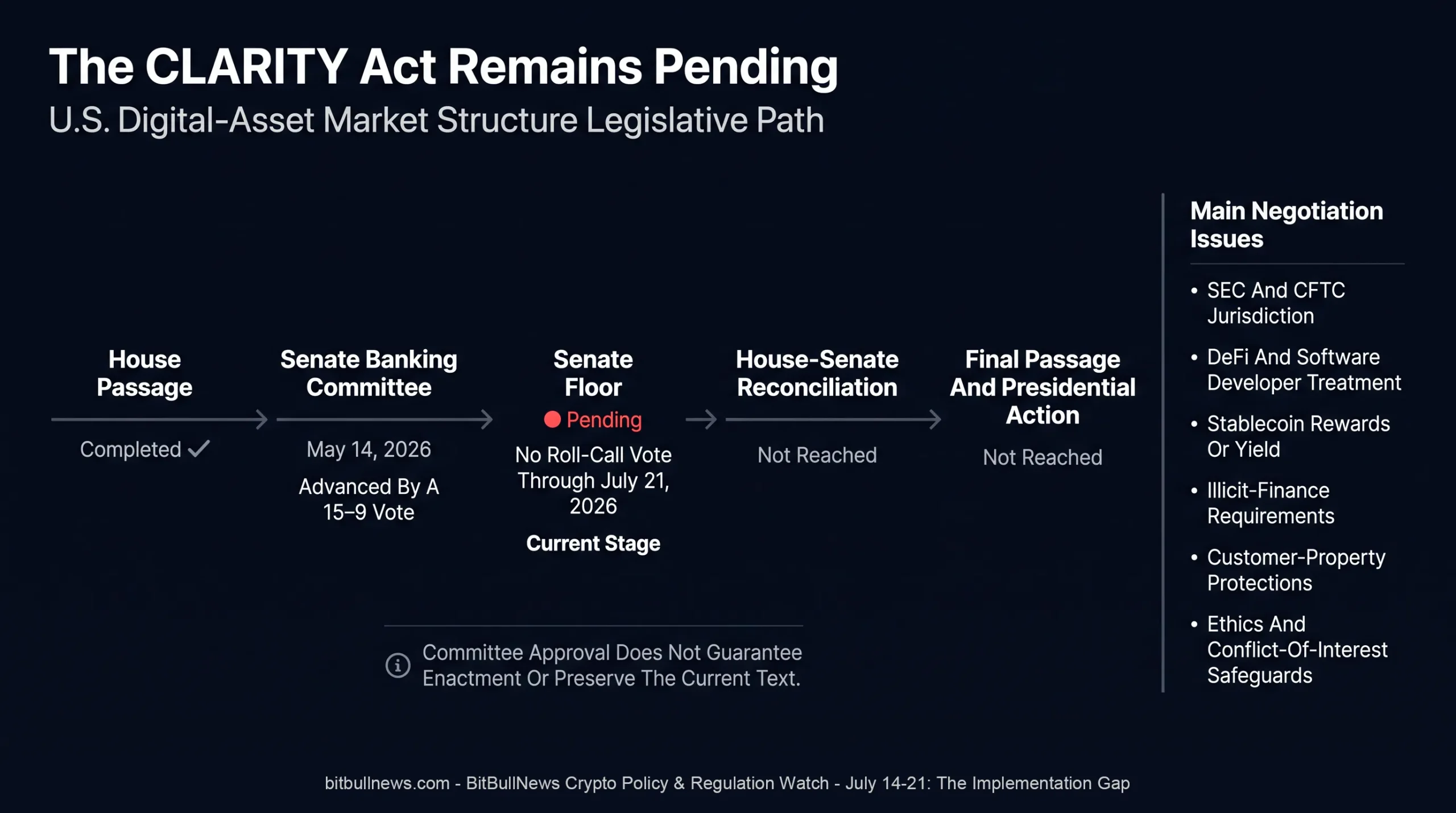
Legislative Process Timeline Showing House Passage, The Senate Banking Committee’s 15–9 Vote On May 14, The July 16 Ethics Disclosure Debate And The Absence Of A Senate Floor Vote Through July 21. Mark The Current Stage As “Pending Senate Floor Action.”
Europe Moves From Rulebook To Testing
The ECB selected 36 payment service providers for a digital euro pilot on July 14 after receiving more than 50 applications.
The selected group includes banks and non-bank providers. The pilot is scheduled to begin in the second half of 2027 and run for 12 months at the ECB and 19 euro-area national central banks. It will test account setup, person-to-person transfers, point-of-sale payments and merchant acceptance.
The pilot will use a beta digital euro that is functionally close to the version described in draft legislation. It will not have legal-tender status.
That limitation is important. The ECB has selected an operating test group, not made a final issuance decision.
| Policy Dimension | United States | United Kingdom | Eurozone |
| Primary Digital-Money Track | Privately issued regulated stablecoins | Privately issued regulated stablecoins and tokenized deposits | Potential central-bank digital euro alongside private money |
| Current Milestone | GENIUS implementation and reporting proposals | Stablecoin regime development and U.S. coordination | 36 providers selected for pilot |
| Reserve Model | One-to-one eligible liquid reserves for payment stablecoins | High-quality liquid backing under developing domestic rules | Direct central-bank liability in final form |
| Cross-Border Direction | Comparability and reciprocal access under future rules | Reciprocal access and transatlantic alignment | Distribution through supervised European payment providers |
| Current Legal Status | Statute enacted; core operating rules not final | Domestic framework still developing | Pilot preparation; beta will not be legal tender |
| Next Major Date | January 18, 2027 outside GENIUS effective date | Further domestic rules and U.S.-UK implementation work | Pilot begins in the second half of 2027 |
The comparison shows two different models rather than a simple race. The U.S. and UK are prioritizing supervised private money. The euro area is building a public digital-currency option while retaining a role for banks and payment providers in distribution.
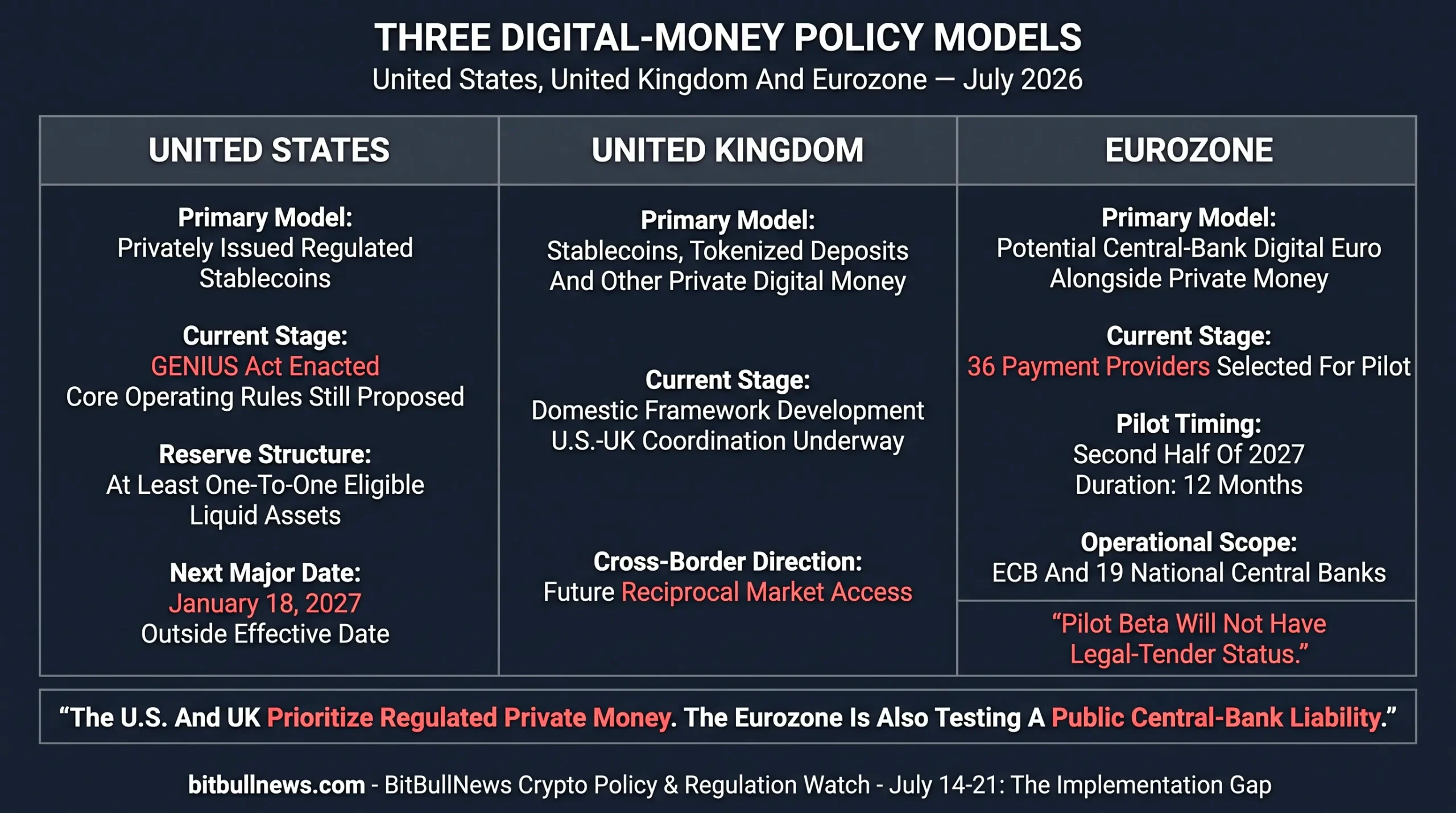
Three-Column Institutional Comparison Of The U.S., UK And Eurozone Digital-Money Models. Show Private Stablecoins In The U.S., A Multi-Money Private-Sector Model In The UK And A Central-Bank Digital Euro Distributed Through 36 Pilot Providers In The Eurozone.
MiCA Creates A Harder Operational Benchmark
Europe entered the monitoring period with MiCA’s transitional phase already over.
Since July 1, unauthorized crypto-asset service providers have been expected to stop onboarding new EU clients, cease marketing and restrict operations to the transfers, sales or position closures required for an orderly exit. Custody may continue only for the period necessary to complete the wind-down.
This provides a useful contrast with the United States.
MiCA has implementation problems of its own, including uneven national authorization capacity and the movement of clients away from providers that did not secure licenses in time. It nevertheless creates an enforceable perimeter: authorization now determines whether a firm may expand its European business.
The U.S. framework remains less synchronized. Stablecoin legislation is enacted but unfinished at the rule level. Market-structure legislation remains pending. Agency initiatives continue on separate timetables.
For global firms, the compliance burden comes from managing those different clocks at once.
FINRA Maps Broker-Dealer Exposure
FINRA’s 2026 Crypto Asset Activity Information Request is due July 24.
The request asks all member firms about current and planned crypto activities. FINRA says the information will inform updates to its regulatory programs, compliance tools and risk oversight. The regulator also clarified that merely making crypto ETFs available to customers does not mean a firm provides direct crypto trading or custody, and does not automatically make it an authorized participant.
This is not a new licensing regime. It is a supervisory inventory.
The request gives FINRA a clearer view of which broker-dealers:
- Offer direct or third-party crypto trading.
- Provide custody access.
- Act as authorized participants for crypto exchange-traded products.
- Operate through affiliates.
- Plan to enter digital-asset business lines.
Firms should treat the submission as more than a questionnaire. The answers may become a baseline for future examinations. Discrepancies between the response and later business activity could raise governance and disclosure questions.
What Market Participants Should Do Now
Stablecoin Issuers Should Build To The Proposed Rules
Waiting for final text creates unnecessary implementation risk.
Reserve reporting, wallet inventories, redemption stress tests, AML controls and cross-entity reconciliation are unlikely to disappear from the final framework. Firms should design systems that can adapt to changed thresholds or form fields without rebuilding the entire data stack.
Foreign Issuers Should Not Assume Reciprocal Access
The U.S.-UK statement creates a political route toward cross-border recognition. It does not grant market access today.
Foreign issuers still need to evaluate U.S. registration, local reserve requirements, consent to jurisdiction and the future Treasury comparability process.
Brokers Should Complete A Full Activity Inventory
FINRA’s request covers current and planned activities, including arrangements conducted through affiliates or third parties.
Compliance teams should compare the submission with product inventories, marketing materials, vendor agreements and board-approved plans. Crypto activity often sits across several business units and may not be visible from one legal entity.
EU Providers Should Verify Authorization At The Service Level
A group authorization or recognizable brand does not necessarily cover every service, entity or jurisdiction.
Firms and clients should confirm which legal entity is authorized, which MiCA services it may provide and whether custody, execution, advice and transfers are all inside the licensed perimeter.
Investors Should Separate Policy Direction From Legal Effect
The U.S.-UK statement is policy direction. The ECB announcement is pilot preparation. The CLARITY Act is pending legislation. The GENIUS Act is enacted law with unfinished regulations. MiCA is enforceable.
Treating those events as equivalent leads to poor legal and investment decisions.
Regulatory Risk Calendar
| Date Or Period | Regulatory Event | Status | Why It Matters |
| July 24, 2026 | FINRA Crypto Asset Activity Responses | Fixed Deadline | Establishes a supervisory record of broker-dealer crypto activities |
| Coming Months | Final GENIUS Regulations | Timing Unknown | Starts the 120-day route to effectiveness if completed before January |
| Coming Months | CLARITY Act Senate Floor Consideration | Unscheduled | Determines whether the U.S. receives a statutory market-structure framework |
| Ongoing | FDIC And OCC Reporting-Form Development | Proposed | Defines the data architecture required of stablecoin issuers |
| Ongoing | U.S.-UK Stablecoin Coordination | Policy Workstream | Could create reciprocal access and reduce cross-border fragmentation |
| January 18, 2027 | GENIUS Act Outside Effective Date | Statutory Backstop | Core framework takes effect unless final rules trigger an earlier date |
| Second Half Of 2027 | Digital Euro Pilot Begins | Planned For 12 Months | Tests operational use through 36 payment providers and 19 central banks |
| Ongoing | MiCA Post-Transition Enforcement | Active | Unauthorized providers must exit rather than continue expanding EU services |
Dates and statuses are drawn from FINRA, the GENIUS Act, federal banking proposals, Senate records, U.S.-UK Treasury documents, ECB materials and ESMA guidance.
Vision Is Clear. Execution Is Lagging
The week exposed the gap between agreeing on crypto policy and making it operational.
The United States and United Kingdom now share a clear vision for regulated private digital money: one-to-one reserves, protected holder claims, risk-based banking access and eventual cross-border use in payments, settlement and tokenized markets.
The U.S. domestic rulebook did not keep pace. The GENIUS Act’s one-year deadline passed while major federal rules remained proposed. The FDIC and OCC are already designing the weekly and quarterly reports that will underpin supervision, but issuers still lack final operating requirements.
Market structure remains the larger unfinished file. The CLARITY Act has cleared committee but not the Senate floor. Ethics safeguards have joined SEC–CFTC jurisdiction, DeFi and stablecoin rewards as issues that can reshape the final coalition.
Europe is further ahead in enforcement and testing. MiCA now forces unauthorized providers to wind down, while the ECB has selected 36 firms to test a beta digital euro beginning in 2027.
The strategic direction is no longer ambiguous. Regulated stablecoins, tokenized deposits and central-bank digital money will coexist. The unresolved questions concern access: who may issue, which instruments qualify for cross-border distribution, what can serve as collateral and how quickly holders are protected when an issuer fails.
For institutions, the next competitive advantage will not come from predicting the next policy announcement. It will come from building reporting, reserve and compliance systems before the final rules arrive.
Data Sources & References
- GENIUS Act Compiled Statute — GovInfo
- OCC Proposed GENIUS Act Rule
- OCC Stablecoin Reporting Forms And Instructions
- FDIC GENIUS Act Requirements And Standards Proposal
- FDIC Proposed Stablecoin Reporting Forms
- Federal Register — July 20, 2026 Issue
- NCUA Stablecoin Issuer Application Proposal
- NCUA Stablecoin Issuer Standards Proposal
- Treasury, FinCEN And OFAC AML Proposal
- U.S.-UK Transatlantic Taskforce Recommendations
- U.S.-UK Joint Statement On Stablecoins
- Senate Banking Committee — CLARITY Act Vote
- Senate Banking Committee — July 16 Financial Disclosure Request
- U.S. Senate Roll-Call Votes
- ECB Digital Euro Pilot Announcement
- ESMA Statement On The End Of The MiCA Transitional Period
- FINRA 2026 Crypto Asset Activity Information Request