


Content
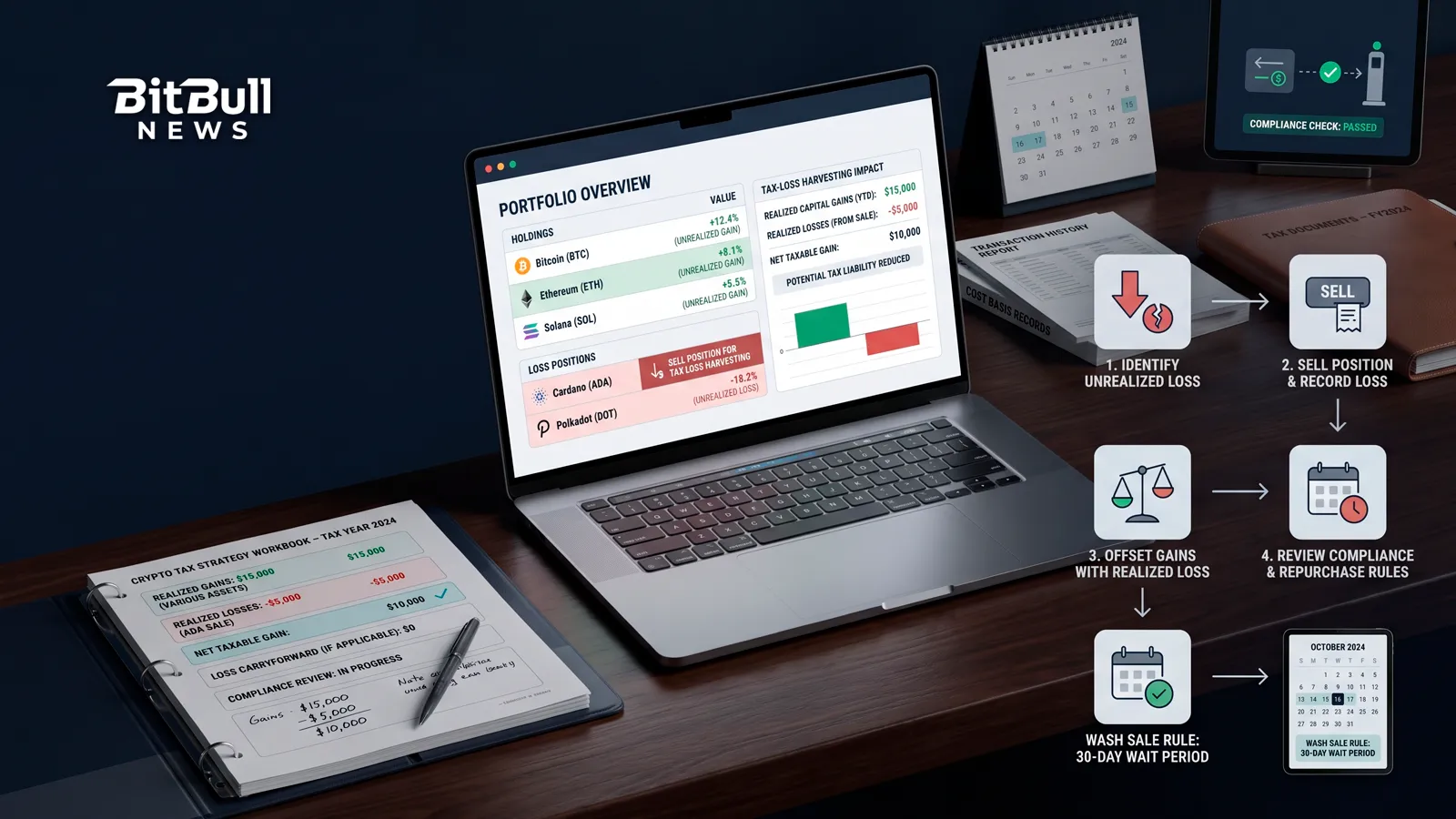
A red portfolio has a hidden upside: your losses can cut your tax bill. Tax-loss harvesting is the practice of deliberately selling losing positions to lock in the loss, then using it to offset gains and lower what you owe. And in the US, crypto has a quirk that makes this far more powerful than it is for stocks.
That quirk is the wash-sale rule — or rather, its absence for crypto. It lets you do something stock investors can’t. But it rests on a specific legal treatment that lawmakers keep trying to change, so understanding both the strategy and its shaky foundation matters.
This is a US-focused overview for education, not tax or investment advice. Tax rules differ by country and change, and this area is under active legislative pressure, so confirm the current rules with a qualified professional before acting.
What Tax-Loss Harvesting Actually Does
The core idea is simple. When you sell crypto for less than you paid, you realize a capital loss. That loss isn’t just a bad memory — it’s a deductible amount that reduces your taxable gains.
A paper loss does nothing for your taxes. You have to actually dispose of the asset — sell it, swap it — to turn a drop on the screen into a realized loss you can use. Harvesting is doing that on purpose, at the right time, to capture the tax benefit.
Here’s the order in which those losses get used, under US rules:
- Losses offset capital gains first, dollar for dollar. Short-term losses apply to short-term gains, long-term to long-term, then across the two.
- Leftover losses offset ordinary income, up to $3,000 per year currently.
- Anything still unused carries forward to future tax years, with no expiration.
So a big loss can wipe out this year’s gains, shave a bit off your salary income, and keep working for you for years. That’s the engine. Now the part that makes crypto special.
The Wash-Sale Rule: Why Crypto Is Different (For Now)
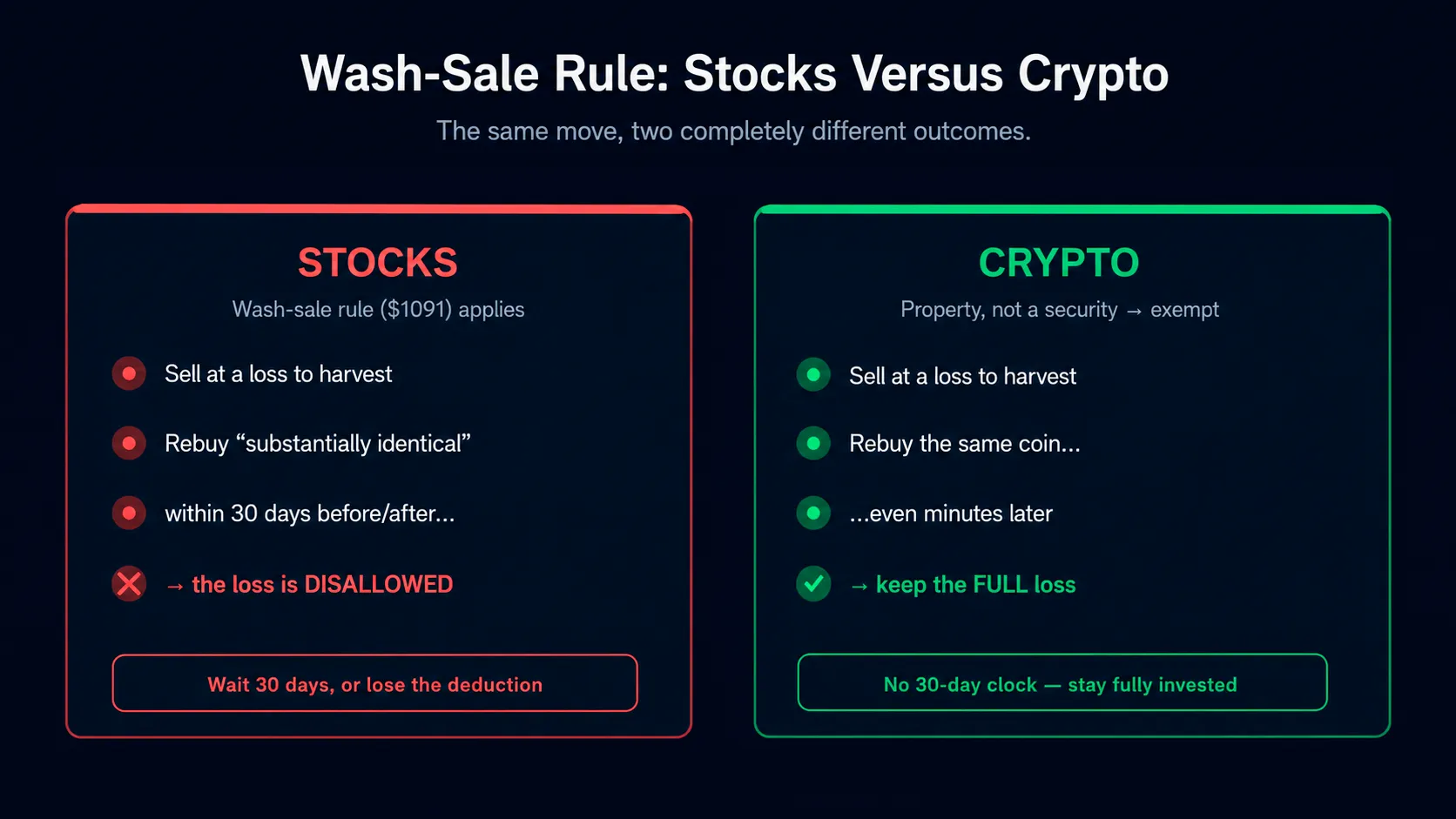
For stocks, a rule stops the most aggressive version of this game. The wash-sale rule (IRC Section 1091) disallows your loss if you buy a “substantially identical” security within 30 days before or after selling at a loss. Sell a stock to harvest the loss, rebuy it right away, and the IRS denies the deduction.
Crypto has sidestepped this. The IRS treats crypto as property, not a security, and Section 1091 applies only to “stock or securities.” Property that isn’t a security sits outside the rule.
The practical effect is striking:
- You can sell crypto at a loss and rebuy it immediately — even minutes later — and still claim the full loss.
- There’s no 30-day clock to sit out.
- You keep your market position while banking the tax benefit.
For a stock investor, harvesting means either waiting 30 days (and risking a rebound) or buying something merely similar. A crypto investor can harvest the loss and stay fully invested in the same coin. That’s a real, and unusual, advantage.
Warning: This is current US law, not a permanent feature. Congress has repeatedly proposed extending the wash-sale rule to digital assets — in multiple budget proposals and draft bills over the years — and none has passed so far. But the direction is clear, and the new Form 1099-DA broker report even includes a box for wash-sale losses on digital assets. Treat the exemption as a window that could close, likely on a future effective date, and don’t build a multi-year plan assuming it lasts forever.
How To Harvest Crypto Losses, Step By Step
The mechanics are straightforward once you see them laid out.
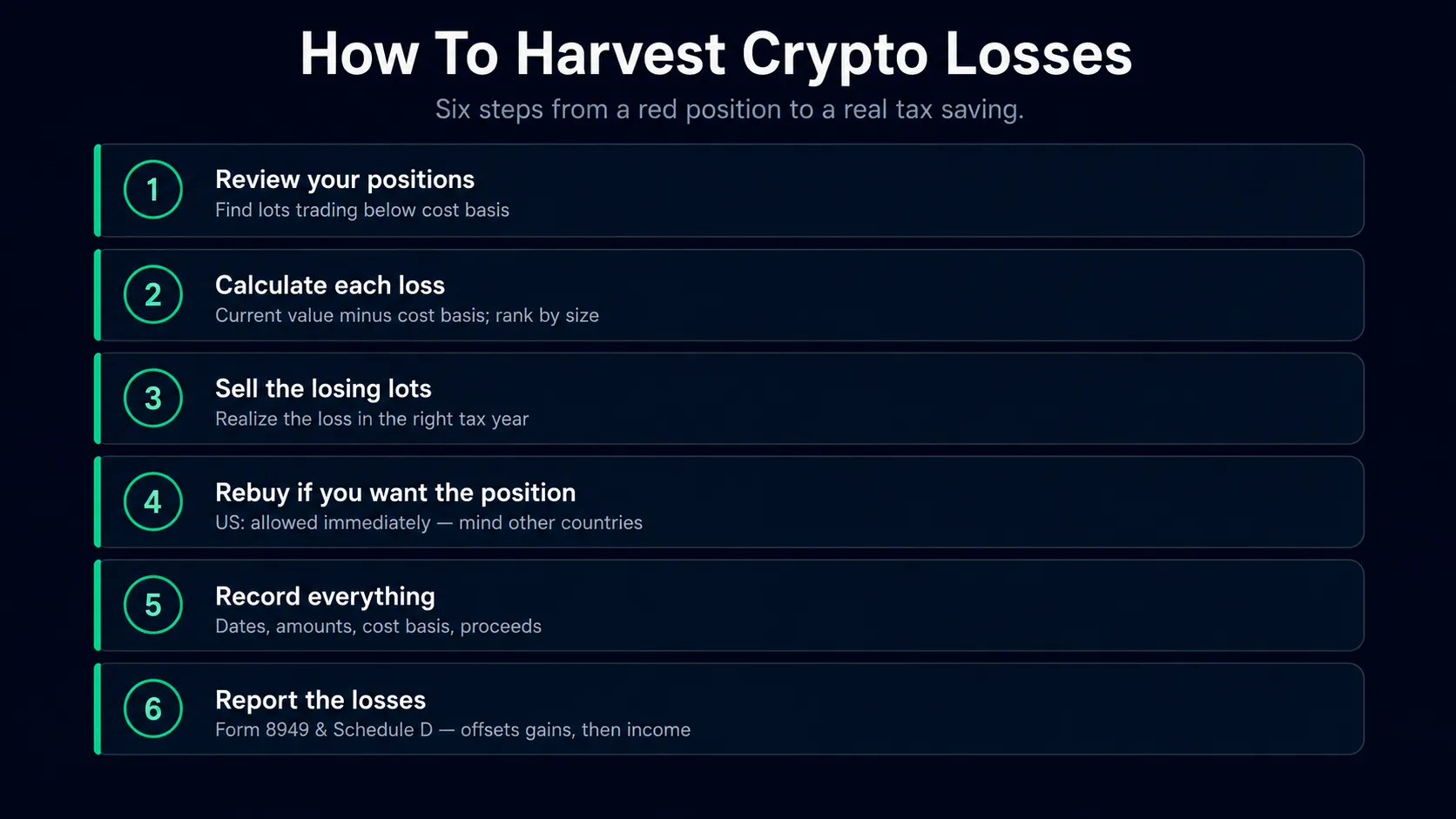
- Review your positions and find the ones trading below what you paid. Your cost basis for each lot is the key number.
- Calculate the unrealized loss on each — current value minus cost basis — and rank by size.
- Sell the losing lots to realize the losses within the tax year you want to claim them.
- Rebuy if you still want the position — currently allowed immediately for crypto, though see the cautions below.
- Record everything — dates, amounts, cost basis, proceeds — because you’ll report each disposal.
- Report the losses on your return (in the US, Form 8949 and Schedule D), where they offset gains and then income.
Timing matters. Losses have to be realized in the tax year you want to use them, which is why harvesting activity clusters near year-end — but a sharp mid-year drop can be a better opportunity than waiting for December.
Cost-Basis Methods: The Quiet Multiplier
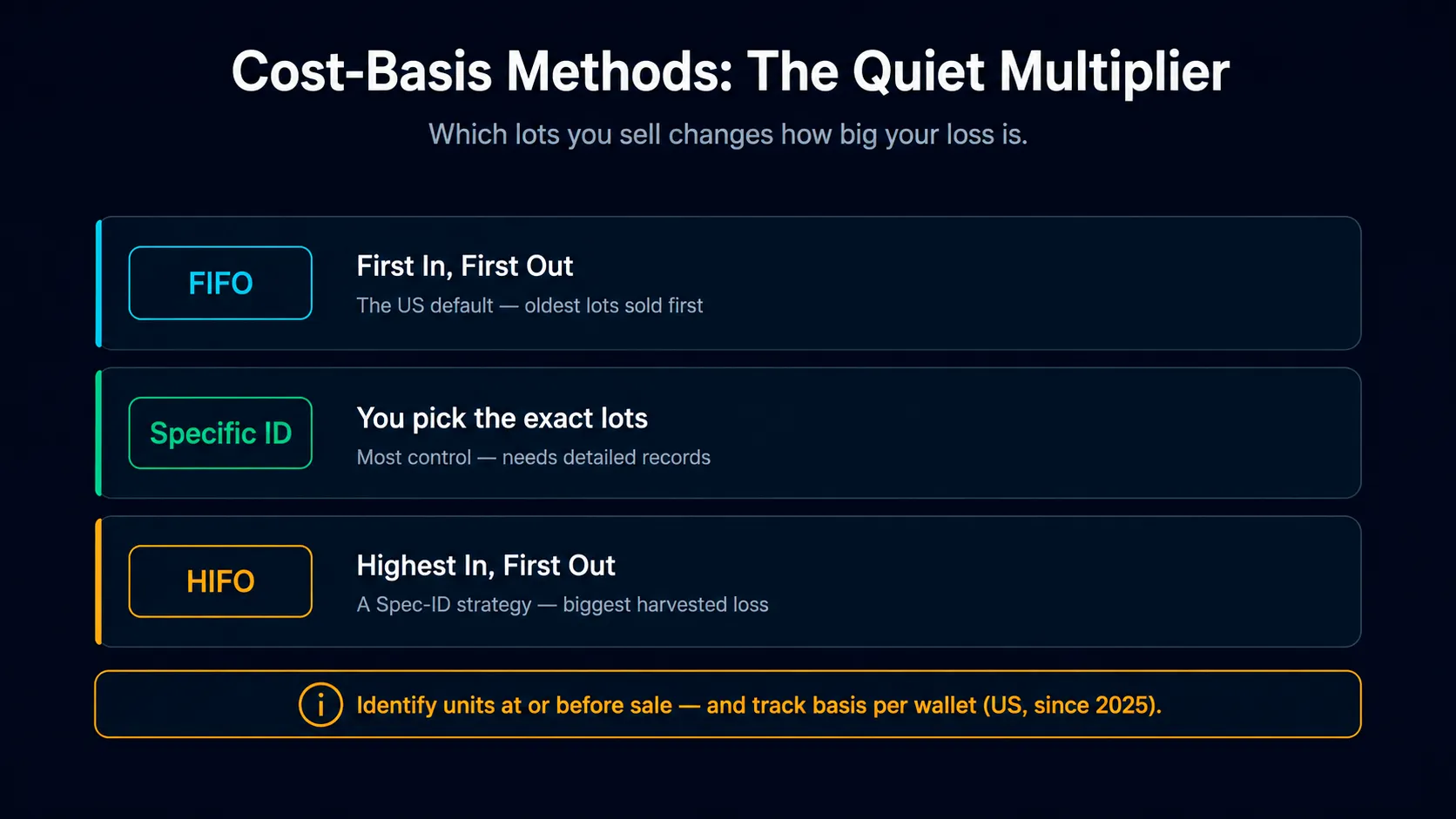
Which specific units you sell changes how big your harvested loss is, and you often get to choose. This is where a good strategy earns its keep.
- FIFO (First In, First Out) is the US default — you’re treated as selling your oldest lots first unless you specify otherwise.
- Specific Identification lets you pick exactly which lots you sell, if you keep the records to prove it. This is the powerful one for harvesting.
- HIFO (Highest In, First Out) isn’t a separate blessed method but a lot-selection strategy within Specific Identification — you sell your highest-cost lots first, which produces the biggest losses (or smallest gains).
To use Specific Identification, you must identify the units at or before the time of sale, not reconstruct it later, and keep detailed records — acquisition dates, costs, and identifiers. Note that US rules now generally require tracking basis per wallet or account rather than across your whole portfolio, which shapes how you plan.
This Is A US Quirk: Other Countries Have Anti-Wash Rules
Don’t assume the sell-and-rebuy trick works everywhere. It’s largely a US phenomenon, and several major countries specifically block it.
- The United Kingdom uses share pooling with same-day and 30-day “bed and breakfast” matching. Rebuy within 30 days and your sale is matched against that repurchase, neutralizing the loss.
- Canada applies the superficial-loss rule — a loss is denied if you or an affiliated person buys the same crypto within 30 days before or after the sale, and the denied amount is added to your cost base.
- Australia has anti-avoidance rules and an intent test the ATO can apply to wash-sale-style trades.
So the strategy has to fit your jurisdiction. In much of the world, harvesting still works — but you genuinely have to wait out a window or change your position, exactly the constraint US crypto investors currently skip. Confirm your local rules before you rebuy.
Mistakes That Undo The Benefit
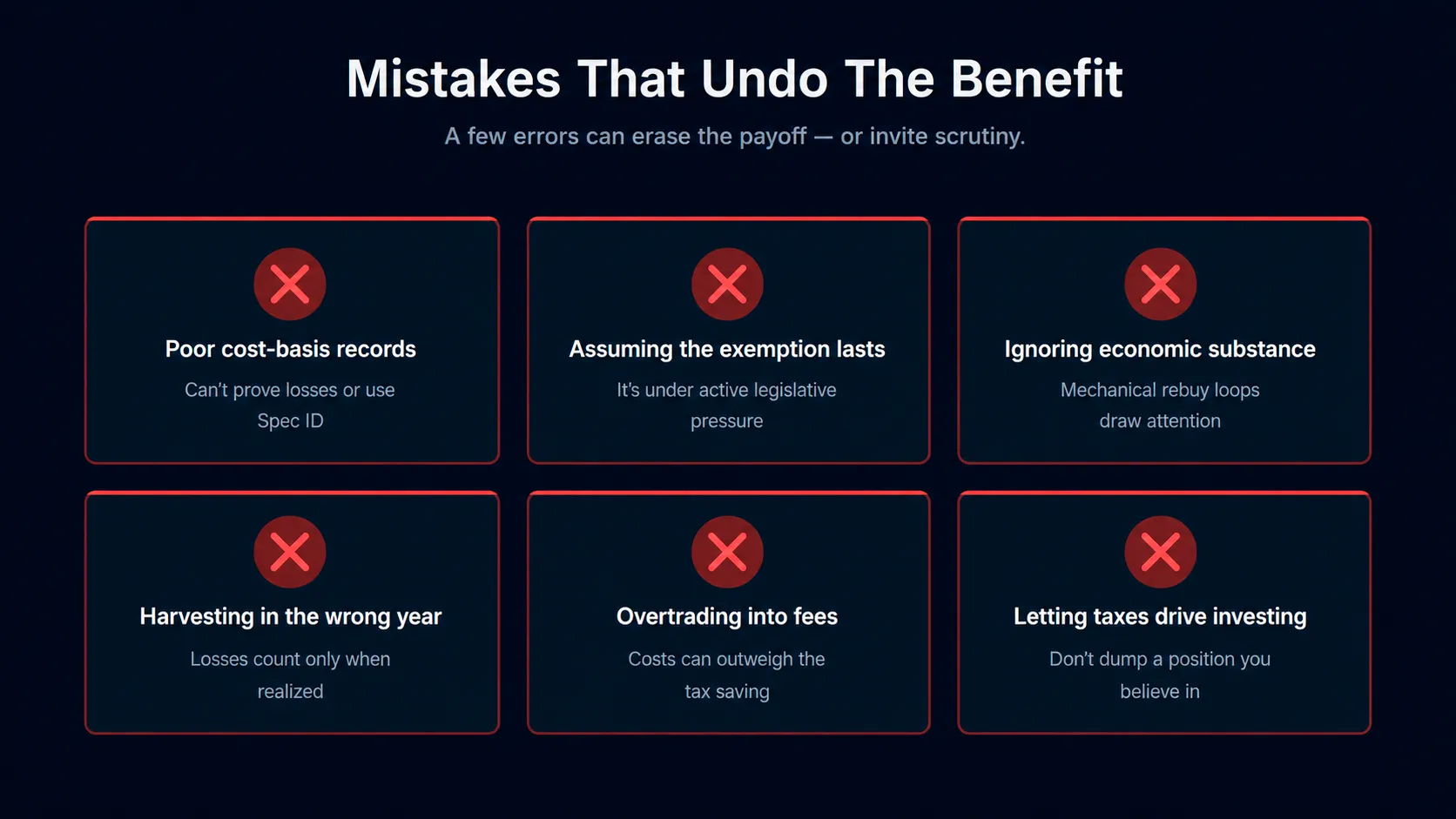
Harvesting is simple, but a few errors can erase the payoff or invite scrutiny.
- Poor records. Without solid cost-basis records, you can’t prove your losses or use Specific Identification. This is the number-one failure.
- Assuming the wash-sale exemption is permanent. It’s under active legislative pressure. Plan for it to change.
- Ignoring economic-substance risk. Mechanical, repetitive same-day sell-and-rebuy loops with no real change in position can draw attention. Keep the trades real and documented.
- Harvesting in the wrong tax year. Losses only count in the year they’re realized, so a late-December sale and an early-January one land in different years.
- Overtrading and eating fees. Trading costs, spreads, and slippage can quietly outweigh a small tax saving.
- Letting taxes drive bad investing. Don’t dump a position you believe in purely to harvest a loss. The tax tail shouldn’t wag the investment dog.
- Forgetting other countries’ rules if you’re not a US taxpayer, where a rebuy can silently void the loss.
The Bigger Picture
Tax-loss harvesting is one of the few tools that turns a down market into something useful. Done right, it offsets your gains, chips away at your ordinary income, and carries forward to help in better years — all while, in the US for now, letting you keep the exact position you want.
But hold two truths together. The strategy is genuinely valuable, and its most powerful feature for crypto rests on a legal treatment that could change with a single provision. Harvest the losses you have, keep meticulous records, respect your own country’s rules, and never let a tax move override a sound investment decision. The savings are real; the certainty isn’t.
FAQ
- What Is Crypto Tax-Loss Harvesting?
It’s deliberately selling crypto that’s worth less than you paid to realize a capital loss, then using that loss to offset your capital gains and, in the US, up to $3,000 of ordinary income per year. Unused losses carry forward to future years. A paper loss doesn’t count — you have to actually sell. - Does The Wash-Sale Rule Apply To Crypto?
Under current US law, no. The wash-sale rule in Section 1091 applies to “stock or securities,” and the IRS treats crypto as property, so you can sell at a loss and rebuy immediately and still claim it. But Congress has repeatedly proposed changing this, so treat the exemption as temporary. - Can I Sell Crypto At A Loss And Buy It Back Right Away?
In the US, currently yes — there’s no 30-day waiting period for crypto because the wash-sale rule doesn’t apply to property. Many other countries block this, though, through rules like the UK’s bed-and-breakfast matching or Canada’s superficial-loss rule, so it depends on where you’re taxed. - How Much Can Crypto Losses Save Me?
Losses first offset your capital gains dollar-for-dollar, which can be substantial. Beyond that, up to $3,000 of net loss can offset ordinary income each year in the US, and any remaining loss carries forward indefinitely to offset future gains and income. - What Cost-Basis Method Is Best For Harvesting?
Specific Identification gives the most control, letting you sell your highest-cost lots (a HIFO strategy) to maximize the loss — but only if you keep detailed records and identify the units at or before sale. Otherwise FIFO applies by default in the US, selling your oldest lots first. - Will The Crypto Wash-Sale Loophole Close?
Possibly, and many expect it to eventually. Lawmakers have proposed extending the wash-sale rule to digital assets multiple times without success so far, and the new Form 1099-DA already includes a wash-sale box. Most proposals would apply going forward from a future date rather than retroactively, but nothing is guaranteed. - Do I Owe Tax When I Harvest A Loss?
No — harvesting realizes a loss, not a gain, so it reduces your tax rather than adding to it. If you rebuy and the asset later rises, that future gain is taxed when you eventually sell, calculated from your new cost basis.