



Content
Stablecoins spent a decade in a legal grey zone. That era is over. The world’s biggest economies have now written stablecoins into law, and the rules share a striking family resemblance: hold real reserves, redeem at par, get licensed, and don’t pay holders yield.

The details differ by region, and they’re still being written. But the direction is set, and it already shapes which stablecoins you can hold, where, and from whom. Here’s how the major frameworks work, what they have in common, and why the same token can be legal in one place and delisted in another.
This is an overview for education, not legal advice. Rules are phasing in and change often, so confirm the current position with the relevant regulator before relying on any specific point.
What A Stablecoin Actually Is
A stablecoin is a crypto token designed to hold a steady value, almost always by pegging to a currency like the US dollar or euro. You send and settle it on a blockchain, but a unit is meant to always be worth about one dollar.
That “meant to” is the whole regulatory story. A stablecoin is only as sound as what backs it, so regulators focus on one question above all: if everyone asked to redeem at once, is the money actually there?
- Fiat-backed stablecoins hold reserves in cash and safe short-term assets. These are what the new laws mostly govern.
- Crypto-collateralized stablecoins are backed by other crypto, over-collateralized to absorb volatility.
- Algorithmic stablecoins try to hold the peg with supply-and-demand mechanics rather than full reserves. Several have collapsed, and regulators treat them with deep suspicion.
The Rules Almost Every Regime Shares
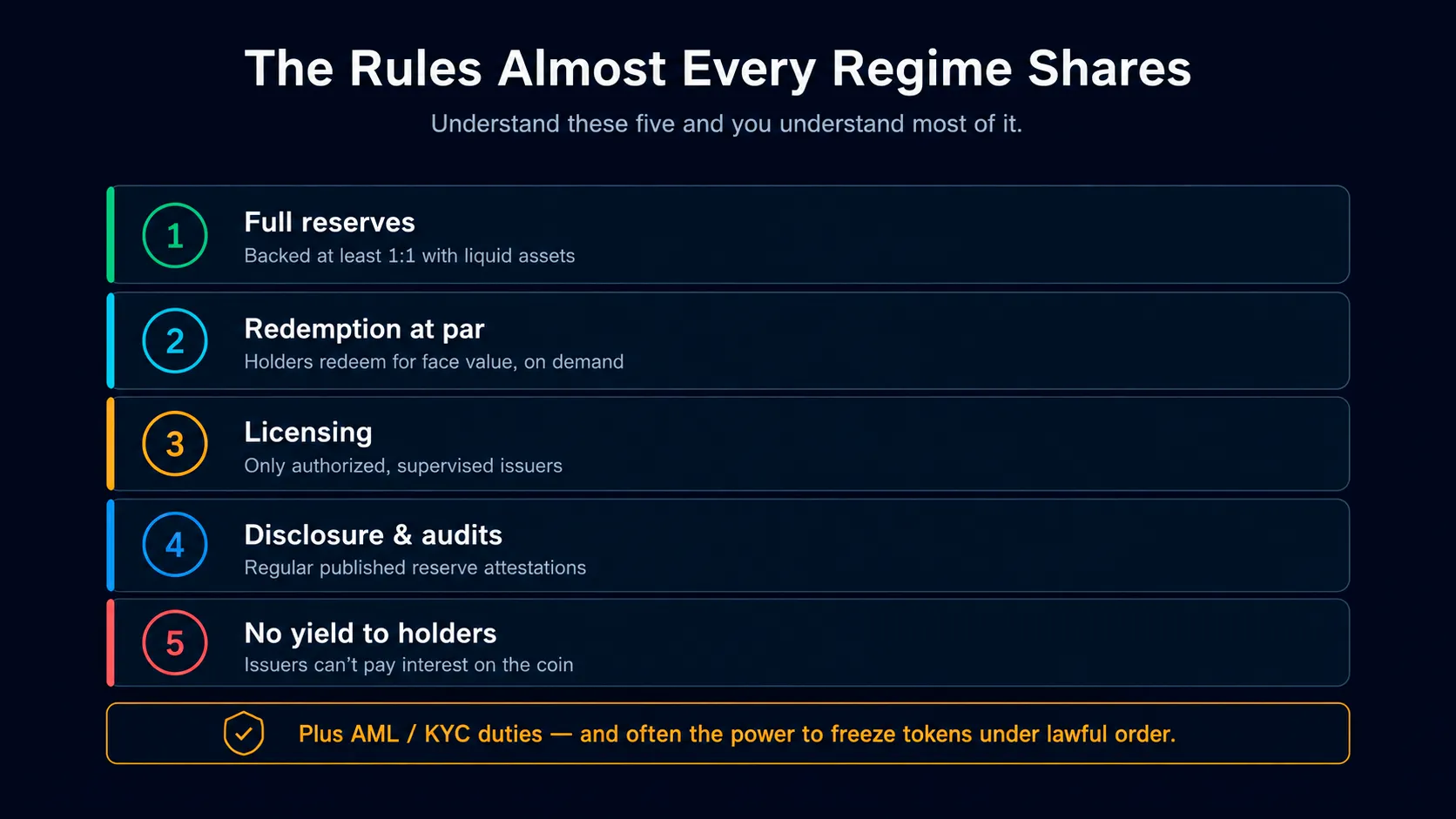
Read the US, EU, and Asian frameworks side by side and the same demands keep appearing. If you understand these five, you understand 80% of stablecoin regulation anywhere.
- Full reserves. Issuers must back tokens at least 1:1 with high-quality, liquid assets. No fractional reserves, no lending out the backing.
- Redemption at par. Holders can redeem their tokens for face value, on demand.
- Licensing. Only authorized entities may issue, under a bank-like supervisor.
- Disclosure and audits. Regular attestations of what’s in the reserves, published.
- No yield to holders. Most regimes bar issuers from paying interest, to stop stablecoins from quietly becoming unregulated bank accounts.
Then come the AML and sanctions duties — know-your-customer checks, and often the technical ability to freeze or seize tokens under a lawful order.
The United States: The GENIUS Act
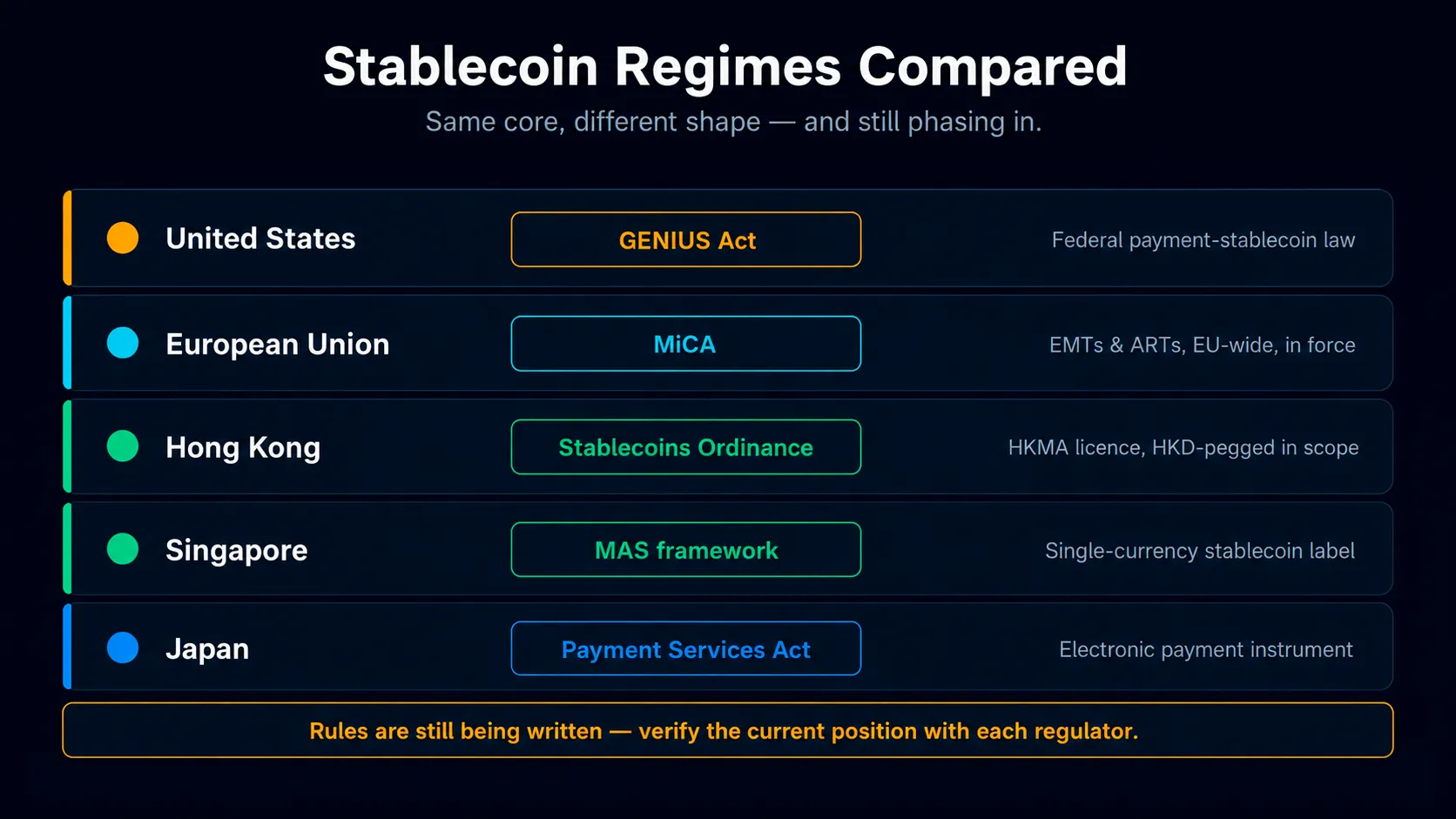
The US passed its first federal stablecoin law, the GENIUS Act, in 2025. It creates a single federal definition for a “payment stablecoin” and a licensing regime for who may issue one, replacing a messy patchwork of state money-transmitter rules.
The core requirements track the common template:
- 100% reserves in high-quality liquid assets like dollars and short-term Treasuries.
- No interest or yield paid to holders.
- Monthly reserve disclosures, with executive certifications.
- Issuance limited to permitted issuers — supervised bank subsidiaries and approved federal or state entities.
- Compliant payment stablecoins are neither securities nor commodities.
Two features stand out. The law gives holders a priority claim on the reserves if an issuer goes bankrupt, treating the reserves as the customers’ property rather than the failed company’s. And issuers must have the technical ability to freeze or burn tokens under lawful orders.
The Act was signed in 2025, but most provisions phase in through regulatory rulemaking over a multi-year window, so exact compliance dates depend on when regulators finalize their rules. You can track the statute itself on Congress.gov and the signing on the White House record.
The European Union: MiCA
Europe got there first. The Markets in Crypto-Assets Regulation (MiCA) is the EU’s comprehensive crypto law, and its stablecoin rules applied from mid-2024, with the wider service-provider rules following at the end of that year.
MiCA splits stablecoins into two regulated types:
- E-money tokens (EMTs) reference a single official currency — most dollar and euro stablecoins. They must be fully reserved (100%), issued only by authorized credit institutions or e-money institutions, and redeemable at par. Issuers can’t pay interest.
- Asset-referenced tokens (ARTs) reference a basket, another asset, or a commodity like gold. They carry additional reserve and governance requirements.
The largest coins get extra scrutiny. Once an EMT or ART crosses “significant” thresholds — very large holder counts, issuance value, or transaction volume — supervision escalates to the European Banking Authority.
MiCA also produced the clearest real-world split in the industry, which is worth understanding in detail.
The USDT Vs USDC Divergence
MiCA turned an abstract question — “is your stablecoin compliant?” — into a concrete one with real consequences. The two biggest dollar stablecoins went opposite ways.
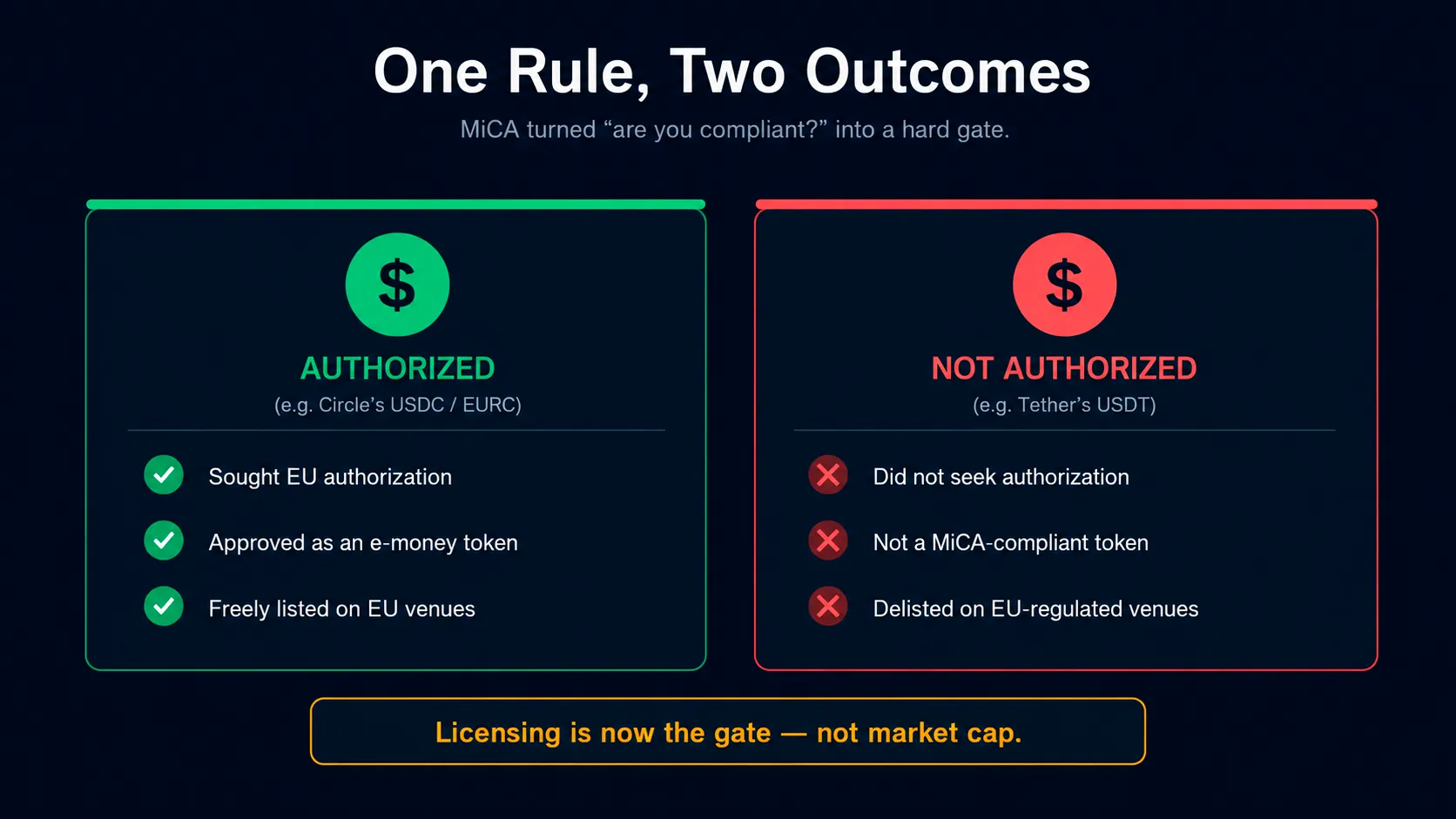
- Circle pursued authorization through an EU-licensed entity and obtained approval for USDC and its euro coin EURC. They remain freely available on EU-regulated exchanges.
- Tether did not seek MiCA authorization for USDT, stating the framework was incompatible with its reserve approach. As a result, EU-regulated exchanges delisted USDT for EEA users to keep their own licenses, since MiCA bars them from offering non-authorized stablecoins to the public.
The lesson isn’t which company was right. It’s that licensing is now a gate. A stablecoin can be the largest in the world and still be unavailable through regulated venues in a major market simply because it didn’t get authorized there. Where you can legally hold a coin now depends on the coin’s paperwork, not just its market cap.
Asia: Several Different Bets
Asia has no single position. The major financial centers each built their own regime, and the contrasts are instructive.
Hong Kong
Hong Kong’s Stablecoins Ordinance took effect on August 1, 2025, making the issuance of fiat-referenced stablecoins a licensed activity under the Hong Kong Monetary Authority (HKMA). Anyone issuing a stablecoin in Hong Kong, or issuing a Hong Kong dollar–pegged stablecoin anywhere in the world, needs an HKMA license.
Issuers must hold full reserves at par, segregate client assets, and meet AML, disclosure, and audit rules. The HKMA has signaled a high bar — it expects to grant relatively few licenses to issuers with credible use cases. You can read the regime on the HKMA’s official page.
Singapore
Singapore’s regulator, the Monetary Authority of Singapore (MAS), finalized a framework for single-currency stablecoins pegged to the Singapore dollar or a major currency. Reserves must be valued at no less than 100% of tokens in circulation at all times, with redemption and disclosure obligations.
Singapore’s angle is a clear, narrow label: a coin that meets the standard can be recognized as a MAS-regulated stablecoin, and one that doesn’t simply can’t use that status.
Japan
Japan moved early, regulating stablecoins through amendments to its Payment Services Act. It treats fiat-backed stablecoins as a form of electronic payment instrument, with issuance generally limited to regulated entities like banks, trust companies, and licensed money-transfer providers, under reserve and redemption rules.
The Common Thread
Across Asia, the same worry recurs: dollar stablecoins dominate globally, and heavy local adoption could pull money out of domestic banking. So each regime pairs openness to the technology with tight control over reserves, licensing, and which currencies get the friendliest treatment.
What This Means If You Just Hold Stablecoins
You don’t need a law degree, but a few practical shifts matter.
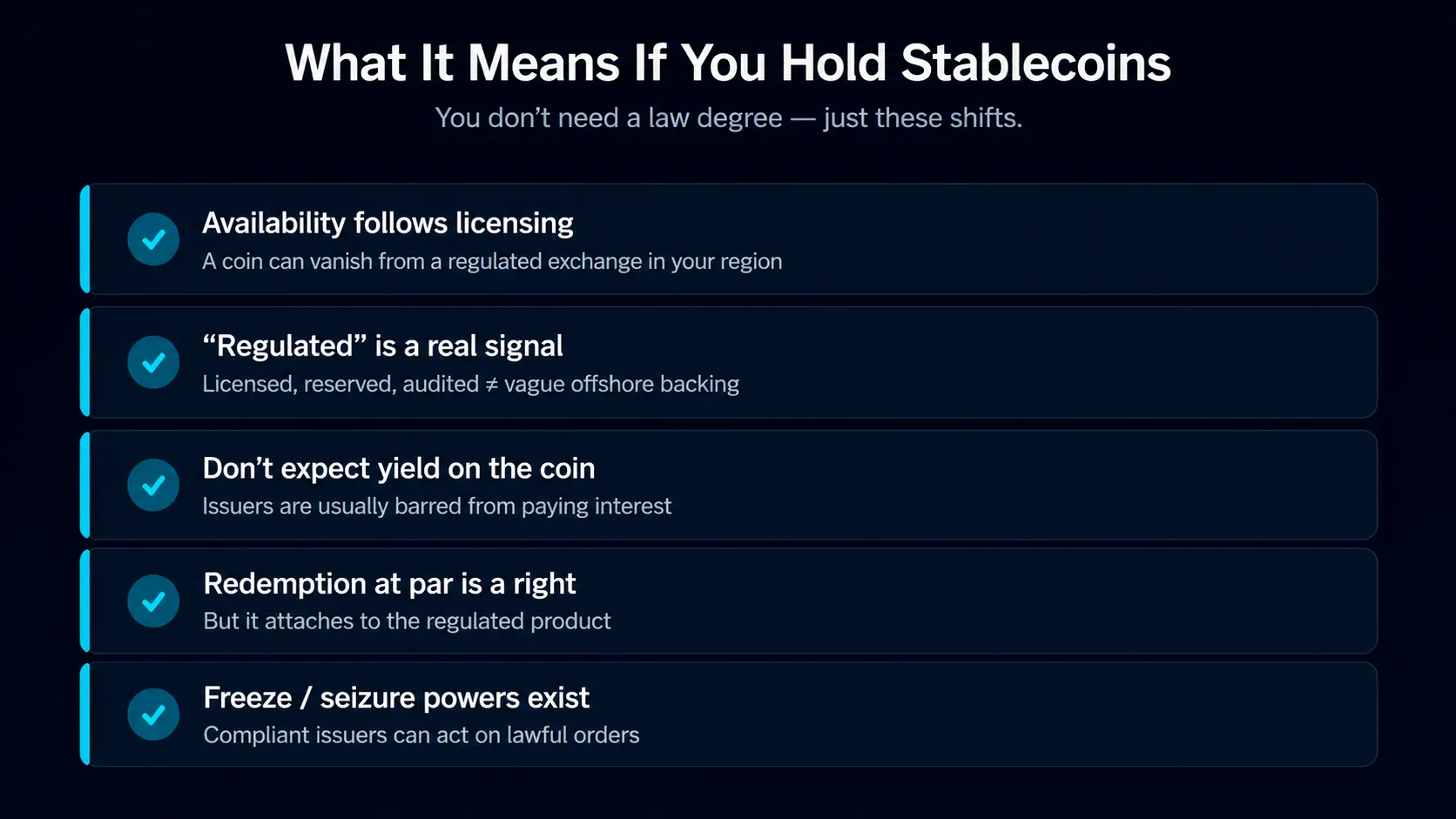
- Availability now depends on licensing. A coin can vanish from a regulated exchange in your region because its issuer didn’t get authorized there. That’s not the exchange being difficult — it’s the law.
- “Regulated” is a real signal, not just marketing. A licensed, fully reserved, audited stablecoin is a very different risk from an offshore coin with vague backing. Check who issues it and under which regime.
- Don’t expect yield on the coin itself. Most frameworks ban issuers from paying interest to holders, so “earn yield just by holding this stablecoin” offers deserve scrutiny.
- Redemption is a right worth knowing. Under these regimes, holders can redeem at par — but that protection generally attaches to the regulated product, not to every token calling itself a stablecoin.
- Freeze and seizure powers exist. Compliant issuers can freeze tokens under lawful orders. That’s a feature for law enforcement and a consideration for you.
Where This Is All Heading
The frameworks differ on the edges, but they’re converging on the same core: stablecoins are being pulled into the same regulatory perimeter as money and payments. Full reserves, licensed issuers, par redemption, and disclosure are becoming table stakes almost everywhere.
Expect more countries to publish rules, more coordination on how foreign stablecoins are treated across borders, and continued pressure on issuers that won’t get licensed. The specifics will keep moving. The shape — regulated, reserved, redeemable — looks durable.
Treat the named laws and dates here as a snapshot. Verify the current rules with the relevant regulator or a qualified professional before you build on, issue, or make decisions around any specific stablecoin.
FAQ
- Are Stablecoins Regulated Now?
Increasingly, yes. Major economies including the US, the EU, and several Asian financial centers have enacted stablecoin laws requiring issuers to be licensed, hold full reserves, and allow redemption at par. The rules are still phasing in, so coverage varies by region and by coin. - What Is The GENIUS Act?
It’s the first US federal law for payment stablecoins, enacted in 2025. It defines who can issue a dollar stablecoin, requires 100% reserves and disclosures, bars paying yield to holders, and gives holders a priority claim on reserves if the issuer fails. - Why Was USDT Delisted On Some EU Exchanges?
Under the EU’s MiCA rules, regulated exchanges can only offer stablecoins whose issuers are authorized. Tether didn’t seek MiCA authorization for USDT, so EU-regulated venues delisted it to stay compliant, while Circle’s authorized USDC remained available. - Do Stablecoin Regulations Mean My Coins Are Safe?
They reduce certain risks — a licensed, fully reserved, audited stablecoin is far more transparent than an unregulated one. But regulation isn’t a guarantee against every risk, and rules differ by region, so check the issuer, the reserves, and the applicable regime. - Can I Still Earn Yield On Stablecoins?
Generally not from the issuer directly, since most frameworks prohibit paying interest to holders. Yield you see elsewhere usually comes from lending or DeFi protocols, which carry their own separate risks and aren’t the same as the coin itself paying you. - Which Stablecoin Rules Apply To Me?
Usually the ones where you and the platform you use are located. A stablecoin’s availability and legal treatment depend on the regime governing the exchange or service offering it to you, which is why the same coin can be treated differently across borders. - Are Algorithmic Stablecoins Legal?
It depends on the jurisdiction, and they face the most skepticism. Several regimes focus on fiat-backed stablecoins and exclude or restrict algorithmic ones, especially after high-profile collapses. Always check how a specific coin is classified where you are.