


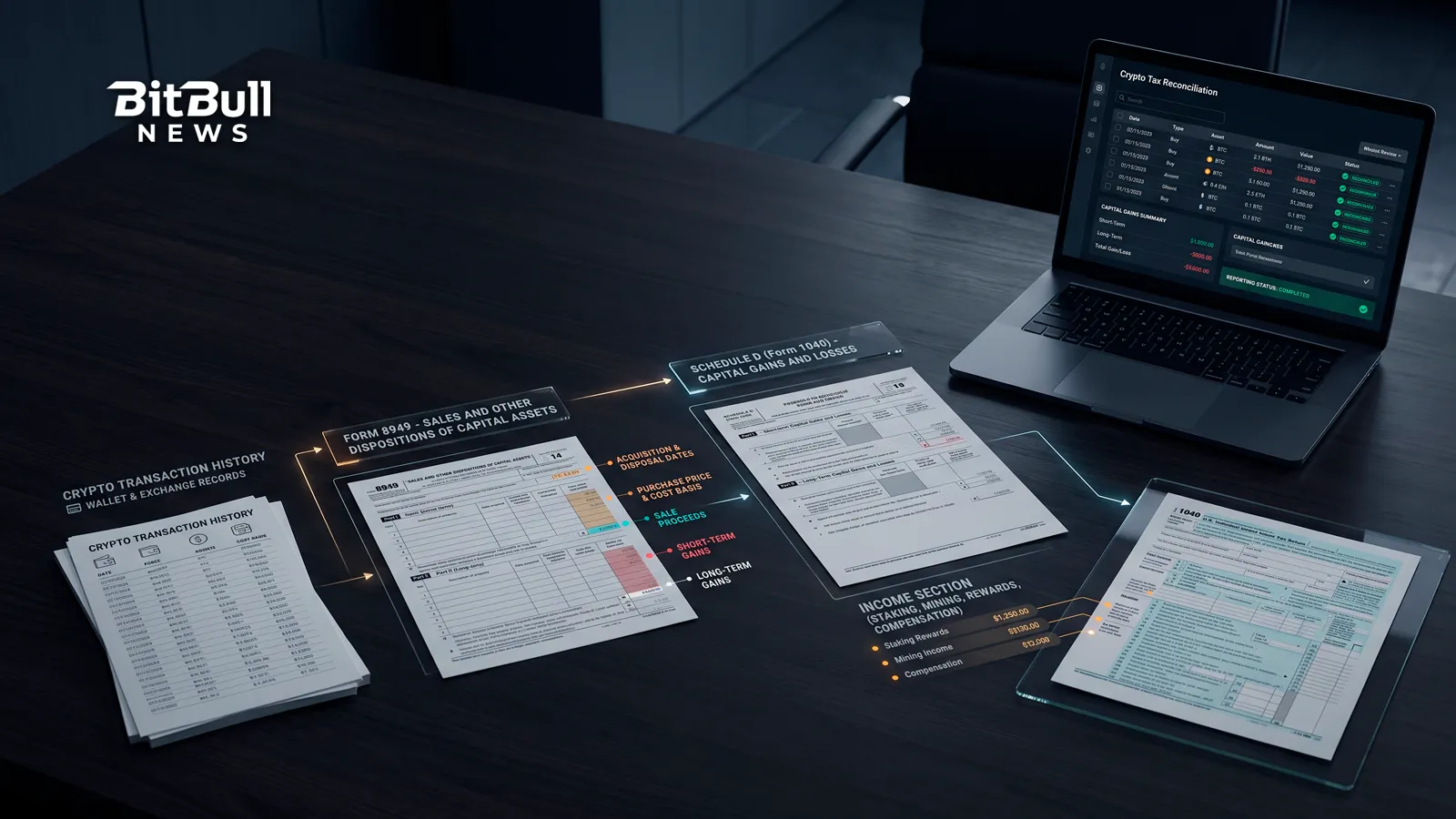
Content
The hard part usually isn’t whether crypto is taxed. It’s which form, which line, and in what order. Get the pieces in the wrong place and you either overpay or invite a letter from the tax authority.

This guide walks the US federal process step by step, using the actual IRS forms. If you file outside the US, the principles rhyme but the forms don’t, so check your own tax authority. And this is educational, not tax advice — forms and rules change, so confirm the current-year instructions or work with a professional before you file.
Before You Start: The Two Kinds Of Crypto To Report
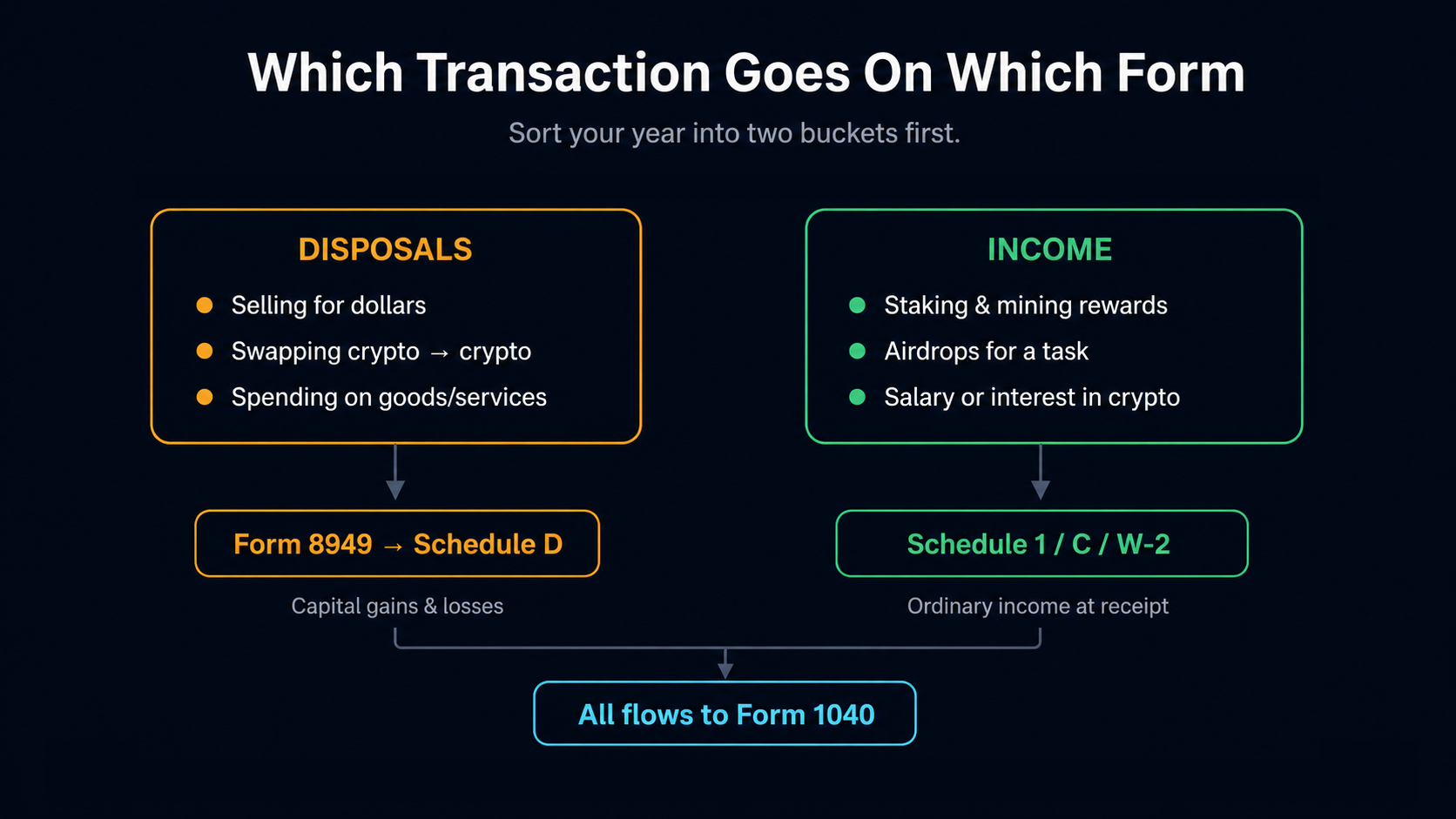
Every crypto tax event fits one of two categories, and each goes to different forms. Sort your year into these two buckets first and the rest is bookkeeping.
- Capital gains and losses come from disposing of crypto — selling it, swapping one coin for another, or spending it. These go on Form 8949 and Schedule D.
- Ordinary income comes from receiving crypto as earnings — staking, mining, airdrops, interest, or a paycheck in crypto. This goes on Schedule 1, Schedule C, or your wages, depending on how you earned it.
Plenty of people have both in the same year. That’s normal, and each is reported separately.
Step 1: Answer The Digital Asset Question
Every Form 1040 (and 1040-SR and 1040-NR) has a digital asset question right at the top, and you must answer Yes or No. It’s not optional, and you’re answering under penalty of perjury.
Answer Yes if you received, sold, exchanged, or otherwise disposed of digital assets during the year. You can answer No if your only activity was buying crypto with cash and holding it, or moving it between wallets you own.
Get this right before anything else. Skipping or fudging it is the simplest way to flag your return.
Step 2: Gather Your Records
You can’t report what you can’t reconstruct, so pull everything together before you touch a form. For each transaction you need:
- The date you acquired the crypto and the date you disposed of it.
- The proceeds — what you received on disposal.
- The cost basis — what you originally paid, including fees.
- The resulting gain or loss.
For income, you need the date received and the fair market value at that moment. Your sources are exchange transaction histories, any tax forms brokers send you, and your own on-chain and wallet records. Crypto tax software can pull and organize most of this, but the output is your responsibility, not the IRS’s ruling.
Step 3: Report Capital Gains And Losses On Form 8949 And Schedule D
Because the IRS treats digital assets as property, every disposal is a capital gains event — just like selling a stock.
List each disposal on Form 8949: a description, the dates acquired and sold, the proceeds, the cost basis, and the gain or loss. Separate your short-term transactions (held one year or less) from your long-term ones (held more than a year), because they’re taxed at different rates.
Those totals carry to Schedule D, which nets your gains against your losses and flows the result to your Form 1040. Losses aren’t wasted, either. They offset gains, and a net capital loss can currently offset up to $3,000 of ordinary income per year, with the rest carried forward to future years.
Step 4: Report Crypto Income On Schedule 1, Schedule C, Or Your Wages
Crypto you earn is ordinary income, valued in dollars at the moment you receive it. Where it goes depends on how you earned it.
- As an investor or hobbyist (staking rewards, airdrops, most mining) — report it as other income on Schedule 1.
- As a business (for example, mining run as a real operation) — report it on Schedule C, and expect self-employment tax.
- As a paycheck — crypto paid as wages shows up on your W-2 and is reported like any salary.
Two things trip people up here. Income events are not on Form 1099-DA — that form is only for sale proceeds, so you self-report earnings (a broker may send a 1099-MISC). And when you later sell crypto you earned, a second, separate capital gains calculation applies, using the value you already reported as income as your cost basis. Report it as income once, then track gains from there.
Step 5: Understand Form 1099-DA, The New Broker Form
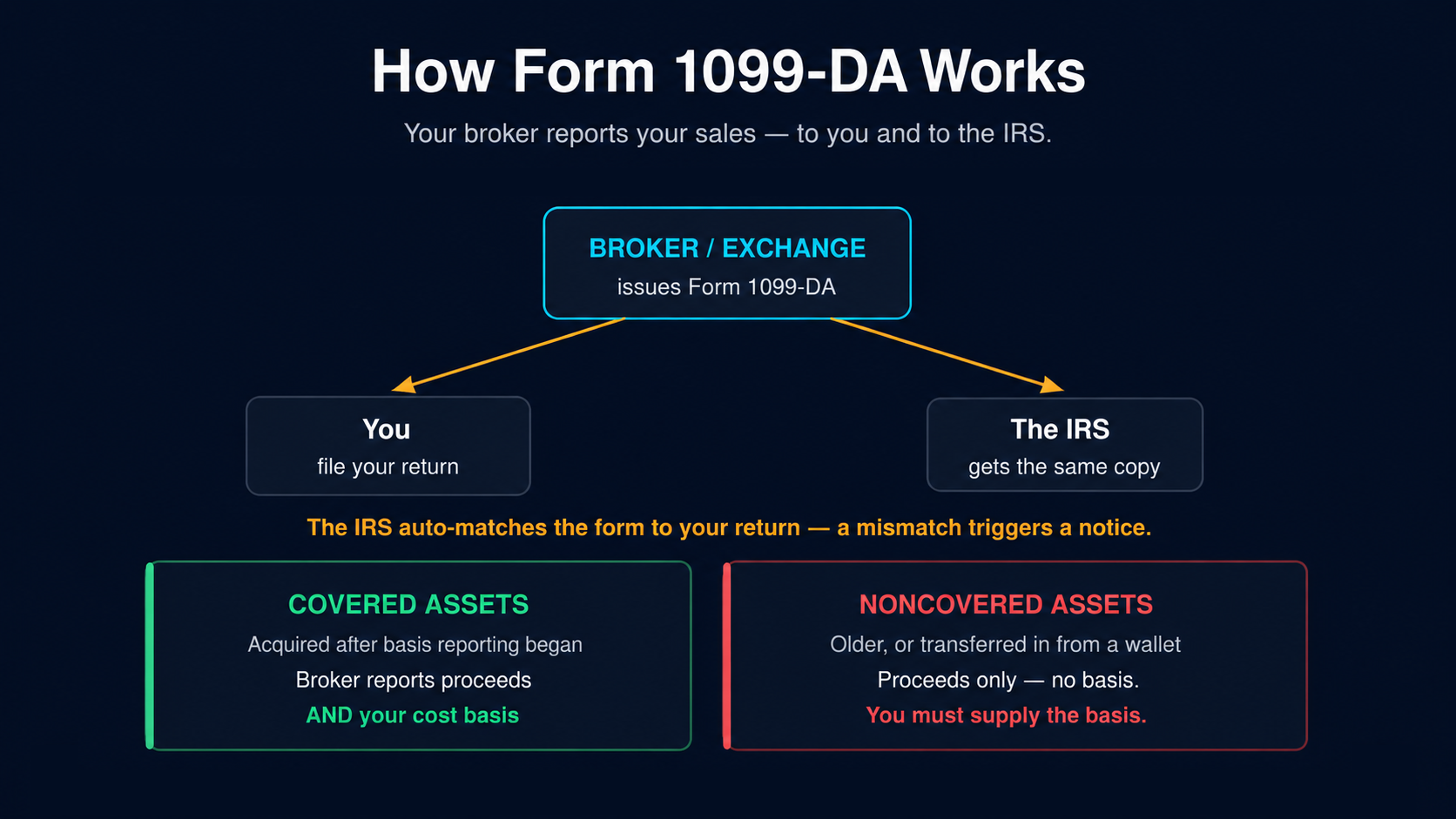
The reporting world changed when the IRS introduced Form 1099-DA, the form brokers and exchanges use to report your digital asset sales and exchanges to both you and the IRS. It works like the 1099-B that stock brokers issue.
It’s rolling out in phases, and the details matter:
- In its first phase, brokers report gross proceeds only — the total you sold for, not your cost basis.
- Cost-basis reporting phases in for assets acquired after basis reporting begins. These are called covered assets.
- Noncovered assets — anything you acquired before basis reporting started, or transferred in from an outside wallet — get proceeds-only reporting. The basis is on you.
Here’s the trap. If you sell an older holding, the broker may report the proceeds with no cost basis, which makes the IRS’s system see what looks like 100% profit. You fix that on Form 8949 by entering your real basis from your own records. The IRS automatically matches every 1099-DA against your return, so a mismatch invites a notice.
And to be clear: you must report your crypto whether or not a 1099-DA ever arrives. The form doesn’t create the obligation; it just makes non-reporting easy to catch.
Common Situations And Where They Go
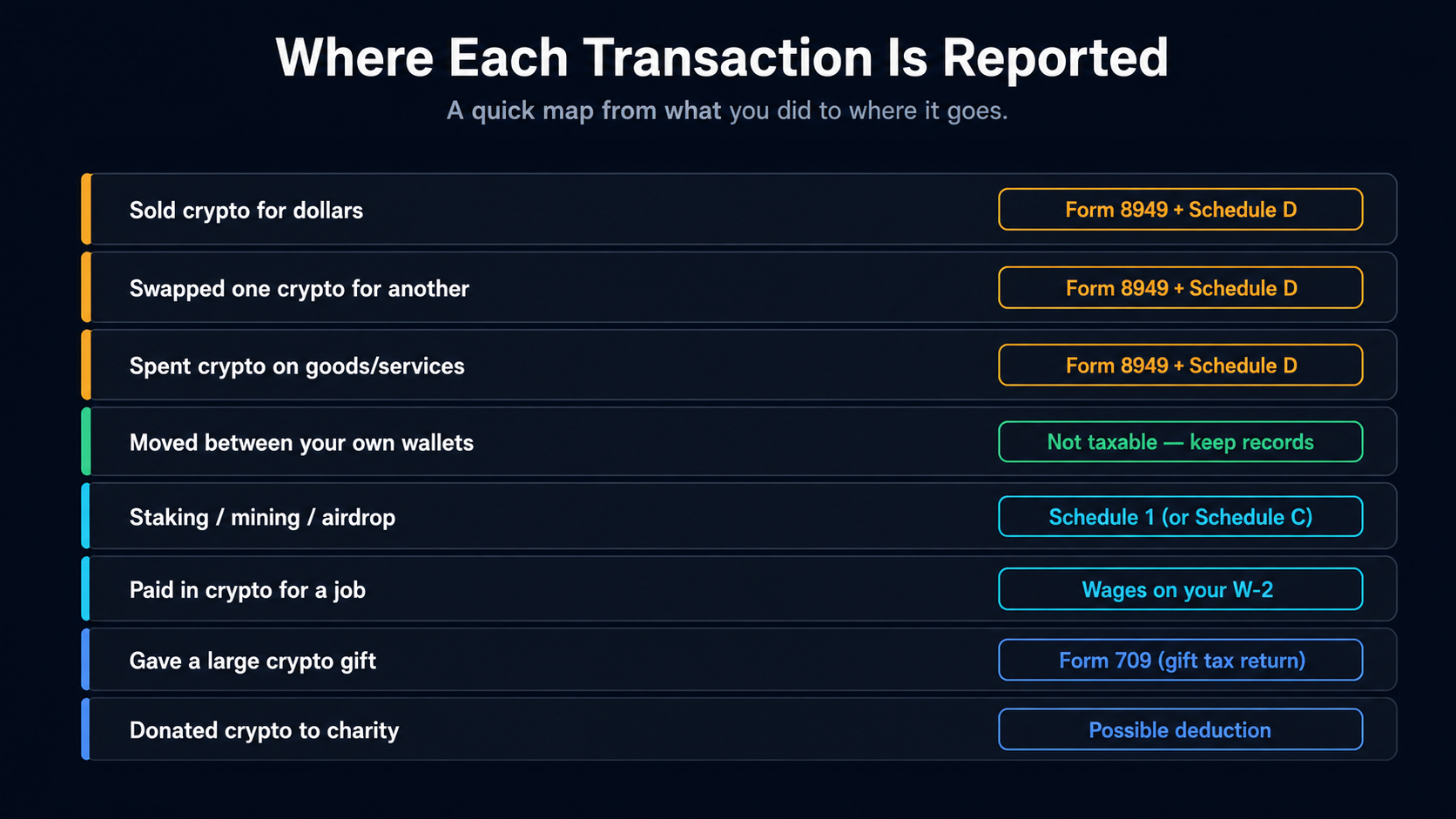
Use this as a quick map from what you did to where it’s reported.
- Sold crypto for dollars — capital gain/loss, Form 8949 and Schedule D.
- Swapped one crypto for another — a disposal, Form 8949 and Schedule D. (Yes, even without cashing out.)
- Spent crypto on goods or services — a disposal, Form 8949 and Schedule D.
- Moved crypto between your own wallets — not a taxable event, not a disposal. Keep records so it isn’t mistaken for a sale.
- Received staking, mining, or airdrop rewards — ordinary income, Schedule 1 (or Schedule C if it’s a business).
- Got paid in crypto for a job — wages on your W-2.
- Received crypto as a gift — not income to you when received, but note the basis for when you sell.
- Gave a large crypto gift — the giver may need to file a gift tax return (Form 709).
- Donated crypto to charity — potentially deductible, though larger donations have appraisal requirements.
The IRS confirms several of these in its digital-asset FAQs, including that moving crypto between your own wallets isn’t taxable and that receiving a bona fide gift isn’t income to you.
Reconciling Your Wallets And DeFi Activity
Your broker forms won’t capture everything. Self-custody wallets and DeFi protocols mostly fall outside 1099-DA reporting, which means the tracking lands on you.
- Log every wallet-to-wallet transfer with the sending and receiving addresses. These aren’t taxable, but undocumented transfers wreck your basis math and can look like unreported sales.
- Treat DeFi swaps as disposals. Trading through a decentralized exchange is still a taxable exchange in most cases.
- Track basis per wallet. The IRS has moved toward wallet-by-wallet basis tracking, so keeping records for each wallet separately saves real pain later.
A plain spreadsheet — date, asset, amount, from, to, value — pays for itself the first time your numbers have to line up.
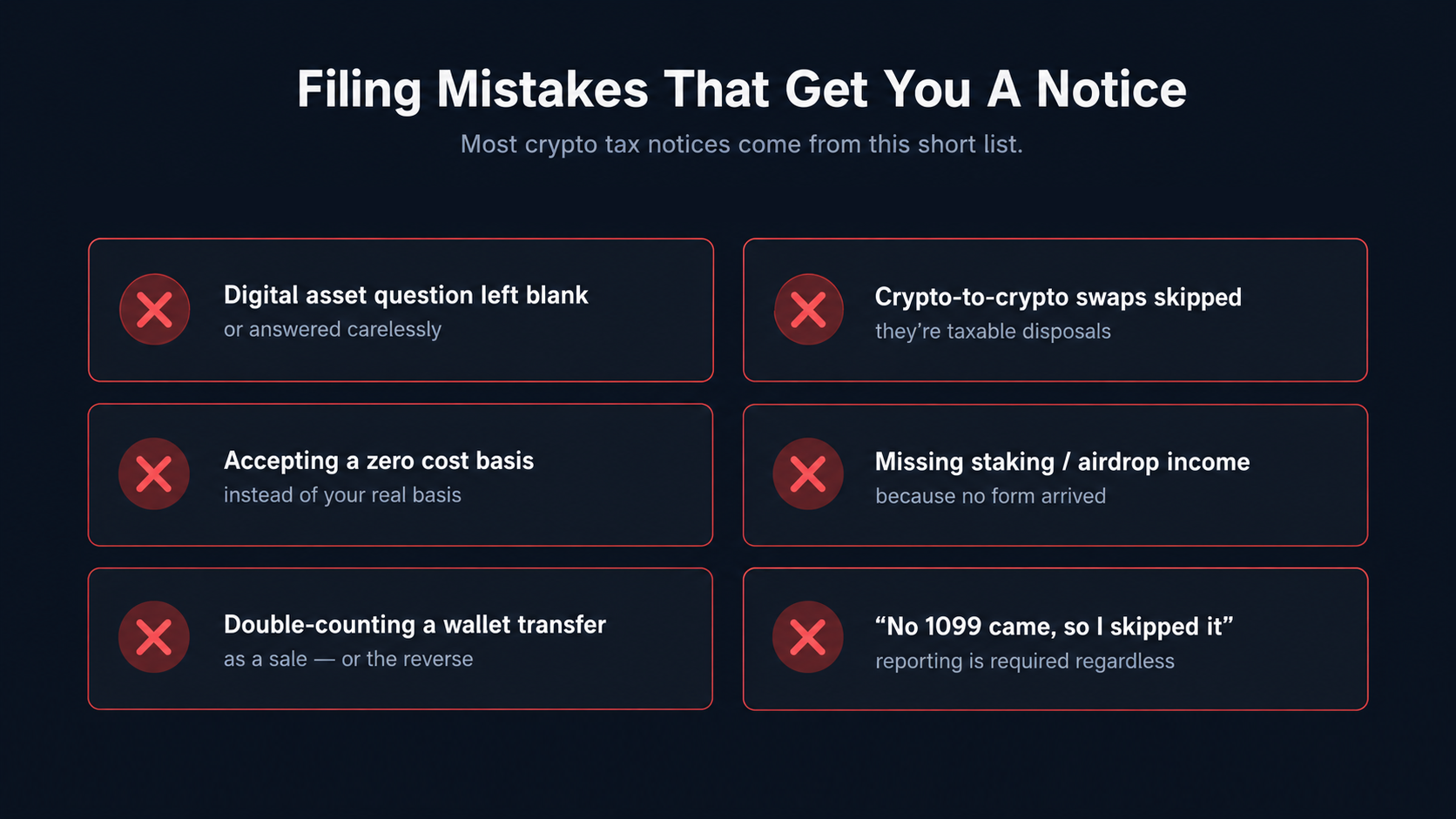
Mistakes That Get You A Notice
Most crypto tax notices come from a short, avoidable list.
- Leaving the digital asset question blank or answering it carelessly.
- Forgetting that crypto-to-crypto swaps are taxable, so entire trades go unreported.
- Accepting a blank or zero cost basis from a 1099-DA instead of entering your real basis.
- Missing earned income from staking or airdrops because no form arrived.
- Double-counting a wallet transfer as a sale, or the reverse.
- Not reporting because “no 1099 came.” Reporting is required regardless.
If You’re Behind Or It Gets Complicated
Missed something in a past year? You can fix it with an amended return (Form 1040-X), and the IRS has voluntary disclosure paths for larger corrections. Catching it yourself is far better than waiting for a notice.
For high-volume trading, heavy DeFi use, NFTs, or several years of untangled history, bring in a tax professional who actually handles crypto. The cost is usually small next to the penalties for getting it wrong — and again, none of this is tax advice.
The mechanics look intimidating, but they reduce to a simple loop. Answer the question, split disposals from income, put disposals on Form 8949 and Schedule D, put income on Schedule 1 or Schedule C, and back every number with your own records. Do that, and a 1099-DA becomes a cross-check instead of a trap.
FAQ
- Do I Have To Report Crypto If I Didn’t Get A Tax Form?
Yes. Reporting is required whether or not a broker sends you a Form 1099-DA or any other form. The form makes non-reporting easier for the IRS to catch, but the obligation was always yours. - What Form Do I Use To Report Crypto Sales?
Capital gains and losses go on Form 8949, and the totals carry to Schedule D, which attaches to your Form 1040. List each disposal separately, splitting short-term from long-term holdings. - Where Do I Report Staking Or Mining Income?
As ordinary income at its value when you received it. Most investors report it as other income on Schedule 1; if it’s a genuine business, it goes on Schedule C and may owe self-employment tax. - Is Swapping One Cryptocurrency For Another Taxable?
Yes. In the US, trading one crypto for another is a disposal, so you calculate a gain or loss and report it on Form 8949 and Schedule D, even though you never touched dollars. - What Is Form 1099-DA?
It’s the IRS form brokers and exchanges use to report your digital asset sale proceeds to you and the IRS, similar to the 1099-B for stocks. It’s rolling out in phases, starting with gross proceeds and adding cost-basis reporting for later-acquired assets. - Why Does My 1099-DA Show No Cost Basis?
Most likely the asset is “noncovered” — you acquired it before basis reporting began, or transferred it in from an outside wallet. The broker only reports proceeds, so you must supply your own cost basis on Form 8949 or the IRS will see the full amount as gain. - Do I Report Crypto Held On A Foreign Exchange?
If you’re a US citizen or resident, yes. The US taxes worldwide income, so your digital asset transactions are reportable even on a non-US platform.