



Content
Here’s the myth that gets people in trouble: crypto isn’t taxed. It is, almost everywhere, and “I didn’t know” is not a defense that tax authorities accept.

The hard part isn’t that crypto goes untaxed. It’s that every country taxes it differently, the rules change often, and enforcement just got dramatically stronger. This guide covers the principles that hold almost everywhere, then how the US, UK, EU, and major Asian economies handle it — so you know what to ask for your own situation.
This is educational, not tax advice. Rates and thresholds shift constantly, so treat every figure here as a starting point to confirm with your own tax authority or a professional.
First, The Rules That Apply Almost Everywhere
Despite the differences, a handful of principles hold across most of the world. Get these and the country details become far easier.
Crypto Usually Falls Into Two Tax Buckets
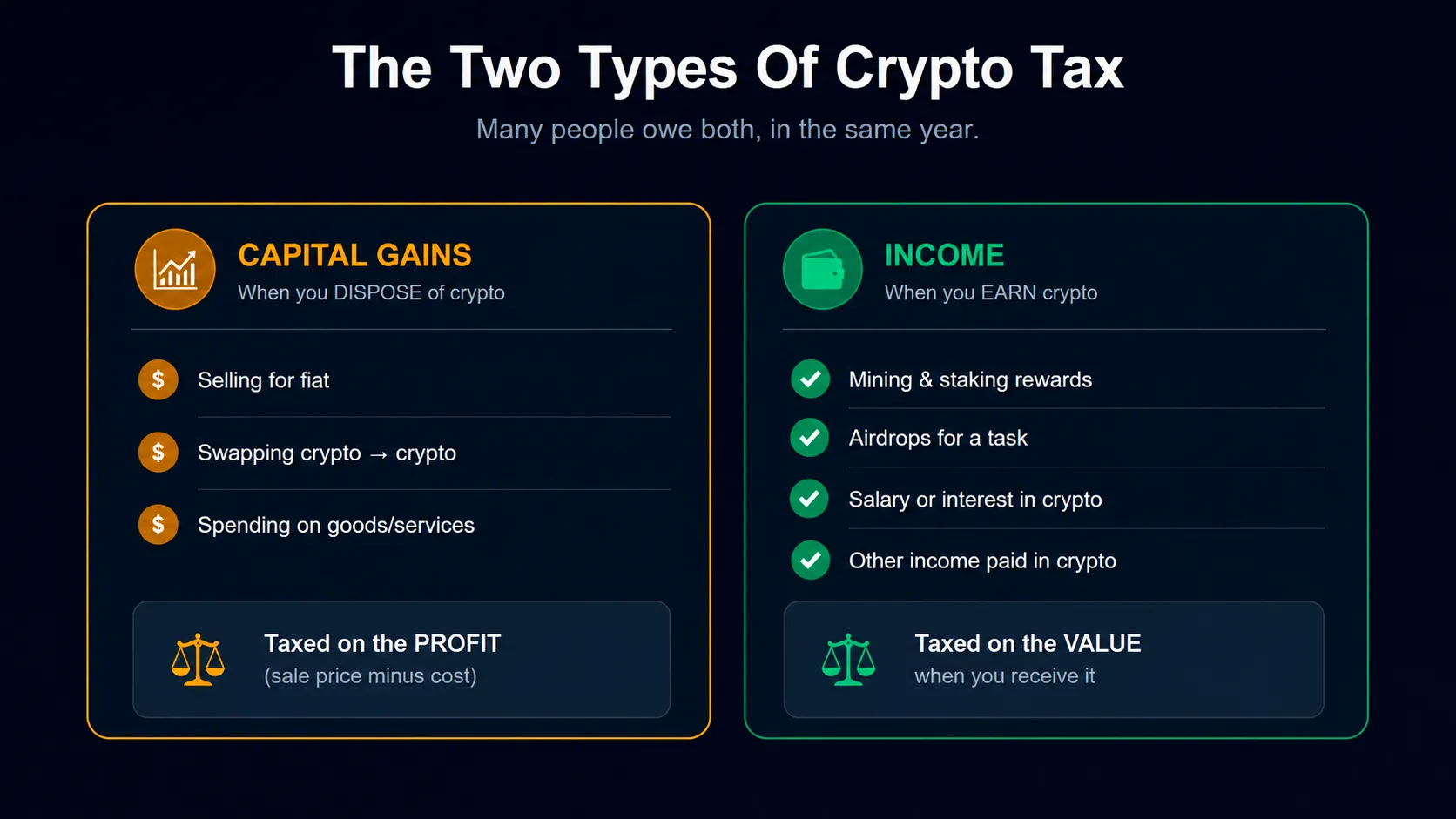
Almost every system sorts crypto tax into two types.
- Capital gains. You owe this when you dispose of crypto for more than it cost you. Selling is the obvious case, but in most countries swapping one crypto for another and spending crypto also count as disposals.
- Income. You owe this when you receive crypto as earnings — mining and staking rewards, airdrops for doing something, interest, or a salary paid in crypto. It’s usually taxed at its market value on the day you get it.
Plenty of people owe both in the same year, on different transactions. Earn a staking reward (income), later sell it for a profit (capital gain), and two separate calculations apply.
What Usually Triggers Tax — And What Usually Doesn’t
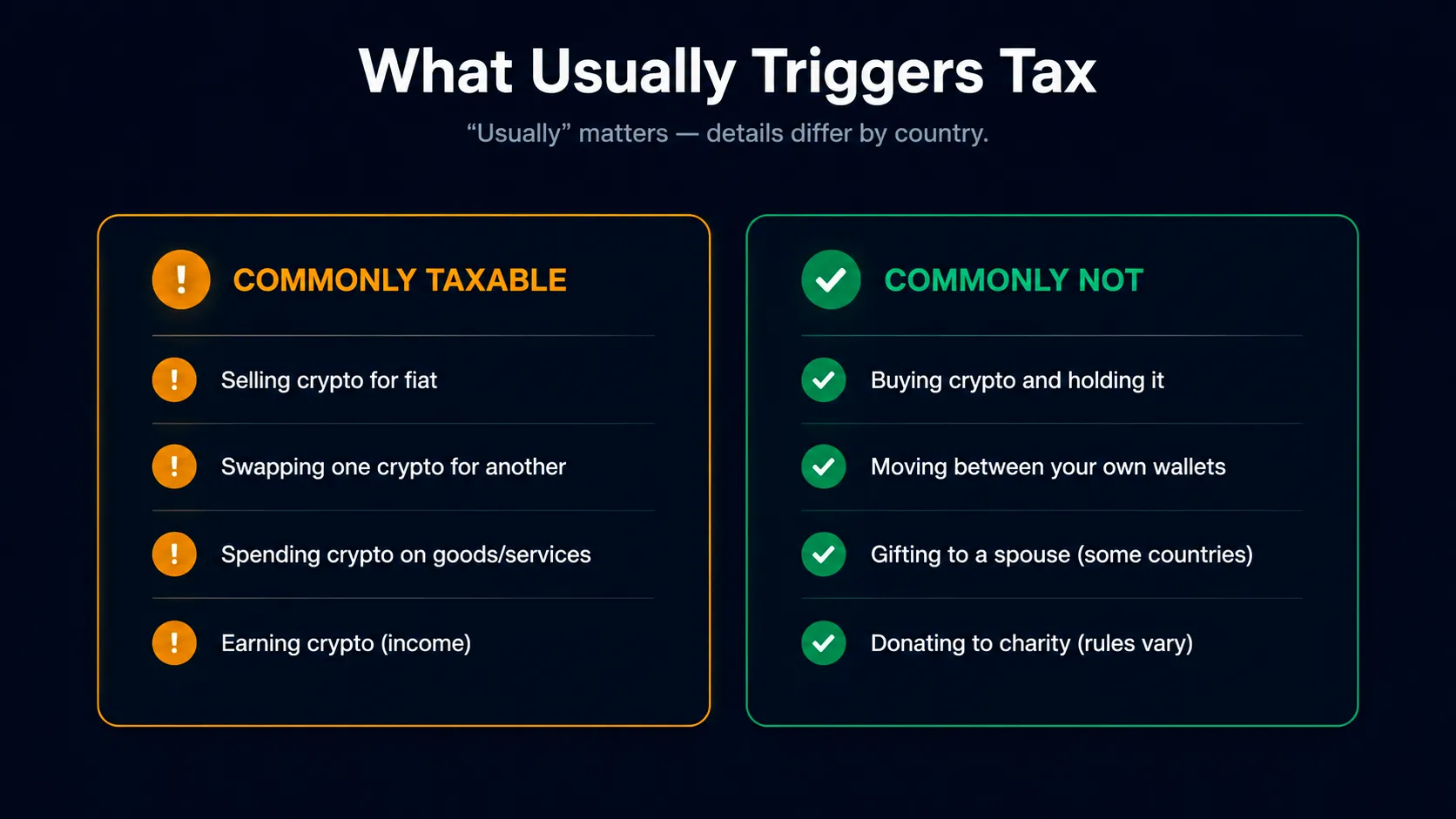
The word “usually” is doing real work here. Details differ by country, but the pattern is consistent.
Commonly taxable events:
- Selling crypto for fiat currency.
- Swapping one crypto for another — a disposal in many countries, even without cashing out. This one surprises people.
- Spending crypto on goods or services.
- Earning crypto (taxed as income).
Commonly not taxable:
- Buying crypto with fiat and simply holding it.
- Moving crypto between wallets or accounts you own.
- Gifting to a spouse, in some countries, or donating to charity (rules vary).
Confirm the specifics for your jurisdiction before you act on any of this.
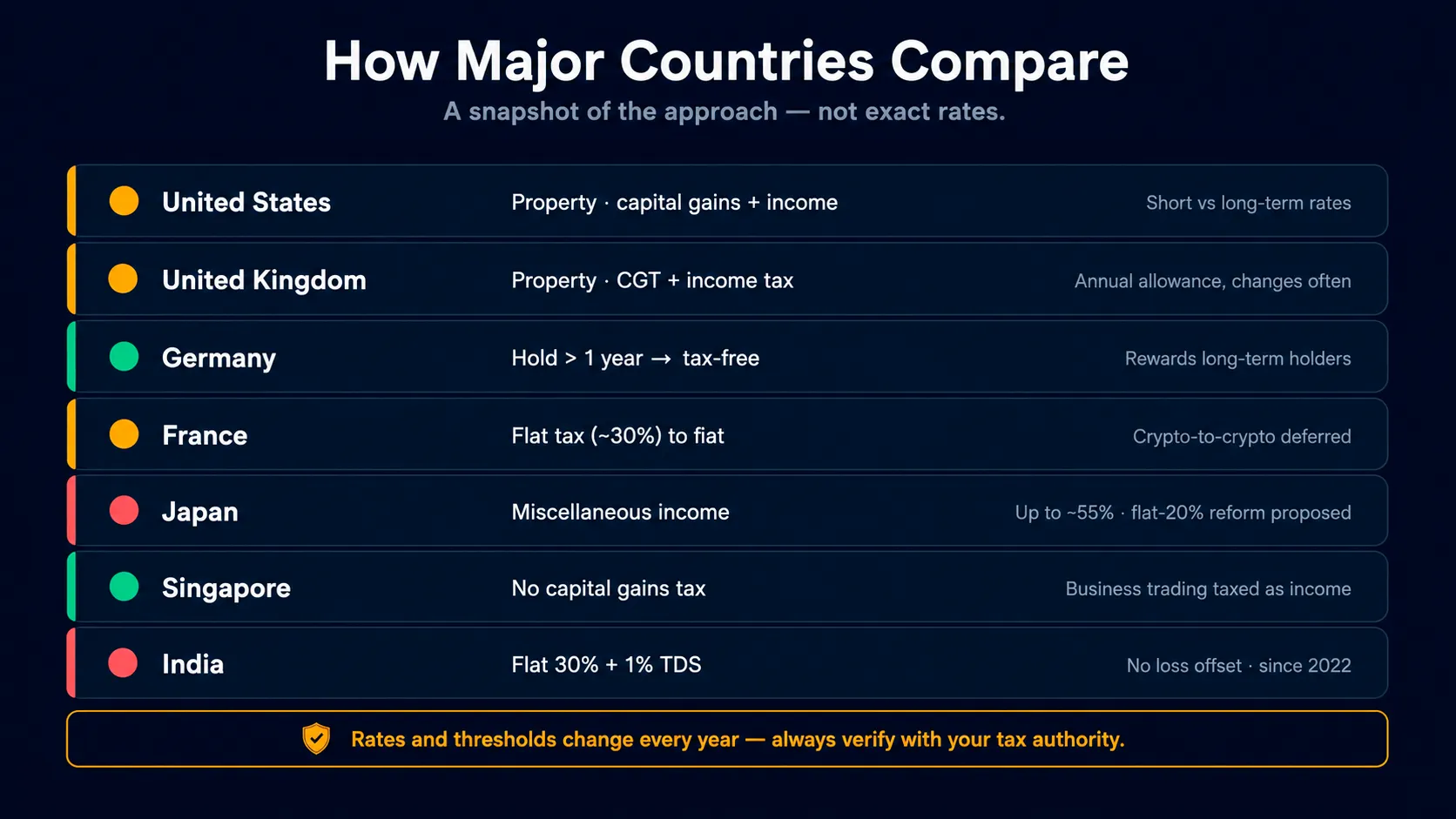
Here’s how the major jurisdictions compare at a glance. The details in each section below matter more than the labels.
The United States
The IRS treats digital assets as property, not currency. That single classification shapes everything.
- Disposals produce capital gains. Held a year or less before selling, and the gain is short-term, taxed at ordinary income rates. Held longer than a year, and it’s long-term, taxed at lower rates.
- Earned crypto is income, valued at receipt — mining, staking, airdrops, and wages paid in crypto all count.
- The digital-asset question sits on every Form 1040. You must answer it, whether or not you transacted.
The US taxes citizens and residents on worldwide income, so where you hold your coins doesn’t get you out of it. Gains are reported on Form 8949 and Schedule D; gifts can require Form 709. Rates and brackets change, so confirm the current year before filing.
The United Kingdom
HMRC also treats cryptoassets as property, not money, and sets out its position in the Cryptoassets Manual. Two taxes do the work.
- Capital Gains Tax on disposals. Selling, swapping crypto-to-crypto, spending, and gifting (except to a spouse or civil partner) all count as disposals.
- Income Tax on earned crypto, such as mining, staking, and airdrops received for a service, plus crypto paid as salary.
The UK pools acquisition costs using its Section 104 rules, and there’s an annual tax-free CGT allowance — one that’s been cut sharply in recent years, so don’t assume last year’s figure. You report through Self Assessment. Buying and holding, moving between your own wallets, and gifting to a spouse are not taxable.
The European Union (It’s Not One System)
Here’s the point most people miss: the EU has no single crypto tax. Each member state sets its own rules, and they range from generous to brutal. The MiCA regulation governs how crypto providers operate; it does not set tax rates.
Germany
Germany rewards patience. For private individuals, gains on crypto held longer than 12 months are tax-free under Section 23 of its income tax law. Sell within a year and the gain is taxed as income, with a small annual exemption below which nothing is due.
France
France applies a flat tax (the “PFU,” commonly around 30% including social contributions) on gains when you convert crypto to fiat. Crypto-to-crypto swaps generally aren’t taxed until you cash out. People trading as professionals are taxed under different, income-based rules.
And The Rest
Other members span the full range, and some don’t fit the gains model at all. The Netherlands, for instance, taxes the value of your holdings rather than your realized gains. There’s no shortcut: your bill depends entirely on your country of tax residence, so check the local rule.
Asia: The Widest Range In The World
No region varies more. Asia runs from zero-tax havens to some of the heaviest rates on Earth.
Japan
Japan currently treats crypto gains as miscellaneous income, taxed on a progressive scale that can reach roughly 55% (up to 45% national plus about 10% local inhabitant tax). That’s among the highest anywhere.
A reform to tax qualifying crypto gains at a flat rate of around 20%, aligning them with stocks, has been proposed but is not yet in effect. Treat it as a proposal until it’s actually enacted, and confirm the current law before you rely on it.
Singapore
Singapore has no capital gains tax, so long-term individual investors generally aren’t taxed on their crypto profits. But if you trade as a business or profession, those profits are taxable as income, and crypto received as payment can be income too. The Inland Revenue Authority of Singapore (IRAS) judges which applies by the nature and frequency of your activity.
India
India runs one of the strictest regimes. A flat 30% tax applies to gains from virtual digital assets, plus a 1% tax deducted at source (TDS) on transfers above set thresholds. You generally can’t offset crypto losses against other income, and only the acquisition cost is deductible. This framework has been in force since 2022.
Elsewhere In Asia
The spread is enormous. Some places impose no personal income or capital gains tax on crypto for individuals, while others have announced regimes and then repeatedly postponed them — South Korea’s much-delayed gains tax is the long-running example. Always check the current, local rule rather than a headline.
The Global Shift: Your Exchange Now Reports To The Taxman
The biggest change in crypto tax isn’t a rate. It’s visibility.
For years, crypto sat in a grey zone. Many people simply didn’t report, and authorities had limited ability to check. That era is closing fast.
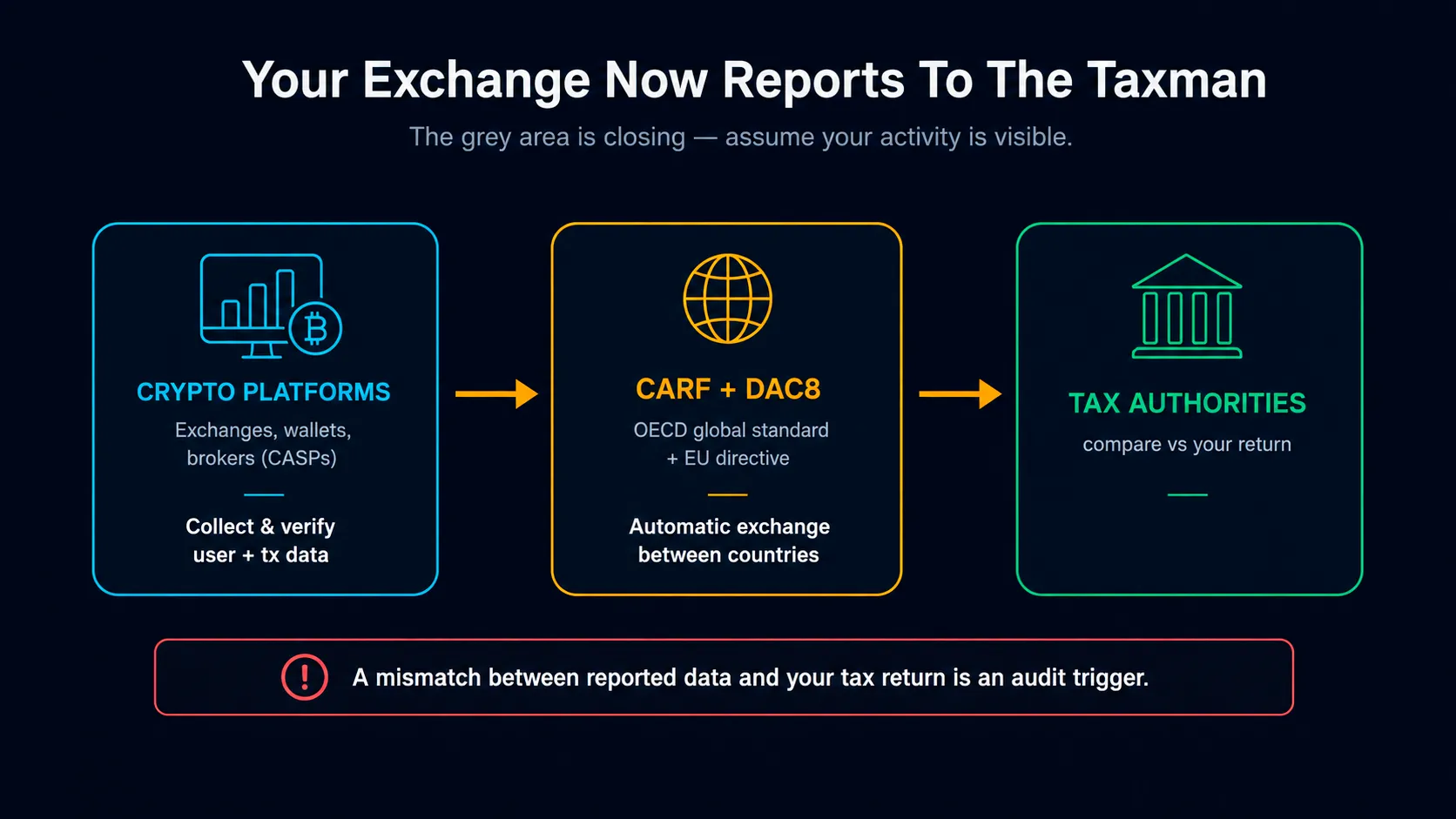
- CARF, the OECD’s Crypto-Asset Reporting Framework, is a global standard for the automatic exchange of crypto data between tax authorities. It’s built on the same machinery used for bank-account reporting, and dozens of countries have committed to it.
- In the EU, the DAC8 directive puts CARF into law. Crypto service providers collect and report user and transaction data, which authorities then exchange.
- The UK and others are rolling out the same CARF reporting rules, with providers collecting data and tax authorities exchanging it across borders.
What it means for you is simple. Exchanges report your activity to tax authorities, who can line it up against what you declared. A mismatch is an audit trigger. Assume your on-exchange history is visible.
Record-Keeping Is The Habit That Saves You
Wherever you live, you’re responsible for your own records, and reconstructing years of trades after the fact is miserable.
For every transaction, keep:
- The date and type — buy, sell, swap, spend, or earn.
- The amounts and their fiat value at the time.
- Any fees.
- The wallet addresses and the platform involved.
Crypto tax software can automate most of this by pulling your history, but you stay responsible for accuracy. The tool’s output is a draft, not your tax authority’s ruling.
Get It Right For Your Own Country
Everything above is a map, not the territory. Crypto tax is genuinely complex, the rules differ by jurisdiction and change most years, and the penalties for getting it wrong are real.
I’m not a tax advisor, and this isn’t tax advice. For anything beyond simple holdings, work with a tax professional who handles crypto in your country, and confirm the current rules directly with your official tax authority.
The one thing that’s true everywhere: crypto is taxable, your activity is increasingly visible, and good records are your best protection. Sort those out, and the country-specific details become a manageable question instead of a nasty surprise.
FAQ
- Do I Have To Pay Tax On Crypto If I Don’t Cash Out?
Often yes. In many countries, swapping one crypto for another or spending crypto counts as a disposal that can trigger capital gains tax, even without converting to fiat. Earning crypto is usually taxed as income when you receive it. Buying and simply holding is generally not taxed. - Is Moving Crypto Between My Own Wallets Taxable?
Generally no. Transferring crypto between wallets or accounts you control isn’t a disposal, so it typically isn’t a taxable event. Keep records anyway, because an undocumented transfer can look like a sale to software or a tax authority. - Which Countries Have The Lowest Crypto Taxes?
It varies and it changes. Some jurisdictions impose no personal capital gains tax on crypto, and others exempt long-term holdings — Germany’s over-one-year rule is a well-known example. Tax residence, not citizenship, usually decides which rules apply, and relocating to chase low taxes carries its own serious legal consequences. - Do Crypto Exchanges Report To Tax Authorities?
Increasingly, yes. Under frameworks like the OECD’s CARF and the EU’s DAC8, crypto service providers collect and report user and transaction data to tax authorities, who exchange it across borders. Assume your exchange activity is visible. - Are Crypto Losses Tax-Deductible?
It depends on the country. Many let you offset capital losses against capital gains, sometimes carrying losses forward to future years. Others, like India, don’t allow it at all. Check your local rules before assuming a loss lowers your bill. - How Is Staking Or Mining Income Taxed?
In most places, crypto earned from staking, mining, or airdrops is taxed as income at its market value when you receive it. If you later sell it, a separate capital gains calculation usually applies to any change in value since then. - What Happens If I Don’t Report My Crypto?
Penalties, interest, and possible investigation — and with automatic reporting rolling out, non-disclosure is far easier to catch than it used to be. If you’re behind, many tax authorities offer disclosure processes, and a crypto-aware professional can help you get compliant.