



Content
“Is crypto legal?” gets a frustrating answer: it depends where you are, and “legal” covers a lot of ground. In most of the world, owning and trading crypto is perfectly lawful. In a handful of countries, it’s banned. And between those poles sits a wide middle where crypto is legal but fenced in by rules.

The status of any single country also changes, sometimes fast. So the useful thing to understand isn’t a memorized list of nations — it’s the categories that status falls into, and why. Get those, and you can place any jurisdiction, even as the specifics shift.
This is an overview for education, not legal advice. Laws differ by country and change often, so confirm the current position with the relevant authority before you act.
“Legal” Does Not Mean “Unregulated”
Start with the biggest misconception. When crypto is “legal” somewhere, that rarely means anything goes. It means you may own and use it — while still following tax law, anti-money-laundering rules, licensing regimes, and securities law.
So a country can be entirely crypto-legal and still require you to:
- Pay tax on gains and income from crypto.
- Verify your identity (KYC) on regulated exchanges.
- Use only licensed service providers.
- Treat some tokens as securities, with all the rules that brings.
“Legal but regulated” is the normal state of affairs, not a contradiction. Keep that in mind, because most of the debate people imagine is about “legal vs illegal” is really about how crypto is regulated.
The Four Broad Categories Of Legal Status
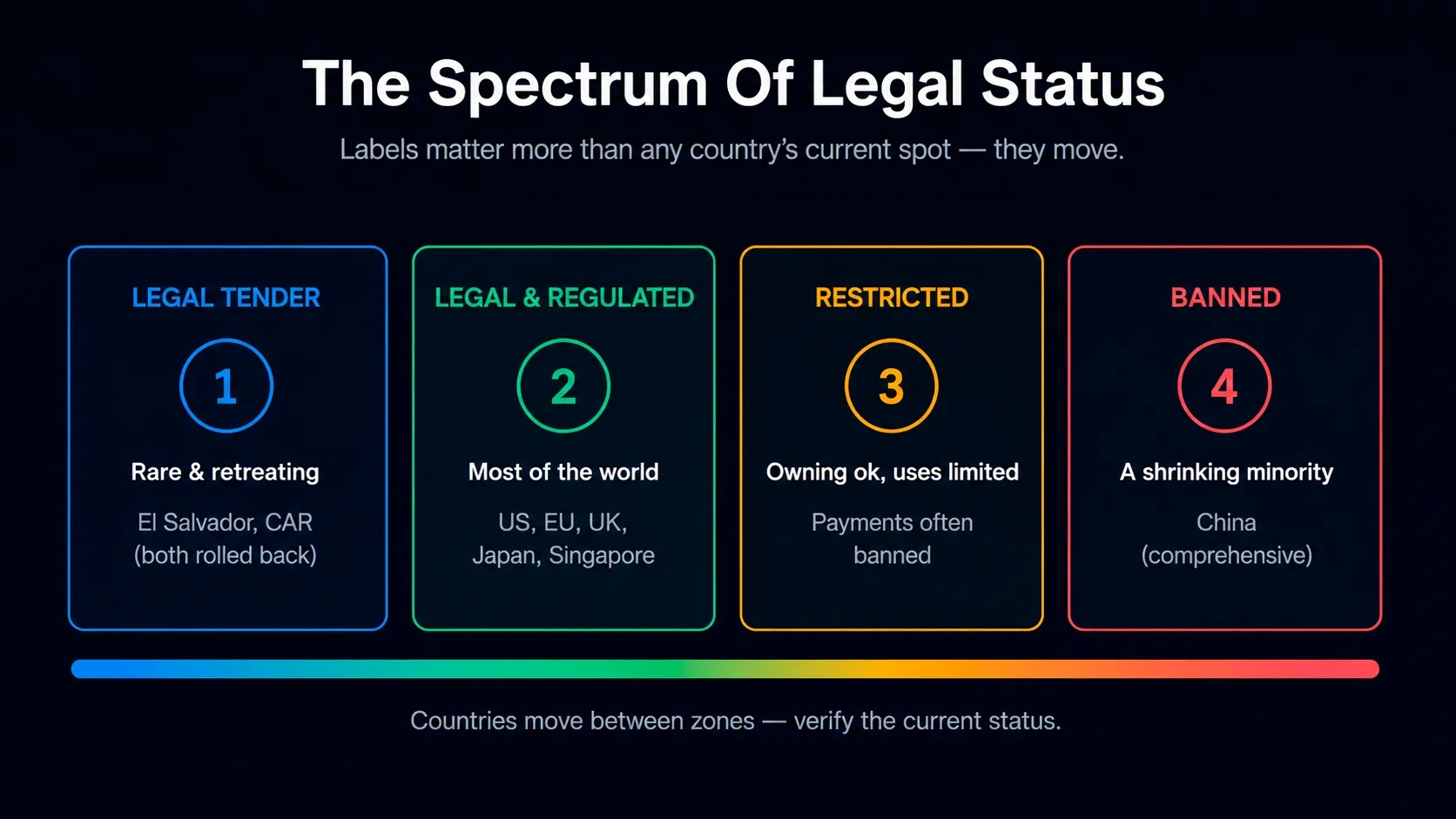
Nearly every jurisdiction fits somewhere on a spectrum with four main zones. The labels matter more than any country’s current spot, because countries move between them.
- Legal and regulated — you can own, trade, and use crypto under a defined rulebook. This is where most of the world sits.
- Legal but restricted — ownership is allowed, but specific uses (often payments, or bank access) are limited.
- Banned or prohibited — some or all crypto activity is outlawed.
- Legal tender — the rarest status, where a crypto is official money. It’s more experiment than trend, and it has been retreating.
Legal And Regulated: Where Most Of The World Sits
In most major economies, crypto is legal and governed by a growing rulebook. You can buy, hold, trade, and usually spend it, as long as you follow the rules around it.
- The United States treats crypto as property for tax, with the SEC, CFTC, and FinCEN sharing oversight — and an unsettled debate over which tokens are securities.
- The European Union runs a single, comprehensive regime through MiCA, licensing service providers across all member states.
- The United Kingdom requires crypto firms to register with the Financial Conduct Authority and meet its rules for cryptoasset businesses.
- Japan, Canada, Australia, Switzerland, and Singapore all run licensed, regulated markets with their own supervisors.
The common thread: crypto is a legitimate asset, taxed and supervised, with licensed exchanges and identity checks. This category has been growing as more countries publish formal frameworks.
Legal But Restricted: The Middle Zone
Some countries let you own and trade crypto but wall off certain uses. The most common restriction bans crypto as a means of payment while still allowing it as an investment.
Others limit how banks can deal with crypto businesses, cap what exchanges may offer, or permit holding while discouraging everything else. This middle zone is common in places that want to control risk without an outright ban, and a country can sit here for years before moving toward fuller regulation.
Banned Or Prohibited: The Small Minority
A small number of countries prohibit some or all crypto activity — trading, running exchanges, mining, or letting banks touch it.
China is the clearest and most consequential example. It has moved to comprehensively restrict crypto, targeting exchanges, mining, and financial-institution involvement. Other countries have imposed bans of varying severity at different times, often citing capital flight, monetary control, financial stability, or money-laundering concerns.
Two honest caveats belong here:
- The list shifts. Countries add, lift, and soften bans regularly, and sources often disagree on any given nation’s current status. Treat any specific roster as a snapshot and verify it.
- Bans rarely mean zero activity. Peer-to-peer trading and underground use tend to persist even where crypto is outlawed. A ban changes your legal exposure, not the network’s existence.
Legal Tender: Rare, And Retreating
The rarest status is crypto as legal tender — official money a country recognizes for payments.
This is where reality has diverged sharply from the hype. El Salvador made Bitcoin legal tender in 2021, and the Central African Republic followed in 2022. But both rolled it back. The Central African Republic repealed its law in 2023, and El Salvador wound its policy back under a 2025 IMF agreement, making acceptance voluntary rather than mandatory and stripping out the core of what legal-tender status had meant.
So the honest read is that legal tender for a decentralized crypto is an experiment that has retreated, not a model that’s spreading. Don’t confuse it with central bank digital currencies (CBDCs) — those are state-issued digital money, not decentralized crypto, and they’re a separate topic entirely.
Why The Same Coin Is Treated So Differently
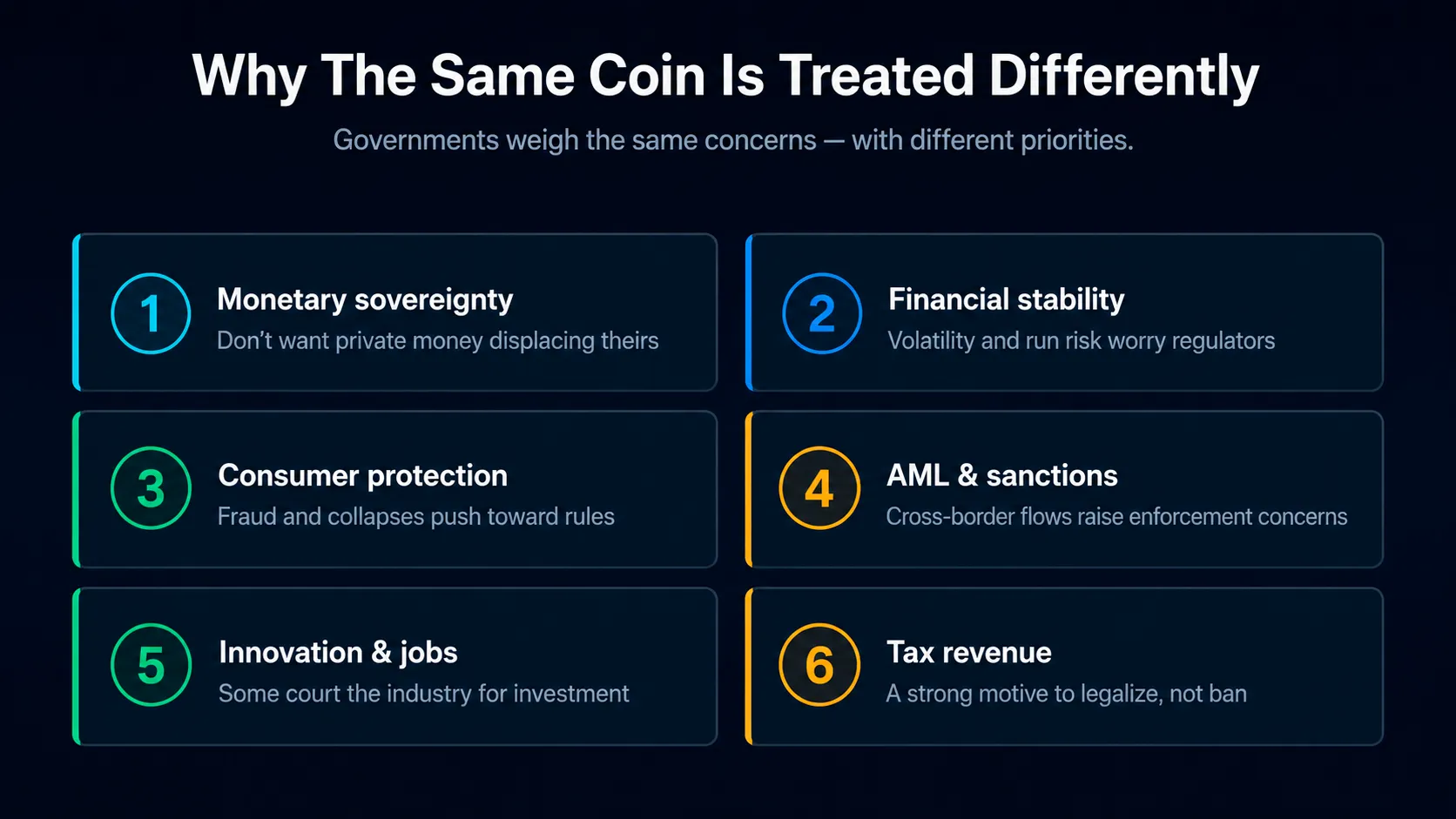
If crypto is the same technology everywhere, why do governments land in such different places? Because they’re weighing the same handful of concerns with different priorities.
- Monetary sovereignty. Governments don’t want a foreign or private currency displacing the one they control.
- Financial stability. Volatility and run risk worry regulators, especially in fragile economies.
- Consumer protection. Fraud, scams, and collapses push governments toward rules or bans.
- Anti-money-laundering and sanctions. Crypto’s cross-border nature raises real enforcement concerns.
- Innovation and competitiveness. Some governments court the industry for jobs and investment.
- Tax revenue. Bringing crypto into the tax net is a strong motive to legalize and regulate rather than ban.
How a country ranks these explains its stance. A financial hub chasing investment regulates to attract business. A country fighting capital flight restricts or bans. Same asset, different math.
How A Country Classifies Crypto Shapes Its Legal Status
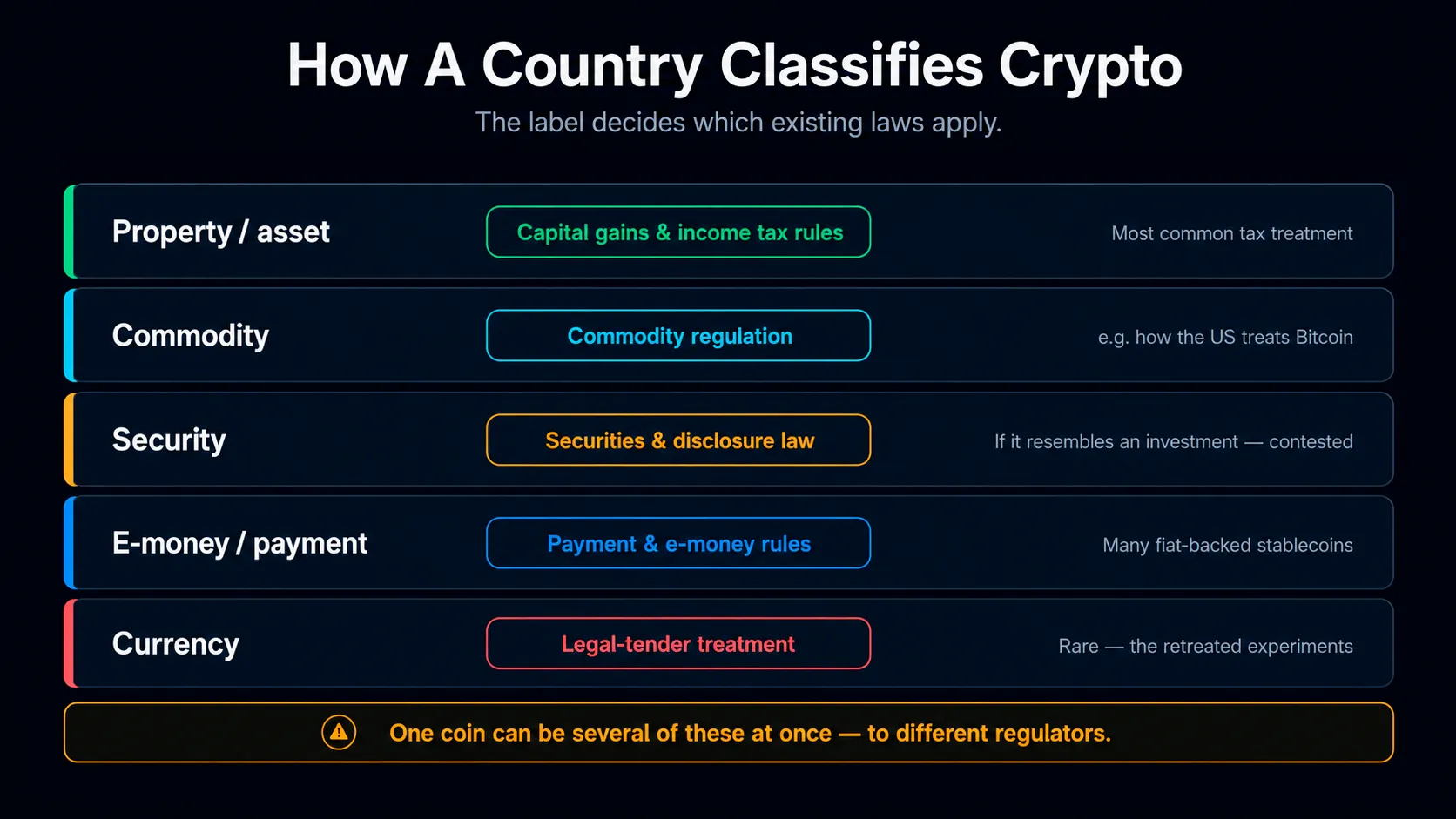
A quiet but important detail: the label a country puts on crypto decides which existing laws apply to it. There’s no global agreement, so the same token can be several different things depending on the border.
- Property or an asset — the most common tax treatment, triggering capital gains and income rules.
- A commodity — regulated like other commodities, an approach the US applies to assets like Bitcoin.
- A security — if a token looks like an investment contract, securities laws and their disclosure rules kick in. Whether a given token is a security is genuinely contested, and it’s the heart of long-running US legal fights.
- Electronic money or a payment instrument — how many stablecoin frameworks treat fiat-backed coins.
- Currency — rare, and mostly limited to the legal-tender experiments above.
A single coin can be a commodity to one regulator, a security to another, and property to the tax office — all at once. That’s not a mistake; it’s what happens when new technology meets old legal categories.
The Global Direction: Regulation, Not Prohibition
Step back from individual countries and the trend is consistent. Most of the world is moving toward regulating crypto rather than banning it.
The evidence is everywhere: the EU’s MiCA framework, national licensing regimes, dedicated stablecoin laws, and global standards from the FATF that pull exchanges into the same anti-money-laundering net as banks. Even the EU’s anti-money-laundering rules now reach crypto directly. Tax authorities are building automatic reporting for crypto across borders, and some countries that once leaned toward bans are drafting frameworks instead.
The arc bends toward “legal and regulated.” The hard-ban minority is shrinking, the legal-tender experiment has cooled, and the real action is in the details of how crypto gets regulated — not whether it’s allowed at all.
What This Means For You
The practical takeaways are simpler than the map.
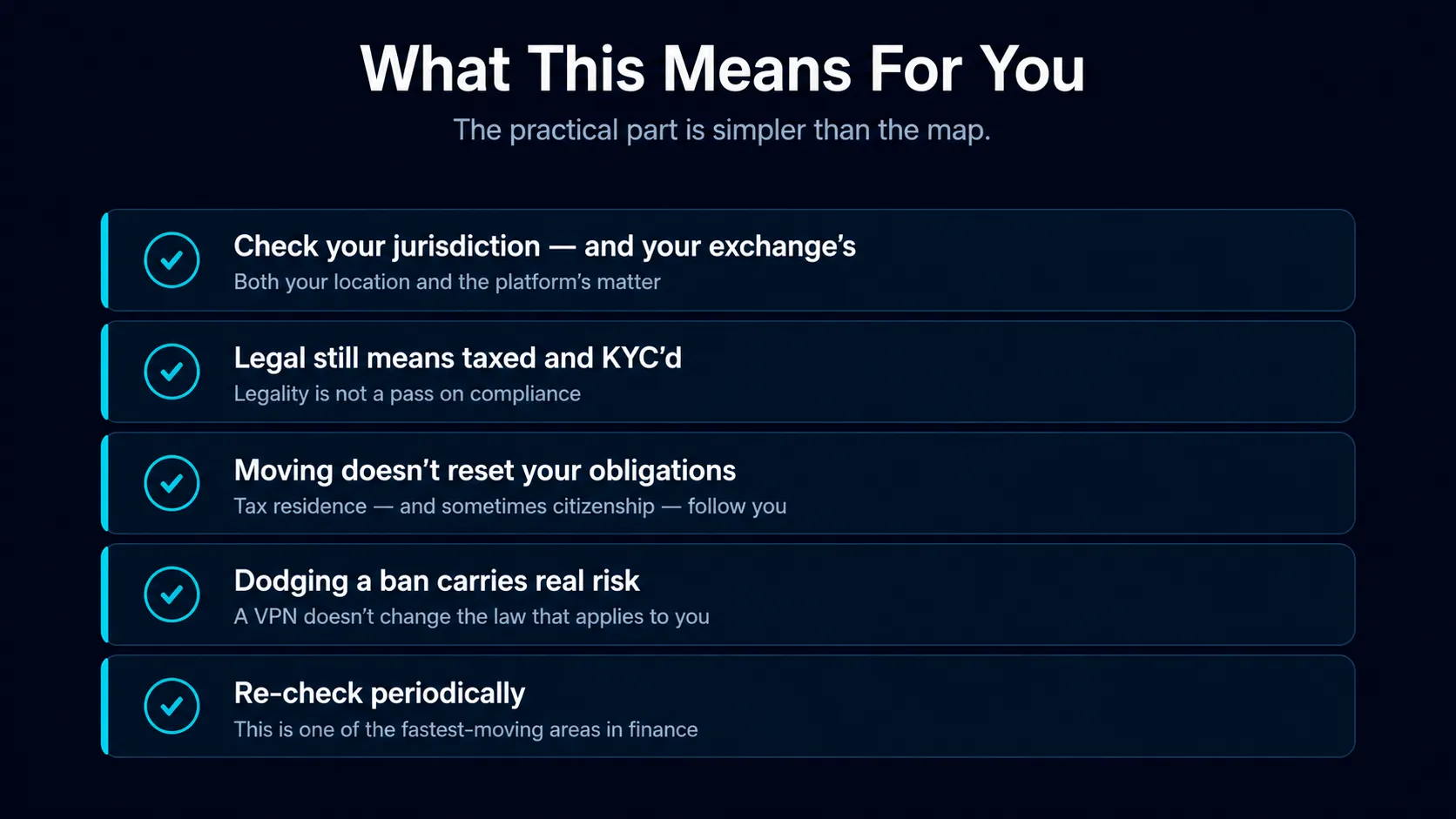
- Check your own jurisdiction, and your exchange’s. Your rights and obligations depend on where you live and where the platform operates. Both matter.
- Legal still means taxed and monitored. In most places you owe tax and complete KYC. Legality is not a pass on compliance.
- Moving or traveling doesn’t reset your obligations. Tax residence rules, and in some cases citizenship, follow you. Relocating to chase friendlier rules is a serious decision with its own consequences.
- Dodging a ban carries real risk. Using a VPN or offshore platform to get around your country’s restrictions can expose you to legal trouble, whatever the network allows technically.
- Re-check periodically. This is one of the fastest-moving areas in all of finance. Last year’s status may not be this year’s.
Crypto’s legality isn’t one answer, and it isn’t frozen. But the shape is stable enough to rely on: legal and regulated almost everywhere, restricted in a middle band, banned in a shrinking few, and a rare, receding experiment with legal tender. Place your jurisdiction on that spectrum, confirm the current details, and you know where you stand.
FAQ
- Is Cryptocurrency Legal?
In most countries, yes — owning and trading crypto is lawful, though subject to tax, anti-money-laundering rules, and licensing. A small minority ban some or all crypto activity, and the exact list changes, so check your own jurisdiction. - Which Countries Have Banned Cryptocurrency?
Only a handful maintain outright bans, with China the most prominent, having comprehensively restricted exchanges, mining, and financial-institution involvement. Several other countries have imposed bans of varying severity over time, but the roster shifts and sources disagree, so verify a specific country’s current status. - Is Bitcoin Legal Tender Anywhere?
Barely, and less than headlines suggest. El Salvador adopted Bitcoin as legal tender in 2021 and the Central African Republic in 2022, but both rolled it back — the CAR repealed its law in 2023, and El Salvador wound its policy back under a 2025 IMF agreement, making acceptance voluntary. - Does “Legal” Mean Crypto Is Unregulated?
No — usually the opposite. Where crypto is legal, it’s typically taxed, subject to KYC and anti-money-laundering rules, and offered through licensed providers. Legality is about being allowed, not about being free of rules. - Why Do Countries Treat Crypto So Differently?
Because they weigh the same concerns differently: monetary sovereignty, financial stability, consumer protection, money-laundering risk, innovation, and tax revenue. A hub chasing investment regulates to attract it; a country fighting capital flight may restrict or ban. - Is Crypto A Security Or A Commodity?
It depends on the token and the jurisdiction, and it’s genuinely contested. Some assets are treated as commodities, others may be securities if they resemble investment contracts, and most tax systems treat crypto as property — sometimes all at once across different regulators. - Can I Get Around A Ban With A VPN?
Technically the network can’t stop you, but legally it’s risky. Circumventing your country’s restrictions through a VPN or offshore platform can carry real legal consequences, and it doesn’t change the law that applies to you.