


Content
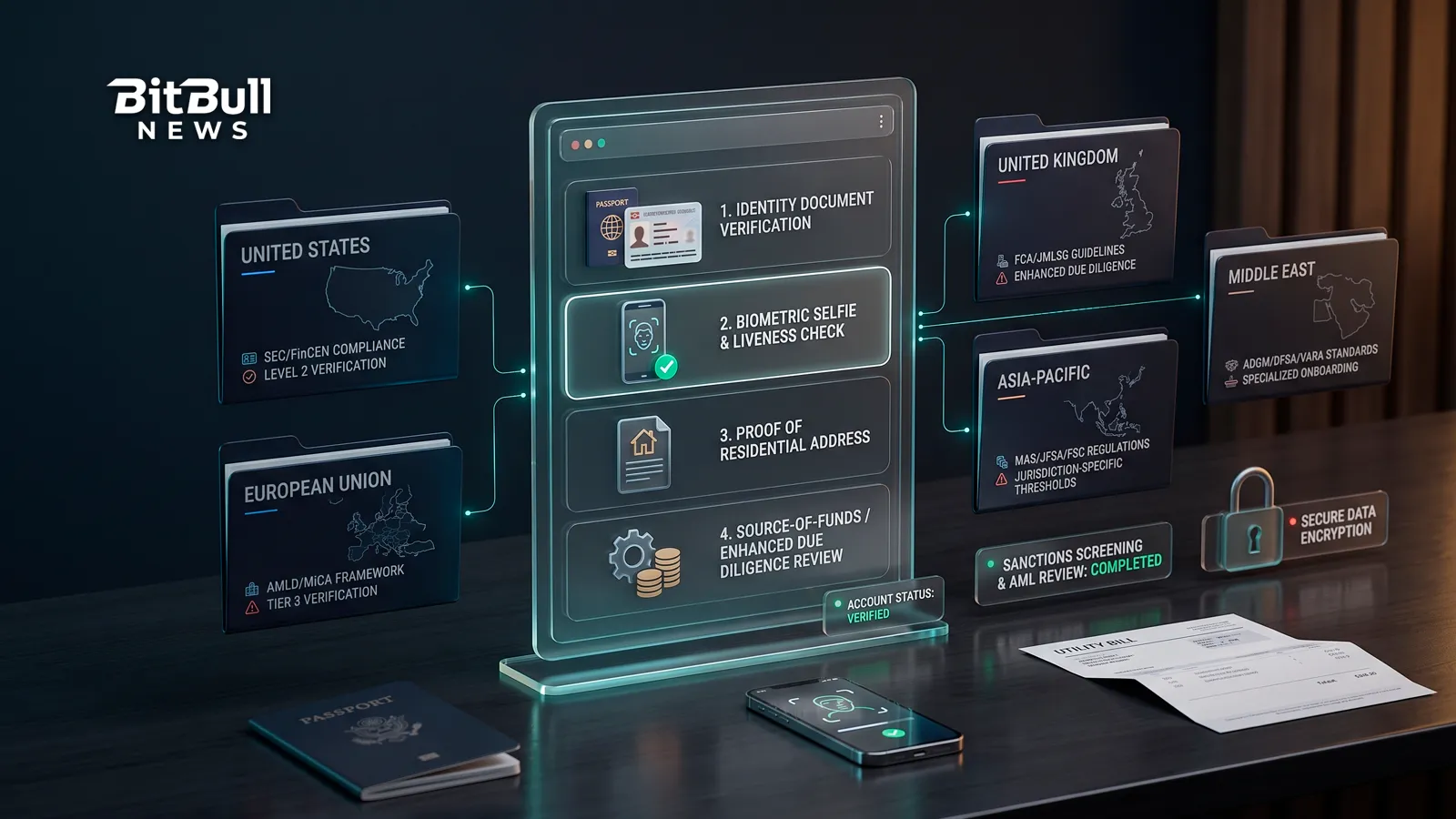
Open an account on almost any mainstream crypto exchange and you’ll hit the same wall: upload your ID, take a selfie, prove where you live. It can feel at odds with crypto’s whole “be your own bank” pitch. But there’s a clear logic to it, and knowing how it works saves you frustration and protects your money.

KYC — Know Your Customer — is how regulated exchanges verify who you are before letting you trade. It isn’t a quirk of one platform. It’s a global standard, enforced by law in most major markets, and it’s only getting stricter. Here’s what’s actually required, why, and how it differs around the world.
What KYC Is And Why Exchanges Require It
KYC is the process a business uses to confirm you are who you say you are. In crypto, it’s the identity-verification part of a bigger anti-money-laundering (AML) framework that regulated exchanges must run by law.
The reasons aren’t mysterious.
- The law requires it. Exchanges that touch fiat and serve the public are treated like financial institutions in most countries, and financial institutions must verify their customers.
- It blocks crime. KYC makes it far harder to use exchanges for money laundering, terrorist financing, fraud, and sanctions evasion.
- It’s the price of a banking relationship. Exchanges need banks and payment partners, and those partners demand solid AML controls.
An exchange that skips KYC isn’t giving you a favor. It’s usually either unregulated, operating illegally in the markets it serves, or both — and that’s a risk to your funds, not a feature.
The Global Rulebook: FATF And The Travel Rule
Almost every national crypto rule traces back to one body: the Financial Action Task Force (FATF), the international standard-setter for anti-money-laundering. Countries adopt FATF’s recommendations into their own laws, which is why the requirements rhyme worldwide.
Two FATF standards shape crypto directly:
- Recommendation 15 extends full AML obligations to “virtual asset service providers” (VASPs) — exchanges, custodial wallets, and similar businesses — treating them like traditional financial institutions.
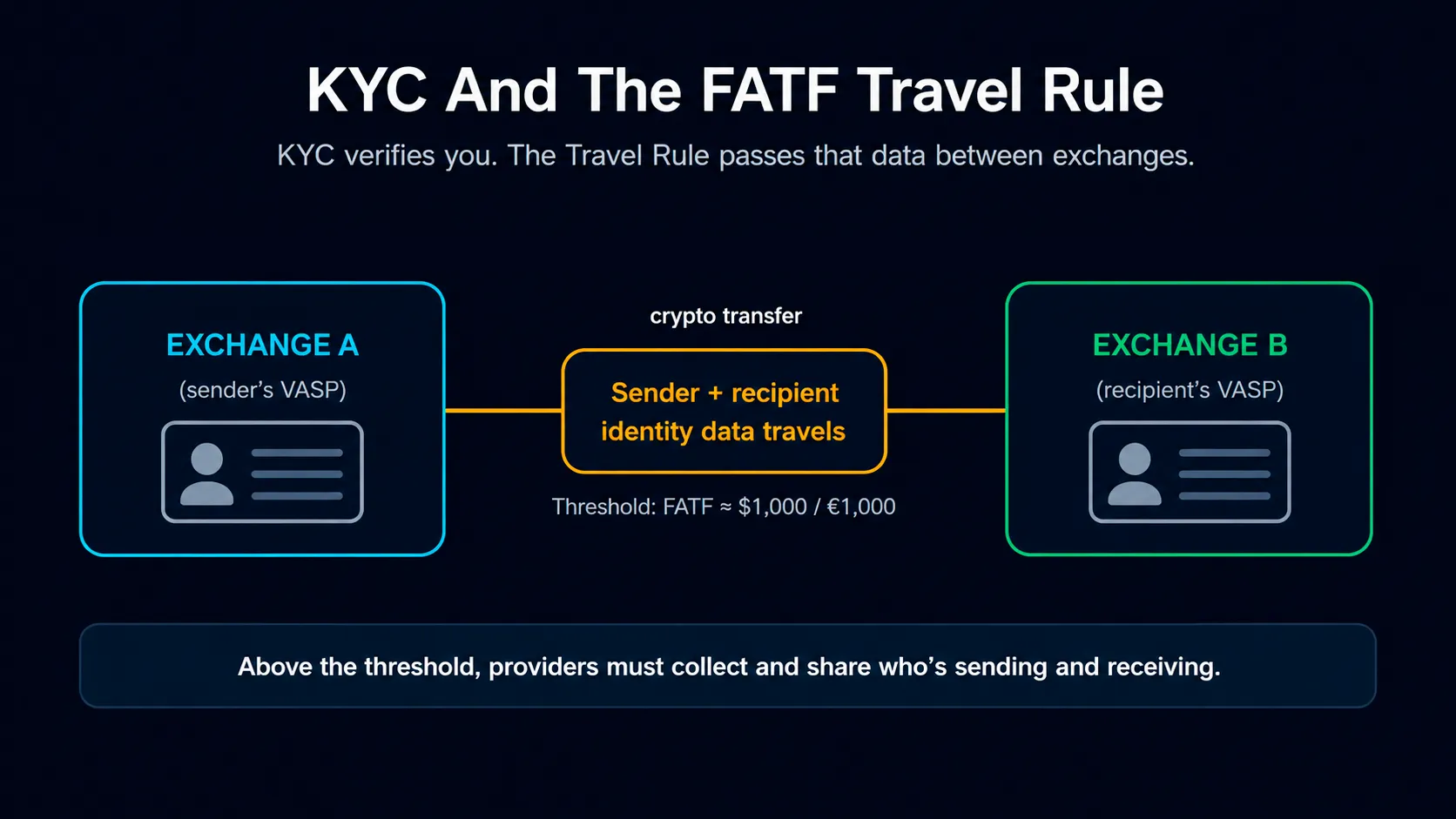
- Recommendation 16, the “Travel Rule,” requires that when crypto moves between providers, identifying information about the sender and recipient travels with it.
The Travel Rule is the one you feel most. FATF recommends applying it to transfers at or above a threshold of USD/EUR 1,000, though jurisdictions set their own numbers. Below the threshold, lighter checks apply; above it, providers must collect and share originator and beneficiary details. FATF revised Recommendation 16 in 2025 to tighten and standardize these data requirements, with countries phasing in the changes over several years.
A key point: KYC and the Travel Rule work together. KYC is how an exchange verifies you. The Travel Rule is how exchanges pass that verified information to each other when your crypto moves between them.
What You’ll Actually Be Asked For
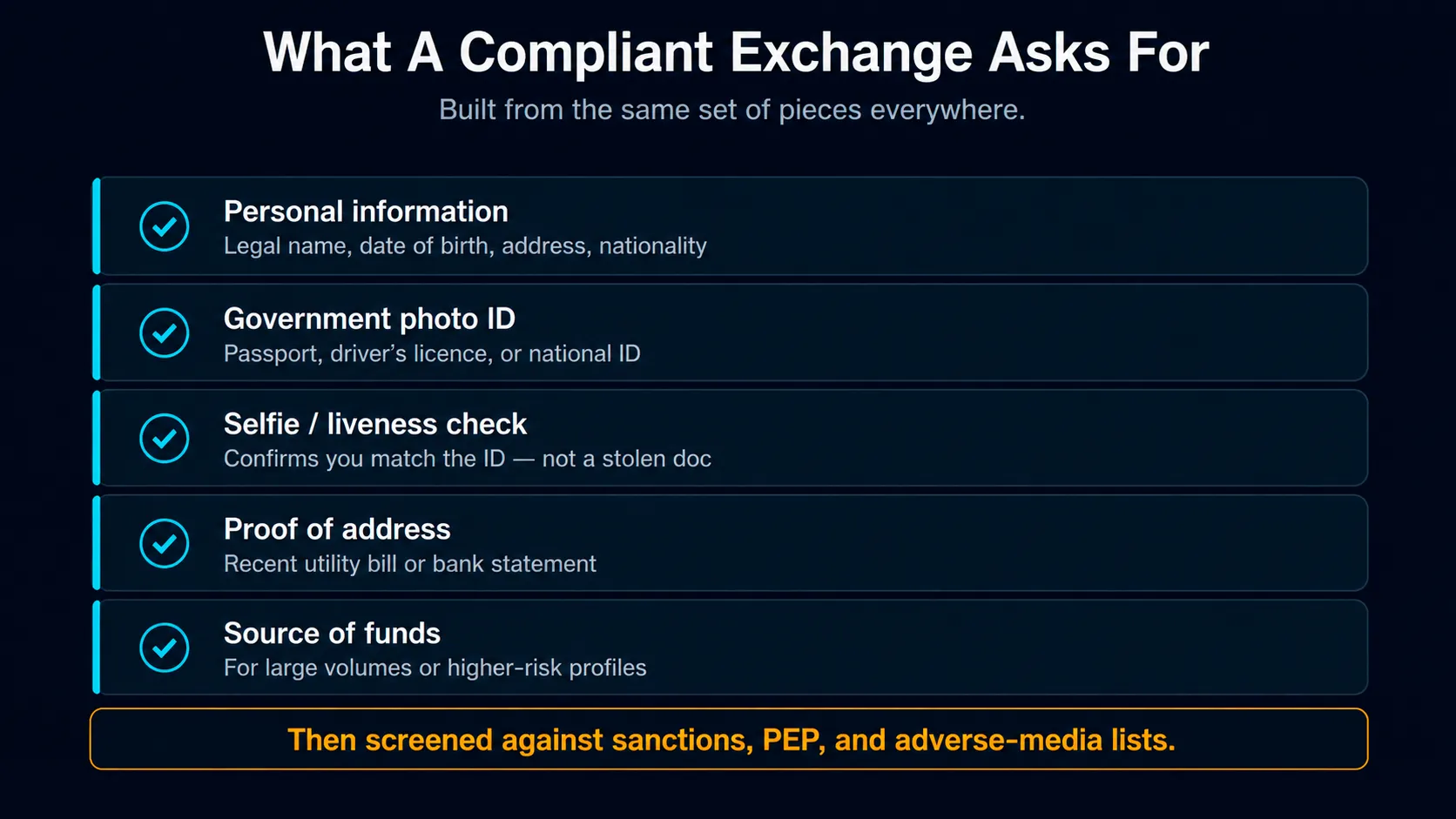
The specifics vary, but a compliant exchange builds your verification from the same set of pieces.
- Personal information. Full legal name, date of birth, nationality, and residential address.
- A government-issued photo ID. A passport, driver’s license, or national ID card, usually checked automatically for authenticity.
- A selfie or liveness check. A photo or short video scan to confirm you match the ID and aren’t using a stolen document.
- Proof of address. Often a recent utility bill or bank statement, typically for higher tiers or larger amounts.
- Source of funds or wealth. For large volumes or higher-risk profiles, documentation of where your money comes from.
Behind the scenes, the exchange screens your details against sanctions lists (like OFAC, UN, and EU lists), politically exposed person (PEP) databases, and adverse-media checks. Being a PEP isn’t illegal, but it flags you for closer scrutiny. Modern systems run most of this in seconds with automated document reading and face-matching, though flagged cases go to human review.
Verification Tiers: Why Access Comes In Levels
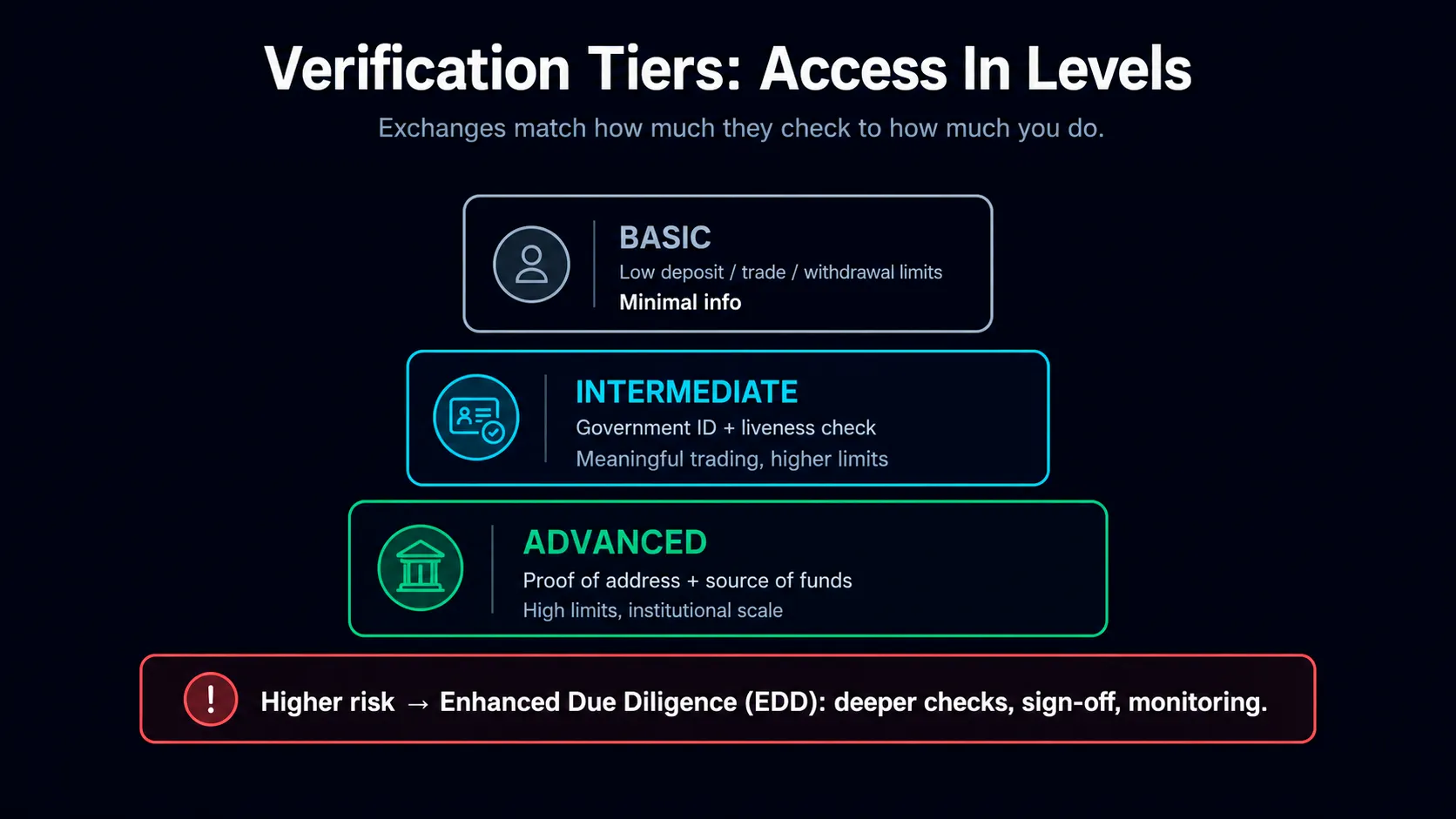
Most exchanges don’t verify everyone to the same depth. They use tiered verification, matching how much they check to how much you do. It’s built on a risk-based approach, the core idea running through all of this.
- Basic tier. Minimal information, with low limits on deposits, trading, or withdrawals. Some exchanges use this for very small activity.
- Intermediate tier. A verified government ID and usually a liveness check, unlocking meaningful trading and higher limits. This covers most users.
- Advanced tier. Proof of address and sometimes source-of-funds documents, for high limits or institutional-scale activity.
Higher risk pulls in Enhanced Due Diligence (EDD) — deeper checks reserved for large transactions, high-risk locations, or PEPs. That can mean extra documents, source-of-funds verification, senior-management sign-off, and closer ongoing monitoring.
The Verification Process, Step By Step
From your side, onboarding usually runs like this.
- Create the account and enter your basic personal details.
- Upload your ID, which the system reads and checks for tampering.
- Complete a liveness check — a selfie or short video that’s matched to your ID.
- Get screened automatically against sanctions, PEP, and watchlists.
- Receive a risk score that decides whether you’re approved instantly or sent for review.
- Get verified — often within minutes, though complex cases take longer.
It doesn’t stop at onboarding. Exchanges run ongoing monitoring, watching transactions for suspicious patterns and refreshing your information when your circumstances or risk profile change.
How The Rules Differ Around The World
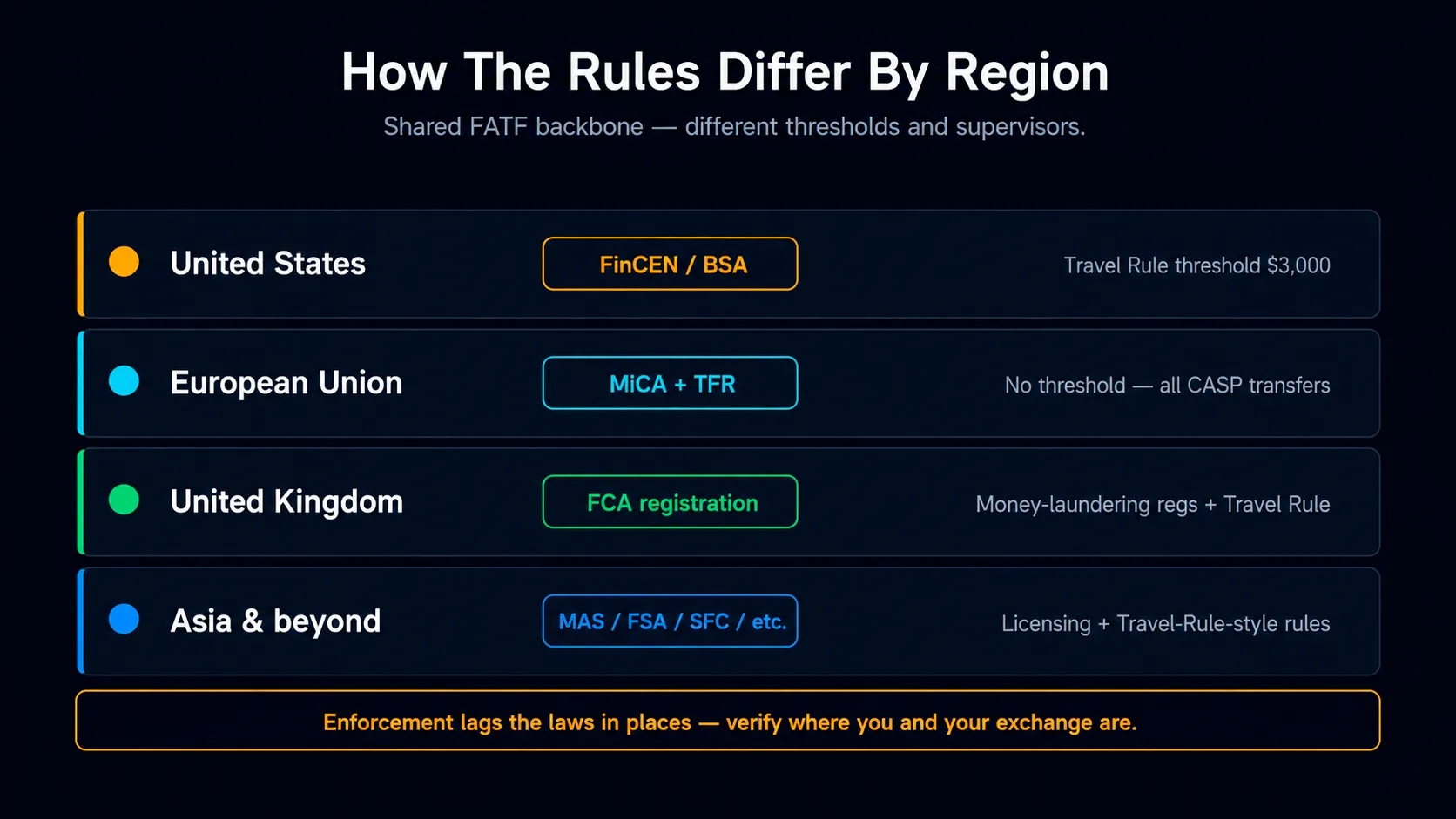
The FATF backbone is shared, but each region bolts its own regime on top. The direction is the same everywhere — more coverage, stricter enforcement — while the details differ.
United States
Crypto exchanges register with FinCEN as money services businesses and follow the Bank Secrecy Act’s AML and KYC rules. The US applies a Travel Rule threshold of $3,000 for transmitting transfer information, higher than FATF’s baseline. State-level money-transmitter licensing adds another layer.
European Union
The EU runs one of the most unified regimes. MiCA licenses crypto-asset service providers across the bloc, and the Transfer of Funds Regulation implements the Travel Rule — notably with no minimum threshold, so identifying information must accompany transfers between providers regardless of size. EU-wide AML rules sit on top.
United Kingdom
Crypto firms register with the Financial Conduct Authority and must meet the UK’s money-laundering regulations, including the Travel Rule. The FCA has taken a demanding stance on registration.
Asia And Beyond
Approaches vary widely. Singapore (under the Monetary Authority of Singapore), Japan, Hong Kong, and South Korea all license exchanges and enforce Travel Rule–style rules, each with its own thresholds and licensing bars. Some jurisdictions restrict or ban exchange activity outright. The through-line is that major financial centers now expect full KYC and AML from any exchange serving their residents.
The uneven part is enforcement. Many countries have passed Travel Rule laws but haven’t fully built the supervision behind them — a gap sometimes called the “sunrise issue,” where rules switch on at different times in different places. So confirm the current position where you and your exchange are located rather than assuming a single global standard.
What KYC Means For You As A User
A few practical takeaways matter more than the regulatory detail.
- Expect it on any reputable exchange. The vast majority of regulated platforms require KYC before you can trade or withdraw. Treat its total absence as a warning sign, not a perk.
- Your data is sensitive — check how it’s handled. You’re handing over your ID and selfie. Favor established exchanges with strong security, encryption, and a clear privacy policy, since these become breach targets.
- Verify before you fund. Complete KYC before depositing serious money, so you’re not stuck unable to withdraw because verification stalls.
- Withdrawals can trigger extra checks. Large or unusual withdrawals may prompt additional verification. That’s normal compliance, not necessarily a problem with your account.
- Self-custody is the KYC-free alternative — with trade-offs. Buying peer-to-peer or holding in your own wallet avoids exchange KYC, but you take on full responsibility for security, and moving funds to and from regulated venues still meets KYC at the on-ramp.
Privacy, Criticism, And The Direction Of Travel
KYC is not without real tension. It collects sensitive data that can be breached, it sits awkwardly against crypto’s privacy ethos, and it can exclude people who lack standard documentation. Those criticisms are legitimate, and the honest position is that KYC trades some privacy for access to the regulated financial system.
Where it’s heading is clear enough. Coverage keeps expanding — toward more transaction types, tighter Travel Rule data, and pressure to extend identity checks into parts of DeFi. Reusable and cryptographic identity approaches may eventually reduce how often you hand over raw documents, but that’s still developing.
For now, the reality is simple: if you use regulated exchanges, you’ll do KYC. Choose platforms that handle your data seriously, finish verification before you rely on an account, and treat any mainstream exchange offering “no KYC, no limits” as a reason for caution rather than celebration.
FAQ
- Why Do Crypto Exchanges Need My ID?
Because regulated exchanges are treated like financial institutions and must verify customers under anti-money-laundering law. KYC helps block money laundering, fraud, and sanctions evasion, and it’s required for exchanges to keep banking and payment relationships. - Can I Use A Crypto Exchange Without KYC?
On most regulated, mainstream exchanges, no — verification is required before trading or withdrawing. Some platforms advertise no-KYC access, but they’re often unregulated or operating illegally in the markets they serve, which puts your funds at greater risk. - What Is The FATF Travel Rule?
It’s a global anti-money-laundering standard (FATF Recommendation 16) requiring exchanges to share sender and recipient information when crypto moves between providers above a threshold, which FATF suggests at around USD/EUR 1,000. It works alongside KYC, which verifies your identity in the first place. - What Documents Do I Need To Verify A Crypto Account?
Usually a government-issued photo ID (passport, driver’s license, or national ID), a selfie or liveness check, and your basic personal details. Higher tiers or larger amounts often add proof of address and sometimes source-of-funds documentation. - How Long Does Crypto KYC Verification Take?
Often just minutes, since exchanges automate document reading, face-matching, and screening. Cases flagged for manual review — mismatched documents, higher-risk profiles, or enhanced due diligence — can take considerably longer. - Is My KYC Data Safe With An Exchange?
It depends entirely on the exchange’s security. Your ID and selfie are sensitive and make exchanges a breach target, so favor established platforms with strong encryption, good security history, and a clear privacy policy — and be cautious with unknown ones. - Does KYC Apply To Self-Custody Wallets?
Setting up your own non-custodial wallet doesn’t require KYC, because no company is verifying you. But the moment you move funds to or from a regulated exchange, KYC and Travel Rule checks apply at that on-ramp or off-ramp.