


Content
The exchange you pick holds your money. That’s the whole point to keep in mind, because when you leave crypto on a platform, you’re trusting a company to still be solvent, honest, and standing when you want to withdraw. FTX taught that lesson at a cost of billions.

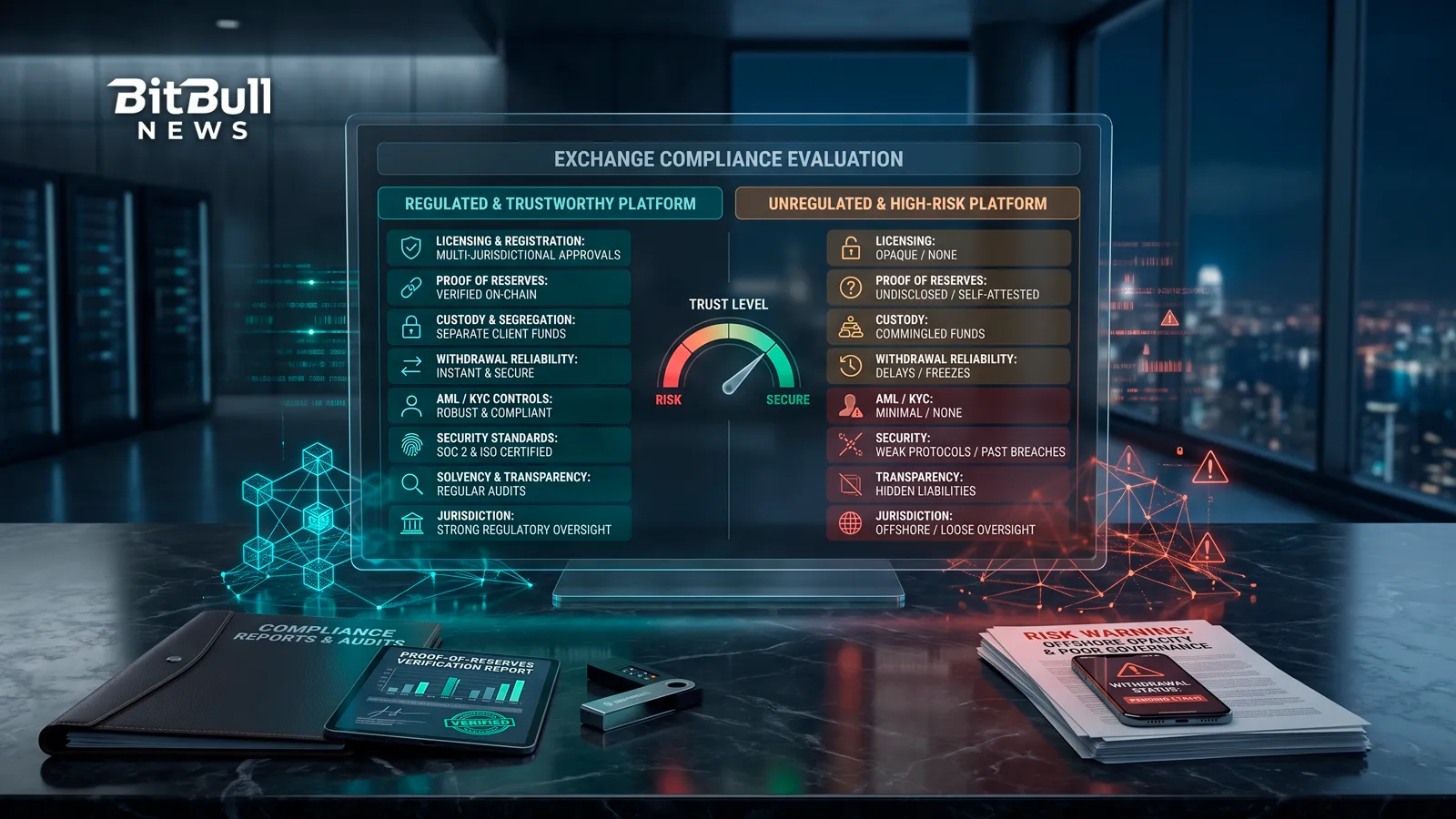
A compliant, well-run exchange isn’t just a legal box-tick. It’s the difference between a platform that safeguards your funds and one that gambles with them behind a slick interface. This guide gives you a practical checklist for telling them apart — what to verify, what to look for, and the red flags that should send you elsewhere.
Why Compliance Is Really About Safety
“Compliant” can sound like bureaucratic box-ticking. It isn’t. The rules an exchange follows are the same ones that protect your money, so compliance is a rough proxy for how seriously a platform treats your funds.
A regulated exchange generally has to hold licenses, keep customer assets separated from its own, run anti-money-laundering checks, and answer to a supervisor. An unregulated one answers to no one — which is exactly the setup that lets a company quietly lend out or spend the funds you thought were sitting safely in your account.
You’re not choosing a compliant exchange to please regulators. You’re doing it because the controls that make a platform compliant are the same controls that make it safe.
Check Licensing And Registration First
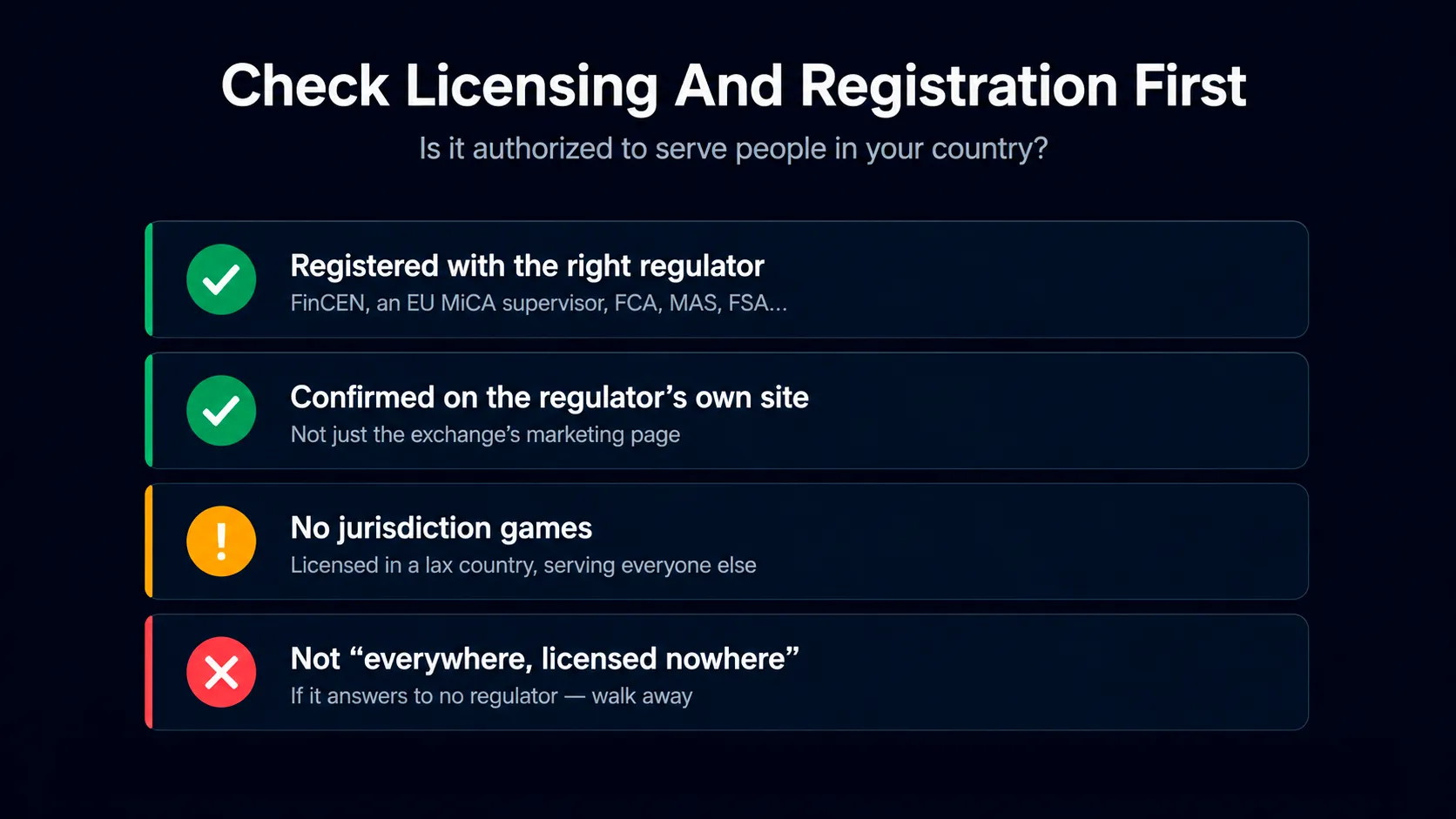
The first question for any exchange: is it authorized to serve people in your country? A platform operating legally under a real regulator has far more to lose from mistreating you than an offshore site with no oversight.
- Look for registration with the right authority. Depending on where you are, that might be FinCEN and state regulators in the US, a national regulator implementing the EU’s MiCA regime, the Financial Conduct Authority’s cryptoasset firm register in the UK, or bodies like MAS, the FSA, or the SFC across Asia.
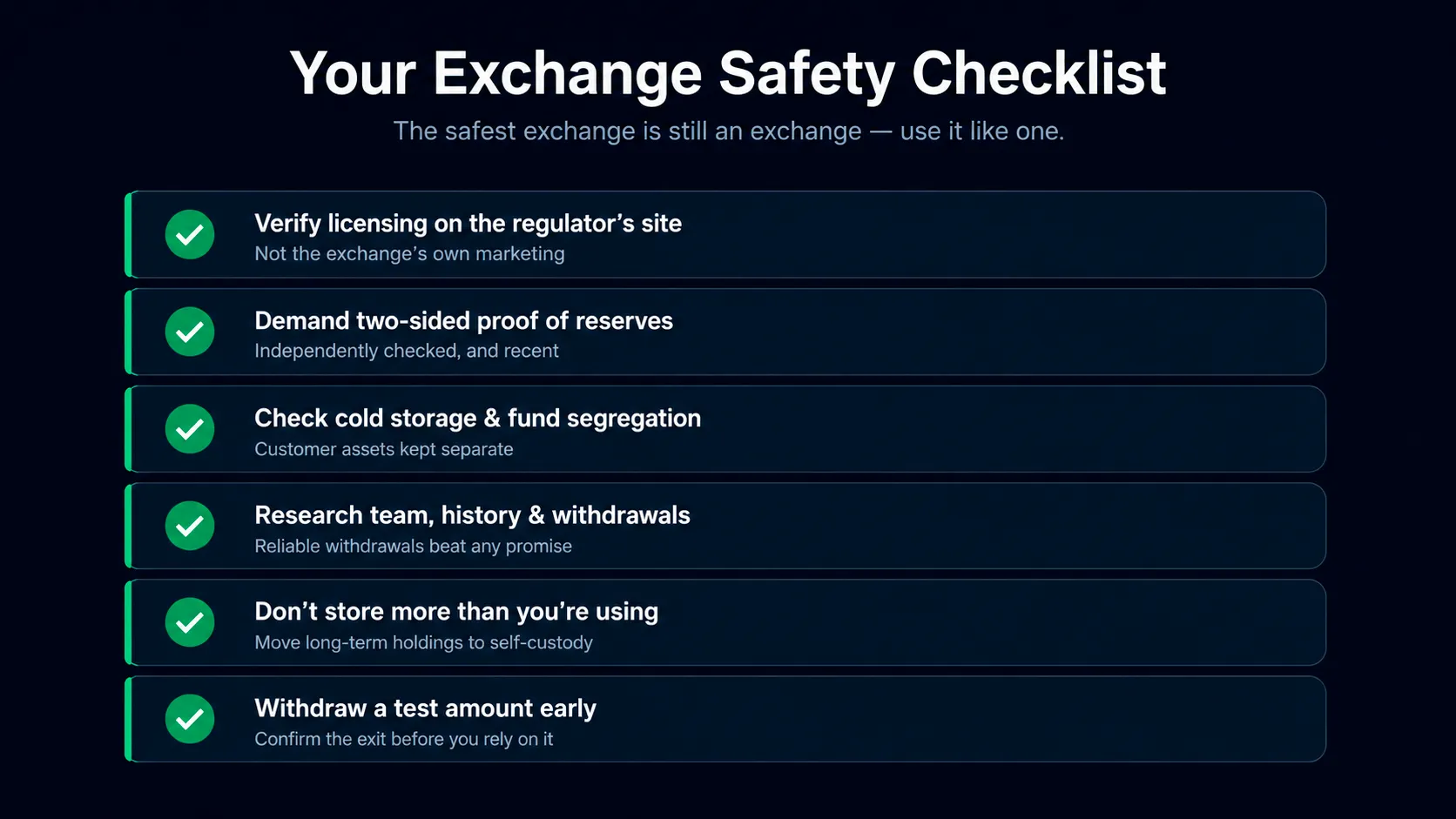
- Confirm it on the regulator’s own site, not just the exchange’s marketing. Reputable regulators publish searchable registers of authorized firms.
- Watch for jurisdiction games. Some platforms are licensed in a lax jurisdiction while serving customers everywhere else, which offers you little real protection.
- Be wary of “available everywhere, licensed nowhere.” If an exchange can’t point to a regulator it answers to, treat that as a serious warning.
Licensing isn’t a guarantee — regulated firms can still fail — but its total absence removes your strongest layer of recourse.
Look For Proof Of Reserves — And Understand Its Limits
After FTX collapsed, one question moved to the center of exchange trust: can the platform actually prove it holds your money? Proof of reserves (PoR) is the tool built to answer it.
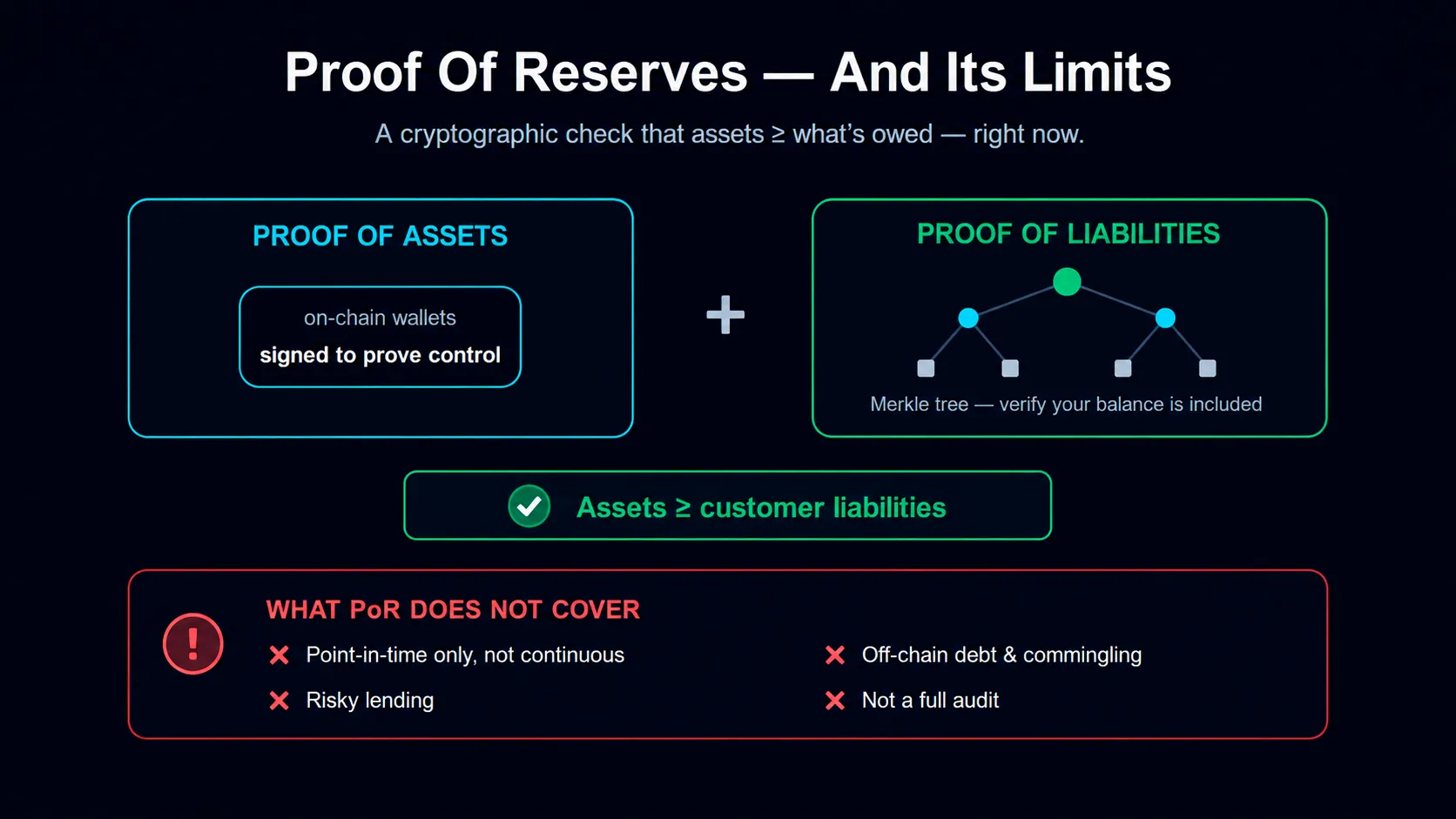
A strong proof of reserves shows two things:
- Proof of assets — the exchange controls specific on-chain wallets, usually by signing messages that prove ownership.
- Proof of liabilities — the total it owes customers, aggregated with a Merkle tree so you can verify your own balance is included without seeing anyone else’s.
Put together, a two-sided proof shows the exchange’s assets are at least equal to what it owes users right now. The best platforms publish these regularly and have them checked by an independent third party.
But know exactly what PoR does and doesn’t tell you. It became an industry standard after FTX’s collapse revealed a roughly $8 billion gap between claimed and actual reserves. It’s a genuine improvement — and it’s also limited:
- It’s a point-in-time snapshot, not continuous monitoring.
- An assets-only graphic proves nothing without the liabilities side.
- It doesn’t examine off-chain finances, corporate debt, commingling, or risky lending.
- It is not a full audit, even when the marketing implies otherwise.
So favor exchanges with frequent, independently verified, two-sided proofs. Treat “we hold billions in reserves” banners with no liability proof as marketing, not assurance.
Judge The Security Setup
Compliance and solvency mean little if the platform gets hacked. Strong exchanges show their security work rather than just claiming it.
- Cold storage. The bulk of customer funds should sit in offline cold wallets, with only a small operational float in hot wallets.
- Fund segregation. Customer assets kept separate from the company’s own money — the exact control FTX violated.
- Strong account security options. Support for app-based or hardware two-factor authentication (not just SMS), withdrawal allowlists, and anti-phishing measures.
- A clean track record, honestly handled. Every large platform faces attacks. What matters is whether past incidents were disclosed and users were made whole.
- Some insurance or a reserve fund against theft — while remembering these are capped and usually don’t cover your own account being compromised.
- Sensible data protection, since exchanges hold your ID and personal details and are prime breach targets.
Assess Transparency And Track Record
Trustworthy exchanges are easy to research. Sketchy ones are strangely hard to pin down.
- Known team and company. You can find out who runs it and where it’s incorporated. Anonymous operators are a real risk.
- A real operating history. Longevity through market crashes says more than a flashy launch.
- Clear terms and fees. Honest platforms spell out fees, withdrawal limits, and what happens to your assets. Hidden or shifting terms are a warning.
- Reliable withdrawals. Consistent, timely withdrawals are the single most practical trust signal. Widespread reports of frozen or delayed withdrawals are a five-alarm fire.
- Reasonable public reputation. Look past paid reviews to how the platform handles complaints and support.
Match The Exchange To How You’ll Use It
Compliance and safety come first, but a platform still has to fit your needs.
- Supported assets and your region. It should offer the coins you want and fully serve your country, including local deposits and withdrawals.
- Fees you understand. Compare trading, deposit, withdrawal, and spread costs — and beware “zero-fee” claims that hide the cost in the spread.
- Liquidity. Deeper markets mean better prices and less slippage on trades.
- Custody model. Know whether it’s fully custodial, and whether it offers options that reduce how much you must trust it.
- Usability and support. A clear interface and responsive human support matter most on the day something goes wrong.
Red Flags That Should Stop You Cold
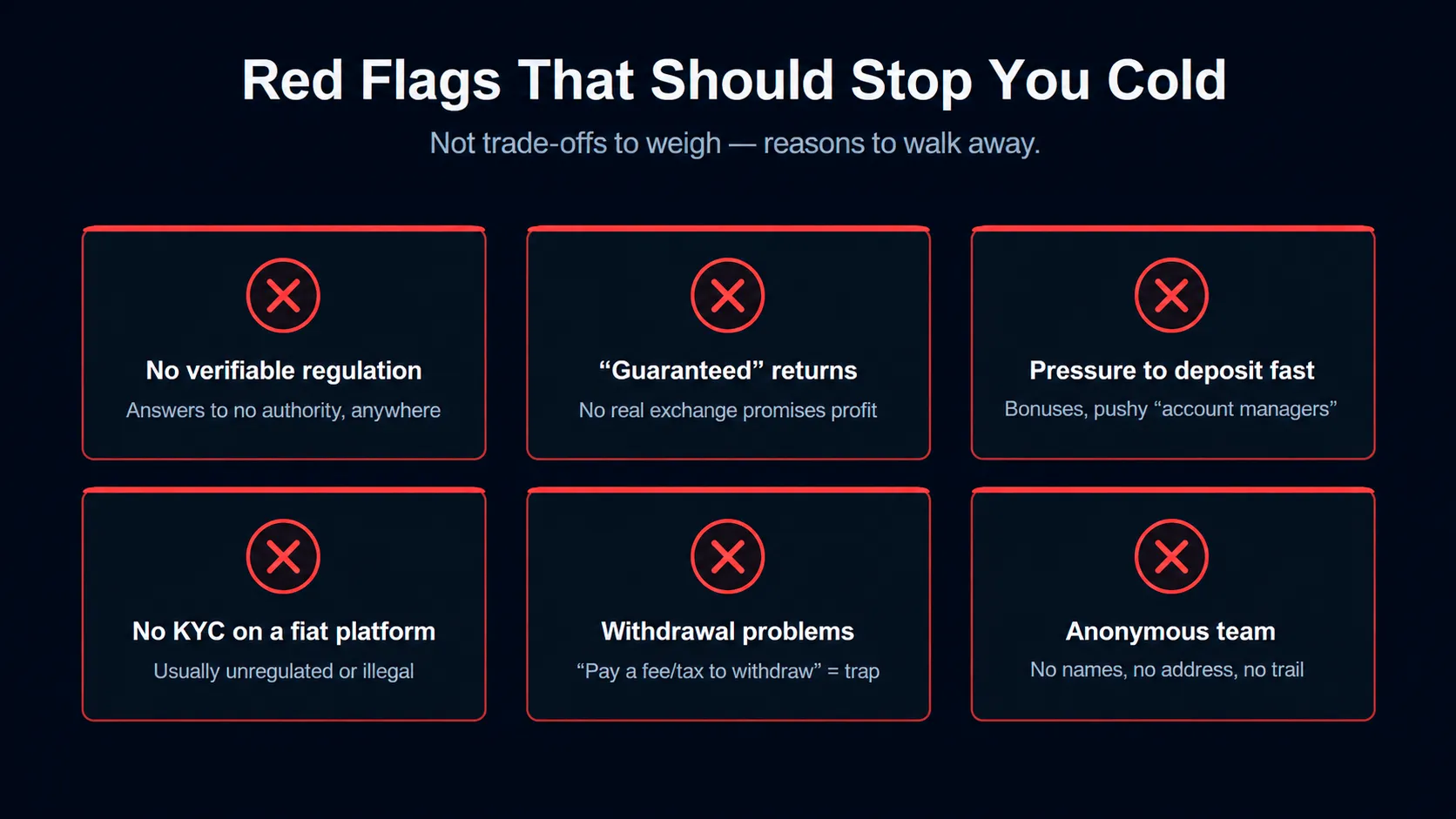
Some signals aren’t trade-offs to weigh — they’re reasons to walk away.
- No verifiable regulation or licensing anywhere it operates.
- Guaranteed or “risk-free” returns. No legitimate exchange promises profits. This is the signature of a scam.
- Pressure to deposit fast, bonuses for depositing more, or aggressive account managers pushing you to trade.
- No KYC at all on a platform handling real fiat, which usually signals it’s unregulated or operating illegally.
- Withdrawal problems, especially demands for extra “fees” or “taxes” before you can withdraw. That’s a classic trap.
- Anonymous team, no address, no paper trail.
- Reserves claims with no liability proof, or no proof of reserves at all on a large custodial platform.
Any one of these is enough to reconsider. Several together mean leave.
The Habit That Beats Any Exchange Choice
Here’s the truth no comparison can change: the safest exchange is still an exchange. Proof of reserves reduces the trust you place in a platform, but only self-custody removes it. Every custodial platform sits between you and your coins.
So treat exchanges as tools for trading and on-ramping, not as long-term vaults.
- Don’t store more than you’re actively using on any exchange.
- Move long-term holdings to your own wallet, ideally hardware, where no company’s solvency is your problem.
- Spread risk if you keep meaningful balances on platforms, rather than trusting everything to one.
- Withdraw a test amount early, so you confirm the exit works before you rely on it.
The best-run, fully compliant exchange in the world is still a counterparty. Use good ones, verify them, and keep your savings somewhere that can’t fail on you.
FAQ
- What Makes A Crypto Exchange “Compliant”?
A compliant exchange is licensed or registered with the relevant regulators, runs KYC and anti-money-laundering checks, keeps customer funds segregated, and follows the rules for the markets it serves. Those same controls are what protect your money, which is why compliance is a strong safety signal. - How Do I Check If An Exchange Is Regulated?
Find which regulator should oversee it in your country, then search that regulator’s own public register rather than trusting the exchange’s marketing. If a platform can’t point to any authority it answers to, treat that as a serious warning. - What Is Proof Of Reserves, And Can I Trust It?
Proof of reserves is cryptographic evidence that an exchange holds enough assets to cover what it owes customers, usually using a Merkle tree so you can verify your own balance is included. Trust the strong version — frequent, independently checked, two-sided proofs — but remember it’s a point-in-time snapshot, not a full audit. - Is A Regulated Exchange Completely Safe?
No. Regulation and proof of reserves reduce risk but don’t eliminate it, since regulated firms can still fail or be hacked. The only way to remove exchange risk entirely is to hold your own keys in self-custody. - Should I Avoid Exchanges With No KYC?
On any platform handling real fiat, an absence of KYC usually means it’s unregulated or operating illegally in the markets it serves, which puts your funds at greater risk. Most reputable exchanges require identity verification, so treat “no KYC, no limits” as a reason for caution. - How Much Crypto Should I Keep On An Exchange?
Only what you’re actively trading or about to use. Move long-term holdings to your own wallet, because an exchange is a counterparty that can fail, freeze, or be hacked, while self-custody keeps your funds out of that risk. - What’s The Biggest Red Flag When Choosing An Exchange?
Withdrawal problems, especially any demand for extra fees or taxes before releasing your funds. Combined with promises of guaranteed returns or a complete lack of regulation, it’s a clear signal to walk away.