


Content
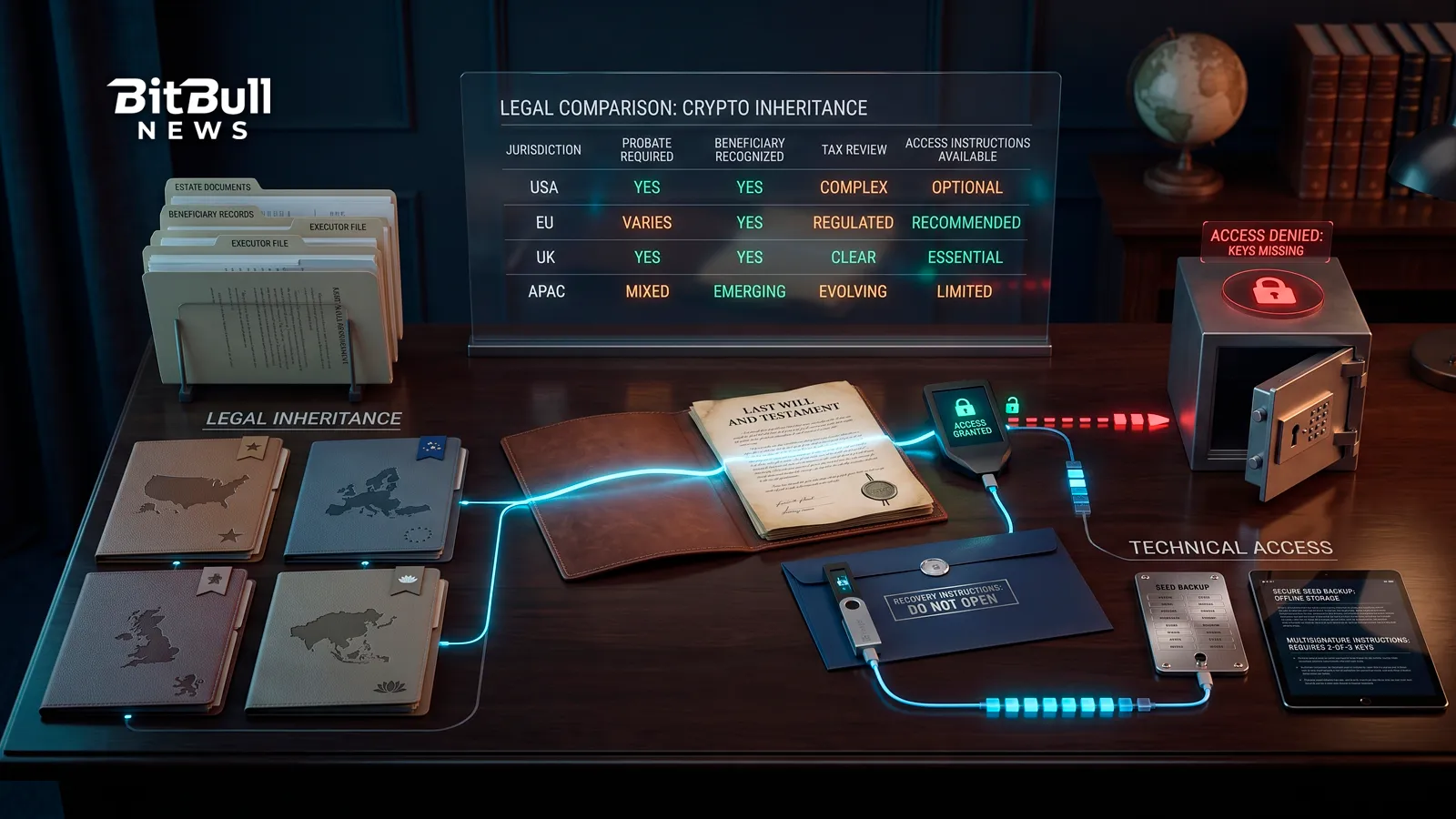
Crypto inheritance has two halves that don’t always agree. There’s the legal question — who is entitled to your coins when you die — and the technical one — whether anyone can actually reach them. Every country answers the first differently. None of them can fix the second for you.

That split is the key to the whole topic. A court can rule that your children inherit your Bitcoin, and it changes nothing if the keys died with you. So this guide maps how inheritance law treats crypto in the major legal systems, where the rules genuinely differ, and the one problem that no jurisdiction on Earth can solve.
This is an overview for education, not legal advice. Succession law is complex, varies by country, and changes, so work with a qualified estate professional in your jurisdiction.
The Universal Starting Point: Is Crypto Even “Property”?
Before any country can pass your crypto to heirs, its law has to recognize crypto as something inheritable in the first place. The good news is that this question has largely settled the same way everywhere.
Most legal systems now treat crypto as property that forms part of your estate, just like a bank account or a house. Courts across many countries have reached this result, and some have written it into statute — England and Wales, for example, confirmed crypto-tokens as personal property in the Property (Digital Assets etc) Act 2025.
Once crypto is property, your country’s normal succession rules apply to it. And that’s exactly where jurisdictions split, because those succession rules differ enormously.
The Great Divide: Who Decides Where Your Crypto Goes
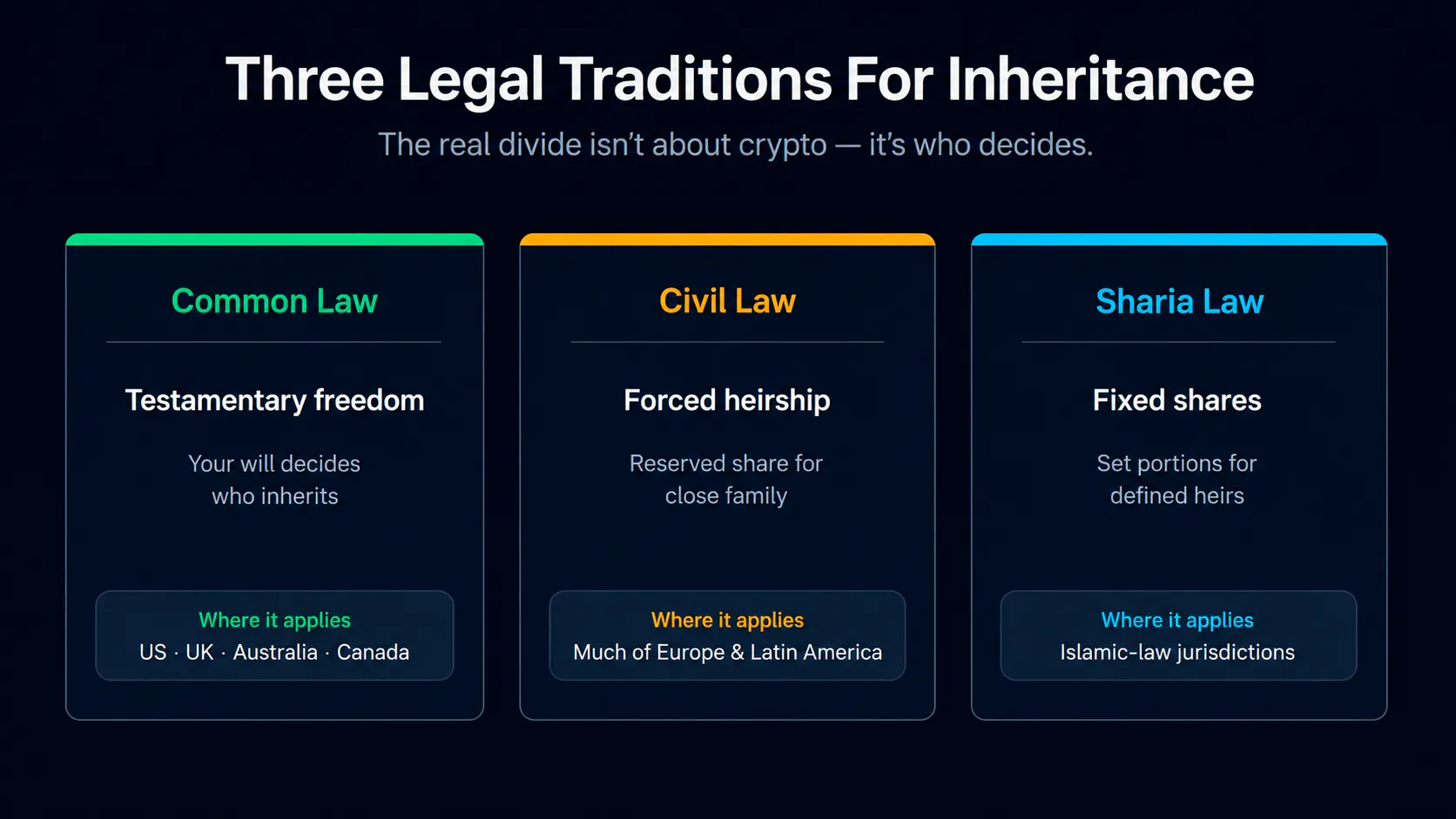
The biggest fault line in inheritance law worldwide isn’t about crypto at all. It’s about a deeper question: do you get to choose who inherits, or does the law decide for you? Legal systems answer in three broadly different ways.
Common Law: Testamentary Freedom
In common-law countries — the United States, the United Kingdom, Australia, Canada, and others — you generally have broad testamentary freedom. Your will decides who gets your crypto, and you can mostly leave it to whomever you choose.
Courts retain some power to provide for dependents who were unfairly cut out, but the starting principle is your choice. Write a valid will naming who inherits your crypto, and the law will largely honor it.
Civil Law: Forced Heirship
Much of Europe, Latin America, and beyond follows civil law, which limits your freedom to protect close family. Under forced heirship, a reserved share of your estate must go to certain relatives — typically children, and often a spouse — no matter what your will says.
This matters directly for crypto. In a forced-heirship country, you often cannot simply leave all your Bitcoin to one person if that shortchanges your children’s reserved share. The reserved portion applies to your whole estate, crypto included, and rules on the exact shares vary country by country.
Sharia Law: Fixed Shares
In jurisdictions applying Islamic inheritance law, the estate is distributed according to fixed shares set out in religious law, with defined portions for specific heirs. As with forced heirship, this constrains how freely you can direct your crypto, and the framework applies to your assets as a whole.
The European Union: One Region, Many Rules
The EU deserves special attention, because it’s a common source of confusion. There is no single EU inheritance law that dictates who gets what — succession rules still belong to each member state, and many impose forced heirship.
What the EU does provide is a rule for deciding which country’s law applies. The EU Succession Regulation, often called “Brussels IV,” generally applies the law of the country where you were habitually resident at death — but it lets you choose the law of your nationality instead, through an express election in your will.
That choice is powerful. A national of a testamentary-freedom country living in a forced-heirship one may be able to elect their home law to govern their estate. But there are limits, some countries apply their own rules regardless, and Denmark and Ireland sit outside the regulation. This is precisely the kind of cross-border detail that needs a specialist.
The United States: RUFADAA And Fiduciary Access
The US adds a specific and useful layer for digital assets. Most states have adopted the Revised Uniform Fiduciary Access to Digital Assets Act (RUFADAA), a model law from the Uniform Law Commission now enacted in roughly 46 states.
RUFADAA gives your executor or trustee legal authority to access digital assets, including cryptocurrency — but only if you grant it properly, and it follows a priority order: a platform’s own legacy tool first, then your legal documents, then the provider’s terms of service.
Here’s the limit that matters. RUFADAA can compel a custodian — an exchange holding your account — to give your executor access. It does nothing for a self-custodied wallet, because no company holds the keys. Legal authority and technical access are two different things, and this law only reaches the first.
Custodial Versus Self-Custodied: The Divide That Really Governs Your Estate
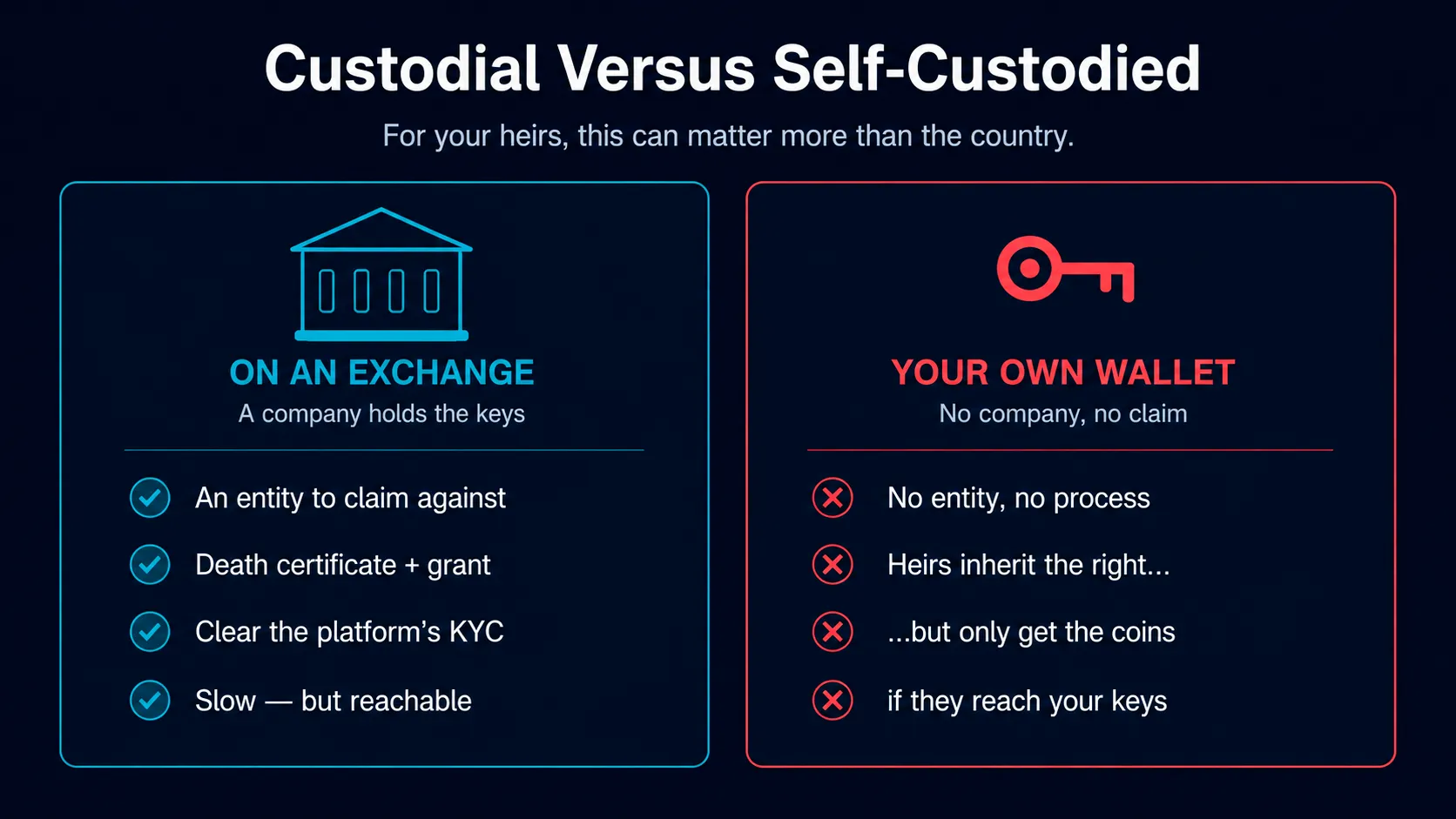
Step back from the map of countries and a more practical divide emerges. For your heirs, whether crypto sits on an exchange or in a private wallet often matters more than which country’s law applies.
- Custodial (on an exchange). A company holds the keys, so there’s an entity to make a claim against. Heirs follow a probate-style process — produce a death certificate and a grant of representation, clear the platform’s identity checks, and wait. In the EU, MiCA now requires service providers to safekeep client crypto, so a custodial estate becomes a documented claim heirs pursue. Slow, but reachable.
- Self-custodied (your own wallet). No company, no claim, no process. Your heirs inherit the legal right to the coins, but they can only get the coins themselves if they can reach your keys. No court order can reconstruct a lost seed phrase.
That second row is the heart of it. Inheritance law can award your crypto perfectly and still leave your family with nothing to open.
The Gap No Law Can Close
Every jurisdiction shares one blind spot, and it’s the most important thing on this page.
A court can grant your heirs the legal right to your crypto. It cannot give them the private key.
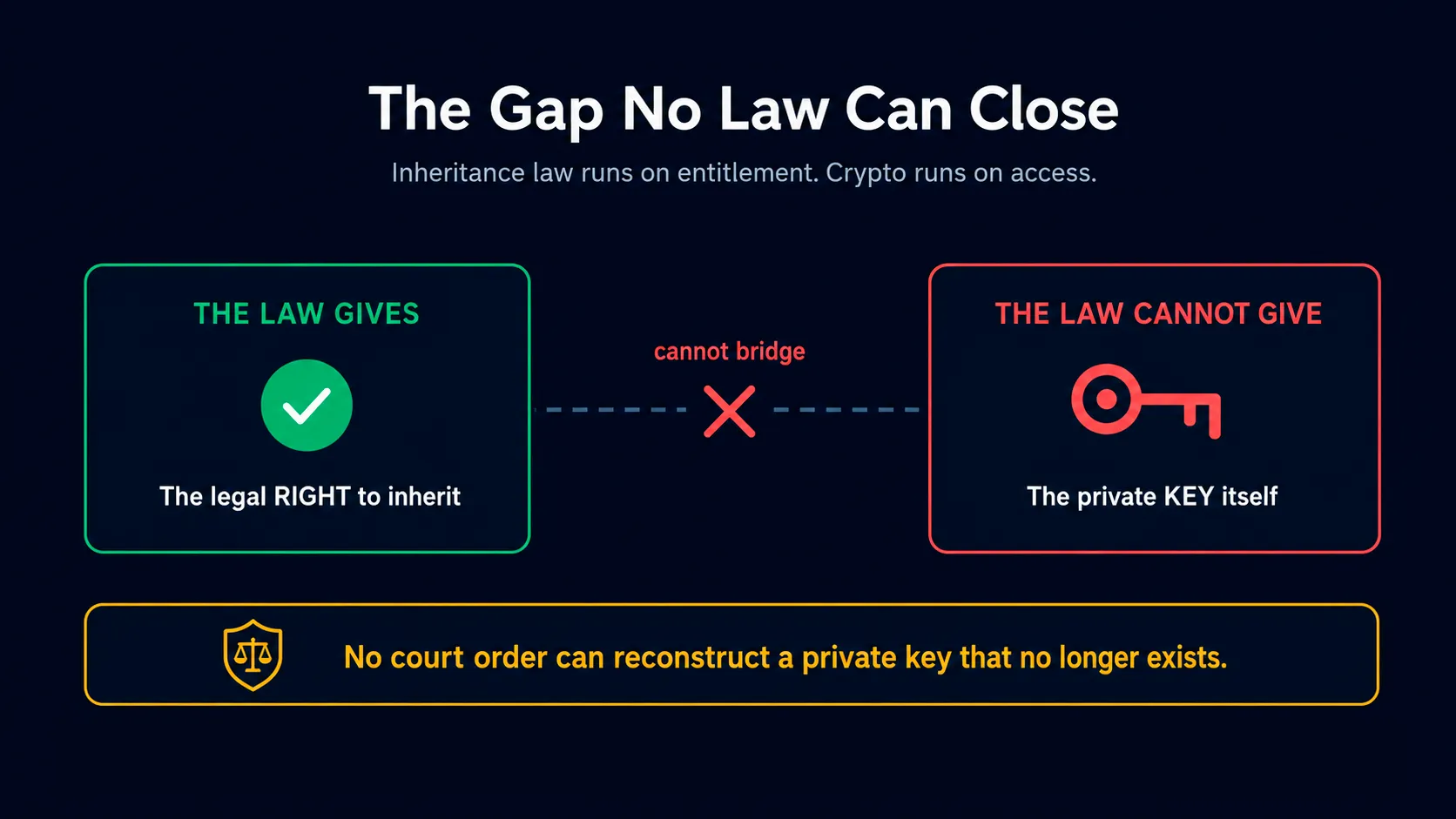
If your keys are gone — no backup, no instructions, no one who knows they exist — the coins stay locked on the blockchain forever, no matter how airtight your will or how favorable your country’s law. Inheritance law operates on entitlement. Crypto operates on access. Bridging the two is on you, not the legal system.
That’s why the legal plan and the technical plan must work together:
- Your will or trust should establish who inherits and give your executor explicit authority over digital assets — while never containing the keys themselves, since a will can become a public court record.
- Your access plan — secure, separate instructions, a multisig setup, or split backups — is what actually lets heirs reach the coins.
- The two connect through a pointer: the legal documents say who and grant authority; a separate, secure source holds the how.
What This Means For You, Wherever You Are
The specific rules depend on your country, but the priorities are consistent everywhere.
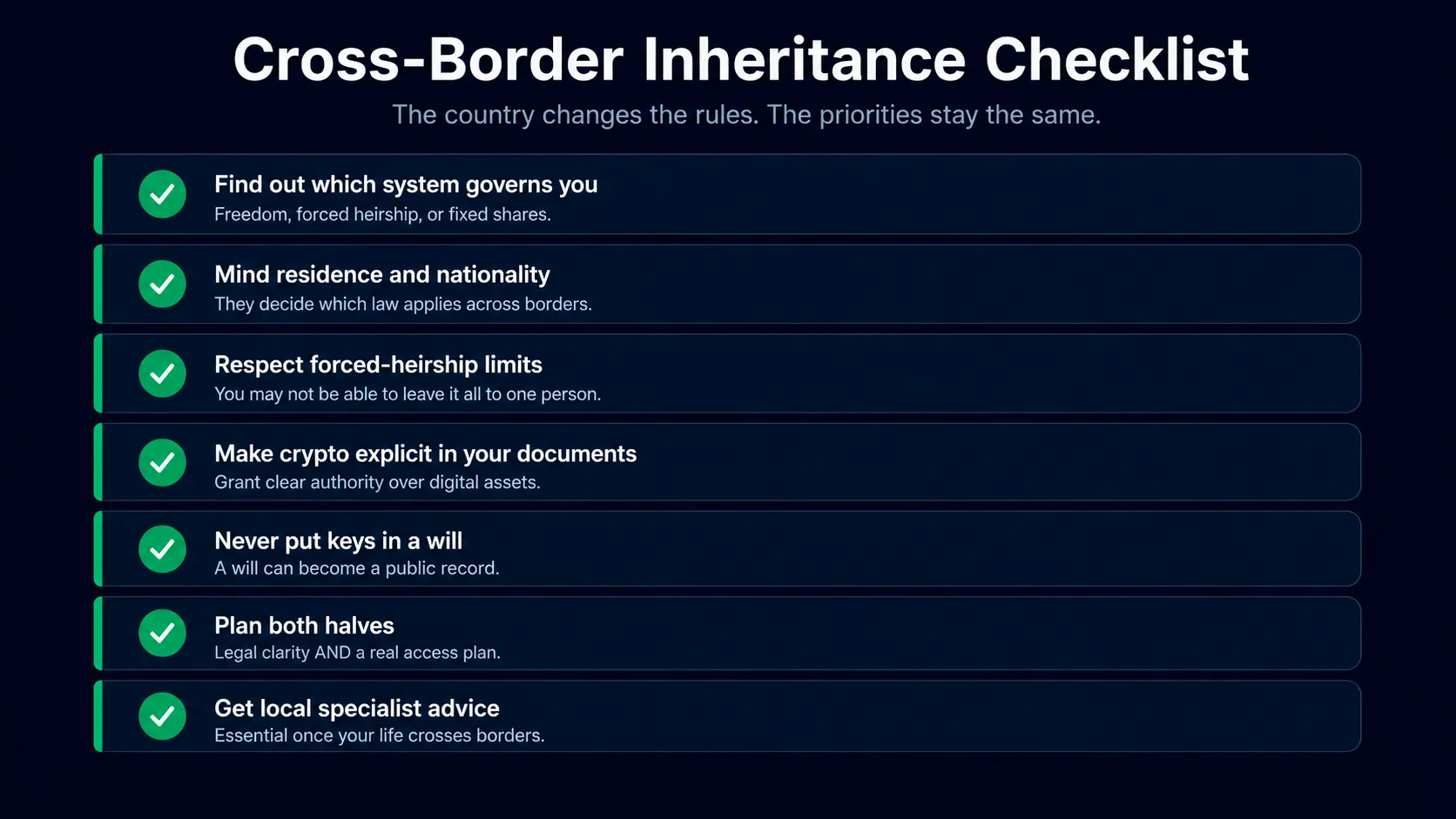
- Find out which system governs you. Testamentary freedom, forced heirship, or fixed shares — this shapes what you can and can’t direct.
- Mind your residence and nationality. Where you live, your citizenship, and where assets sit all affect which law applies, especially across borders.
- Watch forced-heirship limits. In many countries you can’t freely leave all your crypto to one person, so plan within the reserved-share rules.
- Make crypto explicit in your estate documents. Grant clear authority over digital assets; vague wording causes delays and disputes.
- Never put keys in a will, which can become public. Keep secrets in a separate, secure place the will points to.
- Plan both halves. A perfect legal document with no access plan fails, and a perfect access plan with no legal clarity invites disputes.
- Get local, specialist advice for meaningful holdings, especially if your life crosses borders.
Crypto inheritance law is converging on the easy part: nearly everywhere now treats crypto as inheritable property. The hard parts are the ones that vary — who must receive a share, which country’s law governs you — and the one part that never changes: no law can hand over a key that no longer exists. Get the legal side right for your jurisdiction, pair it with a real access plan, and your crypto can actually reach the people you intend.
FAQ
- Is Cryptocurrency Legally Inheritable?
In most countries, yes. Legal systems increasingly treat crypto as property that forms part of your estate, and some have confirmed this by statute. Once it’s property, your country’s normal succession rules apply to it. - Do Crypto Inheritance Laws Differ By Country?
Significantly. Common-law countries generally let your will decide who inherits, civil-law countries often impose forced heirship reserving shares for close family, and Sharia-based systems apply fixed shares. The differences are about succession rules broadly, and crypto simply follows them. - What Is Forced Heirship, And Does It Apply To Crypto?
Forced heirship is a civil-law rule reserving a portion of your estate for certain relatives, usually children and often a spouse, regardless of your will. It applies to your whole estate, crypto included, so in those countries you may not be able to leave all your crypto to one person. - Which Country’s Law Applies If I Live Abroad?
It depends on rules like residence, nationality, and where assets are located. In the EU, the Succession Regulation generally applies the law of your habitual residence but lets you elect your nationality’s law in your will, with some exceptions. Cross-border cases need specialist advice. - Can A Court Force An Exchange To Release A Deceased Person’s Crypto?
Often yes for custodial accounts. With the right documents — a death certificate and a grant of representation — and after identity checks, an exchange can transfer a deceased user’s assets, and laws like RUFADAA in the US support fiduciary access. A self-custodied wallet is different, because no company holds the keys. - What Happens To Self-Custodied Crypto If There’s No Access Plan?
If no one can reach the private keys, the crypto is lost permanently, even if heirs legally inherit it. No court order or law can reconstruct a missing seed phrase, which is why a secure access plan matters as much as the legal documents. - Should I Put My Seed Phrase In My Will?
Never. A will can become a public record during probate, so writing your keys into it can expose them. Keep access instructions in a separate, secure location and have your will point to it while granting your executor authority over digital assets.