


Content
Tokenized real-world assets added value this week. The composition of that growth changed.
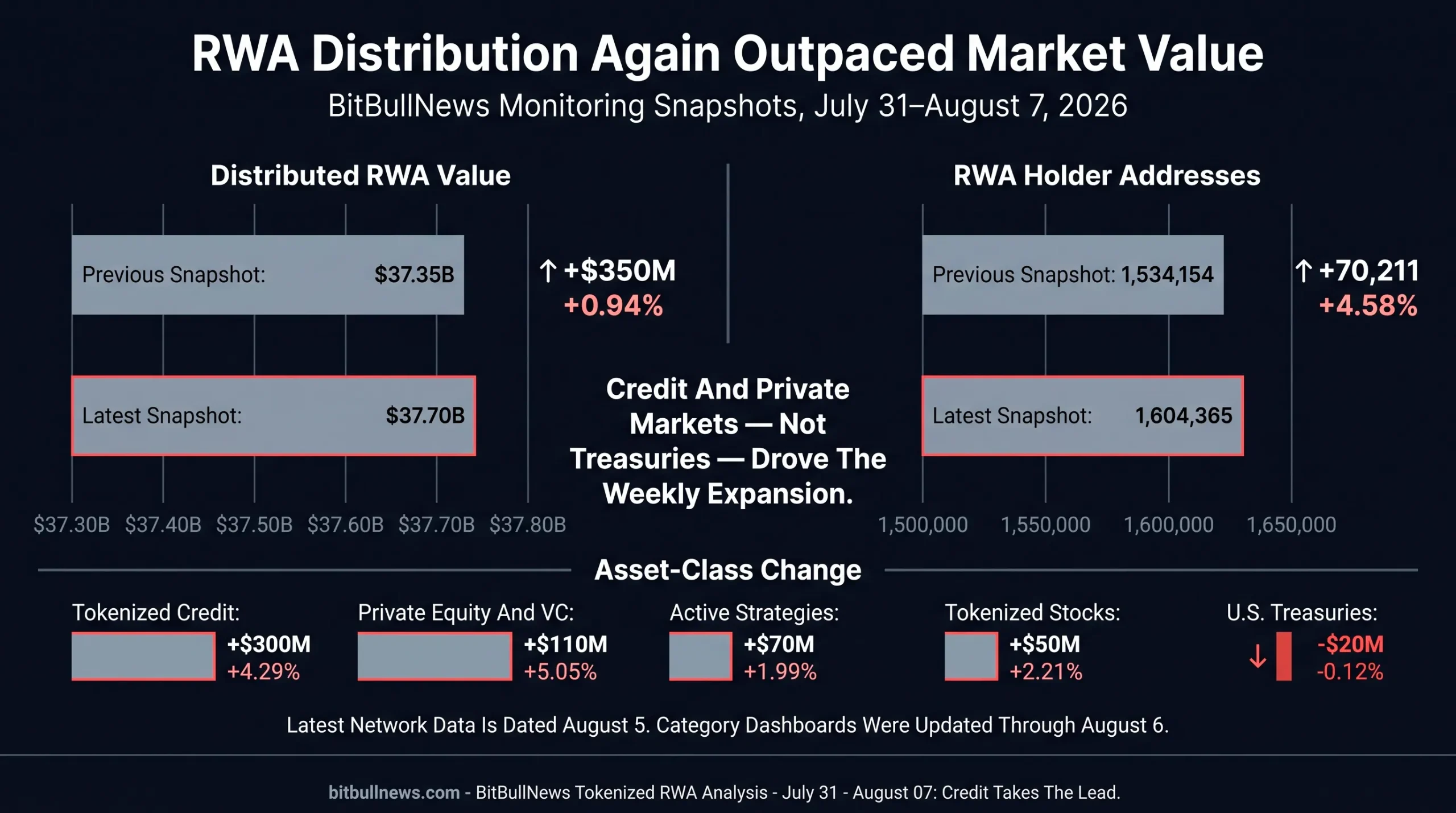
Distributed RWA value reached $37.70 billion in RWA.xyz’s latest network snapshot, up approximately $350 million, or 0.94%, from the previous BitBullNews reading. Holder addresses increased much faster, rising by 70,211 to 1.60 million.
Treasuries did not drive the expansion.
Tokenized credit added roughly $300 million between BitBullNews snapshots. Private equity and venture capital gained around $110 million. Active strategies increased by approximately $70 million, while tokenized stocks added about $50 million.
Tokenized Treasury value slipped slightly to $16.15 billion. Commodities and real estate were effectively flat.
The infrastructure layer moved faster than the market total.
BlackRock introduced two tokenized money-market products designed for institutional cash management and potential stablecoin reserve use. Ripple invested in ZILO and Licuido to add transfer-agency, issuance and collateral-mobility capabilities to its capital-markets infrastructure.
The week’s central shift was clear: tokenization expanded beyond putting Treasury exposure into wallets. Credit, private markets, reserve management and post-issuance infrastructure became the main sources of movement.
Data Scope And Cutoff
RWA.xyz’s network totals were dated August 5, while most category dashboards were updated through August 6. The real-estate page carried an August 3 timestamp. August 7 was not a completed reporting day at the BitBullNews cutoff.
RWA.xyz reported $37.70 billion of distributed assets and $398.92 billion of represented assets in its network module. Distributed assets use blockchain as a direct ownership and distribution layer. Represented assets primarily use blockchain for recordkeeping inside controlled systems.
The represented-value figure fell from the previous BitBullNews network snapshot. That movement should not be treated as a clean redemption number. Represented balances are more exposed to classification changes, platform coverage and dashboard refresh timing.
Weekly changes in this report compare the latest public dashboard readings with the previous BitBullNews snapshot. Official 30-day changes are shown separately where available.
RWA Market Scorecard
| Market Metric | Latest Reading | Previous BBN Snapshot | Snapshot Change | Market Read |
|---|---|---|---|---|
| Distributed RWA Value | $37.70B | $37.35B | +$350M, +0.94% | Transferable market value continued expanding |
| Represented RWA Value | $398.92B | $411.51B | -$12.59B, -3.06% | Not a clean flow measure due to classification and coverage changes |
| Total RWA Holder Addresses | 1,604,365 | 1,534,154 | +70,211, +4.58% | Distribution again grew faster than value |
| Tokenized U.S. Treasuries | $16.15B | $16.17B | -$20M, -0.12% | Category remained the largest but did not drive weekly growth |
| Tokenized Credit | $7.29B | $6.99B | +$300M, +4.29% | Largest major asset-class increase |
| Tokenized Commodities | $4.60B | $4.61B | -$10M, -0.22% | Value remained broadly stable |
| Active Strategies | $3.59B | $3.52B | +$70M, +1.99% | Growth remained concentrated in large strategies |
| Tokenized Stocks | $2.31B | $2.26B | +$50M, +2.21% | Holder count crossed one million |
| Private Equity And Venture Capital | $2.29B | $2.18B | +$110M, +5.05% | Fastest percentage growth among major categories |
| Tokenized Real Estate | $202.60M | $202.63M | Approximately Flat | Real estate remained the smallest major category |
Growth Rotated Toward Credit And Private Markets
The market gained approximately $350 million between BitBullNews snapshots. Credit alone added an estimated $300 million.
Private equity and venture capital produced the strongest percentage increase, rising about 5.05%. Active strategies and tokenized stocks also expanded. Treasury value slipped slightly despite remaining more than twice the size of distributed credit.
Asset-Class Rotation
| Asset Class | Current Distributed Value | Snapshot Dollar Change | Snapshot Percentage Change | Official 30-Day Change | Structural Signal |
|---|---|---|---|---|---|
| U.S. Treasuries | $16.15B | -$20M | -0.12% | +3.74% | Large category entered a short consolidation |
| Tokenized Credit | $7.29B | +$300M | +4.29% | +1.81% | Credit became the main weekly growth engine |
| Tokenized Commodities | $4.60B | -$10M | -0.22% | -3.18% | Gold-led category remained under mild pressure |
| Active Strategies | $3.59B | +$70M | +1.99% | +6.04% | Yield and trading strategies continued attracting value |
| Tokenized Stocks | $2.31B | +$50M | +2.21% | +8.60% | Distribution and transfer volume expanded |
| Private Equity And Venture Capital | $2.29B | +$110M | +5.05% | +6.51% | Private-market tokenization accelerated |
| Tokenized Real Estate | $202.60M | Approximately Flat | Approximately 0.00% | -0.04% | Category remained stagnant |
Snapshot comparisons and rolling 30-day changes measure different periods and should not be combined as one flow series.
The rotation matters because the categories carry different risk.
Treasury tokens generally hold short-duration government instruments or money-market portfolios. Credit tokens depend on borrower performance, underwriting and recovery rights. Active strategies add manager, trading and derivatives exposure. Private-equity tokens retain the valuation delays and transfer restrictions of their underlying funds.
The market did not merely become larger. It became more exposed to assets whose quality is harder to evaluate from headline token value alone.
Credit Became The Weekly Growth Engine
Distributed tokenized credit reached $7.29 billion, up 1.81% over RWA.xyz’s rolling 30-day period and roughly $300 million above the previous BitBullNews snapshot.
Represented credit reached $36.67 billion. The represented market was therefore about five times larger than externally distributed credit.
That ratio shows where institutional adoption still sits.
Most tokenized credit remains inside controlled recordkeeping and servicing systems. A smaller segment is distributed directly to wallets or blockchain-based custodians.
Tokenized Credit Structure
| Credit Metric | Latest Reading | Previous BBN Snapshot | Current Interpretation |
|---|---|---|---|
| Distributed Credit Value | $7.29B | $6.99B | Transferable credit expanded approximately $300M |
| Represented Credit Value | $36.67B | $36.43B | Controlled-platform credit remained much larger |
| Represented-To-Distributed Ratio | Approximately 5.0x | Approximately 5.2x | Distributed credit gained modestly on represented structures |
| Tracked Credit Assets | 2,543 | 2,535 | Product breadth continued increasing |
| Holder Addresses | 191,475 | 191,032 | Ownership grew slowly relative to market value |
| Largest Distributed Platform | STOKR, Approximately $1.30B | Approximately $1.30B | Mining and specialty-finance notes remained significant |
| Maple | $979.4M | $956.7M | Onchain credit value continued expanding |
| Centrifuge | $747.3M | $746.5M | Platform balance was broadly stable |
| Hastra | $513.2M | $490.8M | PRIME remained a major individual credit asset |
| Securitize | $489.4M | $489.1M | Credit remained part of a wider tokenization platform |
RWA.xyz’s platform balances can include several underlying products and legal structures.
Maple’s Syrup USDC was the largest individually listed distributed credit product at approximately $1.10 billion. The Janus Henderson AAA CLO Fund stood near $691.7 million, while Hastra’s PRIME reached about $508.5 million.
The category’s growth was therefore not limited to one form of lending.
It included asset-backed credit, structured credit, specialty finance, mining notes and tokenized collateralized-loan exposure.
That breadth is constructive for adoption. It increases the importance of product-level due diligence.
A tokenized CLO fund should not be evaluated like a stablecoin lending pool. A mining note should not be evaluated like trade finance. Each product needs separate analysis of borrower exposure, legal seniority, collateral, liquidity and redemption rights.
Tokenized Stocks Crossed One Million Holders
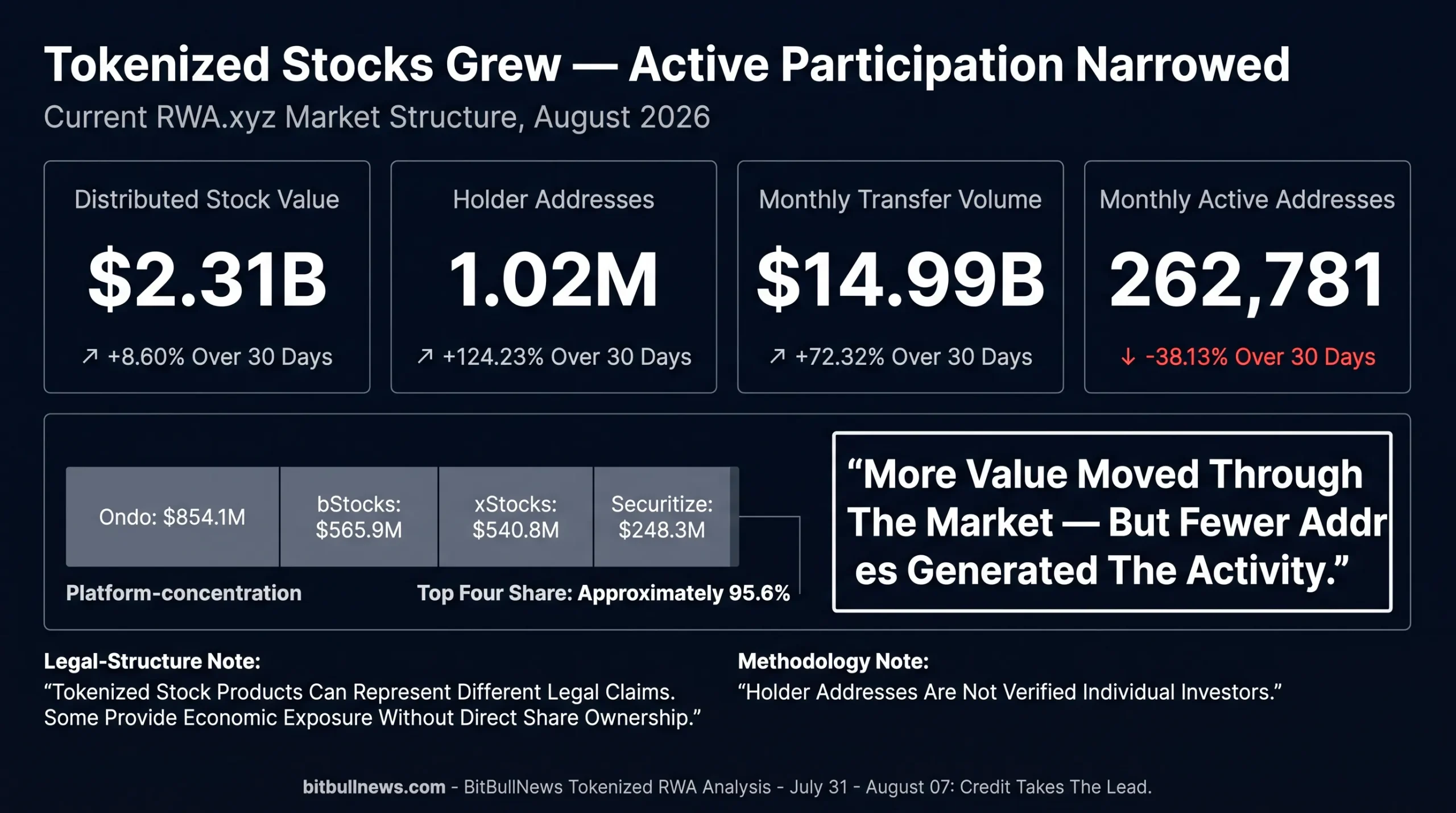
RWA.xyz recorded $2.31 billion of distributed tokenized stocks and ETFs across 3,328 assets. Holder addresses reached approximately 1.02 million, up 124.23% over 30 days.
Monthly transfer volume increased 72.32% to $14.99 billion.
Monthly active addresses moved in the opposite direction, falling 38.13% to 262,781.
The combination suggests that more addresses held stock tokens and more value moved overall, but a smaller group of addresses generated the activity.
Tokenized Stock Market Structure
| Tokenized Stock Metric | Latest Reading | Official 30-Day Change | Market Interpretation |
|---|---|---|---|
| Distributed Value | $2.31B | +8.60% | Category continued expanding |
| Represented Value | $21.01M | -0.99% | Platform-bound equity exposure remained small |
| Holder Addresses | Approximately 1.02M | +124.23% | Distribution broadened rapidly |
| Monthly Transfer Volume | $14.99B | +72.32% | Economic activity increased |
| Monthly Active Addresses | 262,781 | -38.13% | Activity became more concentrated |
| Tracked Assets | 3,328 | — | Product coverage continued broadening |
| Ondo Distributed Value | $854.1M | Not Publicly Displayed | Largest platform by stock value |
| bStocks Distributed Value | Approximately $565.9M | Launch-Period Growth | Fast-growing certificate-based product set |
| xStocks Distributed Value | $540.8M | Not Publicly Displayed | Major tokenized-stock platform |
| Securitize Distributed Value | $248.3M | Not Publicly Displayed | Large value concentrated in three products |
| Top Four Platform Share | Approximately 95.6% | — | Category remained highly concentrated |
Holder addresses are not verified individual investors. One investor may control several wallets, while custodial addresses may represent many clients.
The value concentration remained extreme.
Ondo, bStocks, xStocks and Securitize controlled approximately 95.6% of the distributed category. Expansion in the number of tracked instruments has not yet produced equivalent platform diversification.
bStocks reported $565.9 million of tokenized equity value within seven weeks of launch. Binance also states that the products are certificates representing financial instruments rather than direct ownership of the underlying shares.
That legal distinction matters.
A token can provide price exposure without voting rights, direct shareholder status or the same corporate-action treatment as a conventionally held share. Investors need to understand whether they own the security, a beneficial interest, a fund share or a contractual claim against an issuer.
Higher Transfer Volume Does Not Guarantee Deeper Liquidity
Monthly stock-token transfer volume reached nearly 6.5 times current distributed value.
That ratio does not equal exchange turnover in a conventional market. Transfers can include primary issuance, redemptions, internal movements, bridging and settlement between controlled addresses.
Research on tokenized assets has found that outstanding value alone is a weak predictor of liquidity. Holder distribution, active addresses, transfer frequency and market concentration provide additional information.
The fall in active addresses deserves attention.
A market can post higher dollar transfer volume while becoming more dependent on a smaller set of market makers, platforms or large accounts. That creates the appearance of scale without equivalent depth across participants.
Treasuries Consolidated While Products Rotated
Tokenized U.S. Treasury value stood at $16.15 billion, down about $20 million between BitBullNews snapshots but up 3.74% over RWA.xyz’s rolling 30-day window.
The category reported a 3.44% average seven-day yield and 62,949 holder addresses. Holder growth was almost flat over seven days.
The product-level flow data showed rotation rather than category-wide weakness.
Tokenized Treasury Flow Leaders
| Treasury Product | Issuer Or Platform | Current Value | RWA.xyz 30-Day Net Flow |
|---|---|---|---|
| USYC | Circle | Approximately $3.0B | -$109M |
| BUIDL | BlackRock / Securitize | Approximately $2.7B | +$441M |
| USDY | Ondo | Approximately $2.1B | Not Shown Among Largest Flow Bars |
| iBENJI | Franklin Templeton | $1.73B | +$136M |
| JTRSY | Janus Henderson / Centrifuge | $882.0M | Not Shown Among Largest Flow Bars |
| JLTXX | JPMorgan / Kinexys | Approximately $793.3M | +$105M |
| VBILL | VanEck / Securitize | Not Displayed In Retrieved Overview | +$136M |
| WTGXX | WisdomTree | Approximately $764.9M | +$50M |
| TBILL | OpenEden | Approximately $255.5M | +$43M |
| BENJI | Franklin Templeton | Approximately $712.3M | -$43M |
| Category Total | — | $16.15B | +3.74% In Value Over 30 Days |
The flow column reflects RWA.xyz’s rolling 30-day product-flow chart, not July 31–August 7 subscriptions alone.
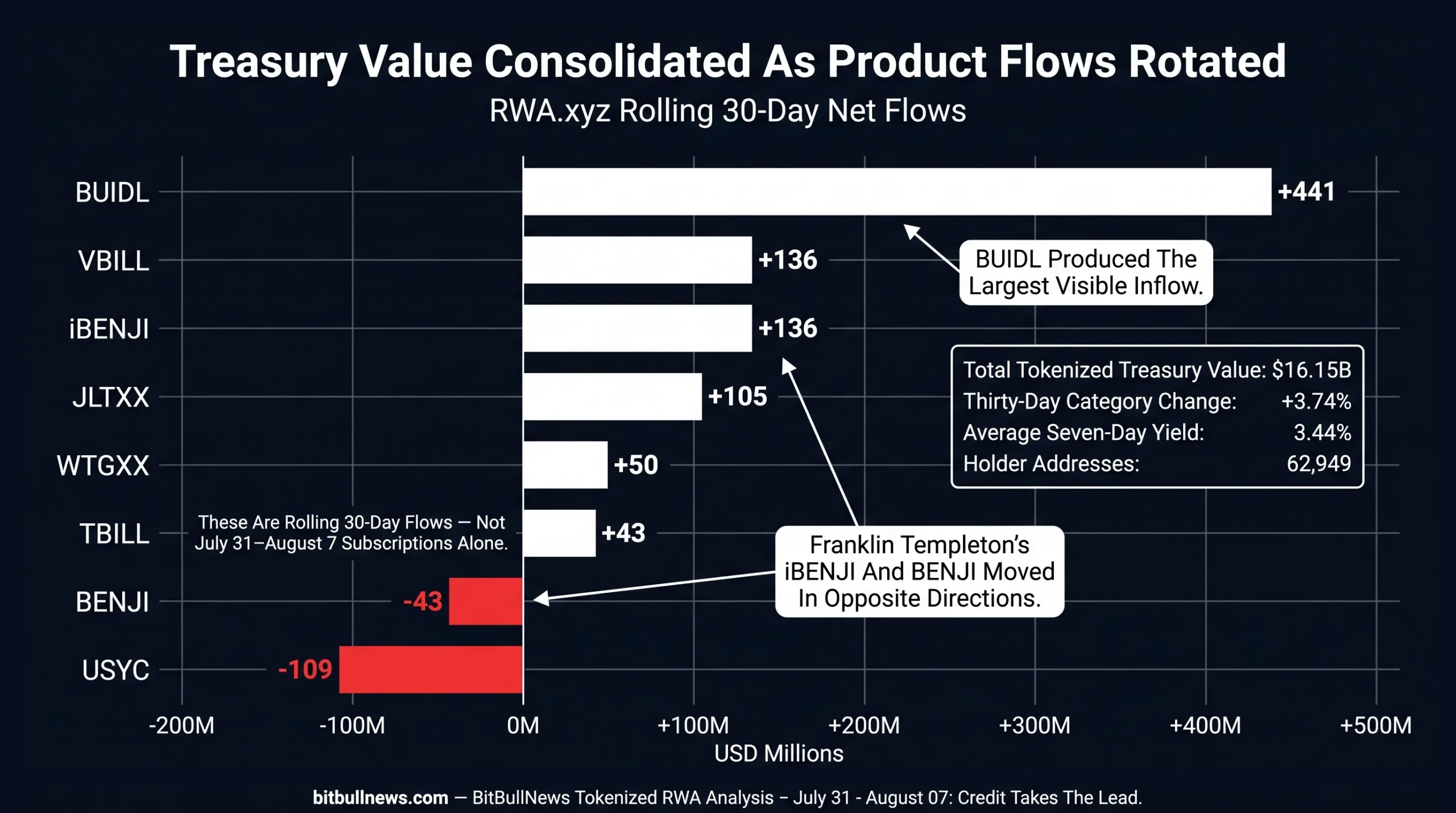
BUIDL remained the strongest visible inflow product, while USYC recorded the largest outflow among the displayed leaders.
Franklin Templeton’s two tokenized share structures moved in opposite directions. iBENJI gained value while BENJI recorded net redemptions. That suggests investors were selecting between wrappers, networks or distribution channels rather than rejecting one asset manager’s entire Treasury offering.
Treasury holder growth remained minimal compared with tokenized stocks.
That is not necessarily a weakness. Institutional money-market products can hold billions across a small number of approved accounts, custodians and omnibus structures.
It does mean the Treasury market’s scale should not be interpreted as broad retail distribution.
BlackRock Built Reserve-Ready Onchain Cash Products
BlackRock announced two tokenized money-market products on August 3: an OnChain share class of the BlackRock Select Treasury Based Liquidity Fund and the new BlackRock Daily Reinvestment Stablecoin Reserve Vehicle.
Both products invest in cash, short-term U.S. Treasury instruments and Treasury-backed overnight repurchase agreements. BlackRock said their strategies are intended to qualify as eligible reserve assets for permitted payment stablecoin issuers under the GENIUS Act and subsequent regulations.
BlackRock Tokenized Cash Platform
| Product Feature | BSTBL OnChain Shares | BRSRV OnChain Shares |
|---|---|---|
| Structure | Tokenized share class of an existing government money-market fund | Newly launched government money-market fund |
| Announcement Date | August 3, 2026 | August 3, 2026 |
| OnChain Share Launch Date | July 31, 2026 | August 3, 2026 |
| Underlying Fund Size, August 5 | $6.46B | $50.0M |
| Separately Reported OnChain Class Size | Not Publicly Displayed | $50.0M |
| Initial Blockchain Support | Ethereum | Ethereum, Tempo And Solana |
| Transfer Agent And Tokenization Provider | BNY | Securitize |
| Minimum Initial Investment | $3.0M | $3.0M |
| Portfolio | Cash, Short-Term Treasuries And Treasury-Backed Overnight Repo | Cash, Short-Term Treasuries And Treasury-Backed Overnight Repo |
| Reserve Strategy | Intended To Meet Eligible Stablecoin-Reserve Requirements | Intended To Meet Eligible Stablecoin-Reserve Requirements |
| Transfer Model | Approved Investor Wallets | Permissioned Multi-Network Wallet System |
| Main Use Case | Moving an established institutional liquidity fund into tokenized form | Stablecoin reserves and digitally native institutional cash management |
BSTBL’s $6.46 billion figure is the size of the underlying fund, not a disclosed balance of the new tokenized share class.
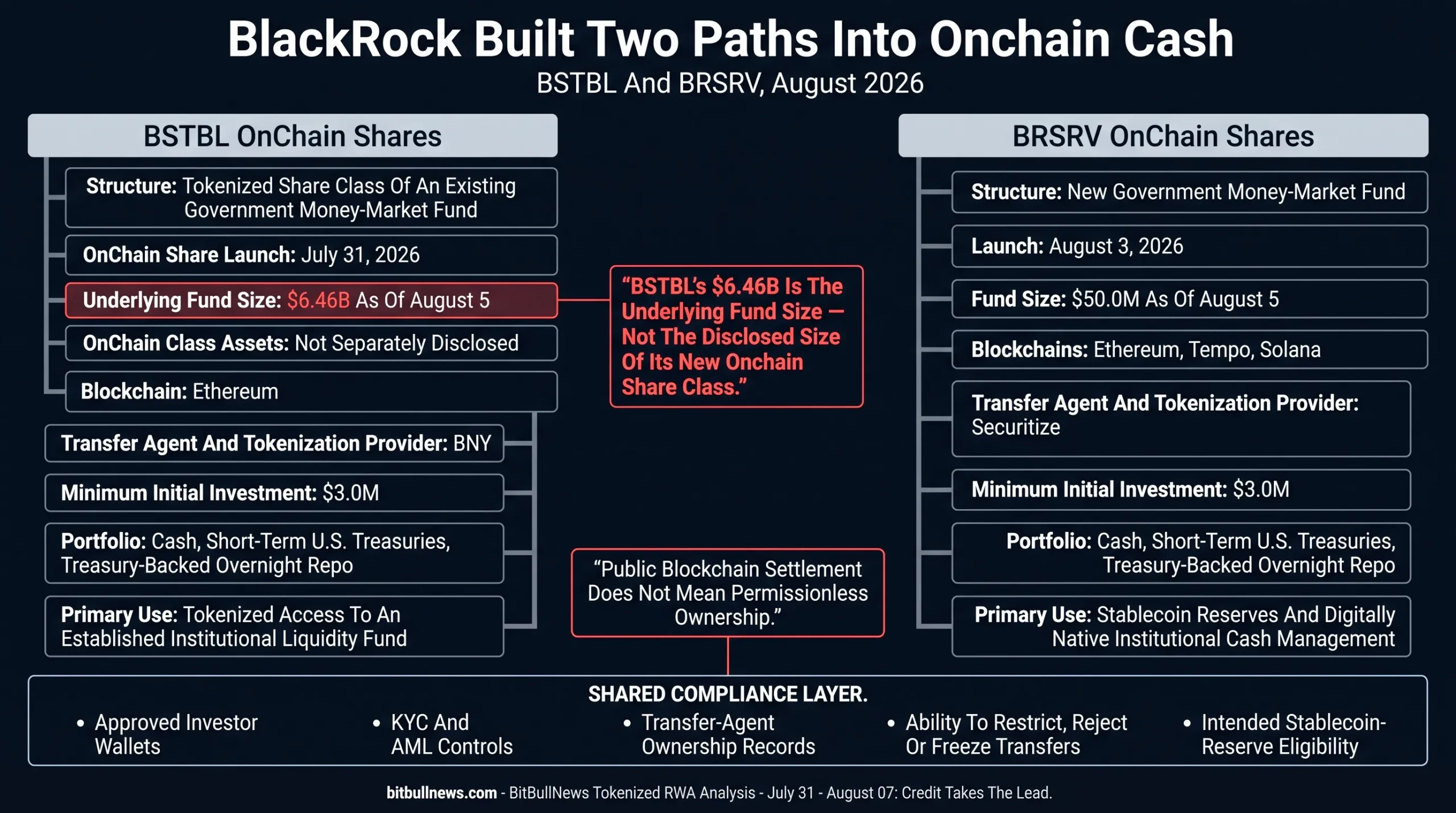
The distinction between the two structures is important.
BSTBL tokenizes access to an existing fund with more than $6 billion of assets. The size of the new onchain class was not separately disclosed on BlackRock’s public product page.
BRSRV began with $50 million and was created specifically for digitally native institutional cash and reserve management.
BlackRock’s prospectus states that BRSRV’s transfer agent maintains the official ownership record through a permissioned system connected to public blockchains. Wallets must be approved, and transfers can be restricted, rejected or frozen.
This is public-chain infrastructure with regulated access controls.
The tokens can move outside standard fund-processing hours between approved investors. They are not permissionless bearer assets that any address can acquire.
That model is likely to become standard for institutional tokenization: public settlement rails combined with offchain identity, transfer-agent authority and legal restrictions.
Stablecoin Reserves Are Becoming An Asset-Management Market
BRSRV is designed around the reserve needs of stablecoin issuers.
That moves tokenized money-market funds into direct competition for a new institutional mandate: managing the liquid assets that support regulated digital dollars.
The product is not a stablecoin. It is a registered government money-market fund whose tokenized shares may serve as reserve assets if the fund and the issuer satisfy applicable law.
This distinction should remain explicit.
Stablecoins promise payment or redemption at a fixed value. Money-market-fund shares represent an investment product subject to fund rules, portfolio performance and operational terms.
The two instruments can work together without becoming legally or economically identical.
Capital Continued Moving Beyond Ethereum
Ethereum remained the largest RWA network with $17.14 billion of distributed value, equal to approximately 45.5% of the market.
BNB Chain held $5.90 billion, Solana $3.73 billion, Stellar $3.07 billion and Avalanche $1.94 billion. The top five networks controlled about 84.3% of distributed RWA value.
Network Capital Distribution
| Network | Distributed RWA Value | Share Of Distributed Market | RWA Holder Addresses | RWA.xyz 30-Day Net Flow |
|---|---|---|---|---|
| Ethereum | $17.14B | 45.5% | 222,023 | Approximately -$1.2B |
| BNB Chain | $5.90B | 15.7% | 320,659 | Approximately +$1.2B |
| Solana | $3.73B | 9.9% | 325,870 | Approximately +$118M |
| Stellar | $3.07B | 8.1% | 19,191 | Approximately +$137M |
| Avalanche | $1.94B | 5.1% | 9,069 | Approximately +$414M |
| Liquid Network | $1.34B | 3.6% | 58 | Not Shown Among Largest Bars |
| ZKsync Era | $960.01M | 2.5% | 152 | Not Shown Among Largest Bars |
| Arbitrum | $820.72M | 2.2% | 9,290 | Approximately -$45M |
| Polygon | $504.25M | 1.3% | 22,522 | Not Shown Among Largest Bars |
| Monad | $484.84M | 1.3% | 1,269 | Approximately +$213M |
| Base | $347.53M | 0.9% | 36,769 | Approximately +$37M |
| Mantle | $196.72M | 0.5% | 3,352 | Approximately -$45M |
Thirty-day flows come from RWA.xyz’s network flow chart and are rounded.
The 30-day flows showed a substantial redistribution.
Ethereum lost roughly $1.2 billion, while BNB Chain gained about the same amount. Avalanche added approximately $414 million, Monad gained $213 million and Stellar gained $137 million.
Ethereum’s decline did not remove its structural lead.
It still held almost three times BNB Chain’s distributed value and supported 1,739 tracked RWA contracts.
The flow pattern does show that institutional and consumer-facing tokenization is no longer expanding through Ethereum alone.
Private-market products, tokenized stocks, commodity tokens and institutional fund structures are spreading across networks selected for specific distribution, compliance or settlement requirements.
Network Holder Counts Describe Different Markets
Solana and BNB Chain each had more than 300,000 RWA holder addresses. Ethereum had about 222,000. Stellar held more than $3 billion across fewer than 20,000 addresses.
Those figures should not be read as a direct investor ranking.
A blockchain address may represent one person, several accounts, an exchange, a custodian or an omnibus structure. Different token standards also affect how holders are counted.
The comparison still reveals product design.
Stellar’s high value and lower holder count indicate larger balances concentrated through institutional or fund-distribution structures. Solana and BNB Chain show broader address-level distribution through tokenized stocks and consumer-facing products.
Active Strategies Remained Concentrated
Tokenized active strategies reached $3.59 billion, up 6.04% over 30 days.
Staked USDe accounted for approximately $1.57 billion. Spiko’s euro-denominated Amundi overnight-swap fund added another $979.1 million. Together, the two products controlled about 71% of the category.
Private equity and venture capital showed a similar pattern.
The category reached $2.29 billion, but BCAP, Titan III and Hera I together represented roughly 72.7% of distributed value.
Concentration Across Active And Private Markets
| Category | Total Value | Largest Product | Largest Product Share | Top Products | Combined Share |
|---|---|---|---|---|---|
| Active Strategies | $3.59B | Staked USDe, $1.57B | 43.7% | Staked USDe And Spiko eurSAFO | Approximately 71.0% |
| Private Equity And VC | $2.29B | BCAP, $960.0M | 41.9% | BCAP, Titan III And Hera I | Approximately 72.7% |
| Tokenized Stocks | $2.31B | Ondo Platform, $854.1M | 37.0% | Ondo, bStocks, xStocks And Securitize | Approximately 95.6% |
| Distributed Credit | $7.29B | STOKR Platform, Approximately $1.30B | 17.8% | STOKR, Maple And Centrifuge | Approximately 41.5% |
Category and product shares are calculated from current public values.
Concentration is not automatically negative.
Large anchor products can create standards, attract service providers and establish operational precedents.
The risk appears when category growth is interpreted as broad market depth even though one or two products can materially change the total.
A redemption from Staked USDe or a valuation change in BCAP would have a disproportionate effect on its category.
Commodities Added Users Faster Than Value
Tokenized commodities held $4.60 billion of distributed value, down 3.18% over 30 days.
Monthly transfer volume declined 5.33% to $4.38 billion. Holder addresses increased 6.68% to 254,360, while monthly active addresses jumped 89.44% to 76,356.
The category therefore moved differently from tokenized stocks.
Stocks added value and transfer volume while losing active addresses. Commodities lost value and volume while adding active addresses.
Gold-backed products still dominated through Tether and Paxos, which together accounted for roughly $4.3 billion.
The activity growth is constructive. The concentration remains a structural dependency on two issuers, their custody arrangements and their redemption processes.
Real Estate Remained Stagnant
Tokenized real estate held $202.60 million of distributed value and $279.84 million of represented value.
Distributed value declined 0.04% over 30 days, while monthly active addresses fell 16.64% to 1,042.
The category’s structural challenges have not changed.
Tokenizing a property interest can simplify ownership records and investor administration. It does not create frequent valuations, standardized assets or natural two-way markets.
Real estate remains difficult to trade because each building, fund and jurisdiction carries separate legal and economic terms.
Ripple Invested In The Post-Issuance Layer
Ripple announced strategic investments in ZILO and Licuido on August 3.
ZILO provides transfer-agency and fund-administration technology. Licuido provides issuance, distribution, trading and collateral-mobility infrastructure for digital ownership. Ripple said the investments would bring those functions into its institutional infrastructure on the XRP Ledger.
The company described RLUSD as the cash leg for delivery-versus-payment transactions and said tokenized funds could be used as collateral from issuance.
These are Ripple’s stated product objectives, not independently verified volume claims.
The strategic logic is stronger than the announcement headline.
Issuing a fund token is only the beginning. A functioning capital market also requires:
- An official shareholder record.
- Eligibility and transfer controls.
- Subscription and redemption processing.
- Secondary execution.
- Collateral recognition.
- Cash settlement.
- Custody and reconciliation.
- Procedures for errors, freezes and legal orders.
ZILO addresses the ownership-record and transfer-agency layer. Licuido targets issuance, distribution and collateral utility.
That combination shows where institutional competition is moving: from token creation toward the systems that make tokenized assets usable after issuance.
BlackRock And Ripple Target Different Bottlenecks
BlackRock is tokenizing regulated cash products.
Ripple is assembling the infrastructure required to issue, record, trade and mobilize tokenized funds.
The models are complementary.
| Market Function | BlackRock Tokenized Funds | Ripple, ZILO And Licuido |
|---|---|---|
| Asset Manufacturing | Government money-market funds | Supports third-party tokenized assets and funds |
| Official Ownership Record | BNY Or Securitize Transfer Agency | ZILO transfer-agency infrastructure |
| Distribution | Approved institutional wallets | Issuance and distribution through Ripple and Licuido infrastructure |
| Cash Leg | Fund subscriptions and redemptions | RLUSD proposed for delivery-versus-payment |
| Collateral Utility | Reserve and institutional cash use cases | Tokenized funds intended for borrowing, lending and margin |
| Settlement | Token transfers between approved wallets | Atomic settlement on XRPL |
| Core Bottleneck Addressed | Onchain access to regulated liquidity products | Post-issuance market infrastructure |
The table summarizes publicly stated product designs. It does not imply interoperability between the BlackRock and Ripple systems.
Institutional tokenization is becoming a stack rather than a single product.
Asset managers manufacture the investment exposure. Transfer agents maintain the official ownership record. Tokenization providers create the digital share. Custodians control assets and keys. Settlement networks move ownership. Stablecoins or deposits provide the payment leg.
The strongest platforms will connect those functions without weakening legal certainty or operational controls.
What Institutional Allocators Should Watch Next
Whether Credit Growth Produces Secondary Activity
Distributed credit gained approximately $300 million between BitBullNews snapshots.
The stronger confirmation would be higher transfer activity, more controlled secondary transactions and transparent redemption data. Outstanding credit value alone does not show whether investors can exit positions.
Whether Tokenized-Stock Activity Broadens
Stock-token volume increased while active addresses declined.
A healthier structure would show transfer volume and active participation growing together rather than relying on a smaller group of large accounts.
Whether BUIDL Keeps Taking Treasury Share
BUIDL led visible 30-day Treasury flows with approximately $441 million.
Continued growth would strengthen BlackRock’s position across both private-placement tokenized funds and registered onchain money-market products.
How Much Capital Enters BSTBL’s Onchain Class
The underlying fund held $6.46 billion, but BlackRock did not separately display the assets held through the new onchain class.
A class-level balance would show whether institutions are changing the way they hold the fund rather than simply receiving another access option.
Whether BRSRV Grows Beyond Its Initial $50 Million
BRSRV launched with $50 million and multi-network support.
The next evidence should include assets, wallet count, stablecoin-issuer participation, transfers and reserve-management use.
Whether Ethereum’s Outflow Stabilizes
Ethereum remained the largest network but recorded approximately $1.2 billion of negative 30-day flow.
A return to growth would show that new multi-chain issuance is expanding the market rather than steadily reallocating value away from Ethereum.
Whether BNB Chain Converts Flow Into Durable Products
BNB Chain gained approximately $1.2 billion over 30 days.
Analysts should determine whether the value remains in stable institutional products or reflects launch-period stock-token issuance that can reverse quickly.
Whether Ripple Reports Live Collateral Activity
The ZILO and Licuido investments target transfer agency, issuance and collateral mobility.
The next useful disclosures would be assets issued, funds serviced, collateral pledged, settlement volume and the share of transactions using RLUSD.
RWA Risk Dashboard
| Signal | Current Reading | Interpretation | Confirmation Needed |
|---|---|---|---|
| Distributed RWA Value | $37.70B | Market continued expanding | Growth persists without major coverage changes |
| RWA Holder Addresses | 1.60M, +4.58% Between BBN Snapshots | Distribution outpaced market value | Repeat activity and higher average balances |
| Represented RWA Value | $398.92B | Large controlled-platform market remains | Better classification and module reconciliation |
| Tokenized Treasuries | $16.15B | Largest asset class consolidated | Renewed multi-product net growth |
| Tokenized Credit | $7.29B | Main weekly growth engine | Secondary transfer and redemption evidence |
| Represented Credit | $36.67B | Most credit tokenization remains platform-bound | More controlled external transferability |
| Tokenized Stocks | $2.31B Across 1.02M Holders | Distribution reached a new scale | Growth in legally clear, active ownership |
| Stock Transfer Volume | $14.99B, +72.32% Over 30 Days | Economic movement increased | Volume remains high across several platforms |
| Stock Active Addresses | 262,781, -38.13% Over 30 Days | Activity became more concentrated | Active participation returns to growth |
| Top Four Stock Platforms | Approximately 95.6% Of Value | Platform concentration remained extreme | More credible distribution venues gain share |
| Active Strategies | $3.59B | Strategy value continued expanding | Growth broadens beyond the top two products |
| Top Two Active Strategies | Approximately 71.0% Of Category | Product concentration remains high | Additional managers reach institutional scale |
| Private Equity And VC | $2.29B | Fastest major weekly percentage growth | Better valuation and transfer transparency |
| Top Three PE/VC Tokens | Approximately 72.7% Of Category | Private-market value remained concentrated | Broader issuance and investor distribution |
| Commodity Value | $4.60B, -3.18% Over 30 Days | Category contracted moderately | Value stabilizes as active addresses grow |
| Real Estate Value | $202.60M | Market remained stagnant | More active investors and secondary transactions |
| Ethereum RWA Share | Approximately 45.5% | Network retained capital leadership | Outflows stabilize |
| BNB Chain 30-Day Flow | Approximately +$1.2B | Largest positive network move | Value remains after launch-period activity |
| BlackRock BRSRV | $50M At Launch | Reserve-focused tokenized fund entered production | Stablecoin issuers and institutional users adopt it |
| BSTBL Onchain Assets | Not Separately Disclosed | Underlying fund size overstates visible tokenized adoption | Class-level asset and holder disclosure |
| Ripple Infrastructure Investments | ZILO And Licuido | Focus shifted toward transfer agency and collateral utility | Live issuance, settlement and collateral metrics |
The Market Quality Test: Proving Liquidity After Proving Demand
Tokenized RWA value reached $37.70 billion this week, up approximately $350 million from the previous BitBullNews snapshot.
Holder addresses increased faster, rising by more than 70,000 to 1.60 million.
The growth did not come from Treasuries.
Distributed credit added roughly $300 million. Private equity and venture capital gained about $110 million. Active strategies added $70 million, while tokenized stocks gained approximately $50 million.
Treasury value slipped slightly to $16.15 billion. The category remained the market’s largest capital base, but product flows showed rotation. BUIDL gained approximately $441 million over 30 days while USYC lost $109 million.
Tokenized stocks crossed one million holder addresses and produced $14.99 billion of monthly transfer volume. Monthly active addresses fell 38.13%.
That is not a simple liquidity improvement. More value moved through a market used by fewer active addresses.
Credit was the stronger weekly story.
Distributed value reached $7.29 billion, while another $36.67 billion remained represented inside controlled platforms. The gap shows that blockchain recordkeeping has scaled faster than externally transferable credit markets.
BlackRock supplied the week’s most important product launch.
BSTBL brought an onchain class to an existing $6.46 billion Treasury liquidity fund. BRSRV launched with $50 million as a multi-chain money-market vehicle designed for institutional cash and potential stablecoin reserve use.
The products show how regulated tokenization is likely to scale: public blockchains, approved wallets, official transfer-agent records and the ability to freeze or reject prohibited transfers.
Ripple targeted the next layer.
Its investments in ZILO and Licuido focus on transfer agency, issuance, execution and collateral mobility. The strategy reflects a market moving beyond token creation toward complete capital-markets infrastructure.
Network distribution continued broadening.
Ethereum retained a 45.5% share of distributed RWA value but recorded a large negative 30-day flow. BNB Chain gained roughly $1.2 billion. Avalanche, Monad, Stellar and Solana also expanded.
The market is not converging on one blockchain or one token standard.
It is separating into specialized systems for cash management, credit, public equities, private funds, collateral and settlement.
The next stage will be measured by market quality.
Can tokenized credit trade between eligible investors? Can stock-token volume broaden beyond a few platforms? Can onchain fund shares serve as collateral without breaking ownership records? Can reserve products grow beyond launch capital?
The market is already large enough to prove demand.
It now has to prove liquidity, interoperability and operational resilience.
Data Sources & References
- RWA.xyz — Network Analytics
- RWA.xyz — Tokenized U.S. Treasury Funds
- RWA.xyz — Tokenized Credit
- RWA.xyz — Tokenized Stocks
- RWA.xyz — Tokenized Active Strategies
- RWA.xyz — Private Equity And Venture Capital
- RWA.xyz — Tokenized Commodities
- RWA.xyz — Tokenized Real Estate
- BlackRock — BSTBL And BRSRV Launch
- BlackRock — Select Treasury Based Liquidity Fund
- BlackRock — Daily Reinvestment Stablecoin Reserve Vehicle
- BlackRock — BRSRV Prospectus
- Ripple — Investments In ZILO And Licuido
- Binance — bStocks Market Data And Product Structure
- Tokenized But Illiquid? Evidence From RWA Markets
- Beyond TVL: Risk Scoring For Tokenized RWAs