


Content
Crypto policy moved away from broad classification debates this week and into the machinery that determines whether regulated markets can function.
The clearest development came from U.S. stablecoin implementation. The comment period closed on August 4 for an FDIC proposal that would apply Bank Secrecy Act, sanctions and customer-identification requirements to payment stablecoin issuers supervised by the agency. The proposal also sets out how the FDIC would coordinate with FinCEN before taking significant anti-money-laundering supervisory or enforcement action.
At the SEC, four Crypto Task Force meetings between July 28 and August 3 focused on secondary trading, token disclosure, decentralized infrastructure and onchain credit vaults. These were industry presentations, not agency decisions. Their subject matter still showed where the next regulatory bottlenecks sit: disclosure standards, investment-adviser registration, qualified custody, transfer restrictions and lawful secondary-market access.
Europe moved deeper into enforcement. ESMA refreshed its MiCA register on July 31, one month after the final EU transitional period expired. The register now serves as an operational verification tool for authorized providers, token issuers and entities identified as non-compliant. It remains subject to a weekly reporting lag and does not constitute approval of listed white papers.
Congress remained the missing piece. The completed Senate record available at the reporting cutoff showed no floor vote on the CLARITY Act. The Senate’s August 4 session had not yet begun at the BitBullNews cutoff, so this report does not treat the bill as defeated or formally delayed. It remained pending while regulators continued building rules under existing and recently enacted authorities.
The week’s enforcement action supplied the final warning. OFAC sanctioned an Iranian maritime scheme that accepted Bitcoin and other digital assets, extending sanctions controls from wallets and exchanges into shipping, insurance, ownership networks and service providers.
The regulatory perimeter is no longer defined by whether a business calls itself a bank, exchange, protocol or software company.
It is being defined by what the business controls, whose assets it holds, how transactions move and which party remains responsible when the system fails.
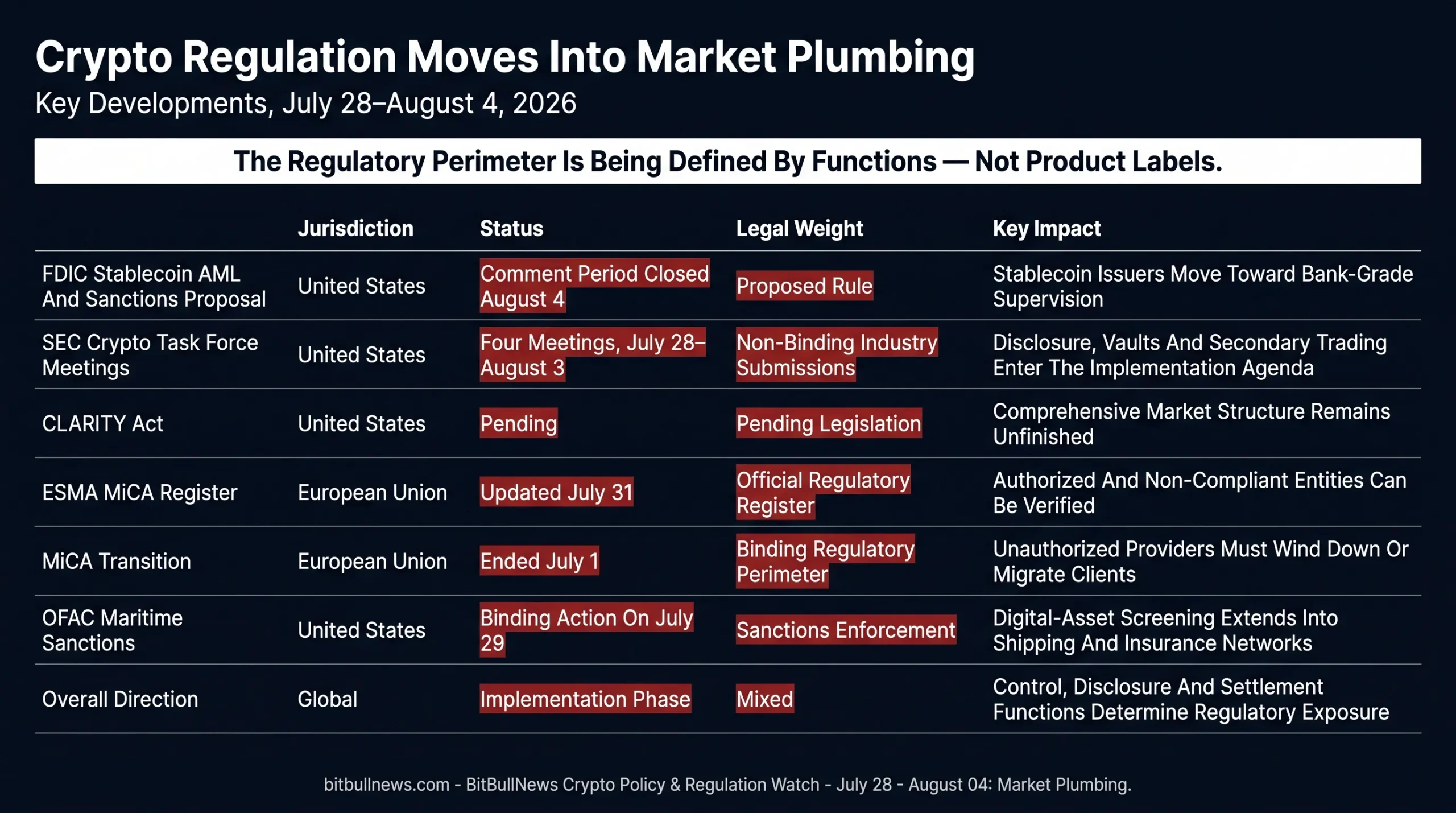
Weekly Regulatory Scorecard
| Jurisdiction | Development | Status At The Reporting Cutoff | Market Significance |
|---|---|---|---|
| United States | FDIC stablecoin AML and sanctions proposal | Public comment period closed August 4 | Moves GENIUS Act implementation from statute toward examination and enforcement |
| United States | SEC Crypto Task Force meetings | Four industry meetings held July 28–August 3 | Disclosure, secondary trading, DePIN and vault registration moved onto the implementation agenda |
| United States | CLARITY Act | No completed Senate floor vote in the published record through August 3 | Comprehensive market-structure legislation remained unfinished |
| European Union | ESMA MiCA register | Latest register update published July 31 | Authorization and non-compliance can be verified by legal entity |
| European Union | End Of MiCA transition | Final transitional period expired July 1 | Unlicensed providers must exit or transfer clients to authorized entities |
| United States | OFAC Iran maritime action | Binding sanctions imposed July 29 | Digital-asset screening must extend beyond named wallet addresses |
| Global | Regulatory direction | Supervision increasingly focused on control, disclosure and settlement functions | Product architecture now affects licensing and compliance outcomes |
Stablecoin Regulation Entered The Supervisory Phase
The GENIUS Act established the U.S. federal framework for permitted payment stablecoin issuers. The FDIC proposal now addresses what compliance would look like for issuers operating through subsidiaries of state nonmember banks and state savings associations supervised by the agency.
The proposal would require those issuers to comply with applicable Bank Secrecy Act regulations, economic-sanctions rules, AML/CFT program obligations, customer-identification requirements and regulatory reporting standards.
That sounds close to the framework already applied to banks. The technical challenge is different.
Stablecoin issuers must apply those controls to transactions that can involve:
- Self-hosted wallets.
- Smart contracts.
- Cross-chain bridges.
- Tokens moving outside the issuer’s direct interface.
- Secondary transfers between parties with no direct account relationship.
- Transactions that settle outside conventional banking hours.
- Addresses that can be created or changed almost instantly.
The proposal therefore matters less for its high-level requirement to maintain an AML program than for how issuers will connect blockchain monitoring to bank-grade customer and sanctions controls.
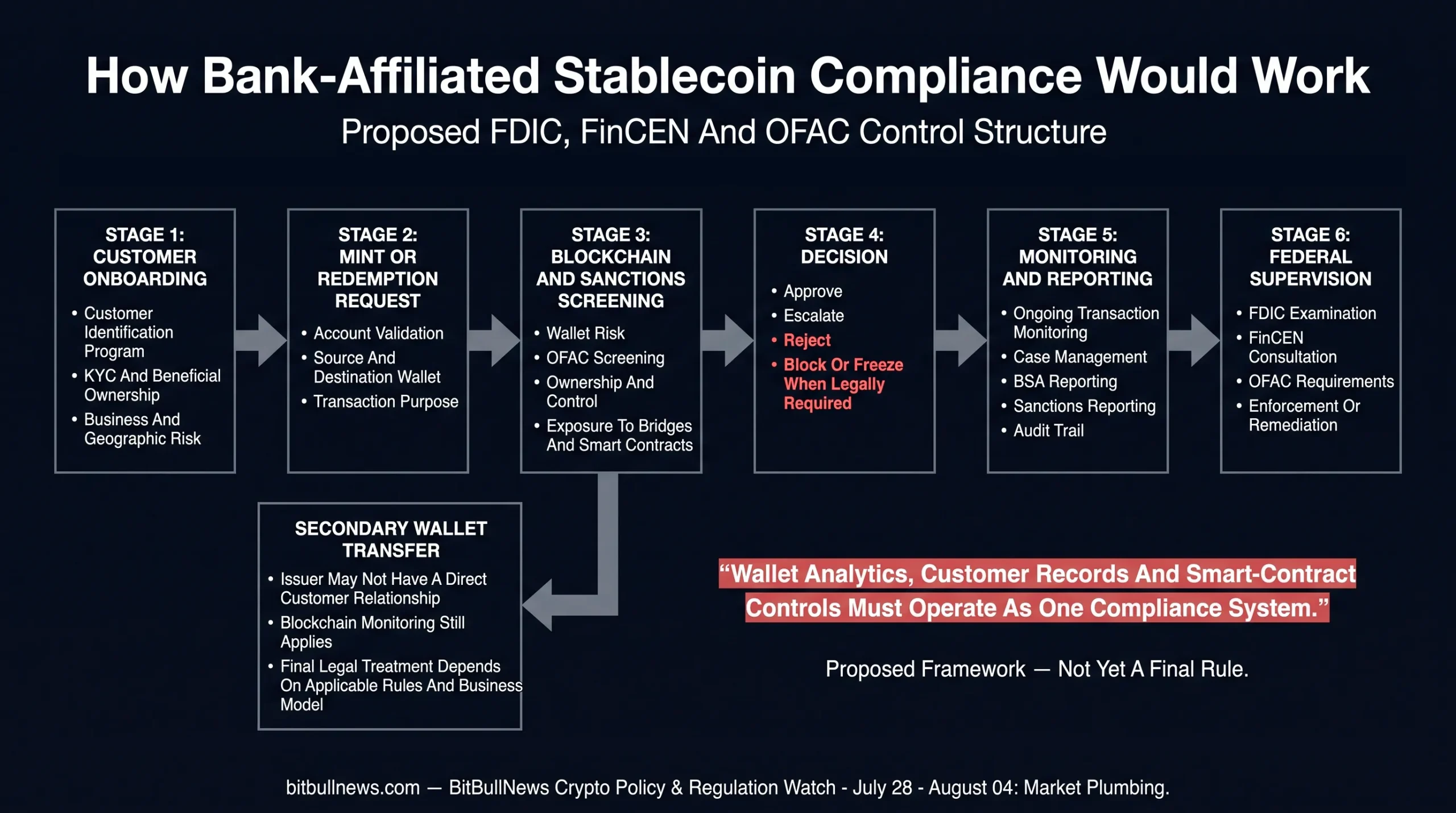
FDIC Stablecoin Compliance Architecture
| Regulatory Component | Proposed Requirement | Operational Consequence |
|---|---|---|
| Bank Secrecy Act | PPSIs must comply with applicable BSA rules | Issuer controls must connect wallet activity with customer and transaction records |
| AML/CFT Program | Effective program required under applicable FinCEN rules | Risk assessments, monitoring, escalation, testing and governance must cover stablecoin activity |
| Economic Sanctions | Effective sanctions-compliance program required | Issuers need capabilities to identify, reject, block or freeze prohibited transactions |
| Customer Identification | PPSIs must comply with joint federal CIP requirements | Direct customers must be identified under a documented onboarding framework |
| Regulatory Reporting | Applicable BSA and sanctions reports must be filed | Onchain transaction data must be converted into usable compliance and regulatory records |
| FDIC Supervision | FDIC may take formal or informal action over deficiencies | Stablecoin operations become part of prudential examination rather than a separate technology experiment |
| FinCEN Coordination | FDIC generally gives FinCEN advance notice before significant action | Enforcement responsibility is coordinated across banking and financial-crime regulators |
| Supervisory Information Sharing | Proposal provides mechanisms for sharing protected information with FinCEN | Issuers should expect compliance findings to move between relevant federal supervisors |
| Technical Integration | DLT monitoring must connect with enterprise compliance systems | Wallet risk, ownership, customer data and lawful-order handling cannot remain in separate systems |
The rule remains proposed. The August 4 deadline closed the public-comment phase; it did not make the text final.
The Proposal Does Not Require Identity Checks For Every Wallet Holder
The distinction between an issuer’s customer and every downstream token holder will be one of the hardest implementation questions.
A payment stablecoin can circulate after issuance. The issuer may know the institution that minted the tokens without having a direct relationship with every person who later receives them.
The proposal requires compliance with applicable customer-identification rules. It does not, by itself, state that every secondary holder of every token must open an account directly with the issuer. The final treatment will depend on the interaction between the FDIC rule, the joint federal CIP proposal, FinCEN requirements and the issuer’s business model.
That leaves a three-layer control structure:
- Direct-customer controls: identification and due diligence for the issuer’s minting, redemption and account customers.
- Transaction controls: blockchain monitoring and sanctions screening for token movements involving known or higher-risk addresses.
- Intermediary controls: reliance on regulated exchanges, custodians and payment providers that manage their own customers.
The final rules will determine how much reliance issuers may place on regulated intermediaries and when activity involving a self-hosted wallet requires enhanced review.
Stablecoin Compliance Will Depend On Execution Capability
A policy that requires an issuer to block prohibited property is only useful if the token and operational structure allow the issuer to do so.
Issuers will need to document:
- Whether tokens can be frozen at the smart-contract level.
- Who can exercise freeze or burn authority.
- How lawful orders are authenticated.
- How false-positive sanctions alerts are reviewed.
- Whether controls operate across every supported blockchain.
- How bridged or wrapped versions of the stablecoin are handled.
- What happens when tokens enter an immutable protocol.
- How redemptions are denied or delayed when ownership is disputed.
The FDIC said relevant costs may include integrating distributed-ledger monitoring into existing enterprise systems and developing the ability to block, freeze or reject transactions when required by law.
That makes token administration part of prudential compliance.
A bank-affiliated issuer cannot place wallet analytics in one system, customer records in another and lawful-order execution in a manual process with no shared audit trail.
FDIC And FinCEN Would Share The Enforcement Perimeter
The proposal creates a structured consultation process between the FDIC and FinCEN.
Before initiating a significant AML/CFT enforcement or supervisory action, the FDIC would generally provide FinCEN with notice and supporting information at least 30 days in advance. The period could be shortened when the FDIC considers faster intervention necessary to address an unsafe or unsound condition.
The division of responsibility is important:
| Authority | Primary Role In The Proposed Structure |
|---|---|
| FinCEN | Administers BSA and AML/CFT regulations and evaluates program effectiveness |
| OFAC | Administers economic-sanctions programs and prohibited-property obligations |
| FDIC | Supervises applicable bank-affiliated issuers and addresses unsafe, unsound or non-compliant practices |
| Other Federal Stablecoin Regulators | Apply parallel GENIUS Act rules to issuers within their respective jurisdiction |
| Issuer’s Parent Bank | Provides much of the governance, monitoring and enterprise compliance infrastructure |
The exact structure remains subject to final rulemaking.
The model reduces one form of regulatory fragmentation by linking stablecoin oversight to existing banking supervision.
It may create another challenge: the same product can generate legal issues for several agencies at once. A sanctions problem, weak AML program, unsafe risk-management practice and misleading disclosure can arise from the same transaction pattern.
Public Comments Focused On Implementation, Not Whether Controls Should Exist
The FDIC’s public comment page showed submissions from standards organizations, risk specialists, compliance firms and market participants before the deadline. The published comments addressed issues including identity standards, transaction monitoring and technology design. The comment record may continue updating as the FDIC processes submissions received near the deadline.
The central policy question is no longer whether bank-affiliated stablecoin issuers need AML and sanctions programs.
It is how those programs can remain effective without converting every public-blockchain transfer into a permissioned bank transaction.
A rule that is too loose leaves an obvious illicit-finance gap. A rule that assumes every wallet functions like a bank account may make lawful open-network transfers operationally impossible.
The SEC Shifted From Classification To Market Infrastructure
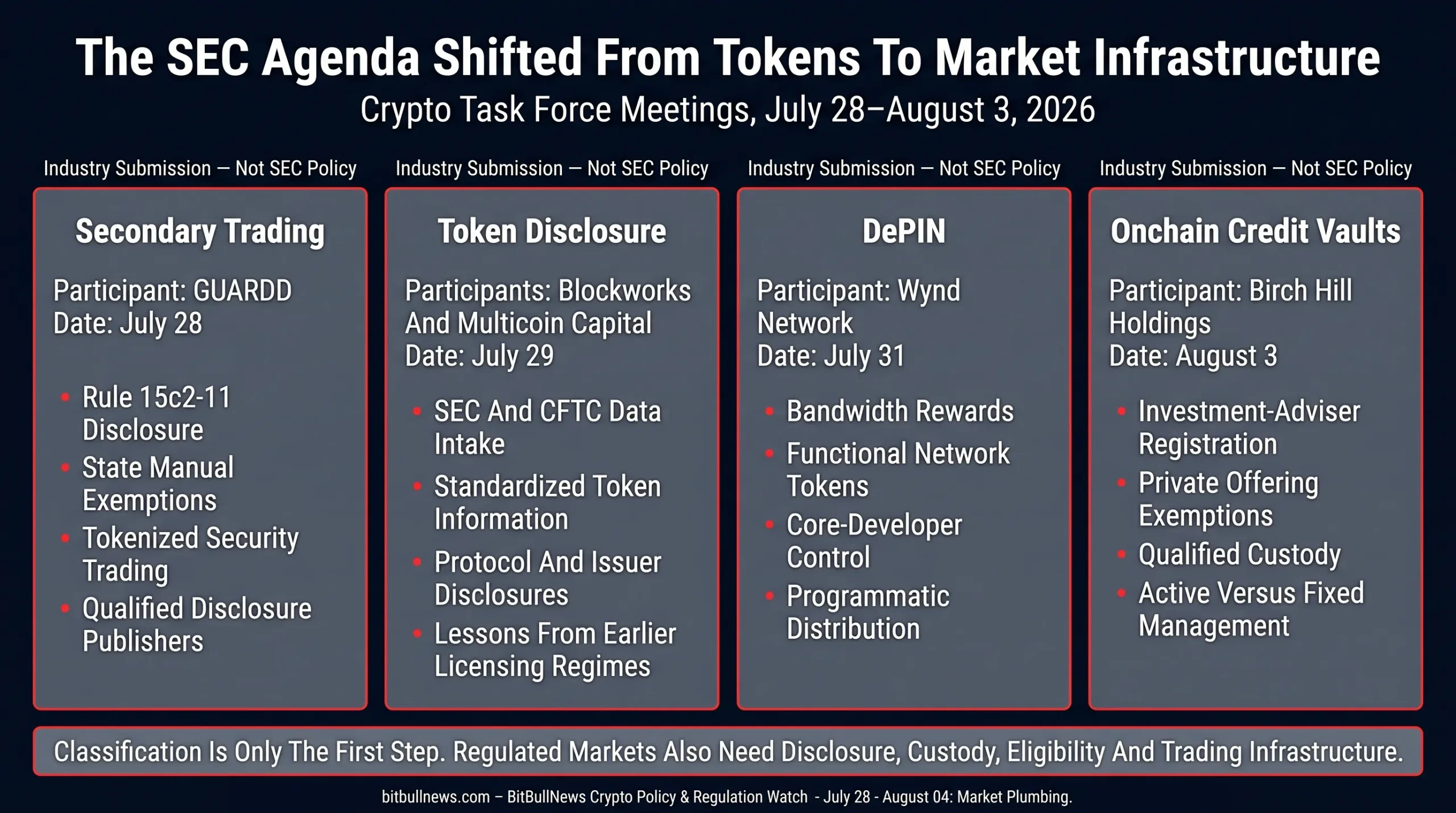
The SEC Crypto Task Force held four disclosed meetings during the reporting period.
None resulted in a rule, exemption, no-action position or Commission interpretation. The materials were supplied by private parties seeking regulatory engagement. They should be read as proposals and market evidence, not as SEC conclusions.
The pattern across the meetings was still notable.
SEC Crypto Task Force Meetings
| Date | Participants | Primary Topic | Regulatory Bottleneck |
|---|---|---|---|
| July 28 | GUARDD | Secondary trading of tokenized and exempt securities | Disclosure availability, Rule 15c2-11 and state-law fragmentation |
| July 29 | Blockworks And Multicoin Capital | Token-market disclosure systems | Standardized issuer and protocol information for SEC and CFTC use |
| July 31 | Wynd Network And Counsel | Decentralized physical infrastructure networks | Treatment of token incentives tied to bandwidth and network contribution |
| August 3 | Birch Hill Holdings And Counsel | Onchain credit vaults | Adviser registration, exemptions, custody and actively managed strategies |
The meetings reflect private submissions to SEC staff. They do not represent Commission approval of the proposed models.
Token Issuance Is Only Half Of A Market
GUARDD’s submission focused on a structural problem that applies to tokenized securities as well as traditional exempt offerings.
An issuer may legally raise capital under an exemption. That does not automatically create a usable secondary market.
GUARDD told the SEC that Regulation Crowdfunding had produced more than $2.95 billion across 10,899 offerings by more than 9,300 issuers since 2016, but fewer than 1% of issuers achieved what it described as meaningful secondary liquidity. Those figures came from GUARDD’s affiliated database and were submitted for policy advocacy; the SEC did not independently adopt them.
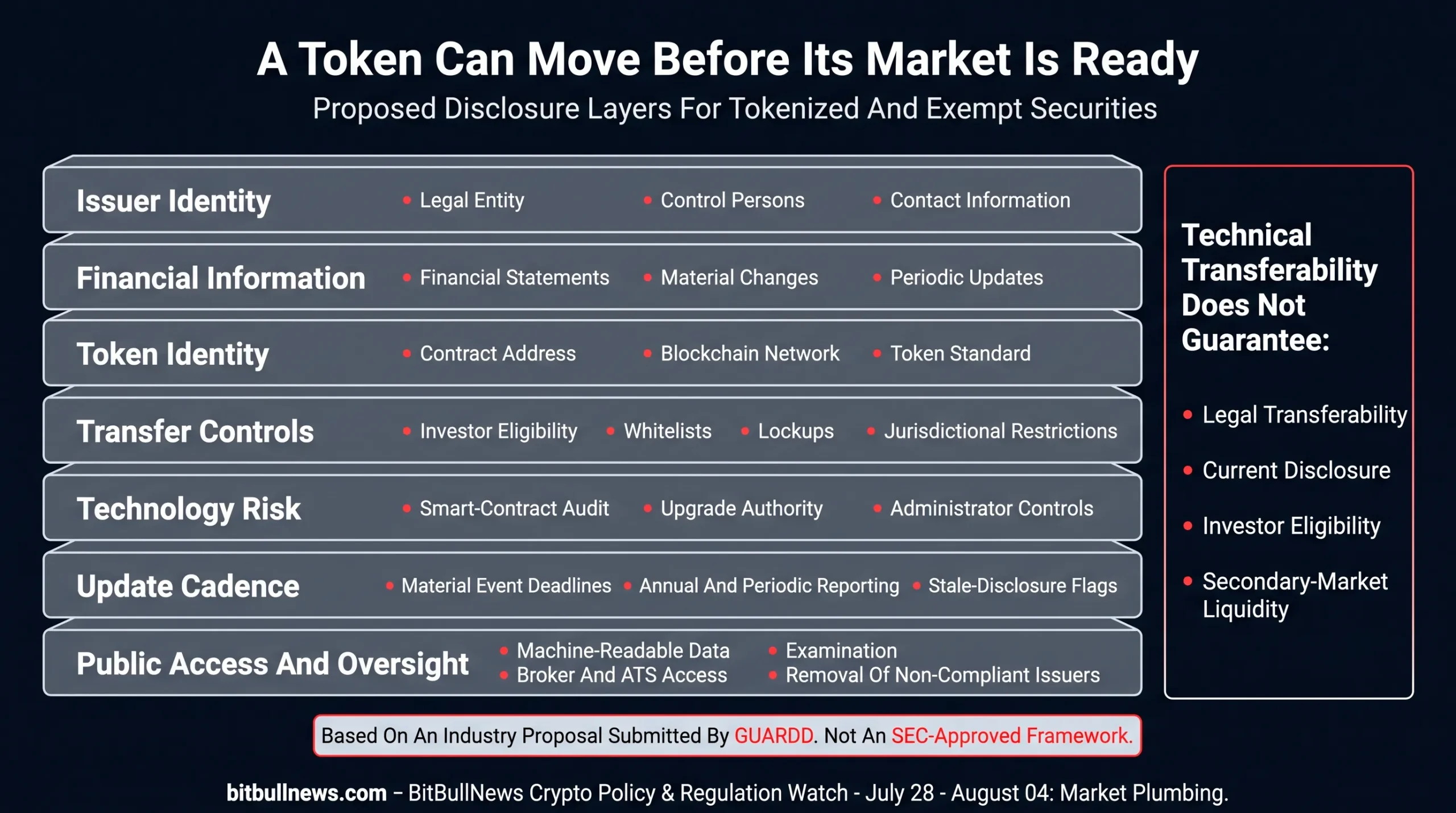
The company proposed recognition of “Qualified Disclosure Publishers” that would maintain standardized, publicly accessible information for exempt and tokenized securities.
The suggested disclosures included:
- Financial statements.
- Material issuer changes.
- Contract addresses.
- Blockchain network.
- Token standard.
- Transfer restrictions.
- Smart-contract audit status.
- Defined update schedules.
The objective is to give broker-dealers and alternative trading systems a reliable source of current information when evaluating whether a security may be quoted or traded.
Proposed Tokenized-Security Disclosure Model
| Disclosure Layer | Proposed Information | Market Function |
|---|---|---|
| Issuer Identity | Legal entity, control persons and contact information | Links the token to an accountable issuer |
| Financial Information | Periodic financial statements and material updates | Supports valuation and fraud review |
| Token Identity | Contract address, network and token standard | Prevents confusion between similarly named or copied tokens |
| Transfer Controls | Whitelists, lockups and contractual restrictions | Shows who may legally receive or transfer the asset |
| Technology Risk | Smart-contract audits and upgrade authority | Identifies software and administrative dependencies |
| Update Cadence | Defined deadlines for material and periodic disclosures | Reduces stale information |
| Public Availability | Standardized and machine-readable access | Allows regulators, intermediaries and investors to use the same record |
| Oversight | Policies, examination access and removal procedures | Creates accountability for disclosure publishers |
This is a summary of GUARDD’s proposal, not an SEC-endorsed regulatory framework.
The core issue is not specific to crowdfunding.
Tokenized private credit, fund interests and private-company shares can be technically transferable while remaining legally restricted and informationally opaque.
Blockchain can move the token. It cannot supply missing financial statements, resolve state-law exemptions or determine whether a buyer is eligible.
Disclosure Cannot Replace Registration Or Investor Eligibility
A standardized disclosure publisher could make information easier to find. It would not turn a restricted security into an unrestricted asset.
A compliant secondary market may still need:
- A registered broker-dealer or alternative trading system.
- Verified investor eligibility.
- Transfer-agent controls.
- Contractual transfer restrictions.
- Applicable state-law compliance or federal pre-emption.
- Sanctions and AML screening.
- Accurate ownership records.
- Procedures for errors, lost keys and court orders.
The distinction matters because “onchain liquidity” is often measured by whether tokens can move between addresses.
Regulated liquidity requires more. The buyer must be permitted to own the security, the seller must be permitted to transfer it, and intermediaries must have enough information to support the transaction.
Token Disclosures Are Moving Toward A Joint SEC–CFTC Problem
Blockworks and Multicoin used their July 29 meeting to discuss token disclosures and a potential intake model for both the SEC and CFTC.
Their materials referenced the difficulty of imposing new disclosure systems on market participants that were not previously subject to those systems. They also highlighted lessons from earlier licensing regimes, including New York’s BitLicense.
The joint-agency angle matters.
A future market-structure framework may place different assets or activities under different regulators. Yet the same token project can produce information relevant to both:
- Issuance and capital formation.
- Commodity-market trading.
- Insider allocations.
- Protocol governance.
- Token unlocks.
- Concentrated ownership.
- Market-making arrangements.
- Network and cybersecurity risks.
Separate regulators using incompatible disclosure formats would reproduce the fragmentation Congress is trying to resolve.
DePIN Added A Different Classification Problem
The Wynd Network meeting focused on decentralized physical infrastructure.
Its Grass network rewards users for sharing unused internet bandwidth through an opt-in residential proxy network. The meeting materials did not provide a detailed legal proposal, and SEC staff published no conclusion.
The model raises a different set of questions from tokenized securities:
- Is the token compensation for a measurable service?
- Does value depend primarily on network use or on managerial promises?
- How much control does the core development company retain?
- Are rewards distributed according to transparent and objective rules?
- What disclosures should users receive about demand, token supply and customer concentration?
The completed SEC interpretation issued earlier in 2026 classified functional digital commodities, digital tools and digital securities differently and stated that certain programmatic token distributions may fall outside securities transactions depending on their structure. Product-specific facts still determine the result.
Onchain Credit Vaults Are Testing Existing Fund Rules
The August 3 Birch Hill meeting supplied a practical response to the SEC’s recent scrutiny of crypto vaults.
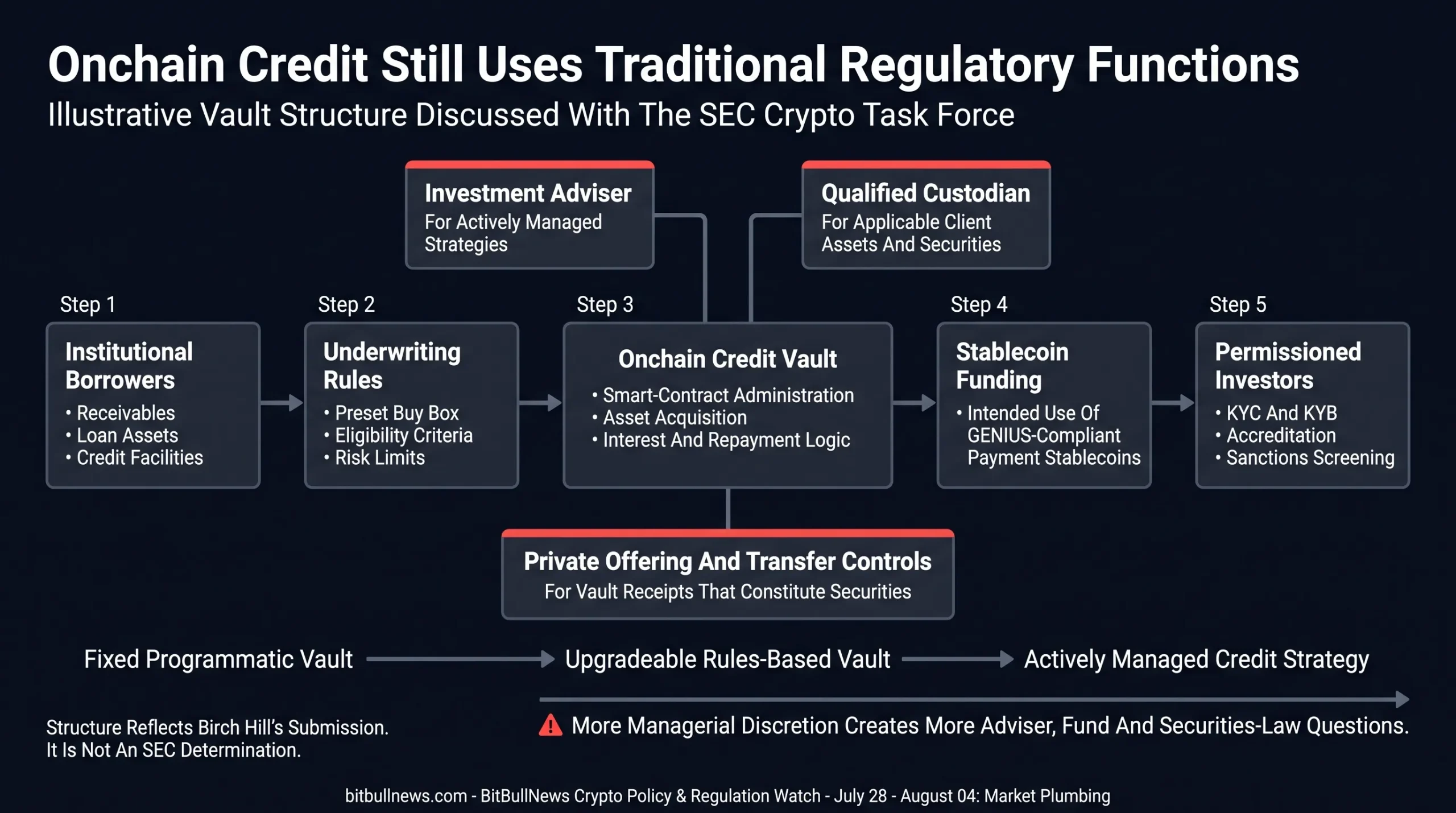
Birch Hill described permissioned credit vaults that would acquire receivables or loan assets under predefined underwriting criteria and receive stablecoin funding from issuers expected to meet GENIUS Act standards. It said vault receipts that constitute securities would be privately placed with users completing KYC/KYB, accreditation and sanctions screening.
The company also distinguished between fixed-parameter vaults and actively managed products. For actively managed securities strategies, it said it planned to use an investment adviser and qualified custodians.
Again, this was the company’s intended structure, not an SEC determination.
Onchain Vault Regulatory Map
| Vault Feature | Potential Regulatory Question | Proposed Compliance Response In Birch Hill’s Submission |
|---|---|---|
| Vault acquires receivables or loans | Does the vault issue a security or investment-company interest? | Private placement under applicable exemptions where required |
| Strategy follows a fixed “buy box” | How much managerial discretion remains? | Preset and transparent underwriting parameters |
| Manager reallocates or selects assets | Is the operator acting as an investment adviser? | Use an affiliated adviser and transition toward full registration as products scale |
| Stablecoins fund the vault | Are the payment assets issued under the federal framework? | Intention to use liquidity from GENIUS-compliant issuers |
| Vault receipts are transferable | Who may hold or trade the interests? | Permissioned access, accreditation and transfer controls |
| Smart contract holds or directs assets | How do adviser-custody rules apply? | Work with a federally chartered digital-asset custodian |
| Users access the product | What financial-crime controls apply? | KYC, KYB, accreditation and onchain/offchain sanctions screening |
The table describes Birch Hill’s submission to SEC staff and does not establish the legal status of its products.
The Existing Framework Is Becoming The Default Starting Point
The Birch Hill proposal is important because it does not assume tokenization requires a completely separate regulatory category.
Its model starts with existing structures:
- Private securities exemptions.
- Investment-adviser registration.
- Qualified custody.
- Accredited-investor verification.
- Sanctions screening.
- Permissioned transfers.
The blockchain changes execution, recordkeeping and settlement. It does not remove the legal functions performed by advisers, custodians, transfer agents and broker-dealers.
That may be the fastest route for institutional tokenization while broader rulemaking remains unfinished.
The drawback is fragmentation. Each product may need a custom analysis under several existing regimes, increasing legal cost and limiting standardization.
CLARITY Remained Unfinished
The completed Senate roll-call record available at the cutoff did not show a CLARITY Act floor vote.
The Senate had completed votes on nominations and other legislation through July 29. It convened briefly on August 3 and was scheduled to return on August 4 after the BitBullNews reporting cutoff.
The bill therefore remained pending rather than formally rejected.
That distinction matters.
A comprehensive statute could establish more durable rules for digital-commodity spot markets, intermediaries, token disclosures, DeFi interactions and interagency coordination. Until then, the SEC, CFTC, Treasury and banking regulators will continue developing narrower pieces under their existing authority.
The political dispute also remained active. Senate Banking Committee minority staff published additional criticism on July 30, focused largely on ethics and conflicts involving public officials. That material represents a partisan analysis rather than an enacted rule or neutral legal conclusion.
U.S. Crypto Policy Is Developing On Two Tracks
| Legislative Track | Regulatory Track |
|---|---|
| CLARITY seeks a comprehensive market-structure statute | FDIC, FinCEN and OFAC are implementing the enacted stablecoin framework |
| Congress may divide SEC and CFTC responsibilities | SEC staff are examining disclosures, vaults, custody and trading infrastructure |
| Legislation could create new intermediary categories | Existing broker, adviser, custody and banking rules still apply |
| Political negotiations can delay the entire package | Agency proposals can proceed on narrower subjects |
| Final text may pre-empt or modify current approaches | Firms must comply with current law until new legislation takes effect |
The risk for market participants is waiting for legislation that may not arrive on their preferred timetable.
Products launching now still need a defensible path under current law.
MiCA Became A Register-Driven Regime
ESMA updated the interim MiCA register on July 31.
The register contains five datasets:
- White papers for crypto-assets other than asset-referenced and e-money tokens.
- Asset-referenced-token issuers.
- E-money-token issuers.
- Authorized crypto-asset service providers.
- Non-compliant entities providing crypto services.
The register now matters more because the final transitional period ended across the EU on July 1. ESMA stated that unauthorized providers must implement wind-down plans and cease providing services after the applicable transition.
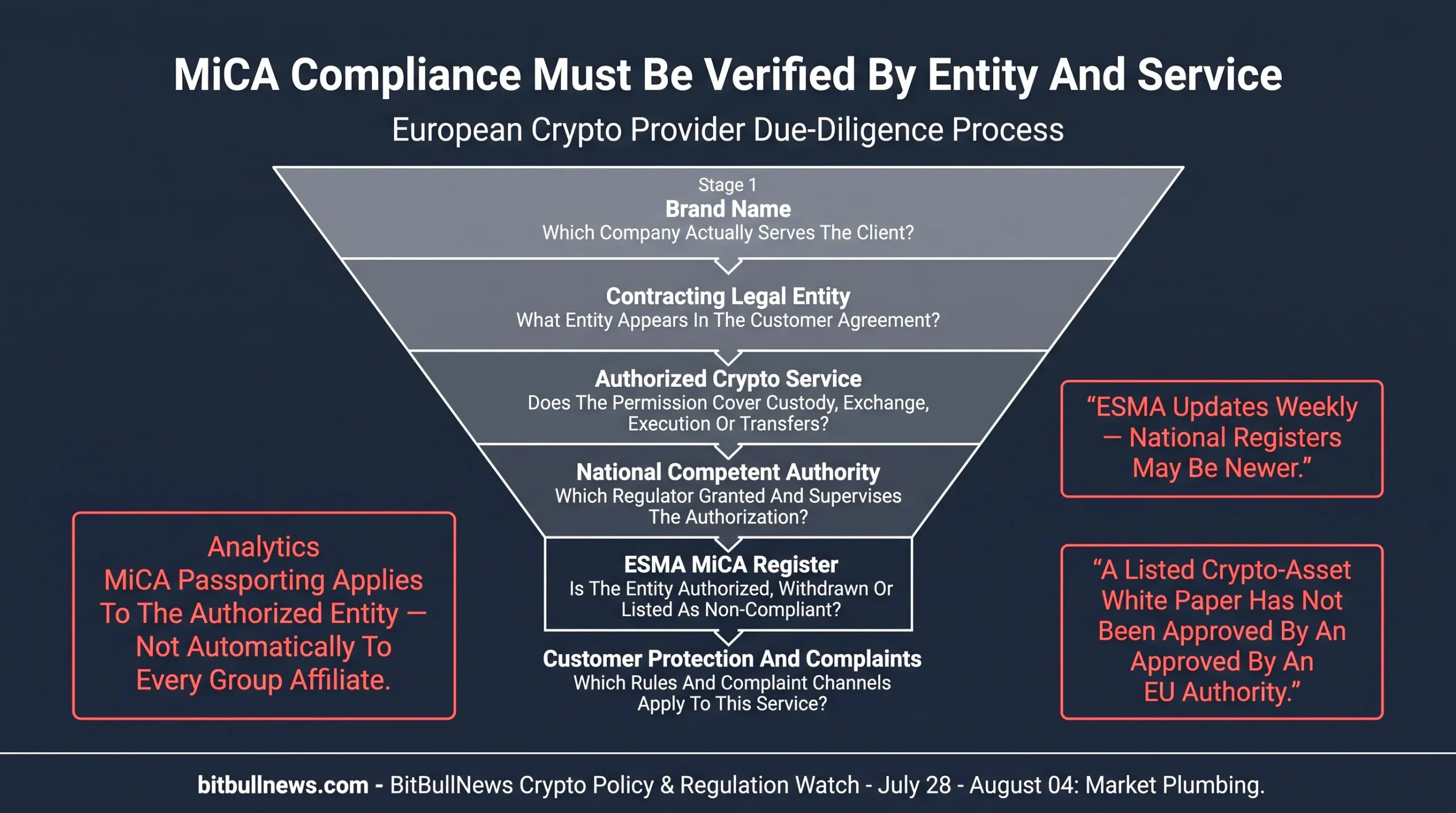
MiCA Register Verification Checklist
| Verification Question | Why It Matters |
|---|---|
| Is the contracting legal entity listed as an authorized CASP? | Authorization applies to an entity, not automatically to every company using the same brand |
| Which services are listed? | Custody, exchange, execution and transfer services may have different scopes |
| Which national authority granted the authorization? | The home regulator leads supervision and complaints handling |
| Has the authorization been withdrawn? | ESMA retains records showing effective withdrawal dates |
| Is the provider listed as non-compliant? | The central register identifies entities reported by national regulators |
| Is the information newer in a national register? | ESMA updates weekly, creating a possible reporting lag |
| Is a token white paper listed? | Listing confirms notification, not regulatory approval |
| Which entity appears in the client agreement? | A group may route EU clients through a different company from its global platform |
The white-paper warning deserves attention.
ESMA states that listed white papers have not been reviewed or approved by an EU authority. The issuer or offeror remains responsible for the content.
A listed white paper therefore should not be marketed as an EU-approved investment document.
MiCA Passporting Does Not Eliminate Legal-Entity Risk
An authorized CASP can use the MiCA passport to provide services across EU member states.
The passport reduces the need for separate national licenses. It does not make every entity in a global corporate group an authorized European provider.
For institutional counterparties, the due-diligence sequence should be:
- Identify the contracting company.
- Confirm its authorization.
- Confirm the service being provided.
- Review custody and outsourcing arrangements.
- Identify the home-state supervisor.
- Confirm which compensation, complaint or insolvency rules apply.
- Check whether group affiliates perform material functions.
A platform can be compliant for one service and outside the relevant authorization for another.
OFAC Extended Digital-Asset Risk Into Maritime Payments
OFAC’s July 29 action targeted an Iranian maritime insurance and shipping structure tied to the Strait of Hormuz.
Treasury designated the Persian Gulf Marine Insurance Company and HormuzSafe Marine Services Authority. It also designated eight shipping companies and identified eight vessels as blocked property. Treasury said HormuzSafe accepted Bitcoin and other digital assets as part of the payment structure.
OFAC Maritime Sanctions Structure
| Target Layer | Action | Digital-Asset Relevance |
|---|---|---|
| Persian Gulf Marine Insurance Company | Designated for operating in Iran’s financial sector | Insurance payment flows become sanctions-screening targets |
| HormuzSafe Marine Services Authority | Designated | Treasury said the service accepted Bitcoin and other digital assets |
| Eight Shipping Companies | Designated | Ownership and operational relationships expand the blocked network |
| Eight Vessels | Identified as blocked property | Compliance systems must connect payment risk with physical assets |
| Owned Or Controlled Entities | Subject to OFAC’s 50% rule | An unlisted subsidiary may still be blocked |
| U.S. Persons And Transactions | Generally prohibited without authorization | Controls apply to direct and indirect transactions |
| Non-U.S. Parties | Risk exposure when causing U.S. violations or evading sanctions | Global exchanges and payment companies need U.S.-nexus analysis |
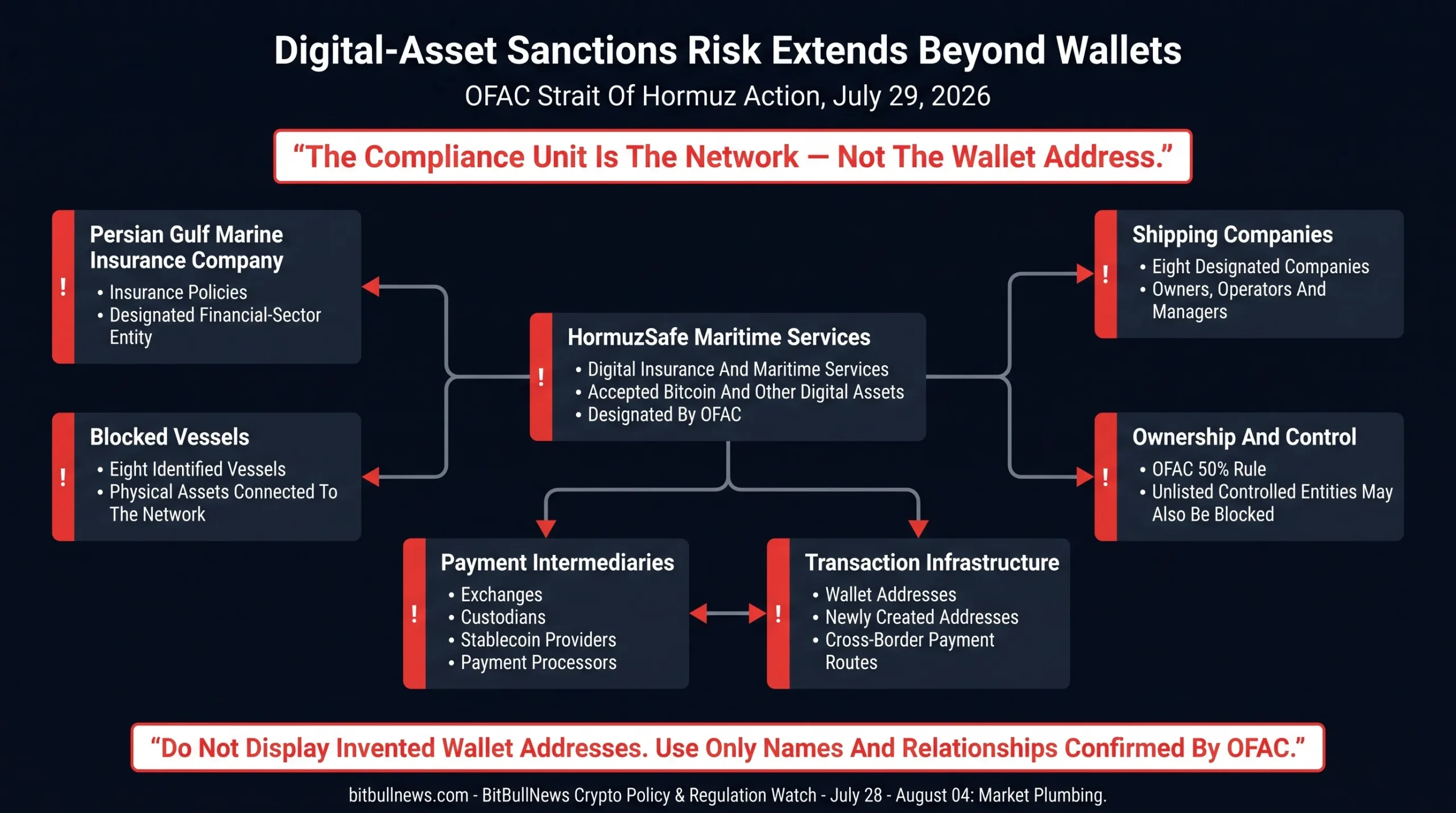
The action shows why sanctions screening cannot stop at a wallet blacklist.
A transaction can involve:
- A non-designated address controlled by a designated company.
- An entity blocked under the 50% ownership rule.
- A payment made through an intermediary.
- A vessel or insurance policy connected to a sanctioned operation.
- A newly created address with links to previously identified activity.
The compliance unit is the network, not the address.
What Compliance Teams Should Do Now
Build Stablecoin Controls Around The Full Token Lifecycle
Issuers should map minting, circulation, freezing, redemption and burning.
The compliance design must show what happens when tokens move beyond the issuer’s direct interface and how lawful orders are executed across each supported network.
Reconcile Wallet Analytics With Customer Records
A wallet-risk score is not a customer file.
Systems should connect addresses with account holders, beneficial owners, counterparties, alerts, case decisions and regulatory reports.
Treat SEC Task Force Materials As Signals, Not Permission
Meeting logs show what the agency is discussing. They do not create safe harbors.
A product team should not claim that the SEC approved a QDP, token-disclosure or onchain-vault model merely because staff met with its proponents.
Build Disclosures For Secondary Trading
Token issuers should document contract addresses, transfer restrictions, administrator rights, financial information and material changes before seeking secondary-market access.
Technical transferability without current disclosure creates an asset that can move but may not be lawfully quoted or traded.
Separate Fixed Vaults From Managed Strategies
Vault operators should identify every discretionary decision:
- Asset selection.
- Underwriting.
- Rate setting.
- Reallocation.
- Liquidation thresholds.
- Emergency controls.
- Contract upgrades.
The greater the discretion, the stronger the case for adviser, fund or securities analysis.
Verify MiCA By Legal Entity
Compliance teams should check ESMA and the relevant national register, then reconcile those records with the customer contract.
Brand-level claims are not enough.
Expand Sanctions Screening Beyond Addresses
Screening should cover ownership, control, affiliates, vessels, corporate service providers and transaction behavior.
New addresses connected to a blocked network can create risk even before they appear on a published sanctions list.
Regulatory Risk Dashboard
| Signal | Current Reading | Interpretation | Confirmation Needed |
|---|---|---|---|
| FDIC Stablecoin Proposal | Comment period closed August 4 | Stablecoin implementation moved toward final rulemaking | Publication of final requirements and effective date |
| Stablecoin AML Scope | BSA, sanctions, CIP and reporting | Bank-affiliated issuers face bank-grade financial-crime controls | Final treatment of secondary wallets and intermediaries |
| DLT Monitoring | Integration with enterprise systems expected | Blockchain analytics cannot remain a stand-alone compliance tool | Examination guidance and implementation standards |
| FDIC–FinCEN Coordination | Advance consultation proposed for significant actions | Supervisory responsibility will be shared | Final information-sharing and enforcement process |
| SEC Crypto Task Force | Four meetings held July 28–August 3 | Staff engagement is focused on implementation architecture | Formal rulemaking, exemption or staff guidance |
| Tokenized-Security Trading | Disclosure and state-law gaps remain | Legal issuance does not guarantee a liquid secondary market | SEC treatment of QDP-style disclosure models |
| Token Disclosures | Joint SEC–CFTC intake models proposed by industry | Standardization pressure is increasing | Agency-approved taxonomy and filing format |
| Onchain Vaults | Adviser, custody and exemption questions remain | Smart contracts do not remove managed-product obligations | Product-specific registrations or Commission guidance |
| CLARITY Act | No completed floor vote at the cutoff | Comprehensive market-structure legislation remains pending | Senate floor action and final negotiated text |
| ESMA MiCA Register | Updated July 31 | Authorization is increasingly verifiable | Faster synchronization with national registers |
| MiCA White Papers | Listed But Not Approved | Register inclusion is not an investment endorsement | Accurate issuer disclosures and supervisory enforcement |
| MiCA Transition | Ended July 1 | Unauthorized providers should no longer operate normally in the EU | National enforcement and orderly client migration |
| OFAC Digital-Asset Action | Maritime scheme accepted Bitcoin and other digital assets | Sanctions controls extend into commercial payment networks | Continuous ownership and transaction monitoring |
| Wallet-Only Screening | Insufficient | Risk can sit in ownership, service and physical-asset relationships | Integrated blockchain and corporate intelligence |
The Accountability Test: Beyond Labels to Operational Reality
Crypto regulation moved into the operating layer this week.
The FDIC’s August 4 comment deadline marked the next stage of U.S. stablecoin implementation. The question is no longer whether bank-affiliated issuers require AML and sanctions controls. It is how those controls apply to tokens that can circulate through public networks, self-hosted wallets and smart contracts.
The proposed structure links stablecoin issuers to the existing banking compliance system. FinCEN sets core financial-crime requirements. OFAC administers sanctions. The FDIC supervises relevant bank-affiliated issuers and coordinates with FinCEN before significant actions.
That model creates regulatory clarity. It also forces issuers to connect blockchain monitoring, customer records, smart-contract controls and lawful-order execution into one defensible system.
The SEC’s agenda moved in parallel.
Industry meetings focused on the information required to trade tokenized securities, joint SEC–CFTC token disclosures, decentralized infrastructure incentives and registration pathways for onchain credit vaults.
None of those meetings changed the law.
They revealed the remaining gaps.
Issuing a token is easier than creating a regulated secondary market. A smart contract can move a security without establishing who may own it, where current financial disclosures can be found or which intermediary is responsible for the trade.
Onchain vaults face the same reality. Fixed programmatic allocation and active management are not the same product. A strategy involving discretionary underwriting, asset selection and reallocation may still require an investment adviser, qualified custodian or fund structure.
Congress had not completed the broader market-structure framework at the reporting cutoff. The CLARITY Act remained pending while agencies continued addressing narrower issues through existing authority.
Europe is further into execution. ESMA’s July 31 MiCA register update gave firms and customers a practical authorization check. The register is useful, but it must be read correctly: authorization attaches to a legal entity and service, national data may appear before the weekly ESMA update, and a listed white paper is not an approved investment document.
OFAC supplied the enforcement boundary.
Its July 29 action connected digital-asset payments with maritime insurance, shipping companies, vessels and ownership networks. That is a direct warning against wallet-only compliance.
The regulatory perimeter is becoming functional.
Who controls the strategy? Who holds the assets? Who knows the customer? Who can stop a prohibited transaction? Who supplies the disclosure? Who is responsible when automated execution produces a legally invalid result?
Those questions now matter more than whether the product is marketed as crypto, DeFi, tokenization or financial infrastructure.
Data Sources & References
- FDIC — Stablecoin BSA And Sanctions Proposed Rule
- Federal Register — FDIC Stablecoin Compliance Proposal
- FDIC — Public Comments For RIN 3064-AG29
- SEC — Crypto Task Force Meetings
- SEC — GUARDD Meeting Materials
- SEC — Blockworks And Multicoin Meeting Materials
- SEC — Wynd Network Meeting Materials
- SEC — Birch Hill Vault Meeting Materials
- SEC — Crypto-Asset Interpretation
- U.S. Senate — 2026 Roll-Call Votes
- U.S. Senate — Floor Proceedings
- ESMA — Markets In Crypto-Assets Regulation And Register
- ESMA — End Of MiCA Transitional Periods
- U.S. Treasury — Strait Of Hormuz Sanctions Action