


Content
The digital-securities platform can now handle both the asset and the cash side of a tokenised trade inside a single regulated entity — closing a gap that has kept much of fund tokenisation stuck in pilot mode.
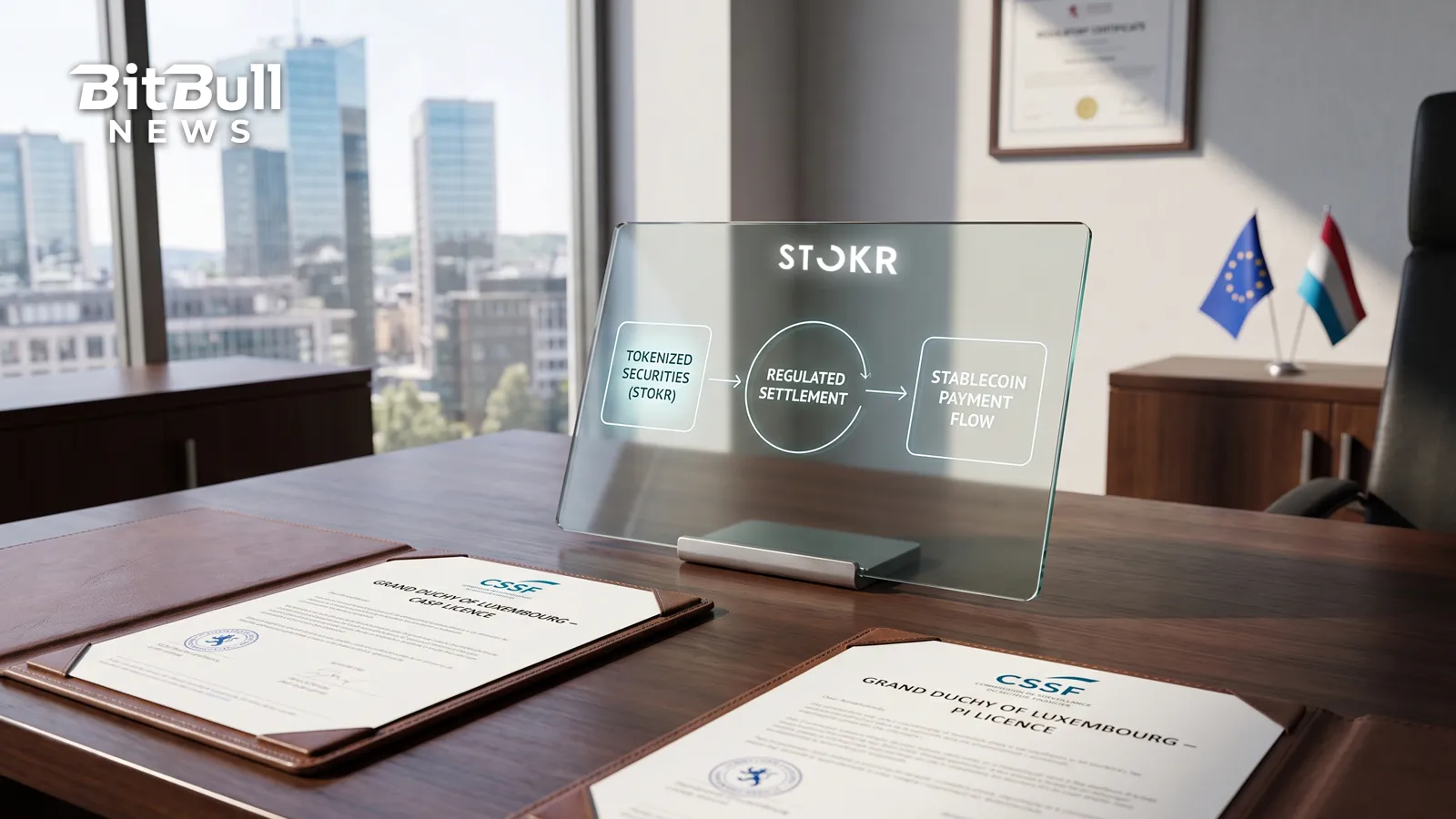
STOKR, the Luxembourg-based digital-securities platform, has been authorised by the Commission de Surveillance du Secteur Financier (CSSF) as both a Crypto-Asset Service Provider (CASP) and a Payment Institution (PI). The approval, granted under the EU’s Markets in Crypto-Assets Regulation (MiCAR) and Luxembourg’s 2009 payment-services law, lands just over a week before the bloc’s crypto rulebook reaches full force on July 1.
It is a deadline much of the industry will not make. The transitional period that has let crypto firms keep operating without a MiCAR licence runs out on June 30, and a sizeable number of providers across Europe are still waiting on their paperwork. Some are looking at pausing services until they are cleared. STOKR’s dual authorisation places it in the comparatively thin group able to serve clients in all 27 member states under one framework.
Both legs, one entity
The reason STOKR pursued two licences rather than one comes down to how a tokenised transaction actually settles.
Holding both means we control both legs of a transaction in one regulated entity.
Tobias Seidl, co-founder and CEO of STOKR, told BitBullNews.
The CASP licence covers custody and transfer of the crypto-assets; the PI licence covers the payment leg in stablecoins.
Clients can settle subscriptions, redemptions and distributions end-to-end with us — without stitching together separate custody and payment providers, with fewer counterparties and a single compliance perimeter.
Seidl was careful about what the licences do and do not cover. They do not regulate the tokenisation of securities itself, he said; that sits outside MiCAR’s scope. What they regulate is the custody and transfer of the crypto-assets and the stablecoin payment leg around them.
What the milestone signals is that MiCA is real and workable, and that regulated rails for the crypto-asset and payment side of tokenised transactions now exist in the EU.
With grandfathering over, firms without authorisation can no longer offer crypto-asset services — which, in his view, points one way. He expects the sector to narrow toward a smaller group of licensed players, and reads that as a net gain for institutional trust.
Where the demand is
STOKR administers more than $1.3 billion in active digital securities and has paid out over $312 million to investors since 2018. Asked what is driving volume now, Seidl pointed to funds, money market funds and private credit. The instant-payout case for money market funds and the transparency case for private credit are the two strongest near-term pulls, he said, and the areas he expects to grow fastest.
The cash side of that is where stablecoins come in. Seidl described them as the cash leg for tokenised securities, settling subscriptions, redemptions and distributions instantly and around the clock. He sees room for both the euro and the dollar — the euro for MiCA-aligned settlement inside the EU, the dollar for global institutional demand — and framed the company’s position as building settlement infrastructure rather than betting on either currency.
That missing cash leg, he argued, is what has held the wider market back.
What’s still missing for most managers is a regulated cash leg on-chain — without it, you can’t truly settle delivery-versus-payment.
With the PI licence, the asset and the payment can now settle together in one entity. “That closes the gap that has kept tokenisation in pilot mode, and it’s where we see the shift moving from concept to production today.”
A Luxembourg base, built on Bitcoin rails
STOKR set up in Luxembourg in 2018 and has stayed for reasons Seidl ties directly to the jurisdiction’s company law. Luxembourg lets a company hold its own investor register, he said — the legal basis that makes tokenisation valuable, and what lets an issuer tokenise from day one. As Europe’s largest fund domicile, with more than €8.2 trillion under management at the end of 2025 and a government openly backing tokenisation, he called it the right place to build. The EU passport that comes with the authorisation lets the firm work across all 27 member states without chasing local licences, which he said should materially speed up expansion.
Part of STOKR’s infrastructure runs on the Liquid Network, a Bitcoin-based settlement layer. Seidl described the choice as a deliberately conservative one: strong finality, confidential transactions suited to regulated assets, and settlement on what he called the most established and security-tested foundation available — the kind of footing institutions tend to ask for.
Beyond Europe
STOKR has flagged ambitions in the United States, the world’s largest capital market, with the appointment of Subhankar Sinha as Senior Advisor and a focus on money market fund tokenisation. Seidl said the plan is to extend the model past Europe by reconciling the EU and US regimes through modular compliance rather than forcing a single one-size approach.
For the end investor, he argued, the practical changes are direct ownership and control of the security, near-instant settlement, lower intermediary costs and better transparency — alongside newer uses such as posting holdings as collateral, peer-to-peer transfers and instant payouts from money market funds.
We are proud to have obtained one of the most demanding licences in the world. Now asset managers and administrators can tap into our stablecoin and crypto transfer and custody capabilities for their tokenisation products — bringing the asset and the payment side together in one regulated entity.