


BitGo Moves $7.7B WBTC From LayerZero To Chainlink CCIP In The Interoperability War’s Biggest Defection

Content
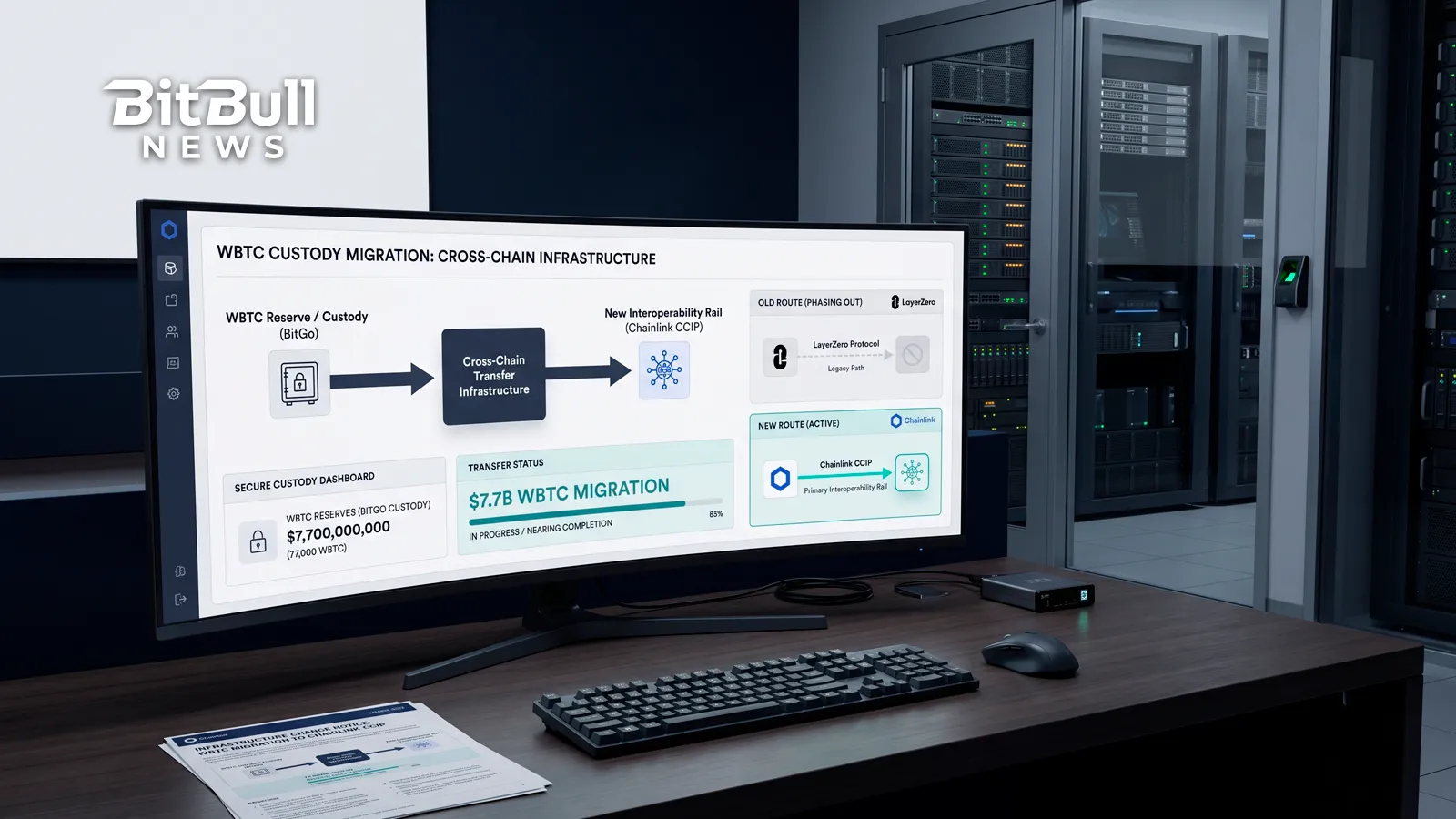
BitGo announced on August 4 that Chainlink’s Cross-Chain Interoperability Protocol will become the exclusive cross-chain infrastructure for Wrapped Bitcoin — more than $7.7 billion of the largest bitcoin token in DeFi — and the default standard for every asset BitGo issues in the future. The company says it will migrate WBTC away from its “legacy solution” and unify deployments under Chainlink’s Cross-Chain Token standard.

The post never names the legacy solution, but it identifies the loser in its own second sentence: WBTC, BitGo notes, is “the largest OFT by market capitalization.” OFT — Omnichain Fungible Token — is LayerZero’s standard, the one BitGo adopted with considerable fanfare in September 2024 when it named LayerZero its official interoperability provider. Twenty-three months later, the flagship asset of LayerZero’s enterprise pitch is packing for Chainlink, and the industry’s interoperability war — a contest over which protocol becomes the settlement fabric between blockchains — has its most consequential customer defection to date.
Twenty-Three Months From “Official Provider” To “Legacy Solution”
The reversal is sharper for how recent the relationship was. The 2024 arrangement was not a trial: BitGo used LayerZero’s OFT to expand WBTC natively to BNB Chain and Avalanche, built a layered verification design pairing its own decentralized verifier network with LayerZero Labs’ or Polyhedra’s, and as recently as December was launching WBTC on Sui in the OFT format, with integrations across the chain’s entire DeFi ecosystem. Eight months after that launch, the same architecture is “legacy.”
The announcement leaves the migration’s practical questions open. No timeline is given beyond “plans to transition”; nothing addresses what happens to existing OFT-format WBTC on Sui, BNB Chain, Avalanche and other networks during the switch, or whether holders will need to take any action; and the commercial terms of exclusivity — what, if anything, changed hands to make Chainlink the sole provider — are not disclosed. For an asset woven into lending markets and collateral systems across a dozen chains, the mechanics of re-plumbing are not a footnote, and they are the part the two-minute blog post spends no time on.
What Chainlink Actually Won
WBTC is the headline, but the durable prize is the pipeline. BitGo is no longer only the issuer of Wrapped Bitcoin: it operates an OCC-chartered national trust bank, runs a stablecoin-as-a-service business built for the GENIUS Act era, and offers tokenization and transfer-agent services for real-world assets. “All future BitGo-issued assets” defaulting to CCIP means every stablecoin, wrapped asset and tokenized instrument that leaves BitGo’s factory ships on Chainlink rails — a standardization decision, not a product integration. Chainlink was already inside the tent, providing proof-of-reserve verification for WBTC’s backing; this extends one service into the whole stack.
The stated rationale is procurement logic as much as cryptography. BitGo’s post leans on CCIP’s minimum of 16 independent node operators per bridge lane, issuer-managed rate limits that function as circuit breakers, and its status as the only cross-chain protocol holding both SOC 2 Type 2 and ISO 27001 certifications — the checkbox language of institutional vendor review, aimed at the banks and asset managers BitGo now serves. Chief executive Mike Belshe framed the choice as alignment with “a proven, institutionally adopted interoperability standard.” The adoption statistics BitGo cites alongside — more than $32 trillion in enabled transaction value, roughly 70% of DeFi — are Chainlink’s own marketing figures, relayed rather than independently established, and worth reading as such.
Trust Repair After Two Bruising Years
The timing makes most sense against WBTC’s recent history. The token has spent two years defending its franchise: the August 2024 custody joint venture that brought Justin Sun’s orbit into WBTC’s structure triggered Sky’s exit and Coinbase’s delisting that December, handed momentum to Coinbase’s rival cbBTC, and cut WBTC’s supply from roughly 153,000 BTC to near 120,000 today. This spring the custody transition completed its next phase: as of May, Hong Kong-based BiT Global holds two of the three vault keys across Hong Kong and Singapore, with BitGo retaining one through its US technology entity.
Read in that light, standardizing the cross-chain layer on certified, insurance-friendly infrastructure is as much reputational engineering as technical upgrade. What BitGo can no longer offer WBTC’s institutional skeptics on the custody axis — sole US-regulated control — it is reinforcing on the movement axis: audited rails, named operators, configurable circuit breakers. Whether that trade satisfies the treasurers and fund platforms that walked away in 2024 is the commercial question underneath the announcement.
One Provider To Rule The Rails
For the interoperability market, the defection redraws the scoreboard. LayerZero loses the largest single asset carrying its standard and the reference logo of its issuer pitch; Chainlink adds the most valuable wrapped asset in crypto to a CCT roster it has been building through bank and market-infrastructure pilots. But the deal also marks a philosophical turn worth naming. BitGo’s 2024 design was explicitly redundant — two distinct verification methods, proof-of-authority and zero-knowledge, precisely so that no single system could fail alone. The 2026 design is explicitly exclusive: one provider, everywhere, for everything, with BitGo noting only that its contracts avoid CCIP-specific code and could layer additional controls later.
That is a defensible enterprise decision — unified standards genuinely reduce operational error, and fragmented bridge stacks have cost this industry billions in exploits. It is also a concentration bet, made by the issuer of an asset whose last crisis was itself a lesson in what happens when too much of a token’s trust model runs through too few hands. The migration’s timeline, its treatment of existing deployments, and the undisclosed terms of exclusivity will show whether this is the security posture BitGo describes or simply a new location for the single point everyone promises to avoid. The bitcoin backing WBTC never moves; everything above it, it turns out, is negotiable.