



Content
Institutional crypto flows reversed sharply this week.

The products covered by Farside Investors recorded $321.8 million of combined net redemptions across Bitcoin, Ether and Solana during the six completed U.S. sessions from July 23 through July 30. Bitcoin funds lost $261.3 million, Ether products lost $43.4 million and the tracked Solana complex lost $17.1 million.
The damage would have been considerably worse without the final session.
Bitcoin funds attracted $233.1 million on July 30, their strongest day of the monitoring period. Ether added another $12.8 million. The combined $245.9 million inflow recovered approximately 43% of the $567.7 million that had left the tracked product set over the preceding five sessions.
The broader reversal was substantial. During the previous BitBullNews monitoring period, the same Farside-listed products attracted $876.2 million. This week they lost $321.8 million, producing a week-over-week deterioration of almost $1.2 billion.
The outflow was not driven by Grayscale’s legacy Bitcoin product. GBTC recorded no net creations or redemptions during the period. The pressure came from the market leaders: BlackRock’s IBIT lost $205.1 million, while Fidelity’s FBTC lost $63.9 million.
Ether produced a different signal. BlackRock’s conventional ETHA product lost $7.7 million, but its staked ETHB product gained $8.8 million. That is a small amount compared with ETHA’s asset base, yet it was the first clear weekly case in this reporting series where BlackRock’s staking wrapper attracted capital while its larger unstaked product contracted.
Data Coverage Note
Morgan Stanley Investment Management launched the Morgan Stanley Ethereum Trust, MSSE, and Morgan Stanley Solana Trust, MSOL, on July 28. Both products carry a 0.14% expense ratio, intend to stake part of their holdings and will not allow Morgan Stanley to retain a percentage of the staking rewards.
As of the July 30 cutoff, Farside’s Ether and Solana tables had not added MSSE or MSOL as separate columns. The weekly ETH and SOL totals in this report therefore cover the products included in Farside’s published dataset, not every newly listed U.S. product.
BitBullNews does not combine Farside and SoSoValue figures into one weekly total because their product coverage and reporting cutoffs were not yet aligned. The comparable flow series is more useful than a larger number assembled from inconsistent universes.
Weekly ETF Flow Scorecard
| Metric | Bitcoin Funds | Ether Funds | Solana Funds | Combined |
|---|---|---|---|---|
| Tracked Net Flow, July 23–30 | -$261.3M | -$43.4M | -$17.1M | -$321.8M |
| Previous Monitoring Period | +$710.5M | +$156.9M | +$8.8M | +$876.2M |
| Week-Over-Week Swing | -$971.8M | -$200.3M | -$25.9M | -$1.198B |
| Positive Sessions | 2 Of 6 | 4 Of 6 | 1 Of 6 | 2 Net-Positive Days |
| Largest Daily Inflow | +$233.1M | +$26.3M | +$1.0M | +$245.9M |
| Largest Daily Outflow | -$240.1M | -$70.7M | -$18.1M | -$310.8M |
| Average Daily Flow | -$43.6M | -$7.2M | -$2.9M | -$53.6M |
| Cumulative Net Inflow In Farside Dataset | $51.64B | $11.21B | $1.12B | $63.98B |
| Weekly Flow As Share Of Cumulative Net Inflow | -0.51% | -0.39% | -1.52% | -0.50% |
Ether and Solana totals exclude MSSE and MSOL because the newly launched Morgan Stanley products were not yet included in Farside’s tables at the reporting cutoff.
The absolute result was Bitcoin-heavy: BTC products generated 81.2% of the tracked net outflow.
Measured against each category’s cumulative inflow base, Solana experienced the larger relative withdrawal. Its $17.1 million loss equalled approximately 1.52% of cumulative net inflows in Farside’s listed product universe, compared with 0.51% for Bitcoin and 0.39% for Ether.
That does not mean institutional investors abandoned Solana more aggressively than Bitcoin. MSOL’s omission makes the Solana total incomplete. It does show that the older tracked Solana products had the weakest flow intensity.
The Week Began With Heavy Redemptions
July 23 and July 24 defined the final result.
Tracked Bitcoin funds lost $465.2 million across those two sessions. Ether funds partly resisted the first wave with a $26.3 million inflow on July 23, but then lost $70.7 million on July 24. The combined product set recorded a two-day outflow of $509.6 million.
Daily Tracked Crypto ETP Flows
| Trading Date | Bitcoin Funds | Ether Funds | Solana Funds | Combined Flow |
|---|---|---|---|---|
| July 23 | -$225.1M | +$26.3M | $0.0M | -$198.8M |
| July 24 | -$240.1M | -$70.7M | $0.0M | -$310.8M |
| July 27 | -$11.6M | +$11.7M | +$1.0M | +$1.1M |
| July 28 | -$49.7M | +$9.4M | -$18.1M | -$58.4M |
| July 29 | +$32.1M | -$32.9M | $0.0M | -$0.8M |
| July 30 | +$233.1M | +$12.8M | $0.0M | +$245.9M |
| Period Total | -$261.3M | -$43.4M | -$17.1M | -$321.8M |
The table uses Farside’s listed products and excludes the new MSSE and MSOL products.
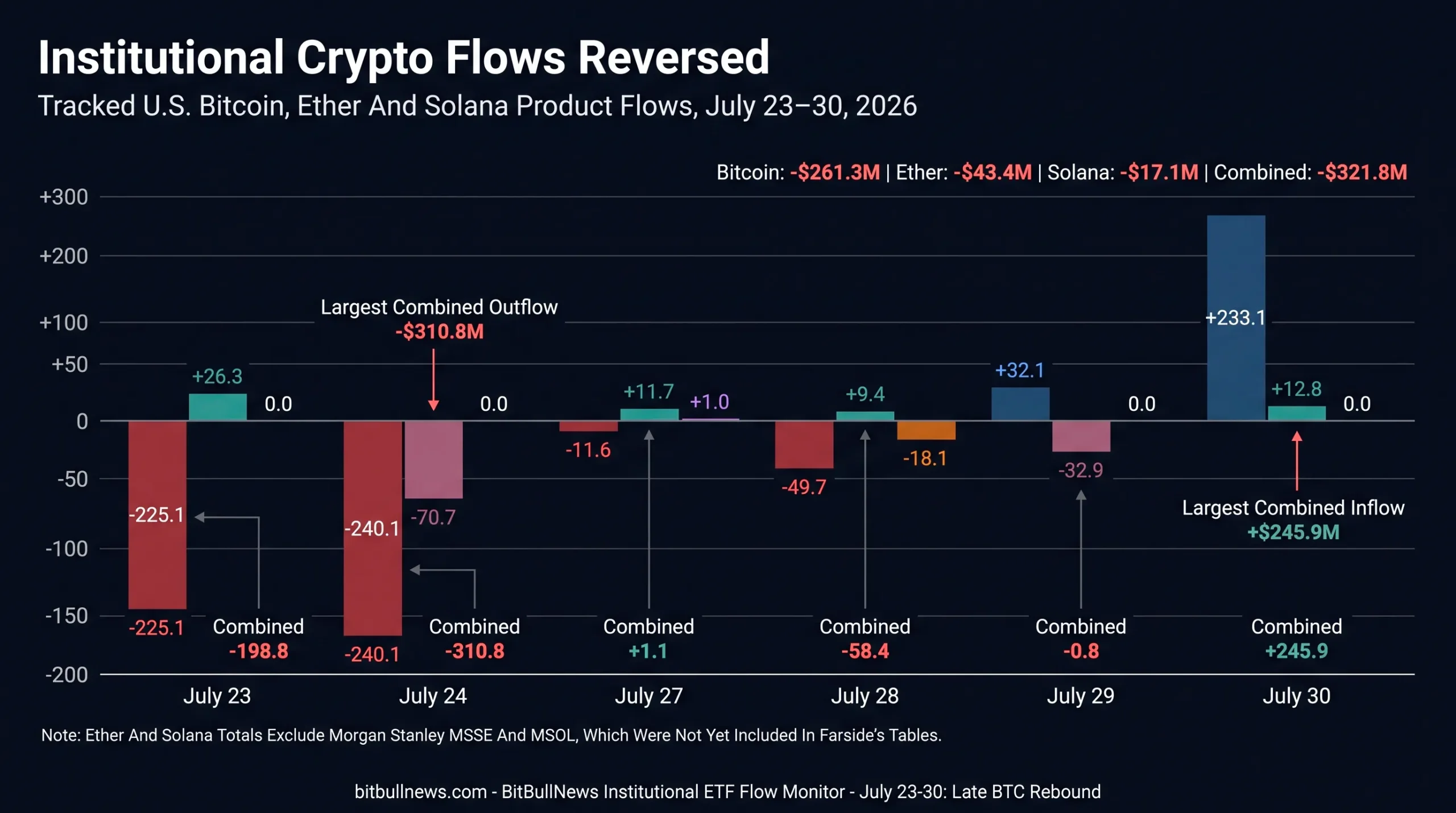
The daily sequence was not a steady institutional exit.
After the initial two-day withdrawal, the market moved closer to balance. July 27 was slightly positive. July 29 was almost flat across Bitcoin and Ether. July 30 produced a meaningful return to creations.
That shape matters. A continuous six-day outflow would point to persistent allocation pressure. This week instead contained one concentrated redemption wave followed by stabilization and a strong final-day rebound.
The rebound still arrived too late to repair the weekly total.
The Week-Over-Week Swing Reached $1.2 Billion
The previous monitoring period was one of the strongest allocation weeks in the recent series. Bitcoin funds attracted $710.5 million, Ether gained $156.9 million and Solana added $8.8 million.
Every category reversed this week.
Week-Over-Week Flow Comparison
| Monitoring Period | Bitcoin Funds | Ether Funds | Solana Funds | Combined |
|---|---|---|---|---|
| July 16–22 | +$710.5M | +$156.9M | +$8.8M | +$876.2M |
| July 23–30 | -$261.3M | -$43.4M | -$17.1M | -$321.8M |
| Week-Over-Week Swing | -$971.8M | -$200.3M | -$25.9M | -$1.198B |
The comparison uses the same Farside-listed product universe available for each monitoring snapshot. New Morgan Stanley products are discussed separately.
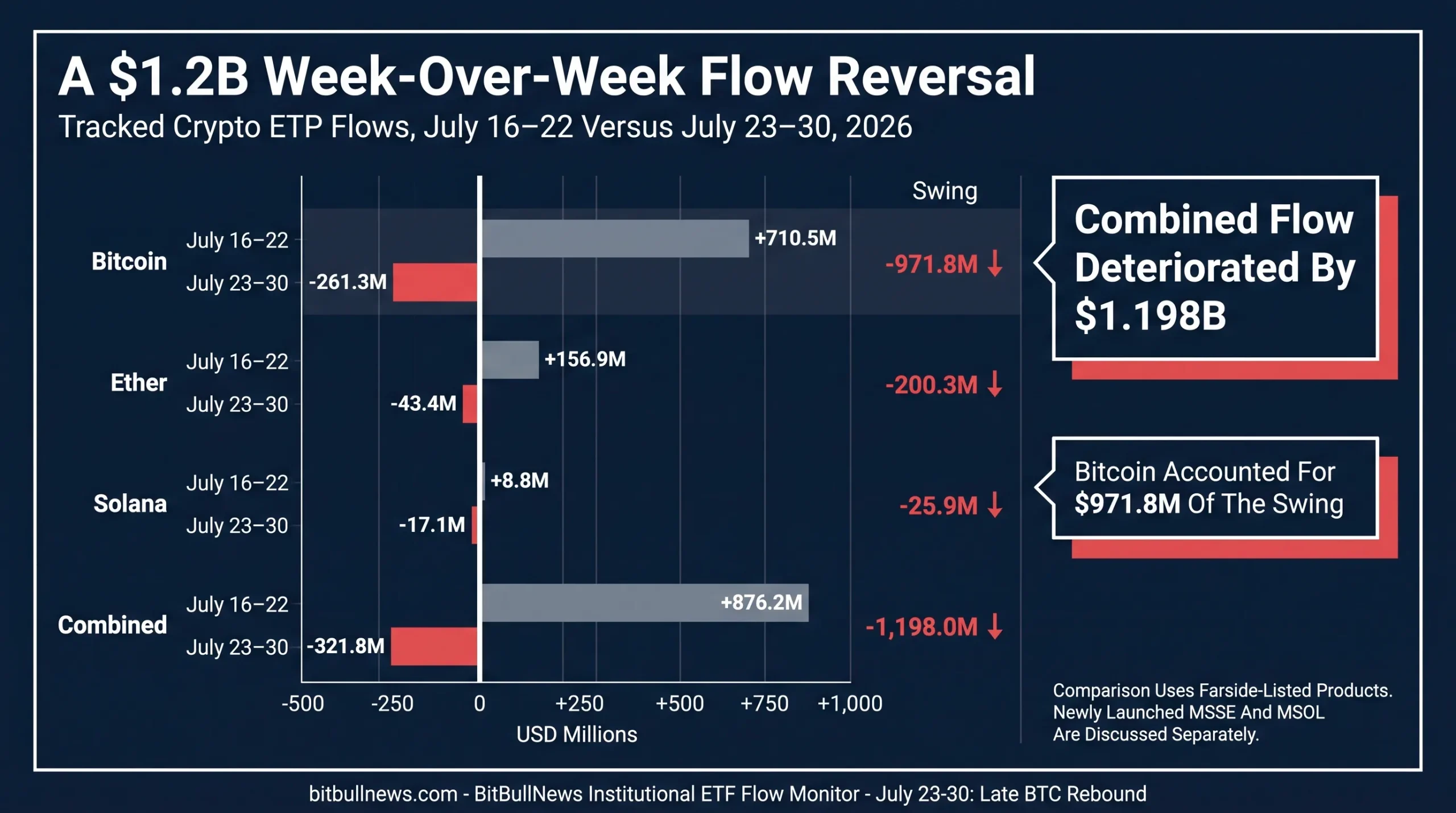
The swing shows why a single inflow streak cannot establish a durable institutional trend.
Bitcoin funds had completed six consecutive positive sessions through July 22. Two sessions later, $465.2 million had left. The products remain liquid enough for institutions to change exposure quickly, and the same creation-redemption mechanism that channels demand into the underlying market can remove it just as quickly.
The result does not prove that all investors turned bearish. ETF redemptions can reflect tactical positioning, portfolio rebalancing, arbitrage activity or movements between wrappers. It does show that the previous week’s demand was not yet persistent.
July 30 Changed The Shape Of The Week
Through July 29, tracked Bitcoin products had lost $494.4 million. Ether had lost $56.2 million and Solana had lost $17.1 million.
July 30 reversed almost half of Bitcoin’s preceding five-session outflow.
The $233.1 million BTC inflow was broad enough to matter:
- IBIT gained $183.4 million.
- BITB attracted $20.7 million.
- FBTC added $15.5 million.
- MSBT gained $7.4 million.
- HODL and Grayscale’s Bitcoin Mini Trust each added $2.3 million.
The late recovery was therefore not only a BlackRock event, although IBIT supplied 78.7% of the day’s net Bitcoin flow.
A single strong session cannot confirm that institutional demand has returned. The next test is whether the July 30 creations continue after the month-end allocation and rebalancing cycle.
Bitcoin Redemptions Came From The Market Leaders
The most unusual Bitcoin signal was the absence of GBTC outflows.
Grayscale’s legacy product recorded zero net flow on all six sessions. Its lower-fee Bitcoin Mini Trust attracted $7.4 million.
The week’s weakness instead came from IBIT and FBTC.
Bitcoin Fund Flows By Product
| Bitcoin Product | Issuer | Net Flow, July 23–30 |
|---|---|---|
| IBIT | BlackRock | -$205.1M |
| FBTC | Fidelity | -$63.9M |
| ARKB | 21Shares | -$17.4M |
| EZBC | Franklin Templeton | -$5.6M |
| BTCW | WisdomTree | -$5.1M |
| BTCO | Invesco | $0.0M |
| BRRR | Valkyrie | $0.0M |
| GBTC | Grayscale | $0.0M |
| HODL | VanEck | +$2.3M |
| BTC | Grayscale Bitcoin Mini Trust | +$7.4M |
| MSBT | Morgan Stanley | +$12.4M |
| BITB | Bitwise | +$13.7M |
| Total | — | -$261.3M |
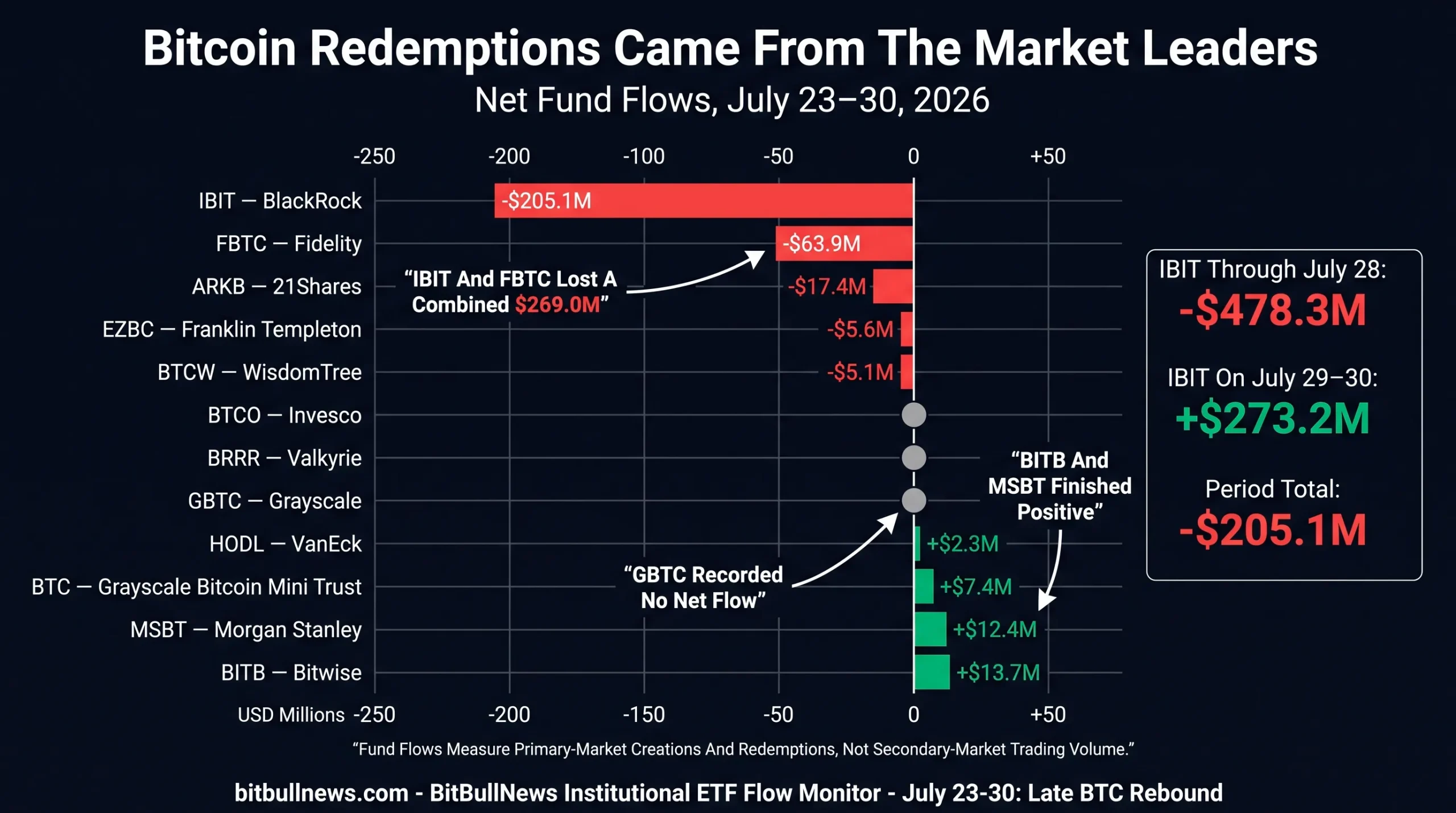
IBIT’s weekly number conceals an internal reversal.
The product lost $478.3 million through July 28, then attracted $89.8 million on July 29 and $183.4 million on July 30. Those two sessions recovered $273.2 million, leaving the weekly result at negative $205.1 million.
BlackRock therefore remained the main source of both the week’s redemptions and its late recovery.
This is the operational consequence of IBIT’s scale. The fund held $47.67 billion in net assets as of July 30 and maintained a 30-day median bid-ask spread of 0.03%. Its distribution and liquidity make it the most efficient route for large Bitcoin allocations, but the same scale means changes in IBIT demand dominate category-level flow prints.
GBTC Was No Longer The Automatic Source Of Selling
For much of the spot Bitcoin ETF market’s history, GBTC redemptions were a recurring explanation for weak aggregate flows.
That explanation does not fit this week.
GBTC’s zero-flow result means the $261.3 million market contraction came from products that had previously been the strongest creation channels. IBIT, FBTC and ARKB lost a combined $286.4 million, exceeding the market’s net outflow because positive flows elsewhere provided partial offsets.
The change matters for interpretation.
A week dominated by GBTC withdrawals can reflect migration away from a high-fee legacy structure. A week led by IBIT and FBTC redemptions is more consistent with reduced exposure through the market’s primary institutional wrappers.
The flow data cannot determine whether those redemptions were outright sales, hedged trades or month-end portfolio adjustments. It does show that the pressure was not simply another fee-driven Grayscale migration.
Ether Outflows Were Concentrated In Fidelity And Grayscale
Ether’s tracked loss was smaller in absolute terms, but the issuer distribution was less healthy than the positive-session count suggests.
Four of six sessions finished positive. The category still lost $43.4 million because the negative days were larger.
Ether Fund Flows By Product
| Ether Product | Issuer | Net Flow, July 23–30 |
|---|---|---|
| FETH | Fidelity | -$31.9M |
| ETHE | Grayscale | -$11.3M |
| ETHA | BlackRock | -$7.7M |
| TETH | 21Shares | -$2.4M |
| ETHV | VanEck | -$0.7M |
| ETHW | Bitwise | $0.0M |
| QETH | Invesco | $0.0M |
| EZET | Franklin Templeton | $0.0M |
| ETH | Grayscale Ethereum Mini Trust | +$1.8M |
| ETHB | BlackRock Staked Ethereum Trust | +$8.8M |
| Tracked Total | — | -$43.4M |
MSSE is excluded because it was not yet included in Farside’s table.
Fidelity accounted for nearly three-quarters of the tracked ETH outflow.
FETH gained $14.9 million on July 23 but lost $27.8 million the following session, $16.1 million on July 29 and another $2.9 million on July 30.
Grayscale’s two Ether products produced a combined $9.5 million net outflow. The Mini Trust gained $1.8 million, but ETHE lost $11.3 million.
BlackRock’s Ether products finished almost balanced in aggregate. ETHA lost $7.7 million while ETHB gained $8.8 million, leaving the pair positive by $1.1 million.
The Staked Wrapper Beat The Conventional Ether Product
ETHB’s $8.8 million inflow is small compared with the broader Ether market. Relative to the fund’s size, it was meaningful.
ETHB held $562.1 million of net assets on July 30. Its weekly inflow equalled approximately 1.57% of that asset base. ETHA held $5.57 billion and lost an amount equal to roughly 0.14% of its assets.
BlackRock Crypto Product Comparison
| Product | Exposure | Tracked Weekly Flow | Net Assets, July 30 | 30-Day Average Share Volume | Median Bid-Ask Spread | Staking Metric |
|---|---|---|---|---|---|---|
| IBIT | Bitcoin | -$205.1M | $47.67B | 36.95M | 0.03% | None |
| ETHA | Ether | -$7.7M | $5.57B | 29.60M | 0.07% | None |
| ETHB | Staked Ether | +$8.8M | $562.15M | 364,255 | 0.08% | 1.66% 30-Day Rewards Rate |
Flow figures come from Farside. Asset, volume, spread and staking figures come from BlackRock’s product pages.
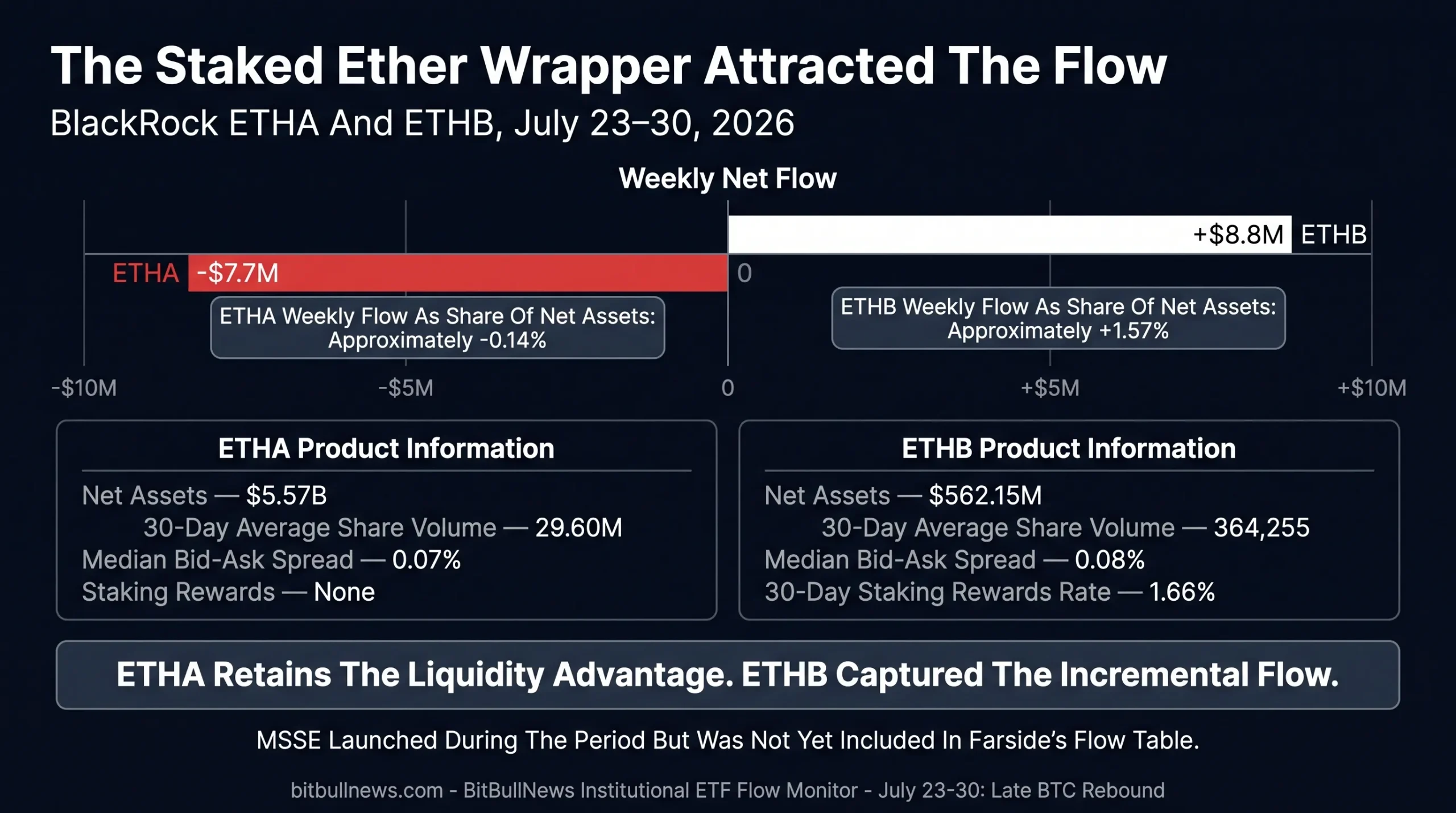
The result does not establish a permanent preference for staked Ether products.
ETHA remains almost ten times larger and trades with roughly 81 times ETHB’s 30-day average share volume. Institutional execution capacity still favors ETHA.
ETHB’s positive flow does show that staking income can attract incremental demand even when the broader Ether product set contracts.
The timing is important because Morgan Stanley launched another staking-enabled Ether product during the week. Competition is moving beyond fees and basic exposure. Issuers are now competing over how much network yield reaches investors, how liquid the wrapper is and how staking risks are managed.
Solana’s Tracked Outflow Was Concentrated In One Fund
The Solana products listed by Farside lost $17.1 million during the period.
The entire net decline came from Bitwise’s BSOL, which gained $1 million on July 27 and lost $18.1 million on July 28. Every other Solana product in Farside’s table recorded no net flow during the period.
The result looks severe relative to the category’s $1.12 billion cumulative net inflow, but it is no longer a complete market total.
Morgan Stanley launched MSOL on July 28, and the product was not present in Farside’s table at the cutoff. The established-product result is still useful for comparison with prior weeks. It should not be presented as the full U.S. Solana ETP flow after the new listing.
This is a data-infrastructure issue, not a minor footnote. When a new product launches, aggregate flow providers can temporarily publish different totals depending on when the fund is added, whether seed capital is counted and which trading date is assigned to creations.
Morgan Stanley Expanded The Institutional Product Shelf
The launch of MSSE and MSOL was the week’s most important product-development event.
Morgan Stanley now offers exchange-traded exposure to Bitcoin, Ether and Solana. MSSE and MSOL both charge 0.14%, matching the fee on the firm’s existing MSBT product. Both new products intend to stake part of their assets, and Morgan Stanley said it will not retain any portion of the staking rewards.
Morgan Stanley Digital-Asset ETP Suite
| Product | Underlying Asset | Launch Status | Expense Ratio | Staking Structure | Additional Context |
|---|---|---|---|---|---|
| MSBT | Bitcoin | Launched Earlier In 2026 | 0.14% | Not Applicable | Held More Than $381M In AUM Through July 16 |
| MSSE | Ether | Launched July 28, 2026 | 0.14% | Intends To Stake Part Of Holdings | Morgan Stanley Will Not Retain A Percentage Of Staking Rewards |
| MSOL | Solana | Launched July 28, 2026 | 0.14% | Intends To Stake Part Of Holdings | Morgan Stanley Will Not Retain A Percentage Of Staking Rewards |
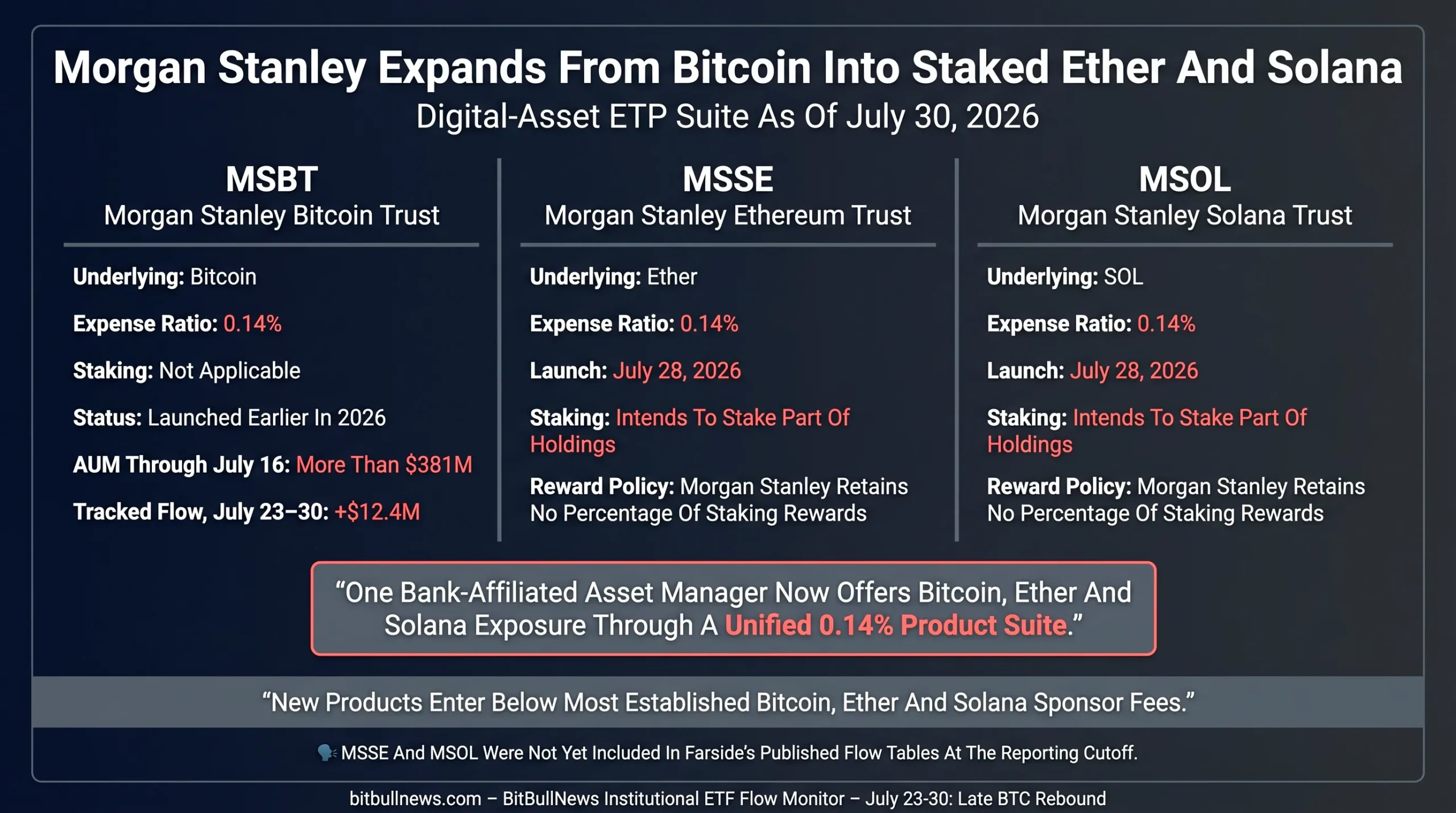
The fee structure creates direct competitive pressure.
Farside lists standard sponsor fees of 0.25% for IBIT, FBTC and ETHA. Existing Solana products in its table charge between 0.19% and 0.30% before separate staking-reward deductions. Morgan Stanley’s 0.14% pricing enters below most of the established market.
Low fees alone do not guarantee assets.
Institutional allocators also care about spreads, secondary-market depth, authorized-participant capacity, custody, tax treatment and operational resilience. IBIT’s $47.67 billion asset base and 0.03% median spread are advantages that a new product cannot replicate immediately.
Morgan Stanley brings a different advantage: a large wealth-management and asset-management distribution network. Its existing Bitcoin product attracted $12.4 million during a week when the broader BTC category lost $261.3 million.
The Flow Data Shows Tactical Allocation, Not A Permanent Exit
Several facts argue against describing this week as a complete institutional retreat:
- Bitcoin funds returned to a $233.1 million inflow on the final session.
- Ether recorded four positive sessions despite finishing negative.
- Morgan Stanley expanded its product lineup rather than reducing its digital-asset commitment.
- ETHB attracted capital while ETHA contracted.
- GBTC did not produce the Bitcoin outflow.
- Smaller Bitcoin products including BITB, MSBT and the Grayscale Mini Trust finished positive.
The negative signal is still real.
The previous week’s $876.2 million inflow did not persist. IBIT and FBTC switched from primary sources of demand to primary sources of redemptions. The established Solana product set experienced its largest relative withdrawal of the three categories.
The market remains capable of absorbing those flows without a proportional price collapse, but flow stability has not been established.
What Institutional Allocators Should Watch Next
Whether The July 30 Bitcoin Rebound Extends
One positive session repaired almost half of the previous five sessions’ BTC outflow.
The stronger confirmation would be consecutive inflows across IBIT, FBTC and at least one secondary product. A return to redemptions would make July 30 look more like month-end positioning than renewed strategic demand.
Whether IBIT Remains The Main Source Of Volatility
IBIT supplied most of both the week’s redemptions and the final-day recovery.
Continued two-way movement in the product will dominate aggregate Bitcoin flow data even when smaller issuers remain stable.
Whether FETH Stabilizes
Fidelity’s Ether fund generated $31.9 million of net redemptions and was the main drag on the tracked ETH complex.
A return to FETH creations would make Ether demand less dependent on BlackRock and newer staking products.
Whether Staked Ether Products Continue Winning Share
ETHB attracted $8.8 million while ETHA lost $7.7 million. MSSE adds another staking-enabled wrapper with a lower headline expense ratio.
The next test is whether this becomes a multiweek shift or remains a small launch-period preference.
Whether MSSE And MSOL Enter The Major Flow Datasets
Until the new Morgan Stanley products are incorporated consistently, provider totals for Ether and Solana will differ.
Institutional analysts should preserve the provider universe used for each time series rather than splicing new products into historical totals without restating prior periods.
Whether Solana Redemptions Broaden Beyond BSOL
The tracked $17.1 million Solana outflow was entirely concentrated in one product.
Outflows across several issuers would indicate category-level pressure. A rebound in BSOL or new creations in MSOL would point toward product rotation instead.
Whether GBTC Remains Neutral
GBTC’s zero-flow week removed a familiar source of structural selling.
If that stability persists, future Bitcoin ETF outflows will carry a different interpretation because they will increasingly reflect changes in demand for current-generation products rather than legacy-fund migration.
Institutional ETF Risk Dashboard
| Signal | Current Reading | Interpretation | Confirmation Needed |
|---|---|---|---|
| Tracked Combined Flow | -$321.8M | Institutional wrapper demand reversed | Multi-session return to net creations |
| Week-Over-Week Swing | -$1.198B | Previous inflow momentum did not persist | Stabilization over more than one week |
| Bitcoin Flow | -$261.3M | BTC drove 81.2% of tracked outflows | IBIT and FBTC continue July 30 rebound |
| Ether Flow | -$43.4M | Four positive sessions were outweighed by larger redemptions | FETH and ETHA return to creations |
| Solana Tracked Flow | -$17.1M | Largest relative withdrawal versus cumulative flow base | Full-market data including MSOL becomes available |
| July 30 Combined Flow | +$245.9M | Strong late recovery | Positive follow-through |
| IBIT Flow | -$205.1M | Market leader was the main source of selling | Consecutive inflows after the late rebound |
| FBTC Flow | -$63.9M | Fidelity added to Bitcoin weakness | Return to positive primary-market demand |
| GBTC Flow | $0.0M | Legacy Grayscale selling was absent | Neutrality persists across future periods |
| ETHA Flow | -$7.7M | Conventional BlackRock Ether wrapper contracted | Broader demand returns |
| ETHB Flow | +$8.8M | Staked wrapper attracted incremental capital | Multiweek growth rather than one-off allocation |
| FETH Flow | -$31.9M | Main source of tracked Ether redemptions | Stabilization and renewed creations |
| Morgan Stanley Launches | MSSE And MSOL Launched July 28 | Product competition expanded across ETH and SOL | Sustained assets, volume and tight spreads |
| Data Coverage | MSSE And MSOL Absent From Farside Tables | ETH and SOL tracked totals are incomplete | Provider datasets incorporate new listings |
| IBIT Liquidity | $47.67B AUM, 0.03% Median Spread | Deepest institutional execution channel | Liquidity remains resilient during outflows |
| ETHB Liquidity | $562.1M AUM, 0.08% Median Spread | Smaller but growing staking wrapper | Higher volume and tighter spreads |
Beyond the Outflow Narrative: Late Recovery and the Rise of Staking Wrappers
Institutional crypto flows reversed this week, but the final session prevented the result from becoming a full-scale withdrawal.
The established products tracked by Farside lost $321.8 million across Bitcoin, Ether and Solana. Bitcoin generated $261.3 million of that total. Ether lost $43.4 million, while the older tracked Solana products lost $17.1 million.
The week-over-week shift was the more important number. A $876.2 million inflow became a $321.8 million outflow — a deterioration of almost $1.2 billion.
The selling was concentrated.
IBIT lost $205.1 million and FBTC lost $63.9 million. GBTC recorded no net movement. That makes this week different from periods dominated by migration out of Grayscale’s high-fee legacy product. Institutions reduced exposure through the market’s leading current-generation wrappers.
July 30 changed the trajectory. Bitcoin funds attracted $233.1 million, recovering nearly half of their preceding five-session losses. The inflow was distributed across BlackRock, Bitwise, Fidelity, Morgan Stanley, VanEck and Grayscale’s Mini Trust.
Ether produced the week’s more interesting product signal. ETHB gained $8.8 million while ETHA lost $7.7 million. The staked product remains much smaller and less liquid, but it attracted capital during a negative week.
Morgan Stanley then raised the competitive pressure by launching MSSE and MSOL at 0.14%, with both products designed to stake part of their holdings without the manager retaining a percentage of the rewards.
The new listings also exposed a reporting problem. Farside had not yet incorporated MSSE or MSOL at the cutoff, so the published Ether and Solana totals do not represent every product now trading. Combining different providers would produce a larger-looking number at the expense of comparability.
The clean conclusion is narrower.
Demand weakened sharply across the established product set. Bitcoin began recovering on the final day. Staking wrappers gained strategic relevance. Product competition expanded. The next report must determine whether July 30 marked the return of institutional buying or only a month-end interruption in a broader outflow cycle.
Data Sources & References
- Farside Investors — Bitcoin ETF Flows
- Farside Investors — Ethereum ETF Flows
- Farside Investors — Solana ETF Flows
- Morgan Stanley — Ethereum And Solana ETP Launch
- BlackRock — iShares Bitcoin Trust ETF
- BlackRock — iShares Ethereum Trust ETF
- BlackRock — iShares Staked Ethereum Trust ETF