


Content
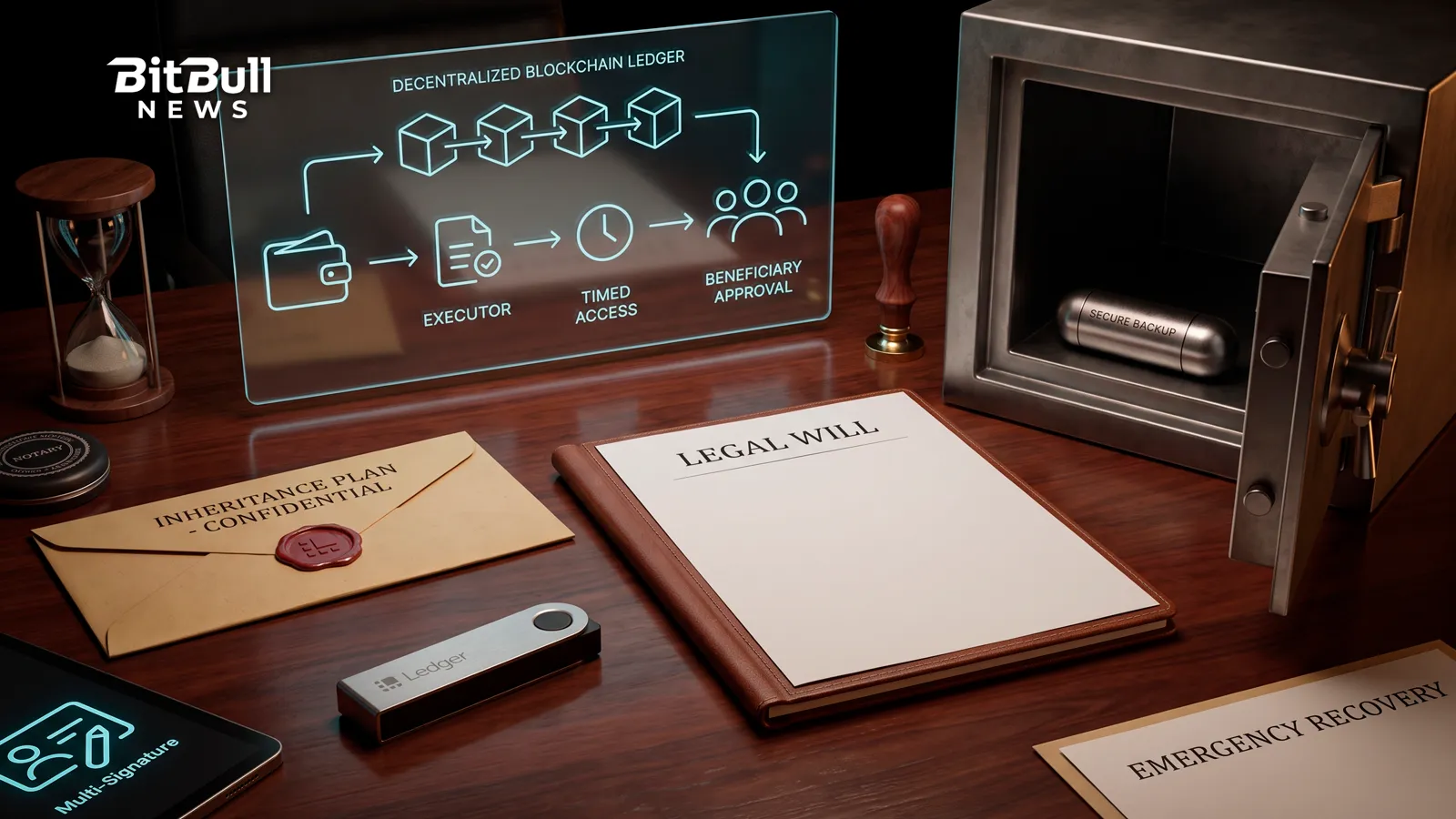
Crypto has a brutal property that traditional assets don’t: it can vanish entirely at the moment of your death. Not get frozen, not go to the wrong person — vanish. If nobody can reach your keys, the coins stay on the blockchain forever, visible to everyone and spendable by no one.
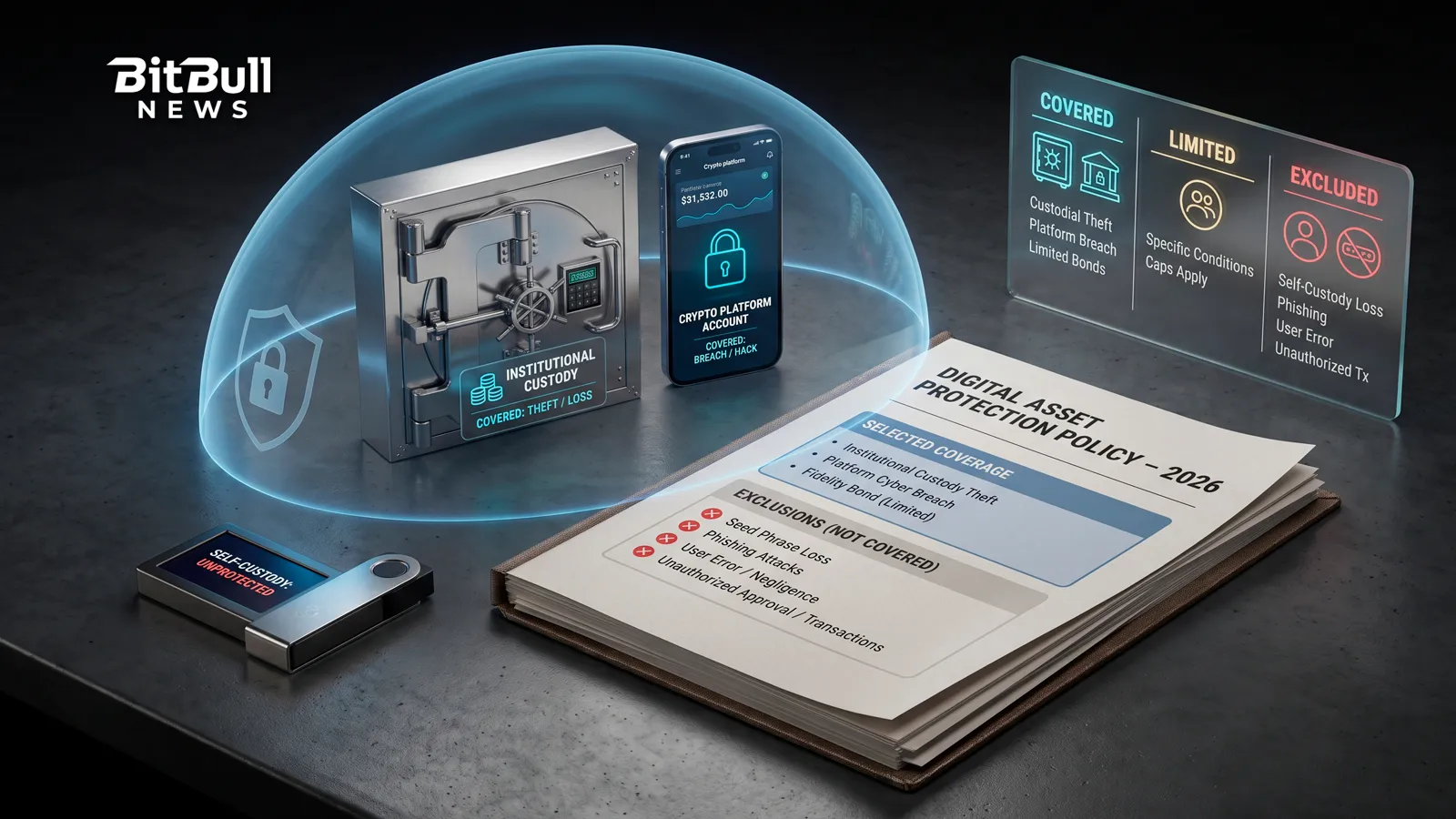
Banks have records, beneficiaries, and staff who can help your family. A self-custodied wallet has none of that. This guide covers what actually happens to crypto when someone dies, and how to build a plan that survives you without handing your keys to a thief while you’re still alive.
Why Crypto Breaks Normal Inheritance
A bank account is a claim against an institution. Your heirs prove who they are, the bank checks its records, and the money moves. The institution is the record.
Crypto works the other way. The key is the asset. There is no institution holding your Bitcoin — the network only recognizes whoever can sign with the private key. That produces two failure modes with no equivalent in traditional estates.
- The access problem. If your heirs can’t reach the keys, the funds are permanently unreachable. No court order fixes it, no company can recover it.
- The discovery problem. If your heirs don’t know the crypto exists, they’ll never look for it. Wallets don’t send statements.
Both are entirely preventable. Both regularly aren’t.
Two Completely Different Situations
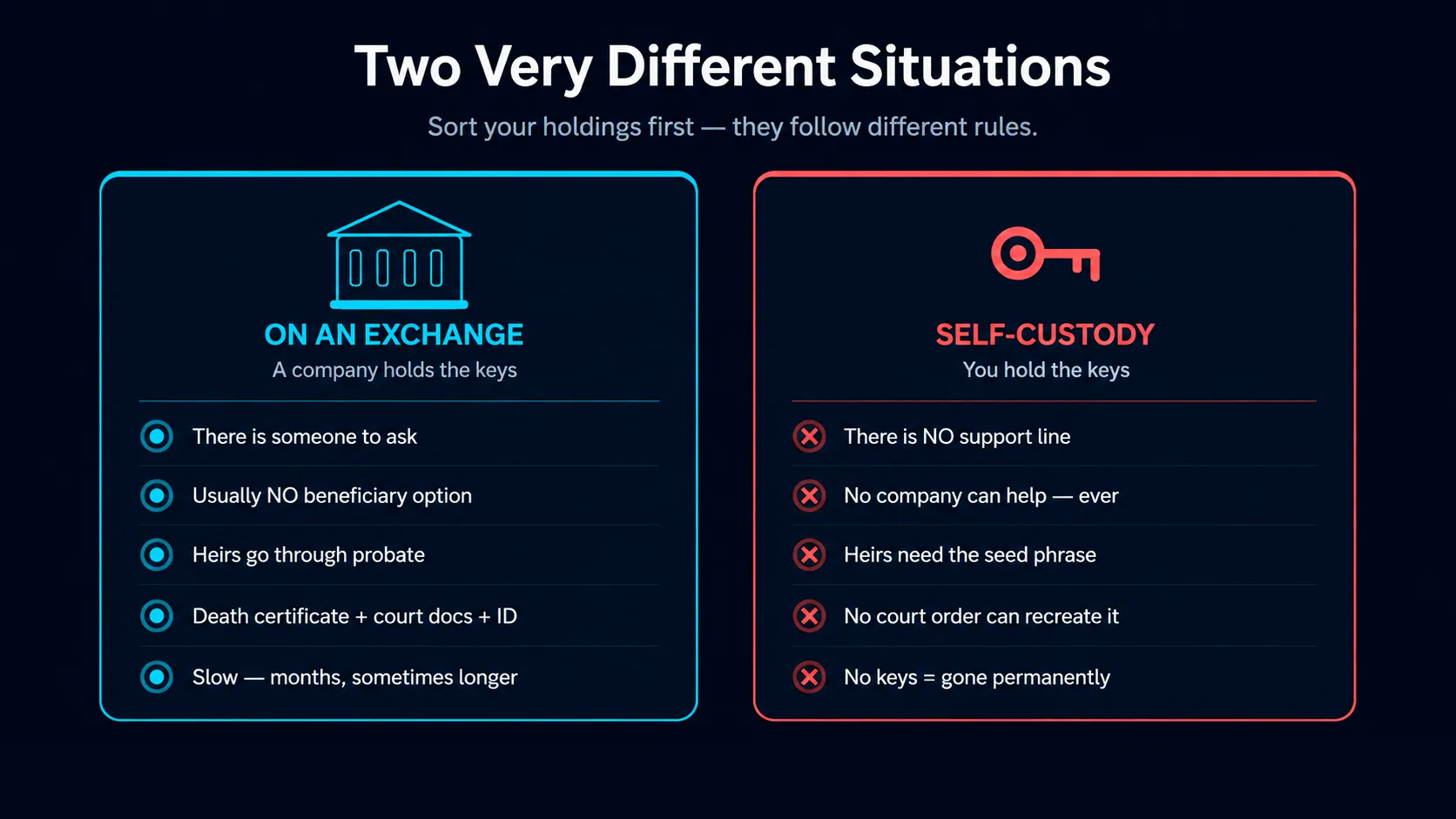
Before you plan anything, sort your holdings into two buckets. They follow different rules.
Crypto On An Exchange (Custodial)
Here a company holds the keys, so there’s someone to ask — and a legal process to follow.
Most major exchanges do not let you name a beneficiary on an individual account, unlike a retirement account or life insurance policy. That means the assets pass through your estate, and your heirs typically need probate.
Coinbase publishes its requirements, and they’re representative of the industry. To claim a deceased account holder’s assets, the estate generally must provide:
- A certified death certificate.
- Probate documents — letters testamentary, letters of administration, an affidavit for collection, or a small estate affidavit.
- Government-issued photo ID of the person named in those documents.
- A signed letter instructing the platform what to do with the balance.
This is slow. Probate can take months, sometimes far longer, and crypto’s price can move dramatically while your family waits for legal clearance.
Warning: Do not simply log in with the deceased’s password. Even with good intentions, that can violate the platform’s terms and create legal problems for the estate. Use the official process.
Crypto In Your Own Wallet (Self-Custody)
There is no support line. No company can help, because no company has your keys.
Your heirs get the funds if — and only if — they can reach your seed phrase or private keys. Everything else in your estate plan is paperwork around that single fact.
The Legal Layer: Give Your Executor Authority
In the US, most states have adopted the Revised Uniform Fiduciary Access to Digital Assets Act (RUFADAA), a model law from the Uniform Law Commission. It gives executors and trustees a legal pathway to your digital assets, including virtual currency.
It works through a three-tier hierarchy:
- A platform’s own online tool, if it offers one (a legacy contact or similar), takes priority over everything else.
- Your legal documents — will, trust, or power of attorney — come next. But you must grant the authority explicitly. Vague language fails.
- The platform’s terms of service apply if you left nothing. Many default to no third-party access at all.
So say it plainly in your documents: your executor has authority to access, manage, and distribute your digital assets and cryptocurrency accounts. Without that sentence, your executor may need a court order — expensive, slow, and not guaranteed.
Laws differ by country, and this isn’t legal advice. Work with an estate attorney who has actually handled digital assets.
RUFADAA grants legal authority. It does not grant technical access. A court can name your executor. It cannot conjure your seed phrase. That part is on you.
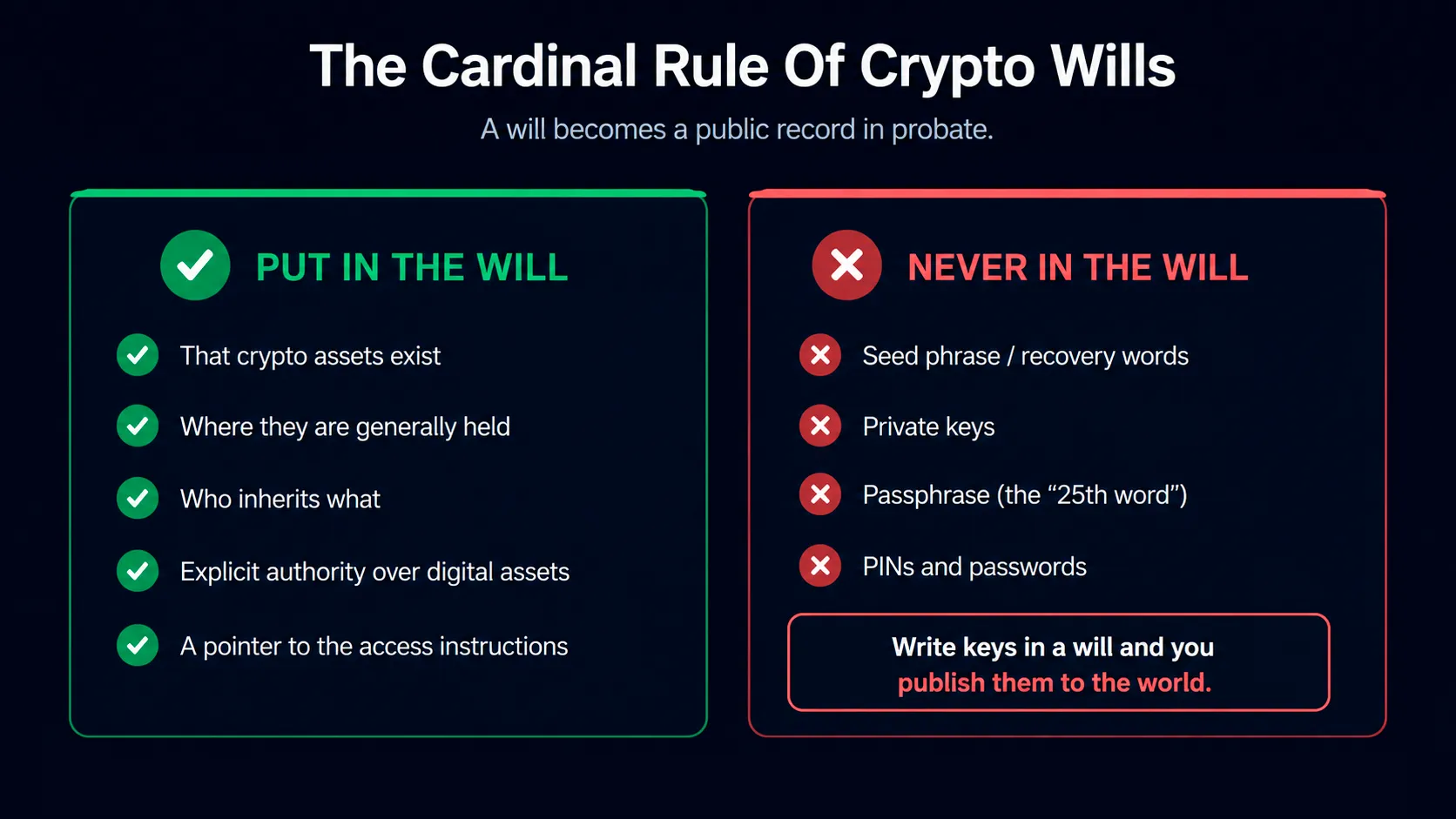
The Cardinal Rule: Never Put Keys In Your Will
This is the mistake that turns a good plan into a theft.
A will typically becomes a public record when it goes through probate. Write your seed phrase, private key, or passphrase into it and you’ve published your keys. Anyone can read them, and they’ll be gone before your heirs finish grieving.
The same logic applies to anything filed with a court or shared broadly.
What goes in the will or trust:
- The existence of crypto assets and where they’re generally held.
- Who inherits what.
- Explicit authority for your executor over digital assets.
- A pointer to where access instructions live — not the instructions themselves.
What never goes in the will:
- Seed phrases, private keys, passphrases, PINs, or passwords.
Keep the secrets in a separate, secure, non-public place, and reference that place from the will.
How To Actually Pass On Access
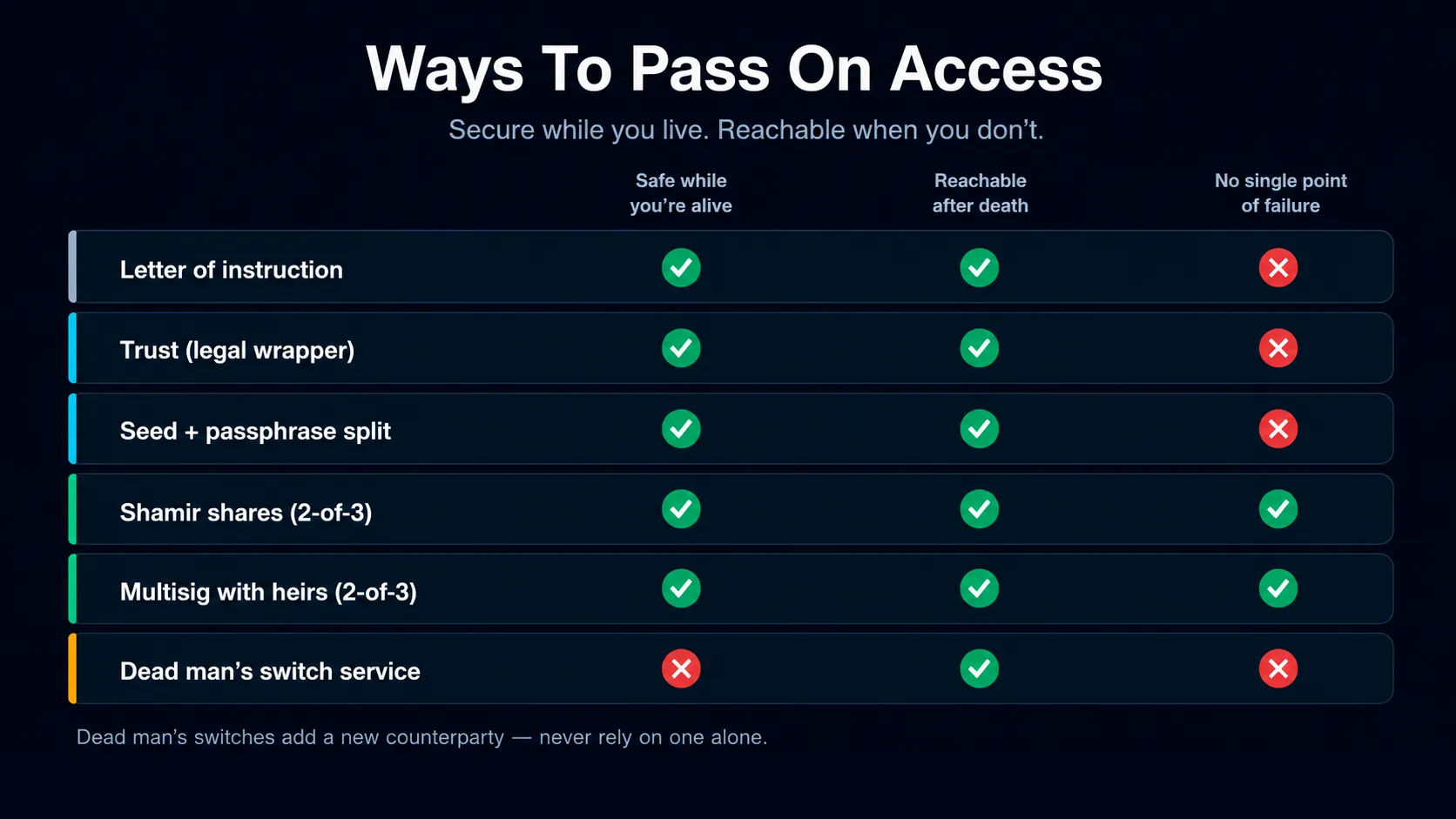
The real design problem: your heirs must be able to reach the keys after you die, and nobody must be able to reach them before. Here are the approaches that work, roughly from simplest to most robust.
A Letter Of Instruction, Stored Securely
A private document — separate from your will — that explains what you hold, where it is, and how to access it. Store it somewhere secure and non-public: a safe, a safe deposit box, or with your attorney.
Simple and cheap. But it’s a single point of failure, and it concentrates full access in one place. Whoever finds it early controls everything.
A Trust
Retitling assets into a revocable living trust can keep them out of probate entirely, so the trustee can act quickly and privately. Trusts don’t become public record the way wills do.
You still have to solve key access separately. A trust is a legal wrapper, not a technical one.
Multisig With Your Heirs
Set up a multisig wallet — say 2-of-3 — where you hold one key, a trusted family member holds another, and an attorney or a second heir holds the third. While you’re alive, no one can move funds without you. After your death, the other two can combine to recover the assets.
This is the cleanest solution technically, because it removes the single point of failure on both sides. It requires setup effort and heirs who can be walked through the process.
Shamir Backup (SLIP39) Shares
Split your recovery into shares using the SLIP39 standard — for example, any 2 of 3 reconstruct the wallet. Distribute the shares to different people or locations.
No single holder can steal the funds. No single lost share locks out your heirs. The trade-off is coordination: they must know the scheme exists, who has what, and how many shares they need.
The Passphrase Split
Give your heirs the seed phrase through one channel and the passphrase through another — an attorney, a sealed envelope, a second location. Neither piece alone opens the wallet.
Effective, but unforgiving. If either half is lost, the funds are gone.
Inheritance Services And Dead Man’s Switches
Various services offer timed release of your credentials if you stop checking in. Some hardware wallets and protocols support time-locked recovery paths.
Judge these carefully. You’re introducing a new counterparty and a new failure mode: the service could shut down, get breached, or trigger by accident. Treat any product in this space as experimental unless you’ve verified how it actually works, and never rely on it as your only plan.
Write The Inventory Your Heirs Will Actually Need
Access is only half of it. Your family also needs to know what exists and how to handle it.
Document, in your secure instructions:
- Which assets you hold and roughly where — which exchanges, which wallets, which chains.
- What hardware exists and where it’s physically stored.
- Where the backups are. Locations, not the words themselves, if the document itself isn’t fully secured.
- Whether a passphrase exists. An heir who has the seed but doesn’t know about a hidden wallet will see an empty balance and give up.
- Which derivation paths or wallet software you used. This detail alone saves enormous confusion.
- Contact details for an attorney or a knowledgeable helper.
Then keep it current. A plan built around an exchange you closed two years ago helps no one.
Teach Someone To Use It
Your heirs may have never touched crypto. Handing them twenty-four words and no context is a plan that fails in practice, even when it succeeds on paper.
- Make sure at least one trusted person knows the plan exists and where to begin.
- Walk them through a dry run if you can, using a small amount.
- Write instructions for someone with zero technical background. Assume they’re grieving and stressed.
- Warn them explicitly about the recovery scams that hunt heirs, and about anyone who offers to “help” retrieve the funds for a fee.
Taxes And Valuation
For US federal tax purposes, the IRS treats digital assets as property, not currency. That shapes how an estate values holdings, how gains are calculated, and what your executor must report.
Rules vary by country and change over time, and estates add real complexity. Get a tax professional who understands digital assets — this is not a place to improvise.
Mistakes That Lose Family Fortunes
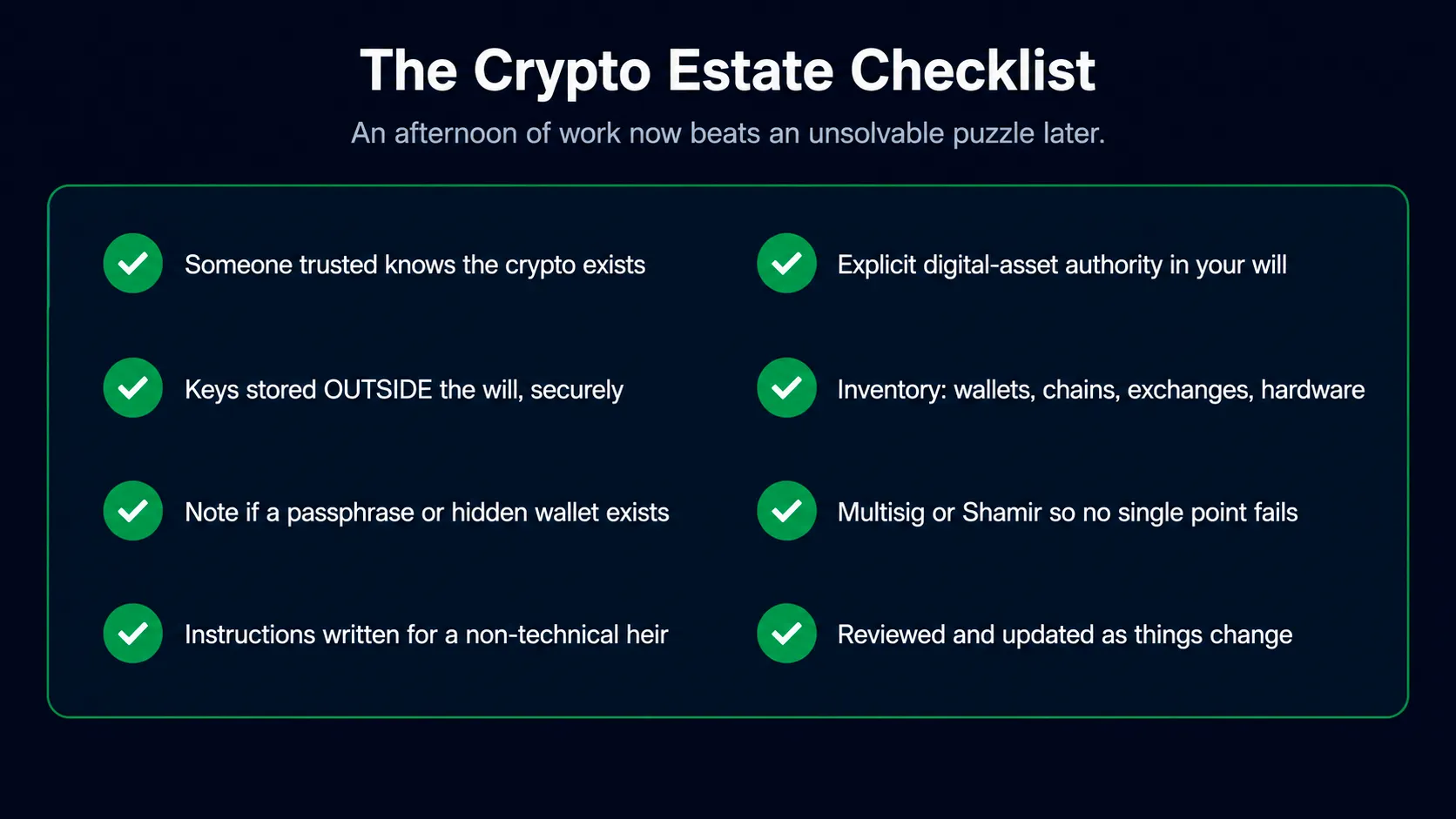
- Telling no one the crypto exists. The most common failure by far.
- Putting the seed phrase in the will, where it becomes public.
- A single copy of the backup, destroyed with the house.
- Vague legal language that doesn’t explicitly cover digital assets.
- A plan only you understand, handed to people who’ve never opened a wallet.
- Never updating it after you change wallets, exchanges, or heirs.
- Sharing full access early with someone who then has no reason to wait.
The goal is a plan that’s secure while you’re alive and executable the moment you’re not. Those two requirements pull in opposite directions, which is exactly why this takes deliberate design rather than good intentions.
Do it now, while it’s an afternoon of work. The alternative is leaving your family a puzzle they can’t solve, standing next to money they can see and will never touch.
FAQ
- What Happens To Crypto When Someone Dies Without A Plan?
If it’s self-custodied and no one can reach the keys, it’s permanently lost — the coins stay on the blockchain, unreachable forever. If it’s on an exchange, heirs can usually claim it through probate, but only if they know the account exists. - Can I Name A Beneficiary On My Crypto Exchange Account?
Usually not. Most major exchanges don’t support beneficiary or transfer-on-death designations on individual accounts, so assets pass through your estate and typically require probate. Holding the account through a trust is one way around that. - Should I Put My Seed Phrase In My Will?
Never. A will generally becomes a public record during probate, so writing your seed phrase into it effectively publishes your keys. Keep secrets in a separate secure location and have the will point to it. - What’s The Best Way To Leave Crypto To My Heirs?
There’s no single answer, but multisig (like a 2-of-3 with trusted people) and Shamir shares are the strongest technically, because no one can steal the funds alone and no single loss locks out your heirs. Pair whichever you choose with clear written instructions and a proper legal document. - Does A Court Order Give My Executor Access To My Wallet?
No. Laws like RUFADAA give an executor the legal authority to manage digital assets, but no court can produce your private key. Legal authority and technical access are separate problems, and you have to solve both. - How Do My Heirs Even Know I Own Crypto?
Only if you tell them, or leave an inventory that survives you. Wallets send no statements and appear in no registry, so undiscovered crypto is one of the most common ways it’s lost forever. - Do I Need A Lawyer For Crypto Estate Planning?
For meaningful holdings, yes. The legal language must explicitly cover digital assets, rules differ by jurisdiction, and taxes add complexity. Look for an estate attorney with actual experience handling crypto.