


Content
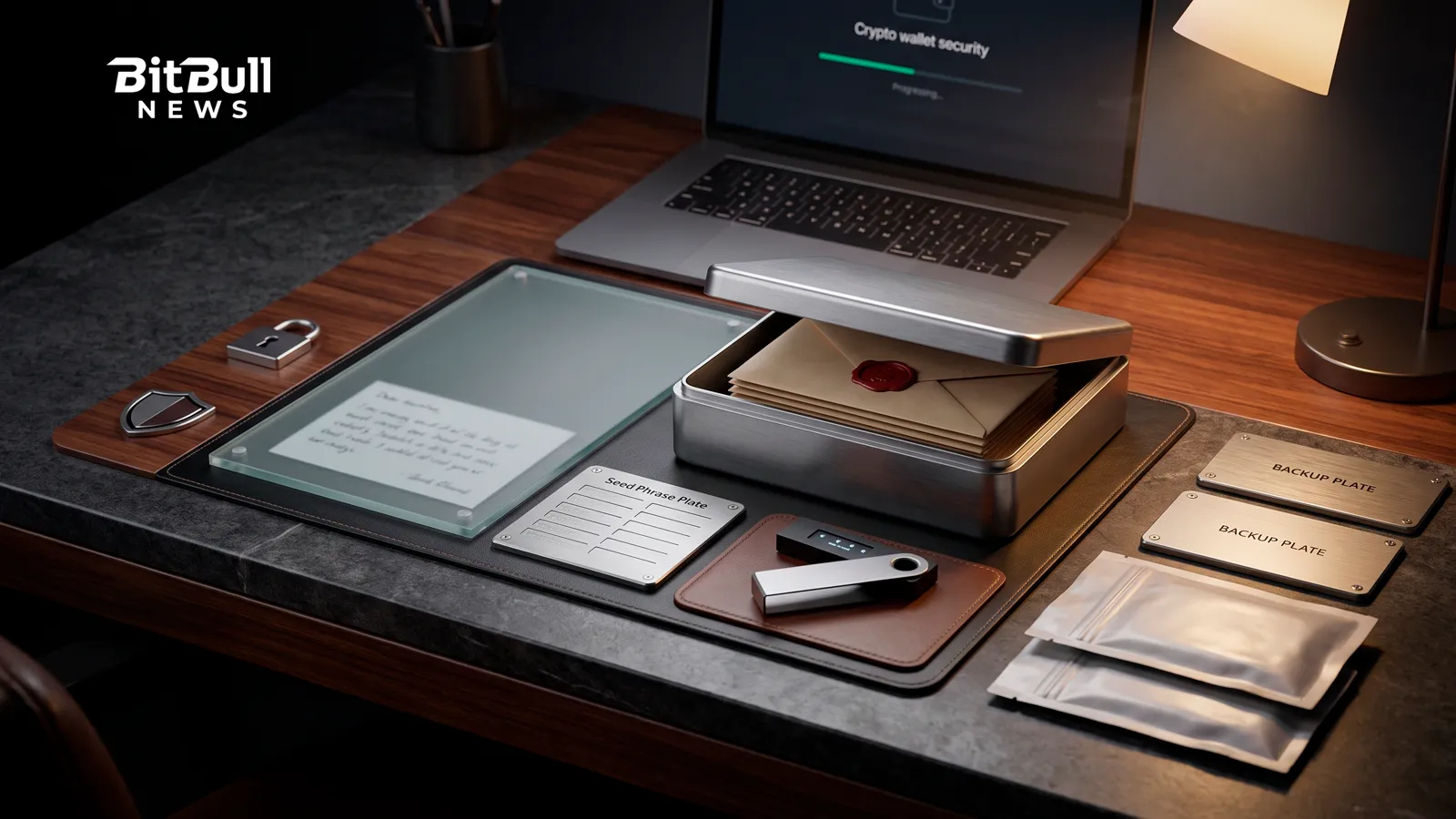
Your seed phrase is the master key to everything in your wallet. Whoever holds it controls the coins, and there’s no support line, no password reset, and no way to reverse a theft.
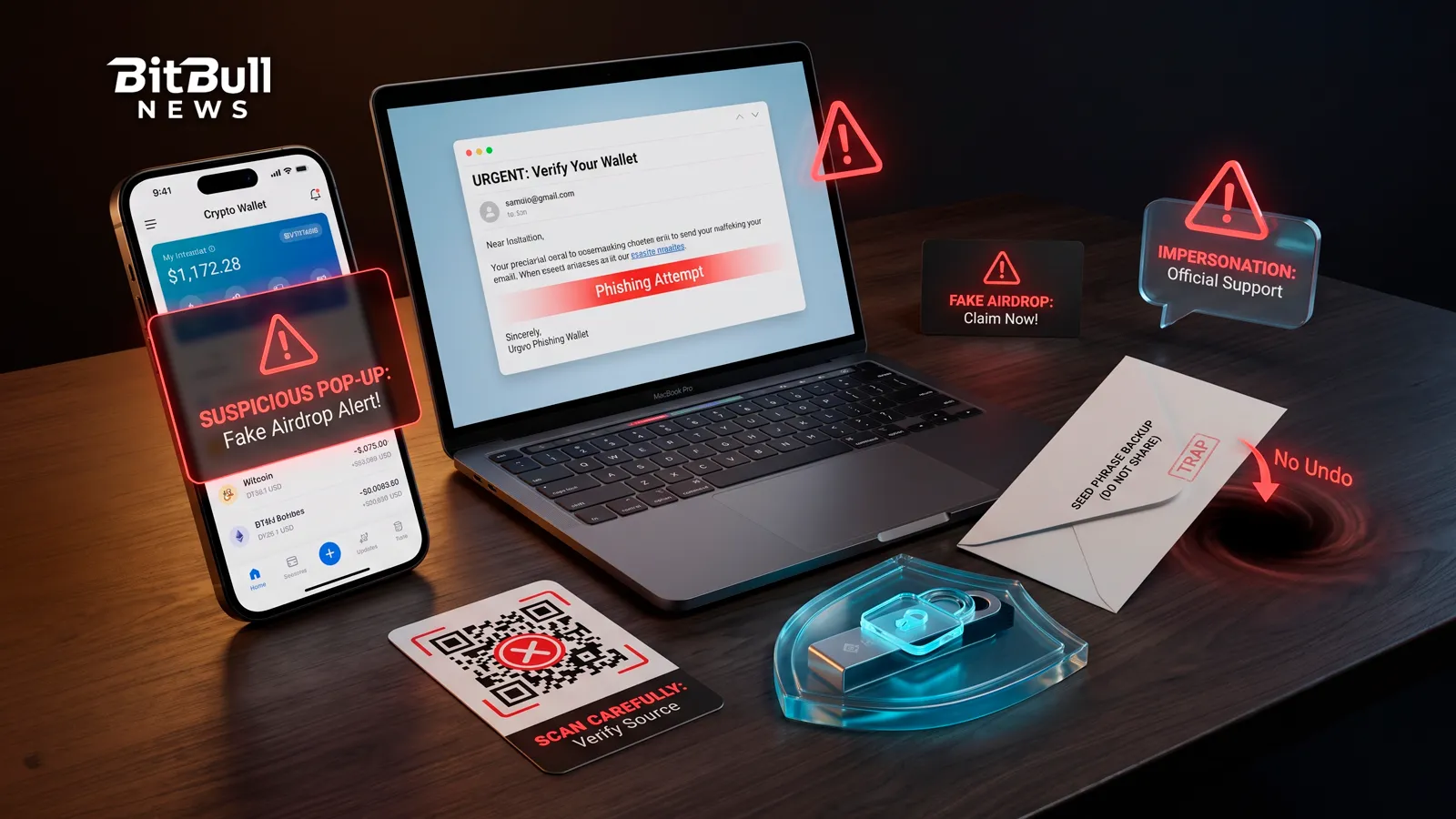
That puts every holder on a knife’s edge between two failures. Let someone else get the phrase and your funds get stolen. Lose it with no backup and your funds are stranded forever. Good storage defends both edges at once, and here’s how to do it right.
What A Seed Phrase Actually Is
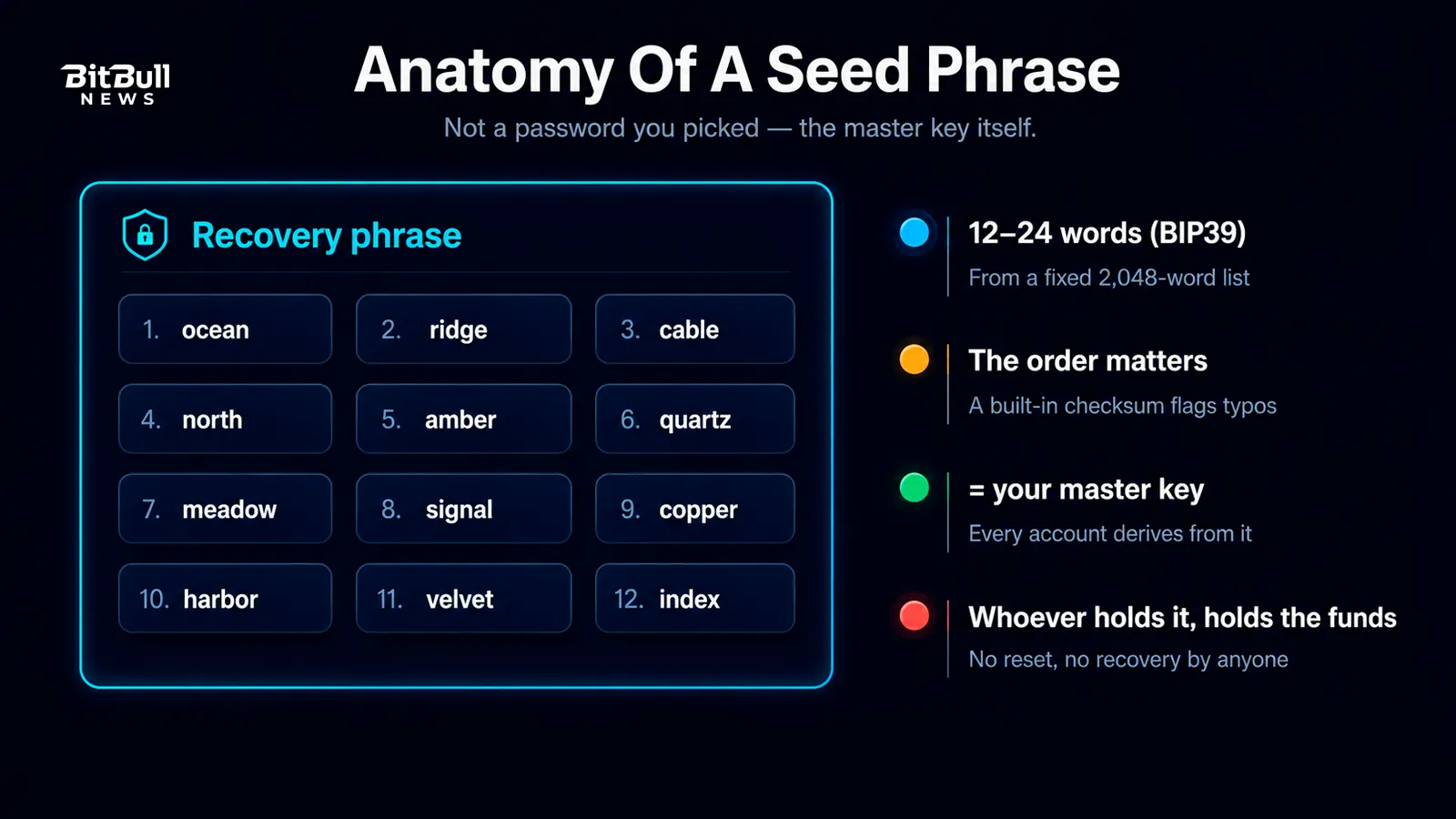
A seed phrase (also called a recovery phrase or mnemonic) is the human-readable form of your wallet’s master secret. Most wallets follow the BIP39 standard, which turns random entropy into an ordered list of 12 to 24 words drawn from a fixed 2,048-word list.
Those words aren’t a password you picked. They encode the master key that every one of your addresses and accounts is derived from. The order matters, and a built-in checksum means a mis-copied phrase usually won’t validate.
The takeaway is blunt: the phrase is the money. Anyone who reads it can rebuild your entire wallet on their own device, and no company can stop them or recover it for you.
The Two Ways You Lose Everything
Every rule in this guide serves one of two goals.
- Stop exposure. Keep the phrase secret so no one else can copy it.
- Stop loss. Keep a durable backup so you never lose access yourself.
Most bad outcomes come from obsessing over one side while neglecting the other. A phrase locked in a fireproof safe is useless if you photographed it first. And a perfectly secret phrase is worthless if your only copy burns.
Rule Zero: Keep It Off Screens And Off The Internet
The single habit that prevents most losses is simple: your seed phrase should never exist as a digital file.
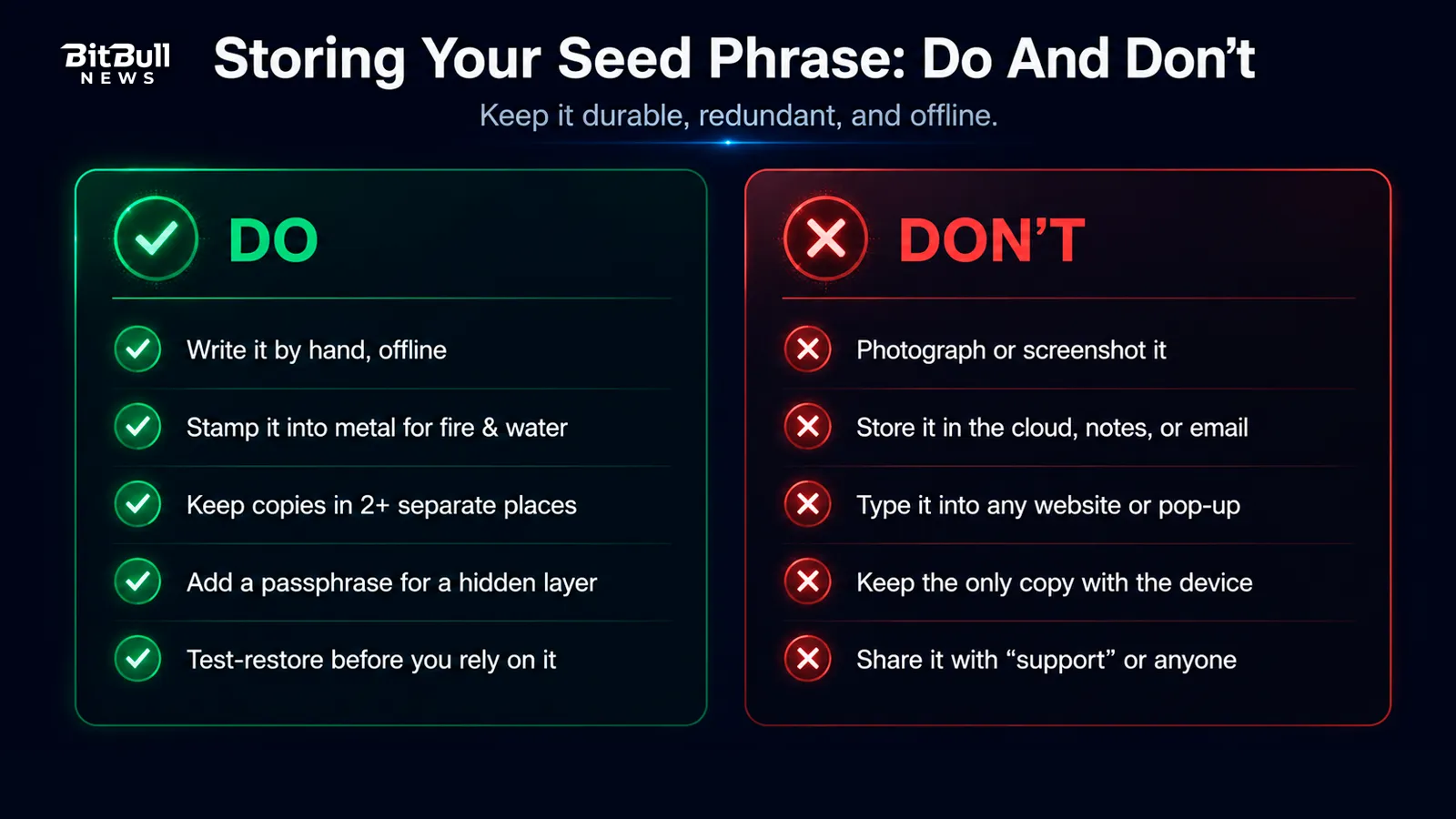
- Never photograph it, screenshot it, or type it into a phone note, email, cloud drive, or password manager.
- Never enter it on any website. Real wallets only ask for it inside the official app when you restore, never in a browser pop-up.
- Never share it with anyone — no “support,” no “wallet validator,” no exceptions.
A phrase that never touches an internet-connected device can’t be stolen by malware or leaked in a breach. That’s the whole game. The Ethereum Foundation is blunt about it too: your recovery phrase is the master key, and anyone who has it can drain every account.
How To Write It Down Right
Paper Is The Baseline
Writing the words by hand on paper is the default, and it’s fine for small amounts. Write legibly, keep the exact order, and note the word numbers so you can’t scramble them later.
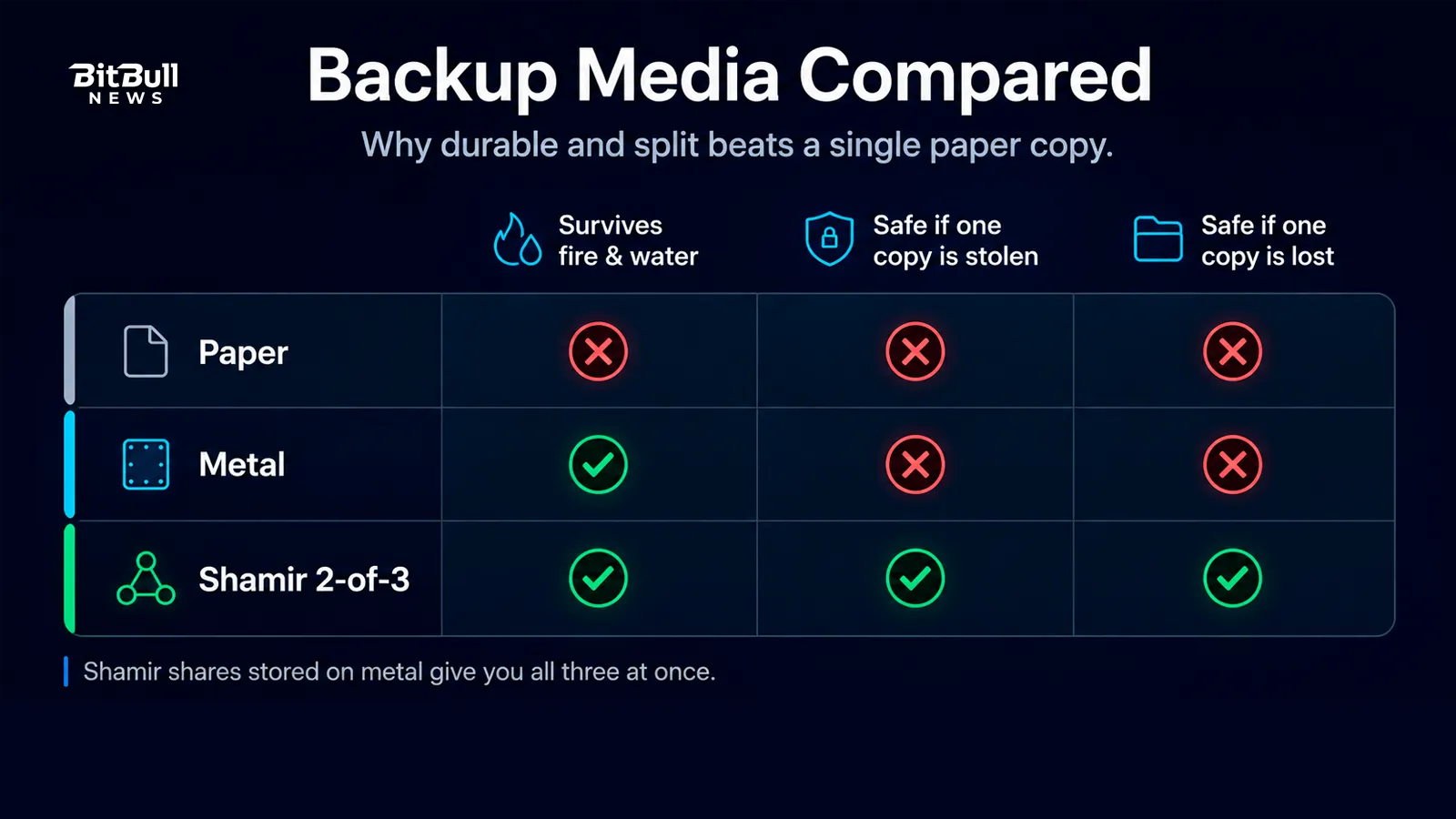
Paper’s weakness is the physical world. Fire, water, sunlight, and simple misplacement all destroy it. Treat a single paper copy as fragile.
Metal Is For Anything Serious
For meaningful holdings, move the backup onto metal. Stamped or engraved steel plates survive house fires, floods, and the decades of slow decay that ruin paper. Plenty of purpose-built products exist, but the principle is what matters: your backup should outlast the paper it started on.
Build Redundancy And Separate Your Copies
One backup is a single point of failure. Two or more, stored in different secure locations, protect against any one disaster taking everything.
- Keep copies in more than one place, so a single fire, flood, or burglary can’t wipe you out.
- Separate them geographically. Don’t keep every copy in one house.
- Balance it. Each extra copy is one more thing a thief could find, so more isn’t automatically safer.
Bitcoin.org’s own guidance makes the same point: a backup that depends on a single location or medium is a backup waiting to fail.
Split The Secret With Shamir Or Multisig
For larger holdings, you can remove the single-copy dilemma entirely by splitting the secret so no one location holds all of it.
Shamir Backup (SLIP39)
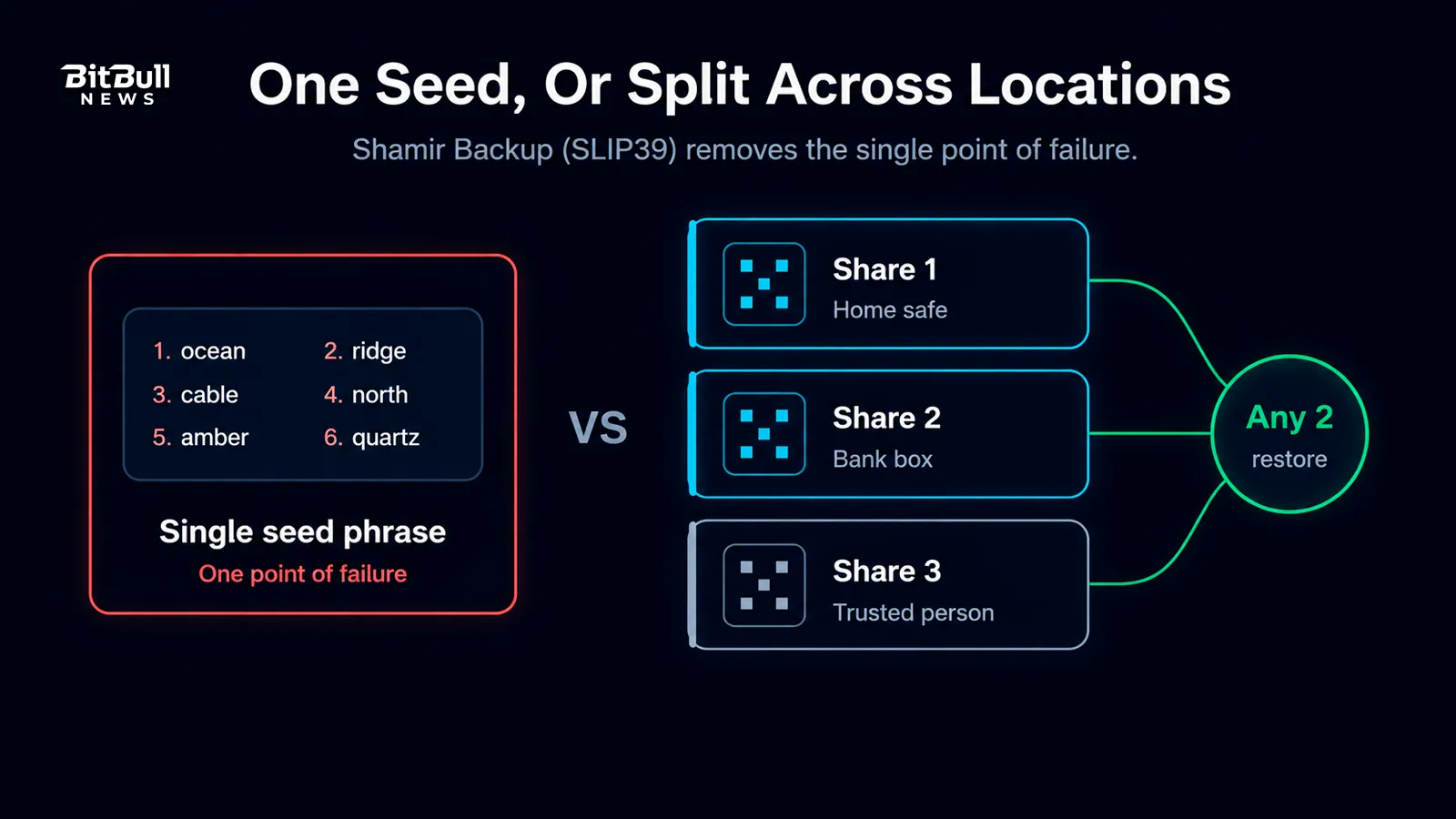
Shamir Backup, defined in the SLIP39 standard, splits your recovery into several shares with a threshold — say, any 2 of 3. Fewer shares than the threshold reveal nothing about the secret, and losing one share doesn’t lock you out.
You store the shares in separate places. A thief who finds one gets nothing, and a fire that takes one doesn’t end you. The trade-off is discipline: more shares mean more to track, and you have to remember your threshold and where each share lives.
Multisig Is A Related Option
Multisig takes a different route to the same idea: several independent keys, a threshold of which must sign to move funds. It’s more involved to set up, but it removes the single-point-of-failure problem too, and it’s common for very large or shared holdings.
Add A Passphrase For A Hidden Layer
BIP39 supports an optional passphrase, sometimes called the “25th word.” It’s an extra secret, chosen by you, that combines with the seed to unlock a separate hidden wallet.
Its strength is real. Someone who finds your seed words still can’t reach passphrase-protected funds without the passphrase. But it cuts both ways. Forget the passphrase and those funds are gone, because it isn’t stored anywhere.
Back up the passphrase as carefully as the seed, and keep it separate from the seed. Store both together and you’ve gained nothing.
Verify Your Backup Before You Trust It
A backup you’ve never tested is a guess. Before you rely on it, confirm it actually works.
- Restore the phrase onto a wallet, or wipe and restore your device, using a small amount first.
- Check that the word order is right, and that any passphrase unlocks the wallet you expect.
A five-minute test now beats discovering a transcription error on the day you actually need the backup.
Plan For What Happens To You
Self-custody carries a cost people avoid thinking about: funds with no recovery plan die with you. If something happens and no one can reach your phrase, the coins are gone for good.
Decide, carefully, how a trusted person could recover your holdings — through sealed written instructions, a multisig setup, or a plan held with an attorney. The tension is between secrecy and accessibility, and only you can set that balance. Just don’t leave it to chance.
Mistakes That Cost People Their Coins
Most losses trace back to a short list of avoidable errors.
- Storing the phrase as a photo, screenshot, or cloud note.
- Keeping only one copy, or keeping the backup right next to the device.
- Typing the phrase into a website or “validation” pop-up.
- Homebrew “encryption” or clever hiding schemes you later forget.
- Telling the wrong person, or splitting shares among people you don’t fully trust.
Every one of these is preventable with the habits above.
Get the basics right — offline, durable, redundant, secret — and your seed phrase becomes what it should be: a key only you can use, that no fire, thief, or scammer can take. That protection outlasts any single wallet, coin, or app you’ll ever own.
FAQ
- What Happens If I Lose My Seed Phrase?
If you lose the phrase, have no other backup, and also lose access to the wallet, your funds are gone for good. No one can recover them, which is why redundant, durable backups matter so much. - Is It Safe To Store My Seed Phrase In A Password Manager?
No. A password manager is a digital file on internet-connected devices, which is exactly what you’re trying to avoid. Keep the phrase offline, on paper or metal. - How Many Copies Of My Seed Phrase Should I Keep?
At least two, stored in separate secure locations so one fire, flood, or theft can’t wipe you out. But don’t over-copy, because every extra copy is one more thing to protect. - What’s The Difference Between A Seed Phrase And A Private Key?
The seed phrase is a human-readable master backup that can regenerate all of your private keys and addresses. A single private key controls one account, while the seed controls the whole wallet. - Do I Need A Passphrase (The “25th Word”)?
It’s optional and adds a strong extra layer, since it creates a separate hidden wallet. But forget it and those funds are gone, so only use one if you’ll back it up as carefully as the seed. - Can I Store My Seed Phrase On A USB Drive Or Encrypted File?
It’s risky. Drives fail, files get lost, and your own encryption is easy to forget. Offline paper or metal is more durable and simpler to recover than any digital scheme.