


Content
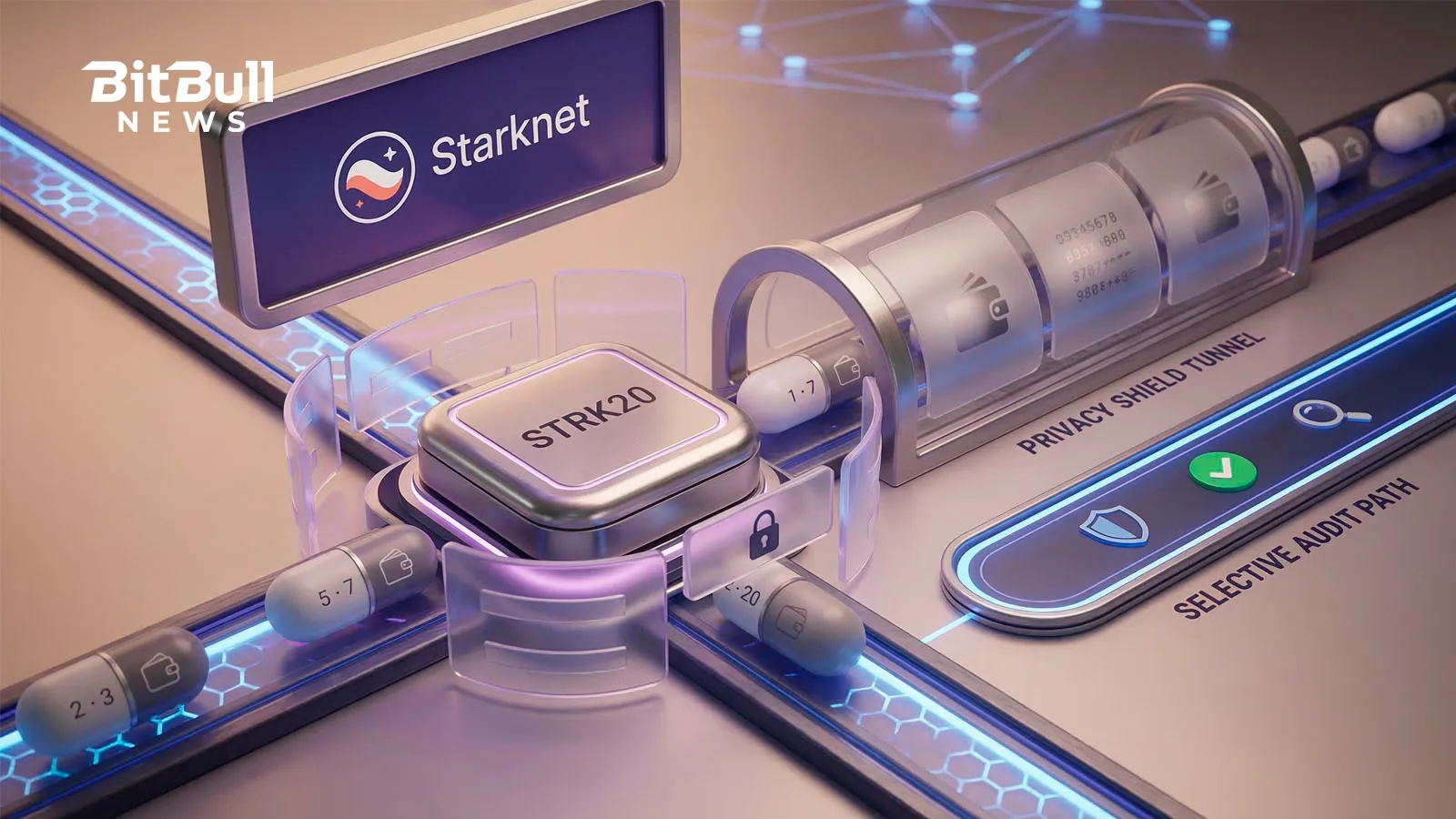
Starknet has introduced STRK20, a new privacy framework that aims to make any ERC-20 token on Starknet private at the token level. The project is designed to hide wallet identity, balances, counterparties, and transfer amounts from public view, while still keeping transactions valid through zero-knowledge proofs.
The pitch is simple: public blockchains made transparency the default, but that model does not work well for many real financial use cases. Starknet says STRK20 is built to change that without forcing developers to wrap assets or rebuild entire token systems from scratch.
What STRK20 is trying to solve
Every on-chain token transfer normally leaves a public trail. That includes the sender, the receiver, the amount, and the timing. Starknet argues that this level of visibility is a major barrier for businesses, institutions, and even ordinary users who want financial privacy.
According to the post, STRK20 is meant to remove that barrier by letting ERC-20 tokens operate privately on Starknet. Instead of using a wrapper or a separate privacy token, the privacy logic is built directly into how the asset works.
How STRK20 works
At the center of the design is the Starknet Privacy Pool. Users deposit tokens into the pool, transact inside it, and withdraw when needed. Starknet says a single pool can support every ERC-20 token.
Private transactions are backed by zero-knowledge proofs, which are generated client-side and verified at the sequencer level. The company says this keeps execution fast and relatively cheap because the same proving infrastructure already used by Starknet for its own blocks is also used here.
Why Starknet says this is different
Starknet argues that other privacy approaches often come with trade-offs: wrapped assets, fragmented liquidity, expensive proof generation, or separate infrastructure that becomes hard to maintain.
By contrast, STRK20 is built in Cairo and uses Starknet’s native architecture. The post says existing Starknet accounts, including multisig wallets, hardware wallets, and smart accounts, work out of the box.
Private DeFi is part of the launch
Starknet says STRK20 is not just a privacy tool for simple transfers. The goal is to make privacy usable inside DeFi from day one.
The post highlights two launch use cases:
- Anonymous swaps on Ekubo, where users can swap from the privacy pool without publicly linking the trade to a wallet address.
- Anonymous staking, where users can move into liquid staking positions without exposing their identity on-chain.
The idea is that privacy only matters if it works where real financial activity happens, not just in isolated wallets.
The compliance angle is built into the design
One of the most important parts of the announcement is Starknet’s attempt to answer the usual criticism of privacy tools: that they clash with regulation.
Starknet says users who join the Privacy Pool register an encrypted viewing key on-chain. If there is a valid regulatory request, a designated third-party auditing entity can decrypt that specific user’s key and trace that user’s transaction history. The post says this access is narrow and does not expose the rest of the pool.
In other words, Starknet is trying to position STRK20 as privacy by default, but not privacy without limits.
Why Starknet thinks this matters for institutions
The company says privacy solutions without a compliance path are not realistic for large-scale deployment. That is why the post leans heavily on enterprise and institutional use cases such as treasury activity, supply-chain payments, and strategy-sensitive transactions.
The broader message is clear: Starknet wants privacy to become part of normal on-chain finance, not just a niche feature for privacy-focused users.
Why it matters for crypto
- STRK20 pushes privacy closer to the base layer of token design instead of treating it as a wrapper or add-on.
- If it works as described, it could make DeFi more usable for institutions and businesses that cannot expose every move on a public ledger.
- The selective audit model shows how privacy projects are increasingly trying to balance confidentiality with compliance.
- Private swaps and staking are a stronger real-world test than simple private transfers, because they bring privacy into core DeFi activity.
What to watch next
- Whether Starknet names the first token teams, institutions, or apps that adopt STRK20 in production.
- How anonymous swaps on Ekubo perform in practice, especially around liquidity and user experience.
- Whether regulators and compliance teams view the encrypted viewing-key model as credible enough for institutional use.
- If STRK20 expands into more DeFi flows beyond swaps and staking, such as lending and treasury management.
Source: Starknet Blog