


Content
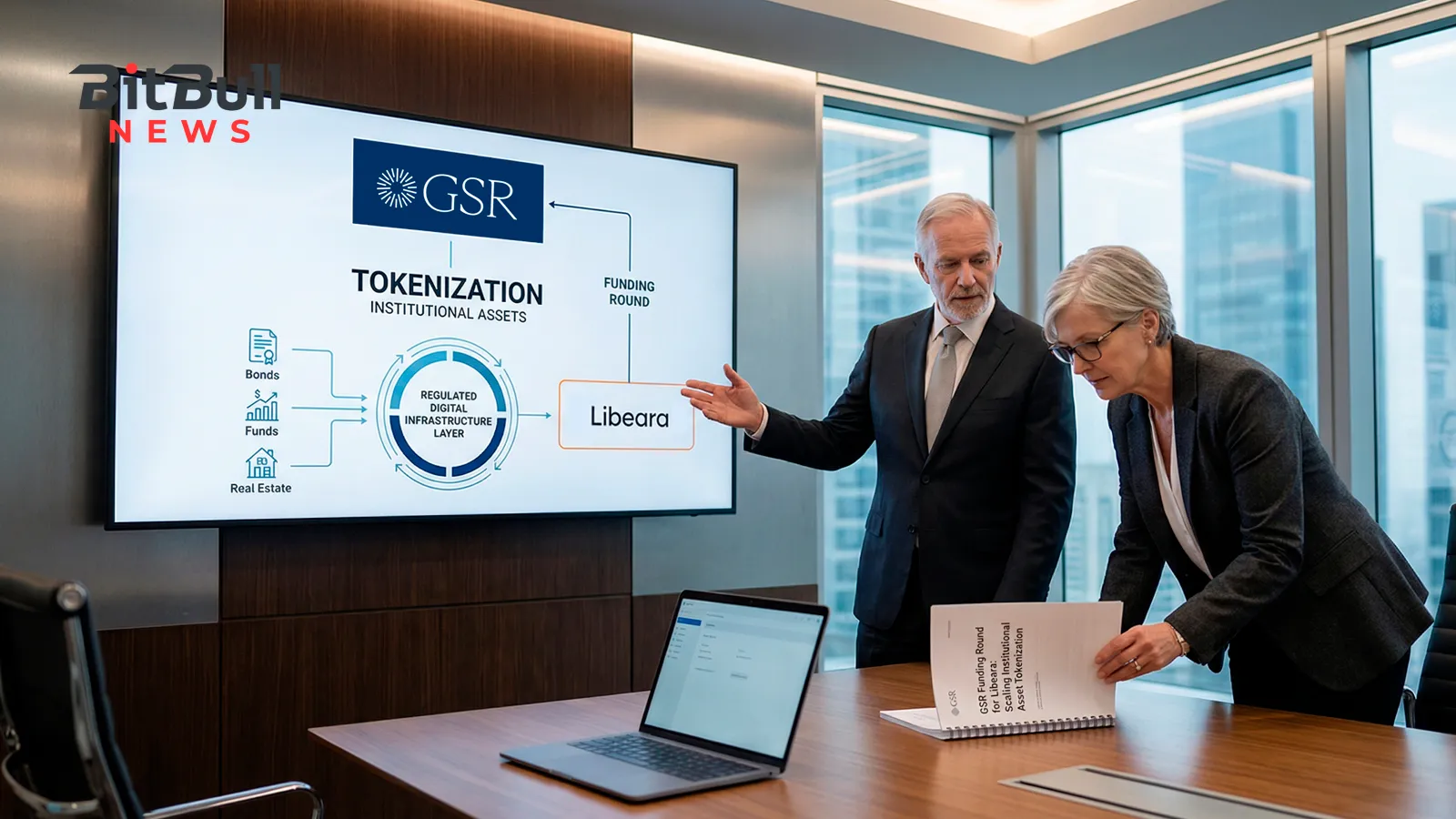
GSR is leading a new funding round for Libeara, the SC Ventures-backed tokenization platform, in a move that sharpens the market’s focus on the infrastructure layer behind institutional real-world assets. The round also includes AlloyX and Monk’s Hill Ventures, with Libeara saying the new capital will help expand its compliant onchain tokenization stack for financial institutions and asset managers.
The stronger angle here is not just that another tokenization startup raised money. It is that a major crypto market maker is putting capital behind the plumbing needed to issue, distribute and trade institutional-grade tokenized assets at scale. GSR is explicitly tying the investment to liquidity, distribution and market infrastructure, suggesting the next phase of tokenization will be judged less by issuance headlines and more by whether serious secondary markets can form around those assets.
A funding round built around market infrastructure, not token hype
Libeara says the fresh capital will support its expansion as a provider of compliant onchain tokenization infrastructure, helping financial institutions and asset managers issue tokenized assets and connect them with institutional distribution channels, market infrastructure and liquidity participants. That wording matters because Libeara is not presenting itself as a simple issuance platform. It is trying to position itself as part of the full institutional tokenization stack.
GSR’s own rationale makes that even clearer. CJ Fong, GSR’s APAC general manager, said tokenization is no longer just a thesis but “a market in formation,” and argued that as the sector scales it will need deeper liquidity infrastructure and stronger institutional connectivity. In other words, GSR is betting that tokenized assets will only become a durable asset class if they can move through real markets, not just sit onchain as static wrappers.
Why Libeara is attracting institutional attention
Libeara already has more operating substance than many tokenization stories at this stage. The company says it received a Capital Markets Services licence from the Monetary Authority of Singapore in March 2026, and that its infrastructure has already supported the tokenization of more than $1 billion in compliant onchain assets. It also says those assets include a top-rated tokenized U.S. Treasury fund and the first tokenized retail money market fund in Asia.
That matters because this is not a platform raising money on vision alone. Libeara is telling the market it already has regulatory footing in Singapore and live experience handling institutional-grade tokenized products. The funding round is therefore being framed as acceleration capital, not rescue capital or a pre-product seed story.
GSR is extending from trading into tokenized capital markets
For GSR, the investment is also a strategic expansion of its own business model. The firm says the move fits naturally with its core trading business as digital assets and traditional financial products continue to converge. It also says tokenized instruments, especially money market funds and Treasuries, create a new class of yield-bearing collateral that can improve capital efficiency across its platform.
That is a meaningful point. GSR is not investing in Libeara as a passive venture bet. It is signaling that tokenized assets could become directly relevant to its trading and market structure business, especially if they start functioning as liquid, yield-bearing institutional collateral. This makes the round look less like startup financing and more like an early position in the next layer of onchain capital markets.
The partnership is trying to solve four institutional bottlenecks at once
The two firms say they want to close the gap across four dimensions: origination, market infrastructure, distribution and liquidity. More specifically, they describe a model where high-quality real-world assets come onchain, Libeara handles compliant issuance infrastructure, GSR connects those products to institutional investors, and GSR’s market-making capabilities help support secondary market liquidity.
That gives the story a stronger shape than a generic tokenization partnership. Many RWA projects can tokenize an asset. Far fewer can claim a credible path from issuance to institutional distribution to active secondary liquidity. The whole point of this deal is to argue that tokenization becomes more valuable when those pieces are connected, not when they operate in isolation.
What we don’t know yet
The release does not disclose the size of the funding round, Libeara’s valuation, or the exact commercial structure of the GSR partnership. It also does not say which new asset classes or markets will be prioritized first beyond broadly naming funds, credit, equities, commodities and balance sheets as target categories.
Why it matters for crypto
- It shows tokenization is increasingly becoming a market-structure story built around issuance, liquidity and institutional distribution, not just onchain representation.
- GSR’s involvement suggests market makers expect tokenized money market funds and Treasuries to become more relevant as collateral and trading infrastructure.
- Libeara’s Singapore licence and claimed $1 billion-plus in tokenized assets give the round more weight than a pre-product RWA startup raise.
- The deal reinforces a broader trend: the next phase of RWAs may be won by platforms that can connect compliant issuance with real liquidity and institutional capital. This is an analytical conclusion based on the structure both firms described.
What to watch next
- Whether Libeara discloses more detail on the size of the round and how the new capital will be allocated.
- Which asset classes move first through the expanded GSR-Libeara pipeline, especially beyond Treasuries and money market funds.
- Whether GSR’s market-making role translates into visible secondary liquidity for tokenized institutional assets rather than only primary issuance growth. This is an inference based on the partnership’s stated priorities.
- Whether more trading firms and market makers start taking direct equity stakes in tokenization platforms as the RWA market matures. This is also an inference from the strategic nature of GSR’s investment.