


Content
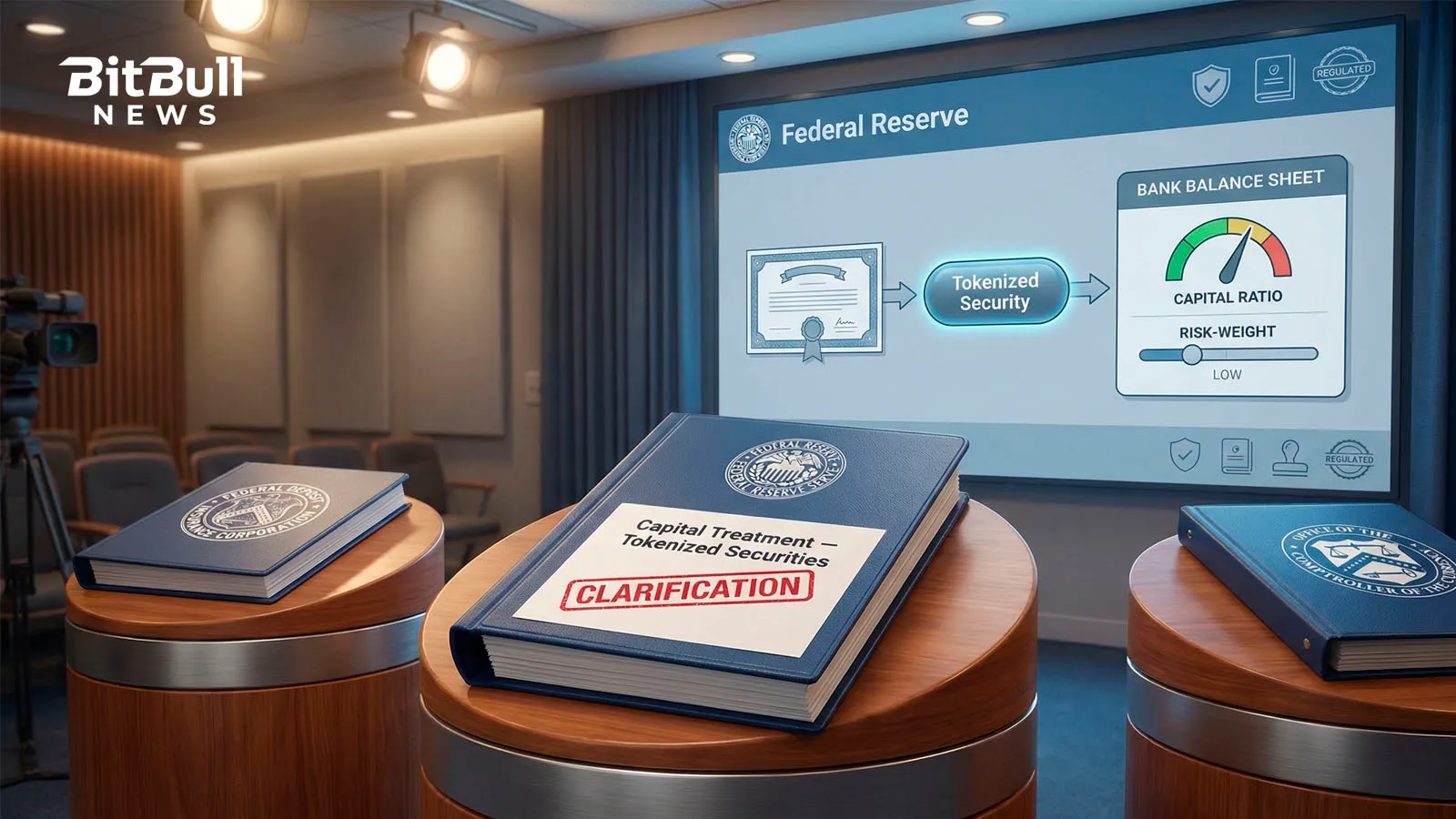
U.S. banking regulators have clarified that banks generally won’t face extra capital charges simply because a security is “tokenized.” In a joint release, the Federal Reserve, FDIC, and OCC said eligible tokenized securities should receive the same capital treatment as their non-tokenized forms under existing capital rules.
The guidance is meant to address growing bank interest in using distributed ledger technology (DLT) to represent ownership rights in securities — without rewriting the core capital framework.
Same security, same capital treatment
In the agencies’ FAQs, regulators describe “eligible tokenized securities” as tokenized securities that confer legal rights identical to the non-tokenized form. For those instruments, they say capital rules are “technology neutral,” meaning the technology used to issue or transact doesn’t generally change the capital treatment.
They also extend the logic to derivatives: a derivative referencing an eligible tokenized security should be treated the same, for capital purposes, as a derivative referencing the non-tokenized version.
Financial collateral treatment can still apply
The FAQs also address whether a tokenized security can qualify as “financial collateral” under the capital rule. Regulators said the use of tokenization does not prevent an instrument from meeting the definition of financial collateral, and if it qualifies and other requirements are met, it may be recognized as a credit risk mitigant.
If it qualifies as financial collateral, it would be subject to the same haircuts as the non-tokenized form.
Permissioned vs permissionless doesn’t change the answer
Regulators also made an explicit point that the capital rule does not provide different treatment based on whether the tokens are issued on permissioned or permissionless blockchains.
Risk management still applies
The agencies emphasized that banks holding tokenized securities must still apply sound risk management and comply with applicable laws and regulations, just as they would for any exposure.
Why it matters for crypto
- It reduces a key uncertainty for banks exploring tokenized bonds, funds, or other securities: tokenization alone doesn’t trigger higher capital charges.
- It reinforces a “tech-neutral” message that could speed up institutional pilots for tokenized market infrastructure.
- It clarifies that tokenized securities can still qualify as financial collateral and receive standard haircuts if they meet requirements.
- It sets expectations that risk controls and legal enforceability matter more than the blockchain label.
What to watch next
- Whether major U.S. banks expand tokenized securities activity now that capital treatment has been clarified.
- How regulators apply “eligible tokenized security” in practice—especially around legal rights, custody setup, and collateral perfection requirements.
- Follow-on guidance (or exam focus) on operational risk areas like smart contracts, key management, and settlement processes for tokenized instruments.
- Whether similar “tech-neutral” clarifications emerge for other regulated areas tied to tokenized markets (market risk, liquidity rules, or broker-dealer capital).
Source: Federal Reserve Board / Office of the Comptroller of the Currency