


Content
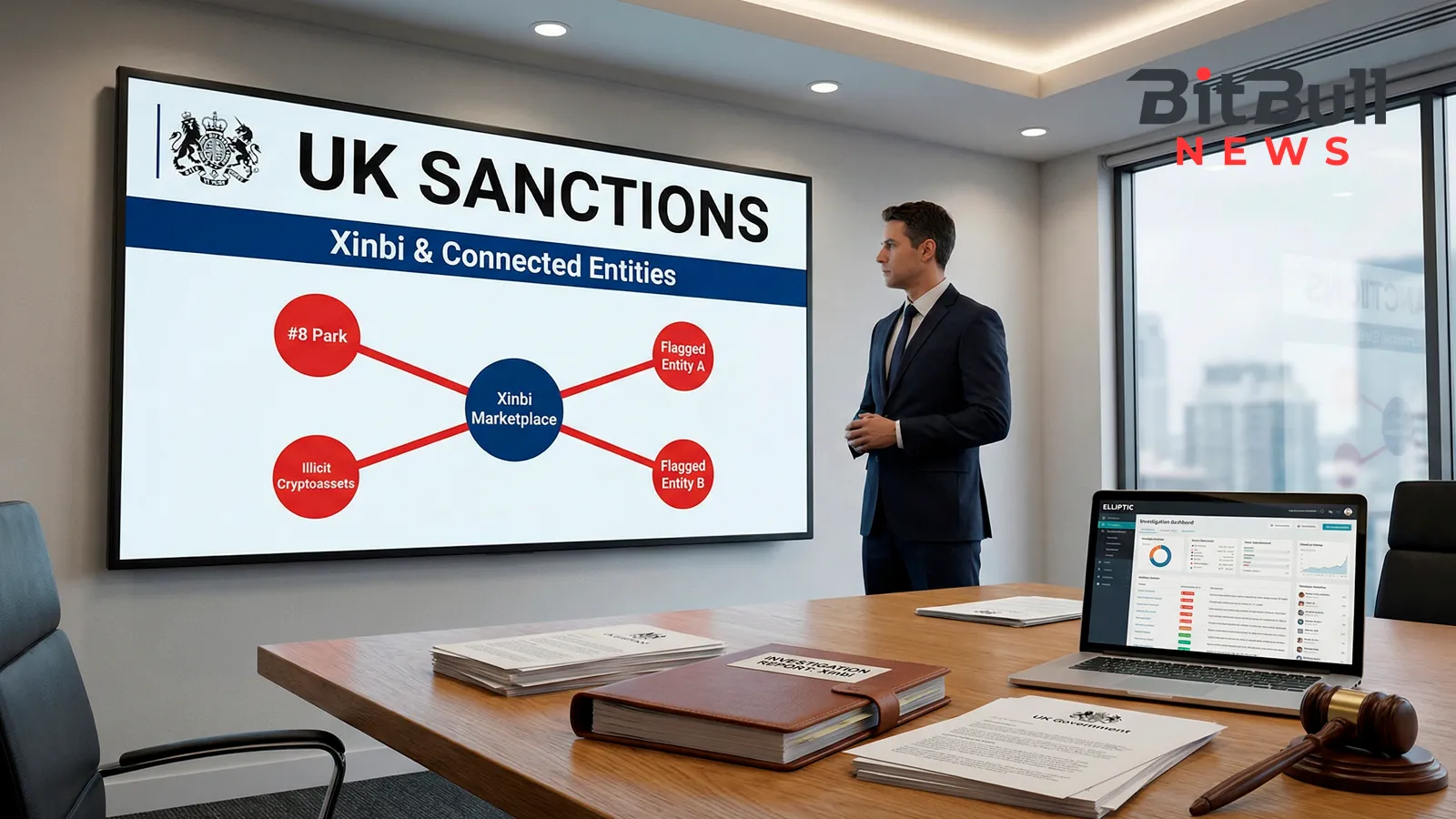
The UK has sanctioned Xinbi, a large crypto-enabled illicit marketplace, along with entities and individuals tied to 8 Park, a scam compound in Cambodia that British authorities describe as part of a wider fraud and trafficking network. The move is part of a broader UK crackdown on Southeast Asian scam centres and the financial infrastructure that supports them.
The crypto angle is what makes this designation stand out. British authorities said Xinbi provided cryptocurrency-based services to scam centres, including the sale of stolen personal data and satellite internet equipment used to reach victims, and said the platform also facilitated laundering of stolen cryptoassets linked to North Korea.
London moved past the scam compounds and hit the crypto rails
The UK said it was the first country to sanction Xinbi. In the government’s framing, the point was not only to name a marketplace, but to cut it off from the legitimate crypto ecosystem and make it harder for the network behind Southeast Asian scam centres to move or launder funds. The same announcement said BYEX, another crypto platform used to launder scam proceeds, shut down after the UK’s earlier sanctions action in 2025.
That makes this more than a human trafficking or fraud story. London is explicitly using sanctions to target the crypto infrastructure that helps these operations function, not just the compounds where victims are held or the people who run them. That is the strongest news angle in the case.
Who the UK actually sanctioned
The UK said the new designations include Legend Innovation Co., identified as the operator of 8 Park; its director Eang Soklim; Xinbi; Thet Li, described as a key lieutenant of Prince Group chairman Chen Zhi; and Hu Xiaowei, described as a long-term associate in the same financial network. The government also said a number of London properties would be frozen as a result of the latest action.
The official release describes 8 Park as Cambodia’s largest scam compound, with capacity for 20,000 trafficked workers. It also links the site to the already-sanctioned Prince Group network, which the UK and US targeted in October 2025.
Why Xinbi matters more than a typical sanctions target
Elliptic says Xinbi is one of the largest crypto-enabled illicit marketplaces ever identified, with at least $19.7 billion in cryptoasset inflows. According to its research, merchants on the platform offered money laundering services, stolen personal data, Starlink equipment and fake identity documents, with many openly advertising their willingness to launder pig-butchering scam proceeds.
Elliptic also says it traced some proceeds from the $235 million DPRK-attributed WazirX hack to addresses controlled by Xinbi merchants, reinforcing the UK’s assertion that the marketplace helped facilitate North Korean laundering. That matters because it places Xinbi at the intersection of online fraud, organized crime, sanctions evasion risk and state-linked cyber theft.
The 8 Park connection turns this into a wider fraud-finance network case
The UK’s action also builds on a broader campaign against scam compounds in Southeast Asia. The government said its October 2025 sanctions on Prince Group and Chen Zhi triggered asset freezes and seizures worth more than £1 billion worldwide and helped drive a wave of regional enforcement action. The latest release says Cambodian authorities have since raided around 2,500 sites, closed hundreds of scam centres and freed tens of thousands of foreign nationals.
Elliptic’s February research on 8 Park added a new layer to that picture by linking the compound to the Prince Group network and identifying crypto wallets used by merchants inside the site. The firm said blockchain data later showed payments to those merchants dropped sharply after reports emerged that the compound was being evacuated in February.
Why this matters now
This designation shows the UK is getting more precise about where crypto fits into transnational fraud. Instead of treating digital assets as a side detail, British authorities are now naming the marketplaces, payment channels and laundering services that sit inside scam-economy infrastructure.
It also suggests that sanctions risk for crypto businesses is broadening. The concern is no longer only direct exposure to mixers, ransomware wallets or North Korean addresses. Platforms, brokers, OTC desks and compliance teams also need to think harder about marketplace-style services, scam-centre support networks and entities that sit one step upstream from victim-facing fraud. This is an analytical inference based on the UK action and the role Xinbi is alleged to have played.
What we still do not know
The UK release does not publish wallet addresses in the press statement, does not detail the full sanctions mechanics for every designated party, and does not say how much of Xinbi’s activity remains operational after the designation. Elliptic’s inflow estimates and marketplace typology add important context, but they are still external analytical findings rather than figures from the UK sanctions release itself.
Why it matters for crypto
- It shows the UK is willing to sanction not just fraud operators, but crypto marketplaces and financial enablers that support scam compounds.
- It reinforces that compliance risk now extends into illicit marketplace infrastructure, stolen-data networks and scam-service ecosystems.
- The North Korea angle makes the case more serious because it links scam infrastructure to state-linked crypto laundering as well as consumer fraud.
- For exchanges, payment firms and investigators, this is another sign that blockchain monitoring has to cover typologies around trafficking-backed fraud compounds, not only classic cybercrime categories. This is an analytical inference based on the sanctions and Elliptic’s research.
What to watch next
- Whether the UK or its allies publish related wallet addresses, identifiers or additional designations tied to Xinbi and the Prince-linked network.
- Whether other jurisdictions follow the UK and formally sanction Xinbi after Britain became the first country to do so.
- Whether centralized exchanges and stablecoin issuers move quickly to block exposure linked to the named network and any associated infrastructure. This is an inference from how sanctions typically work in the crypto compliance stack.
- Whether this case becomes a model for using sanctions against crypto-enabled scam-economy infrastructure, not just against individual wallets or ransomware actors. This is also an analytical inference from the structure of the UK action.