


Content
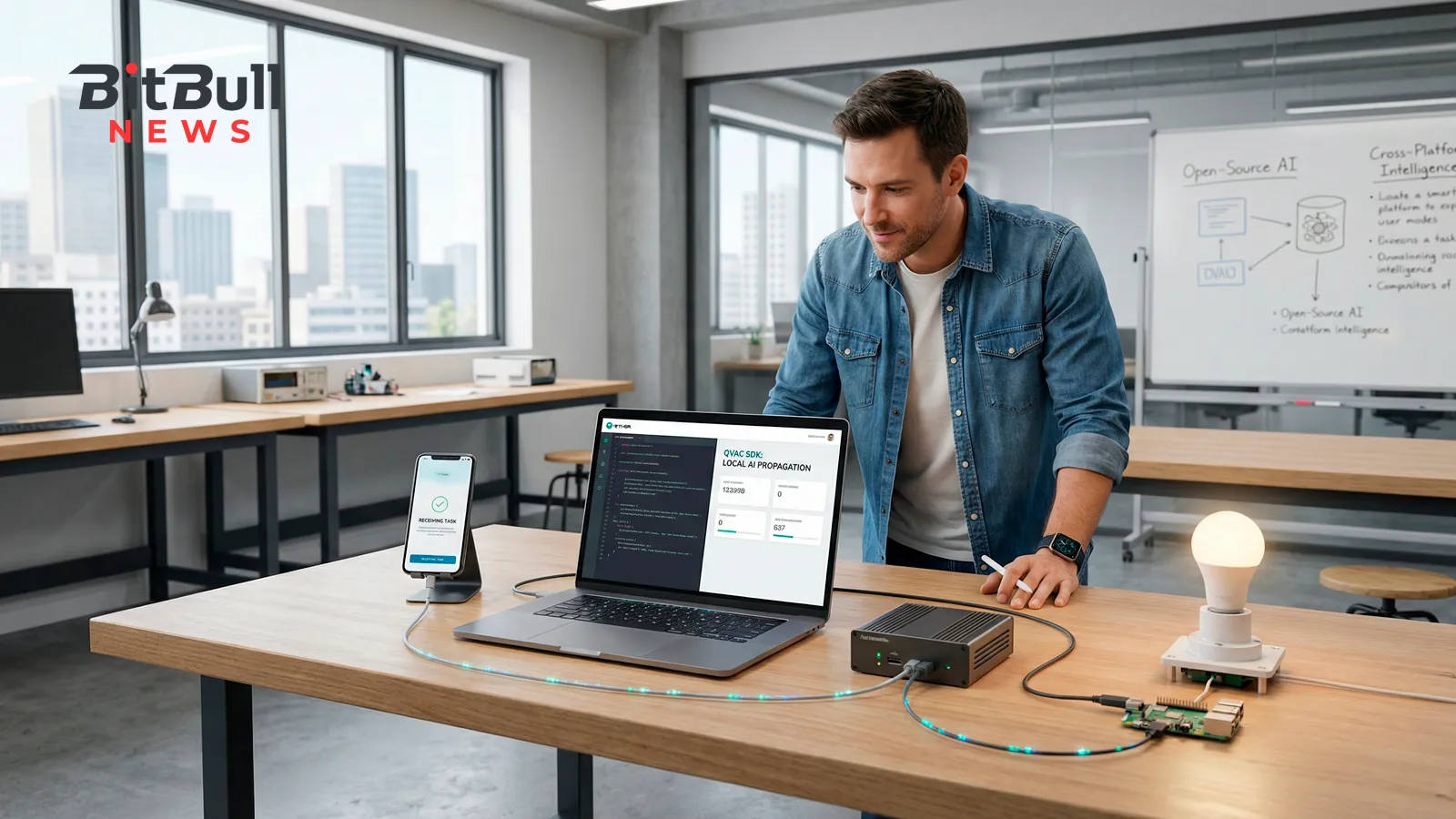
Tether has launched QVAC SDK, a new open-source software development kit that it says is designed to let developers build, run and fine-tune AI locally across a wide range of devices and operating systems. The company is positioning it as a universal building block for on-device intelligence rather than another cloud-dependent AI service.
The stronger news angle is architectural. Tether is arguing that the next phase of AI will not scale if every task has to be routed through centralized servers, and QVAC is its answer to that problem: a local-first framework meant to run the same AI applications across smartphones, laptops, desktops and industrial servers with one codebase.
Tether is making a bet on local AI, not rented AI
Company says QVAC SDK is built around a simple idea: intelligence should run where people actually use it, not only in remote data centers. In the launch post, the company says applications built with the SDK can execute unchanged across iOS, Android, Windows, macOS and Linux, without platform-specific rewrites or separate logic branches.
That matters because this is not being framed as a niche developer utility. Tether is presenting QVAC as a broader alternative to the prevailing cloud AI model, where applications depend on centralized APIs, recurring service layers and permanent connectivity. The company’s pitch is that local AI can be faster, more private and more resilient in real-world conditions.
The core promise is one SDK for many AI jobs
According to Tether, QVAC SDK exposes a growing set of AI capabilities through a single interface, including text generation, embeddings, vision, OCR, text-to-speech, speech-to-text and translation. The company says developers do not need to manage separate toolchains for each of those features or build different versions for different platforms.
The launch post also says the SDK is meant to support everyday consumer and enterprise use cases such as writing assistance, translation, transcription, image generation, summarization, smart search, personal accounting and finance planning. Tether’s broader claim is that these tools should be able to keep working even in low-connectivity environments because they run directly on user devices rather than relying on round trips to remote servers.
Under the hood, QVAC is built on familiar open-source AI engines
Tether says the SDK sits on top of a unified abstraction layer that works across several local inference engines. At the center is QVAC Fabric, which the company describes as a fork of llama.cpp and the base layer for text generation, embeddings and multimodal workloads.
The company also says QVAC integrates whisper.cpp and Parakeet for speech-to-text, along with Bergamot for on-device translation. That is important because it shows the launch is less about inventing a brand-new model architecture and more about packaging proven local inference components into a single cross-platform developer environment. This is an analytical reading of the product stack Tether described.
Peer-to-peer distribution is one of the most ambitious parts of the launch
One of the more distinctive parts of the announcement is QVAC’s peer-to-peer layer. Tether says the SDK uses the Holepunch stack to support decentralized model distribution and delegated inference without centralized infrastructure. It adds that future versions are expected to support peer-to-peer swarms for decentralized training, fine-tuning and inference.
That gives the product a bigger scope than a local inference toolkit alone. Tether is trying to position QVAC as infrastructure for a more distributed AI ecosystem, where models and workloads can move across devices and networks without depending entirely on centralized service providers. The current decentralized distribution and delegated inference are presented as live components; the broader swarm-based training and fine-tuning remain future-facing.
Tether is trying to connect AI to its wider decentralization strategy
The launch also fits into a broader direction inside Tether’s “Data” business. The company says Tether Data is focused on peer-to-peer systems that reduce reliance on intermediaries, while QVAC is described as its advanced AI research initiative centered on “Local AI and Infinite Intelligence.”
That context matters because QVAC is not being launched as an isolated developer product. It is part of a wider Tether narrative about decentralization, resilience and user control, with AI treated as another infrastructure layer that should become more open and less dependent on centralized control points. This is an inference based on the way Tether describes both Tether Data and QVAC in the launch materials.
What still remains roadmap rather than reality
The launch is concrete in some areas and aspirational in others. Tether clearly says the SDK is live and open source, and it specifies the current cross-platform and local inference functionality. But some of the bolder elements, including broader peer-to-peer swarms for decentralized training and toolkits for robotics and brain-computer interfaces, are described as coming in the months and years ahead rather than as shipping features today.
Why it matters for crypto
- It shows Tether is expanding further beyond stablecoins into infrastructure products, this time through local AI tooling.
- It reinforces a growing market theme around on-device and edge AI, where privacy, latency and offline resilience matter as much as raw model scale.
- The peer-to-peer layer suggests Tether wants to bring decentralization logic into AI distribution and inference, not just digital payments. This is an inference based on the product design described in the release.
- It also adds to the broader trend of crypto-linked firms trying to build foundational compute and data infrastructure rather than staying confined to token issuance or trading services. This is an analytical conclusion based on Tether’s recent product direction.
What to watch next
- Whether developers actually adopt QVAC as a real cross-platform toolkit rather than treating it as a technical showcase. This is the key commercial question left open by the announcement.
- How quickly Tether expands the live engine stack and whether future decentralized training and fine-tuning features arrive on schedule.
- Whether QVAC becomes part of a broader Tether ecosystem strategy tying together AI, peer-to-peer systems and edge devices. This is an inference based on the way the launch is framed.
- Whether other crypto-native infrastructure firms respond with similar local-first AI toolkits as the market shifts away from purely centralized AI deployment models. This is also an inference from the strategic significance of the launch.