


Content
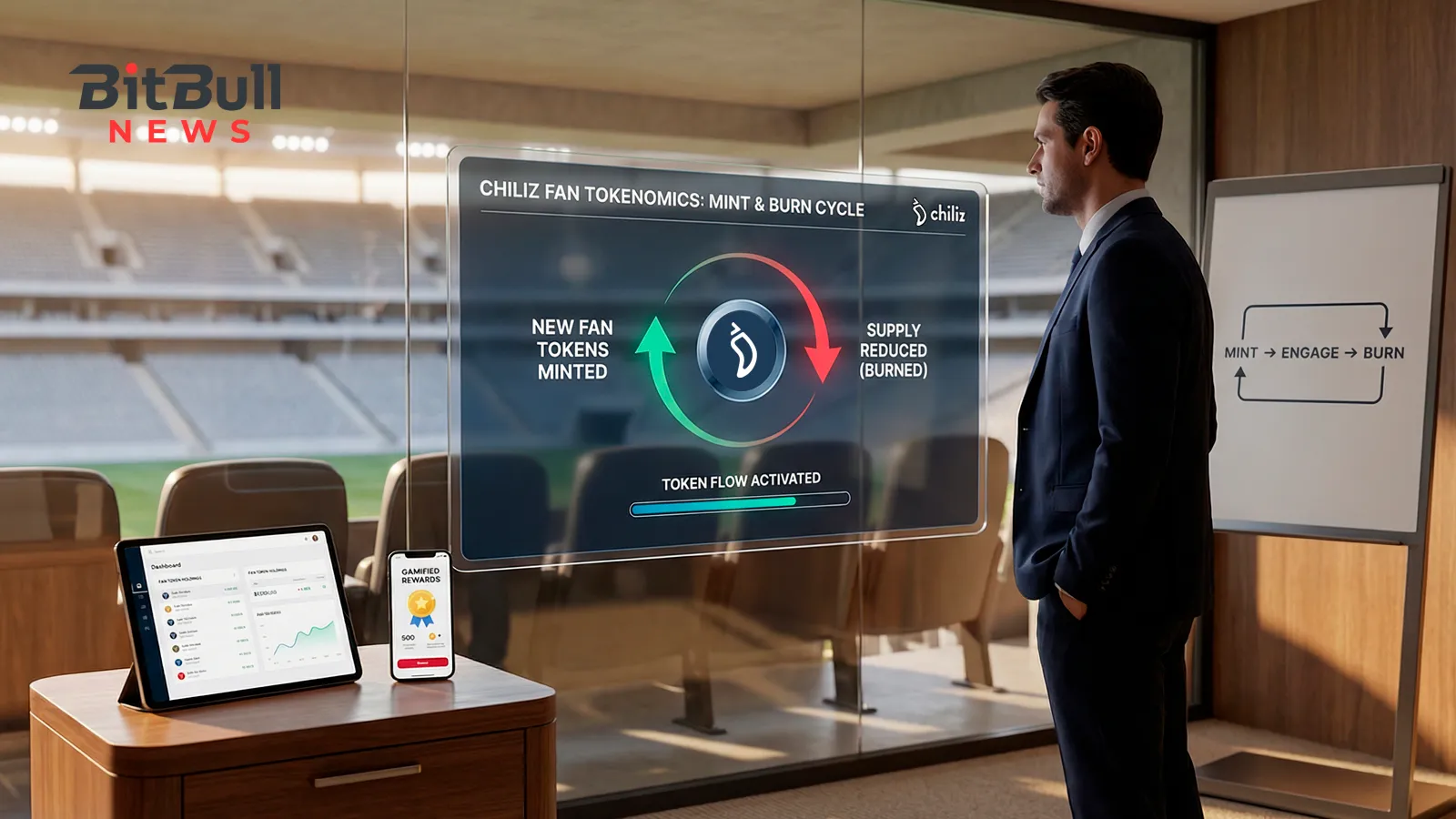
Chiliz is overhauling how Fan Tokens work by linking token supply directly to what happens on the pitch. The company said its new Fan Token Play model will introduce dynamic mint-and-burn mechanics, replacing the long-standing static supply model with one that changes after official first-team competitive matches.
That makes this more than a product refresh. Chiliz is trying to turn Fan Tokens from fixed-supply digital fan assets into performance-linked instruments whose on-chain supply responds to wins and losses. In practice, it is bringing tokenomics closer to live sports outcomes, which is the strongest news angle in the announcement.
Fan Tokens are being redesigned around match results
At the core of Fan Token Play is a simple rule set. Chiliz says Fan Tokens will be burned after wins, minted after losses, and left unchanged after draws. The company says this applies only to official men’s first-team competitive matches, not to friendlies, pre-season games, exhibition matches, academy fixtures or women’s team matches.
That is a meaningful structural change because it shifts Fan Tokens away from a static issuance model and toward a supply model driven by real-world performance. Chiliz says this is the next phase in the growth of the Fan Token asset class and a direct attempt to tie on-chain market dynamics to what fans actually care about most: results on the field.
The first model is treasury-led, algorithmic and performance-based
Chiliz says the first pillar of Fan Token Play is protocol-level treasury governance. Under that model, supply changes are executed through treasury-controlled smart contracts after each eligible match, with the binary result of win, loss or draw determining the adjustment.
The company also says the system includes several stabilizers. Burning stops if total supply reaches a 75% net reduction or if the treasury hits 0%, wins generated while the system is at the stop-loss limit create burn credits to offset future minting, and treasury token releases are capped at 12.5% of current treasury balance per year where applicable. Chiliz adds that an annual inflation rate of 1% to 5% linked to overall season performance will also be part of the design.
Those details matter because they show Chiliz is not simply making supply more volatile for effect. It is trying to build a controlled performance-linked model with guardrails, limits and longer-term balancing logic. That suggests the company knows the biggest risk here is not novelty, but whether the system can stay economically coherent over time. This is an inference based on the design choices laid out in the source.
Chiliz is also testing a more experimental prediction-market route
The second pillar is more ambitious. Chiliz says public testing will explore a prediction market-based supply management model in which 1/400 of a team’s Fan Token supply is pre-liquidated before each match, with the proceeds used to place “WIN” positions on third-party prediction markets.
After the match, the outcomes diverge sharply. If the team wins, Chiliz says the proceeds from successful prediction market positions will be used to buy back tokens on the secondary market, and after a 5% fee, the remaining 95% of win volume will be used to buy and burn the token. If the team loses, tokens equivalent to the pre-liquidated amount are minted back to the treasury. The company also says liquidations and buybacks will operate within strict 48-hour windows around kickoff and final results to reduce market manipulation risks.
This is the more disruptive part of the announcement because it pushes Fan Tokens closer to an actively managed, match-by-match market structure rather than a simple utility token model. Chiliz is effectively testing whether sports prediction infrastructure can become part of token supply management itself. That is an analytical reading of the mechanism described in the release.
Public trials are starting now, not at some distant future date
Chiliz says Fan Token Play will be tested publicly before any full-scale launch. The first live market trial will take place around this week’s Champions League fixture between Arsenal ($AFC) and Sporting Lisbon, and the company says the first tokenomics trial has already been conducted with the $ARS token. It adds that further trials will be carried out using both new and existing tokens depending on contracts and partner relationships.
That is important because this is not being announced as a purely theoretical roadmap feature. Chiliz is already moving into public execution-flow testing, which means the market will soon see how these mechanics behave in live conditions. What remains unclear is how quickly those trials turn into broader rollout across the existing fan token network.
Chiliz is trying to make Fan Tokens less correlated to crypto and more tied to fandom
The company explicitly says the new model is meant to reinforce Fan Tokens as a unique asset class whose market dynamics can be driven by fan sentiment and team performance rather than broader crypto conditions. It also says the Fan Token ecosystem has already generated more than $700 million in income for partners, reached peak market capitalizations above $1 billion, and spans 70-plus partners globally.
That commercial framing matters because Chiliz is not pitching Fan Token Play as a minor engagement tool. It is pitching it as a utility and tokenomics upgrade for a mature product category it wants to differentiate further from the rest of crypto. The bet is that sports-linked supply dynamics can make these assets feel more native to fan culture and less dependent on the usual token-market cycle. This is an inference based on the company’s positioning in the release.
Why it matters for crypto
- It turns Fan Tokens into one of the clearest examples yet of sport-linked on-chain tokenomics rather than static branded assets.
- It shows Chiliz is trying to differentiate the Fan Token category by tying supply directly to real-world performance, not just fan perks and voting rights.
- The prediction-market element suggests crypto sports assets could move closer to outcome-driven market structures, not just simple engagement models. This is an inference based on Chiliz’s trial design.
- It also reinforces that some of the more interesting crypto experiments in 2026 are happening in niche verticals like sport, where token utility can be tied to strong real-world emotional cycles. This is an analytical conclusion from the launch.
What to watch next
- Whether the Arsenal-Sporting and $ARS-related public trials show stable execution and credible market behavior.
- Which existing Fan Tokens are next in line for rollout, especially among Chiliz’s biggest club partners. This is not yet disclosed in the announcement.
- Whether prediction-market execution becomes a permanent feature or remains a trial-only mechanism.
- Whether fans embrace loss-linked minting as part of the game or view it as a source of unwanted dilution. This is an inference based on how the model works.