


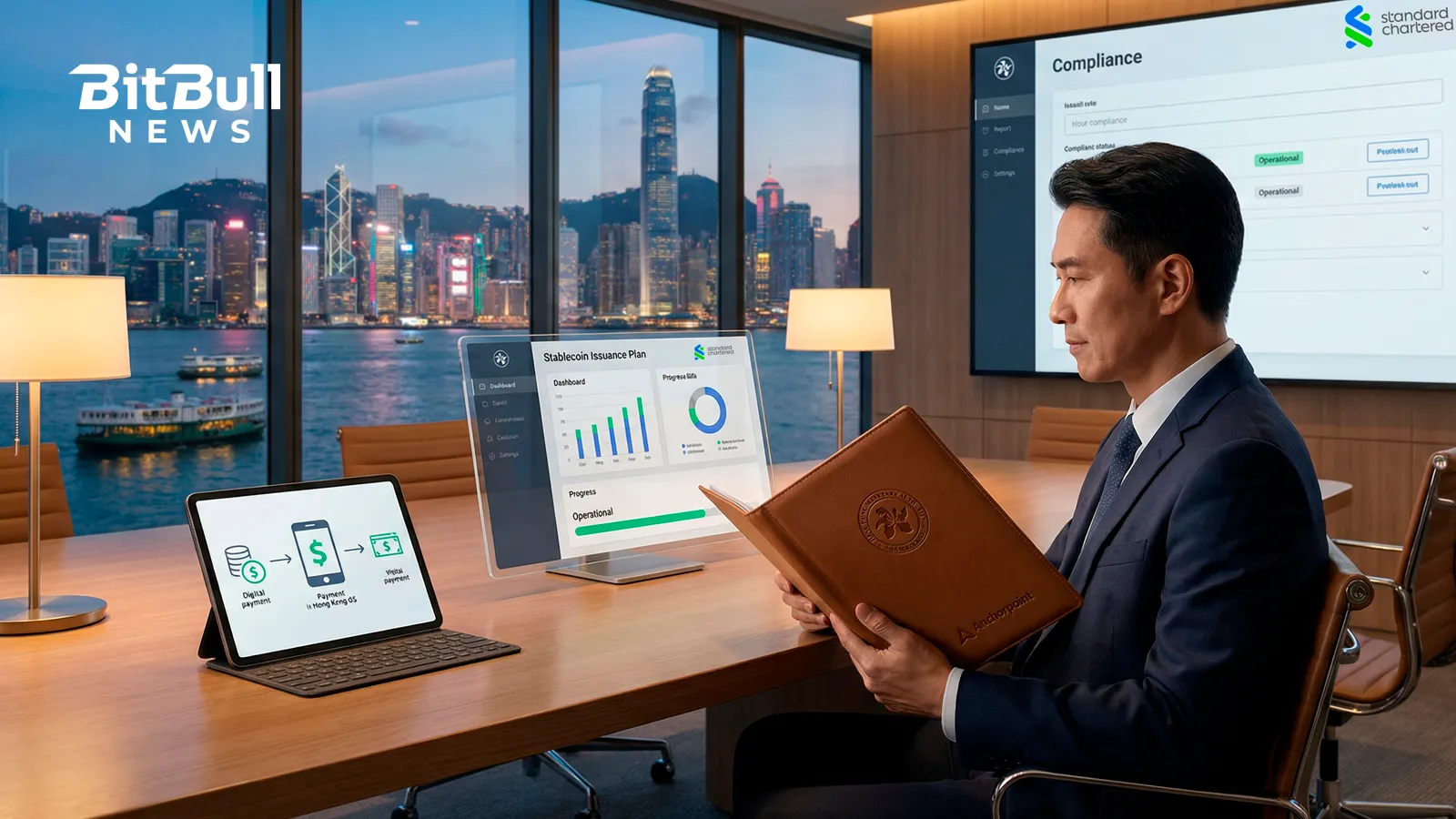
Hong Kong’s new stablecoin regime has its first marquee bank-backed entrant. Anchorpoint Financial, a joint venture backed by Standard Chartered Bank (Hong Kong), HKT and Animoca Brands, said it has been granted a stablecoin issuer licence by the Hong Kong Monetary Authority and plans to launch its regulated Hong Kong dollar stablecoin, HKDAP, in phases from the second quarter of this year.
The bigger story is not only that another stablecoin is coming. It is that one of Hong Kong’s first licensees is tied directly to a major international bank, and it is explicitly positioning the product as regulated settlement infrastructure for tokenized assets, trade and cross-border flows rather than as a retail crypto trading token. That gives the licence far more institutional weight than a standard digital asset launch.
Hong Kong’s first stablecoin regime is already producing bank-backed issuers
Standard Chartered said Anchorpoint was one of the first two institutions granted a stablecoin issuer licence under the Stablecoins Ordinance, which came into effect on August 1, 2025. The HKMA separately confirmed on April 10 that it had granted licences to Anchorpoint Financial Limited and The Hongkong and Shanghai Banking Corporation Limited, with both approvals taking effect immediately.
That matters because the market is no longer dealing with a sandbox or a consultation. Hong Kong has now begun issuing full licences, and Anchorpoint says it is already moving toward a commercial rollout. The company’s target product is HKDAP, short for HKD At Par, a Hong Kong dollar-backed stablecoin that it plans to introduce gradually starting in the second quarter.
BitBullNews already covered the broader regulatory step in Hong Kong grants first stablecoin issuer licences. What makes this new development more significant is that the first licensing wave is already producing a clear institutional winner with direct Standard Chartered backing.
This is a bank-backed settlement play, not a pure consumer coin
Anchorpoint’s own language makes the use case clear. The company says it wants HKDAP to function as a regulated medium of exchange and is focused on use cases involving the settlement and distribution of tokenized real-world assets, as well as cross-border capital and payment flows through stablecoins.
That is the strongest news angle in the release. Standard Chartered is effectively framing HKDAP as part of the plumbing for tokenized finance, not just another branded stablecoin. Bill Winters said the issuance of HKDAP can help “rewire” financial markets and support the next generation of international trade, while also moving markets closer to a model where assets are natively digital and settled instantly on public blockchain infrastructure.
The distribution model is designed to scale through partners
Anchorpoint says it will use a business-to-business-to-consumer, or B2B2C, model for HKDAP. That means the company does not plan to rely only on direct retail distribution. Instead, it wants to work through selected authorised distributors that already have large customer bases, while also offering incentives to early adoption partners building real-world use cases around the stablecoin.
This is an important structural detail because it shows Anchorpoint is trying to scale via existing financial and commercial channels rather than building a standalone consumer app-first model from scratch. In practice, that should make the product easier to insert into payment, treasury and tokenization workflows if partner adoption materializes.
Standard Chartered is using the licence to deepen its digital asset role
The licence is also strategically important for Standard Chartered itself. Mary Huen said Standard Chartered is Anchorpoint’s largest shareholder and described the approval as a breakthrough for Hong Kong’s digital asset ecosystem. She also linked it to the bank’s role as Hong Kong’s oldest note-issuing bank and its broader digital asset ambitions.
That framing suggests Standard Chartered wants to occupy a central role in the bridge between traditional finance and tokenized money. The bank is not presenting itself here as a passive investor in a startup. It is presenting itself as a core architect of regulated digital money infrastructure in Hong Kong.
The licence is the product of a long build, not a sudden win
Anchorpoint says the three partners began exploring stablecoins as a form of tokenized money in early 2023, then joined the HKMA Stablecoin Issuer Sandbox in 2024. That work led to the establishment of Anchorpoint in 2025, focused on money and tokenization infrastructure.
That timeline matters because it shows the licence did not come out of nowhere. It grew out of a multi-year process of sandbox participation, regulatory engagement and venture formation, which is exactly the kind of pathway Hong Kong has been trying to build for digital asset businesses that want to scale inside a supervised regime.
Why it matters for crypto
- It gives Hong Kong one of its first fully licensed stablecoin issuers, and one of them comes with direct backing from a major global bank.
- It shows the next phase of stablecoin growth in Asia may be driven by regulated financial infrastructure and tokenized asset settlement, not only by crypto trading demand.
- It strengthens Hong Kong’s position as one of the first major financial centres to move from stablecoin consultations and sandboxes into active issuer licensing.
- It also suggests bank-backed stablecoins may become a preferred model for jurisdictions that want innovation without giving up supervisory control.
What to watch next
- Whether Anchorpoint meets its phased launch target for HKDAP in the second quarter.
- Which authorised distributors and early adoption partners join the B2B2C rollout first.
- Whether HKDAP gains traction first in tokenized asset settlement, cross-border payments or broader treasury use cases.
- Whether more licensed issuers follow quickly behind Anchorpoint and HSBC as Hong Kong’s stablecoin register expands.