


Content
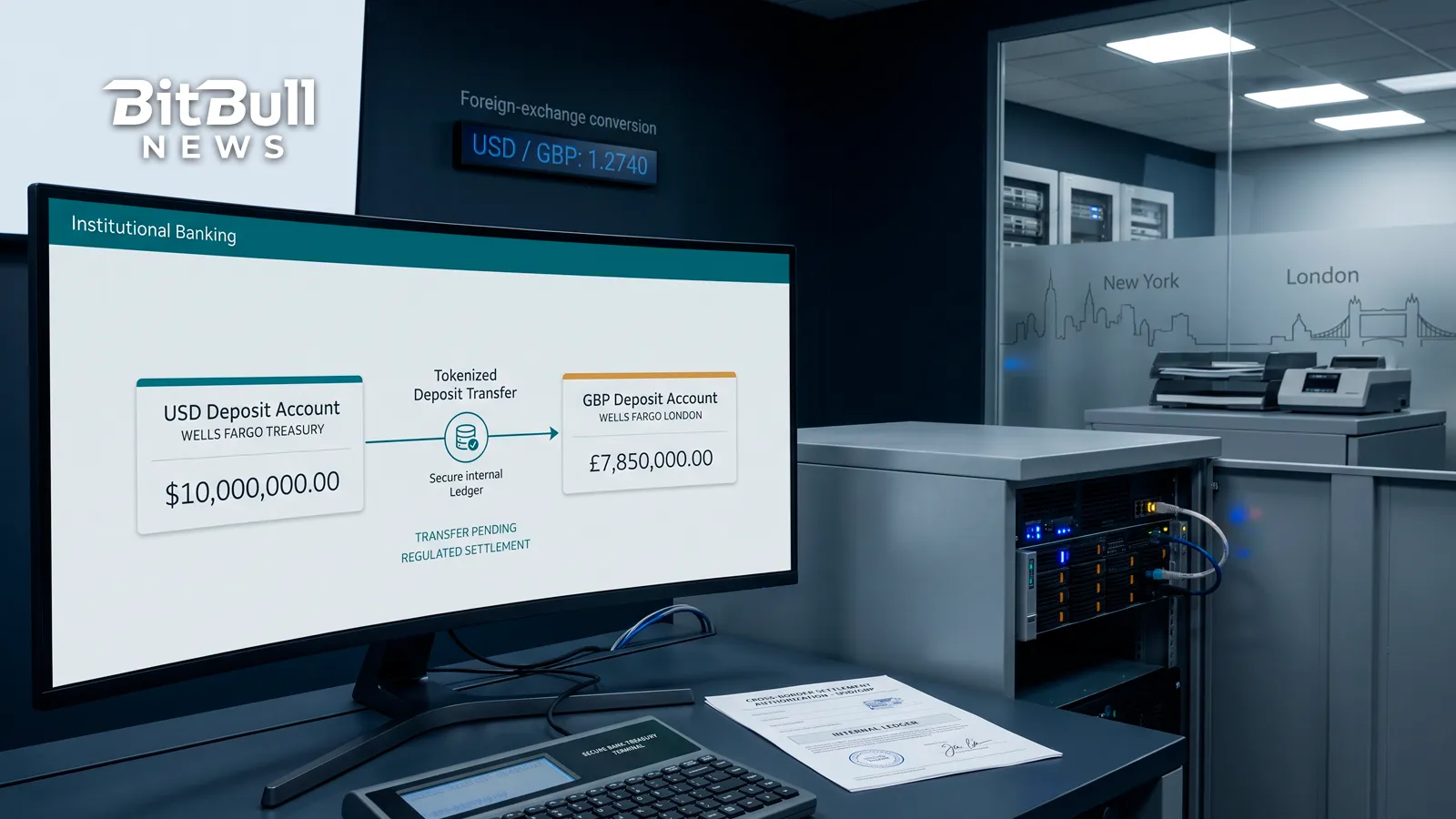
Wells Fargo announced on August 4 that it will launch tokenized deposits for corporate and commercial clients — blockchain-based representations of commercial bank money that settle around the clock, carry the same regulatory protections and deposit-insurance eligibility as ordinary Wells Fargo deposits, and support conditional payments through the bank’s own smart contracts. The rollout begins this fall with a deliberately narrow wedge: US dollar to British pound transactions for select clients, expanding through 2027 to all eligible clients and additional currencies.

The $2.3 trillion bank is the last of America’s payment giants to unveil a client-facing deposit token, and the announcement’s real content sits in three strategic choices it makes almost in passing. The token runs on Wells Fargo’s proprietary blockchain, not a public chain. The first use case is cross-border FX, the corridor where wire windows hurt corporate treasurers most. And clients will not be asked to touch any of it: payments will route through tokenized rails automatically “when they can improve speed, timing, and flexibility,” with CFO Mike Santomassimo stressing that clients can benefit “without experiencing any change to how they interface with Wells Fargo.” The blockchain, in Wells Fargo’s design, is plumbing — deliberately invisible.
Seven Years From Pilot To Product
Long-time observers will recognize nearly every element. In September 2019, Wells Fargo announced a pilot called Wells Fargo Digital Cash — a dollar-pegged token on a proprietary DLT platform built on R3’s Corda Enterprise, used for internal book transfers of cross-border payments, tested first between the US and Canada. The bank said then that its network would not connect to any other digital cash solution, and that corporate customers would notice no process changes. Seven years later, the philosophy has survived intact; what changed is that the internal utility has become a client product. In between came the credibility-building middle chapter: Wells Fargo was one of the institutions in the New York Fed’s Regulated Liability Network proof-of-concept in 2023, which tested deposit tokens and wholesale CBDC on shared infrastructure, and this March the bank filed a trademark for “WFUSD” covering a range of crypto services.
Two things unlocked the productization. The GENIUS Act settled the legal character of on-chain dollars and — critically for banks — barred payment stablecoins from paying interest, while tokenized deposits remain ordinary balance-sheet liabilities with none of that constraint. And the competitive clock started running: JPMorgan shipped its JPMD deposit token to institutional clients on Coinbase’s Base network last November, Citi Token Services runs live 24/7 transfers between New York, London and Hong Kong, and BNY launched its own institutional tokenized deposit service in January. A capability that was experimental in 2019 became table stakes by 2026; Wells Fargo is not early, and the announcement’s fall-and-2027 timeline concedes it.
A Proprietary Chain In A Consortium World
The chain choice is where Wells Fargo diverges most sharply from the front-runner. JPMorgan planted its deposit token on a public Ethereum layer-2 and is extending to the Canton Network; Wells Fargo’s release describes a “leading proprietary blockchain platform” — unnamed, presumably descended from the Corda-based system built for Digital Cash — with in-house custodial wallets and “inter-chain connectivity technology” reserved for future offerings. That last phrase is the tell. A Wells Fargo token on a Wells Fargo chain can move value between Wells Fargo accounts at any hour, but it cannot reach a counterparty at another bank until something connects the gardens. The industry’s answer is the shared tokenized deposit network that JPMorgan, Citi, Bank of America and Wells Fargo itself are building through The Clearing House for a targeted mid-2027 launch — which makes today’s product a two-track bet: a proprietary rail for intra-bank flows now, a consortium rail for interbank flows later, and a bank that intends to own its clients’ on-chain experience in both.
The first corridor also deserves a closer look than the release invites. USD–GBP is a shrewd wedge — cross-border FX is where batch cutoffs, wire windows and time zones impose the most measurable cost on multinational treasurers, the same wedge Kinexys and Citi chose. But it also collides quietly with the announcement’s own fine print: tokenized deposits carry the “same regulatory protections and deposit insurance eligibility” as existing deposits, and the same footnote applies — deposits held in non-US branches are not FDIC-insured. The product’s headline reassurance and its first use case do not fully overlap, a nuance corporate treasurers will notice even if the press release does not dwell on it.
The Counteroffensive Against Stablecoins Takes Shape
Zoom out, and the announcement is one salvo in the defining monetary contest of the post-GENIUS era. Stablecoins move roughly $300 billion of non-bank dollars on public rails, crypto consortia are organizing around shared tokens, and every corporate dollar that migrates from a deposit to a stablecoin is funding a bank loses. Deposit tokens are the banking system’s structural answer: dollars that move like stablecoins but stay on the balance sheet, remain insured within limits, and can pay interest that GENIUS-regulated stablecoins legally cannot. The regional-bank Cari Network is racing toward a retail version this year; the mega-banks are converging on the wholesale version through The Clearing House; and Wells Fargo — with a WFUSD trademark on file and a seat in the reported joint-stablecoin discussions among the Big Four — is hedging every branch of the tree at once.
What the announcement does not contain is evidence of demand: no client names, no volume targets, no disclosed platform details, and a first phase limited to “select participating” clients in a single currency pair. That caution may be the most honest thing about it. Wells Fargo has been technically capable of this product since roughly 2020; what it waited for was a legal regime, a competitive threat and a client base ready to use rails they never see. The first two arrived. The third is the actual experiment beginning this fall — and if corporate treasurers embrace on-chain money precisely because they cannot tell it is on-chain, the crypto industry will have to reckon with an uncomfortable reading: the banks may have found the adoption curve that a decade of visible wallets, tickers and tokens never quite delivered.