



Content
Western Union has spent 175 years being paid for money in motion. The product it launched on August 4 is designed to make money stand still — inside its own ecosystem. Stablecard by Western Union, built with stablecoin card platform Rain, combines a digital wallet holding USDPT — the company’s dollar stablecoin issued by Anchorage Digital Bank on Solana — with a Visa secured credit card, letting recipients take a remittance as a dollar balance and spend it anywhere Visa is accepted, online, in-store or at ATMs. The app is live in 37 markets, chosen, in the company’s unusually blunt phrasing, for being places “where local currency is not stable and demand for stablecoins is already visible,” with more than 60 markets targeted by year-end.

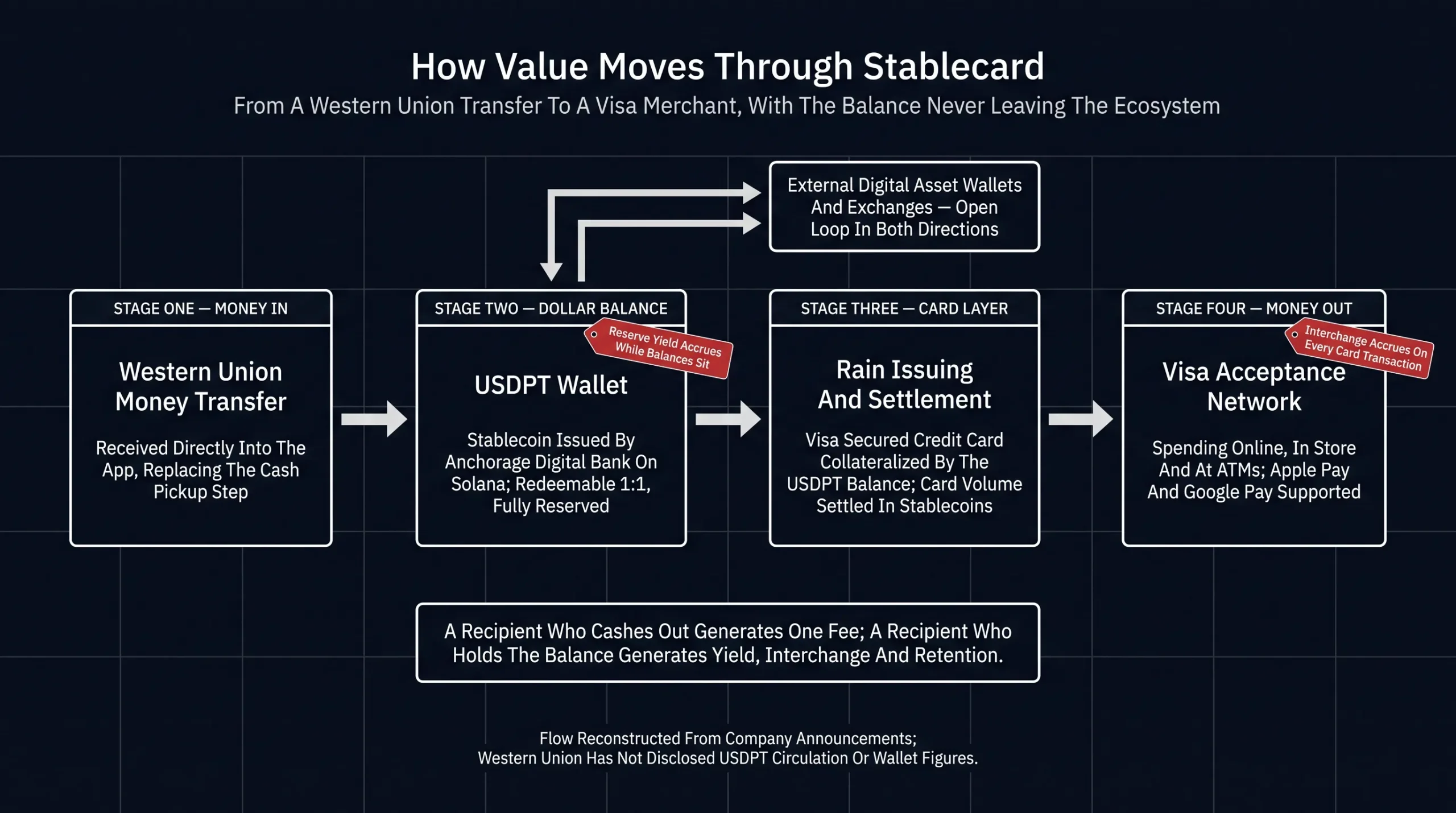
The framing in the release is consumer convenience. The strategy underneath is a business-model inversion. A remittance recipient who cashes out at an agent generates one fee and disappears; a recipient who keeps the payout in USDPT becomes a balance Western Union’s issuer earns reserve yield on, a card user generating interchange, and a customer who never left. Chief executive Devin McGranahan said the quiet part aloud when the stablecoin was first announced last October: USDPT, he told investors, “will allow us to own the economics linked to stablecoins.” Stablecard is the machine that collects them.
What Stablecard Actually Is — And Why It Is A Credit Card
Mechanically, the product merges two components in one app. The wallet holds USDPT, redeemable one-to-one for dollars and fully reserved, and can receive Western Union transfers directly — collapsing the payout step that has defined the company’s product since the telegraph era. Notably, the wallet is not a closed loop: users can send and receive funds to and from external digital asset wallets and exchanges, meaning Western Union has deliberately built a door between its network and the open crypto economy, in both directions.
The card side is where Rain’s architecture shows. Stablecard is a Visa secured credit card rather than a debit card — spending is extended against the USDPT balance as collateral, in line with Rain’s model of tokenizing card receivables and settling 100% of its card volume with Visa directly in stablecoins, seven days a week. For the user the experience resembles a prepaid card with Apple Pay and Google Pay support; structurally, the secured-credit format is what lets a stablecoin balance function as spendable card collateral across dozens of jurisdictions at once. Rain, founded in 2021 and a principal member of both Visa and Mastercard, has raised $88.5 million to build exactly this layer — and its chief executive Farooq Malik described the target customer precisely: people “who have never thought about onchain money and never need to.”
Ten Months From Announcement To Product
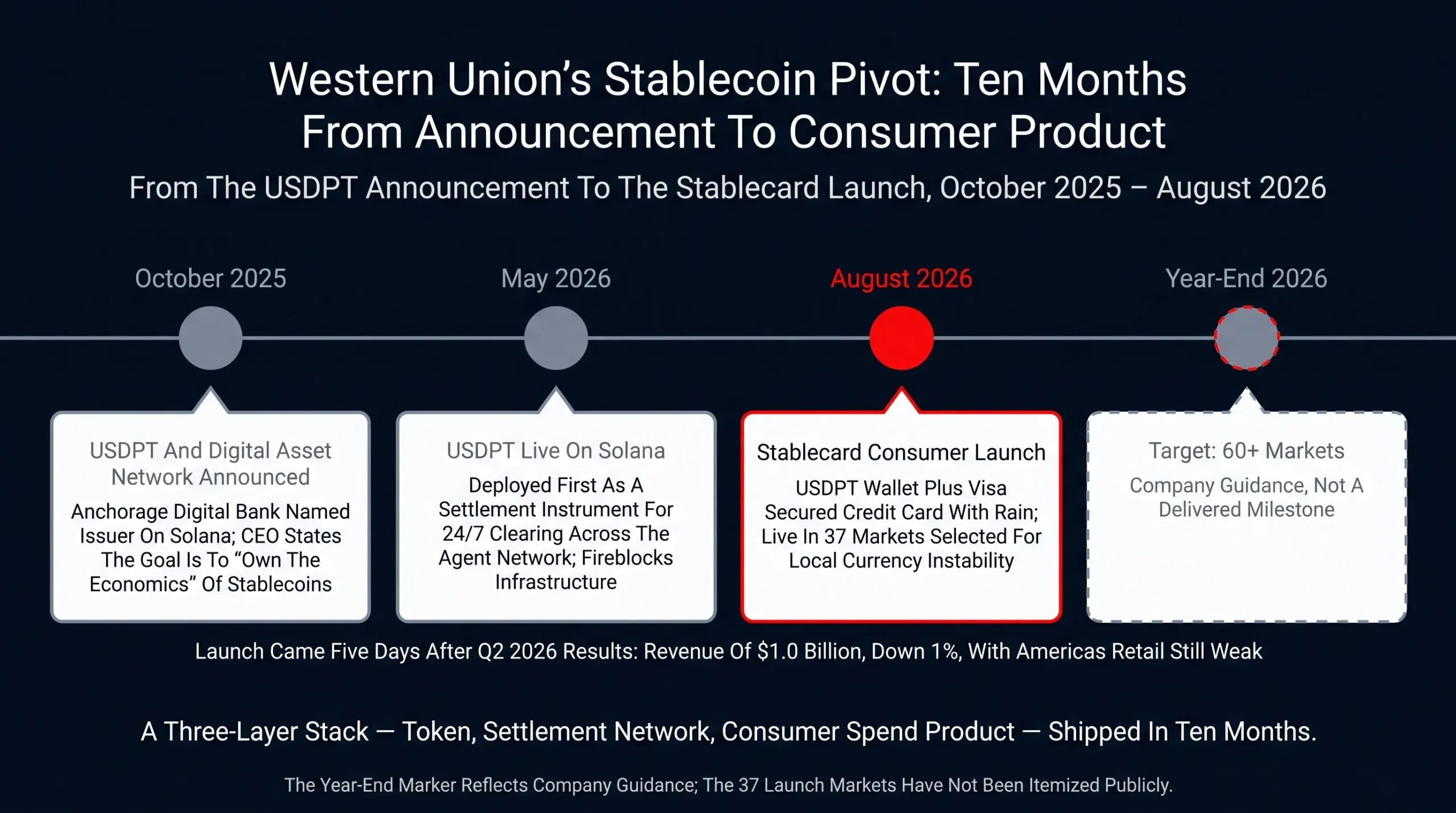
The launch completes a pivot executed at unusual speed for a company of Western Union’s vintage. The stablecoin plan was announced in October 2025 alongside a Digital Asset Network of on- and off-ramps; USDPT went live on Solana on May 4, initially as a settlement instrument letting the company clear with agents around the clock, with Fireblocks providing infrastructure. The consumer product — billed last fall as “Stable by Western Union” and promised for more than 40 countries — has arrived as Stablecard in 37, a modest trim that still amounts to shipping a three-layer stack (token, settlement network, consumer spend product) in ten months.
The urgency has a financial context the release omits. Five days earlier, Western Union reported second-quarter revenue of $1.0 billion, down 1%, with management conceding that the anticipated recovery in its Americas retail business had not materialized. The company’s core product is being squeezed from two directions — digital-first remittance rivals on price, and stablecoin rails on structure — and its answer is to absorb the attacking technology rather than outrun it: if dollar tokens are going to carry remittances anyway, they may as well be Western Union’s token, in Western Union’s app, spent on Western Union’s card.
Dollarization As A Product Category
The most consequential line in the release may be the market-selection criterion. A US-listed company explicitly shipping spendable dollar balances into 37 economies selected for currency instability is retail dollarization operated at network scale — something that has always happened informally through cash dollars and offshore USDT, now packaged with a federally chartered issuer, a Visa logo and a compliance stack. The GENIUS Act made this exportable as a regulated product; Western Union’s 360,000-location distribution and brand familiarity make it deliverable to precisely the customers offshore stablecoins reach last. The friction will come from the other side of each corridor: central banks in remittance-receiving economies have historically resisted currency substitution, and a dollar balance that never converts into naira, pesos or pounds Egyptian is a policy problem in a way a cash payout never was.
Competitively, the move leapfrogs the industry’s earlier experiments. MoneyGram has offered USDC cash-in and cash-out over Stellar since 2022, and PayPal attached a stablecoin to an existing wallet — but no remittance incumbent has previously combined its own token, its own payout network and a card-spend layer in a single consumer product. What none of this yet demonstrates is adoption: Western Union has disclosed no USDPT circulation figures, no wallet counts and no list of the 37 launch markets, and every claim about consumer demand remains, for now, a design assumption.
The unresolved tension is internal as much as external. Every dollar that stays in a Stablecard wallet is a payout fee an agent never earns — and Western Union’s retail agent network, the asset that took a century to build, is now in quiet competition with the company’s own app for the same transaction. Managing that cannibalization while regulators in three dozen countries work out what to call a remittance firm holding interest-generating dollar balances for millions of unbanked customers is the real execution risk. Western Union has, in effect, begun converting itself from a money-transfer company into a dollar bank without a banking license — with Anchorage holding the charter, Rain holding the rails, and the company holding the customers. Whether the economics it now owns are worth more than the ones it is disrupting is the question the next four quarters will price.