



Content
France’s markets regulator has drawn the line that its wealth management industry spent two years waiting for. In a doctrine update published July 27, the Autorité des marchés financiers confirmed that conseillers en investissements financiers — the CIFs who form the backbone of French retail wealth advice — may no longer give personalized recommendations on crypto-assets unless they obtain full authorization as crypto-asset service providers under MiCA. The national side door that let advisers counsel clients on digital assets under lighter domestic rules is formally closed, four weeks after the end of France’s MiCA transition period swept away the old PSAN regime altogether.

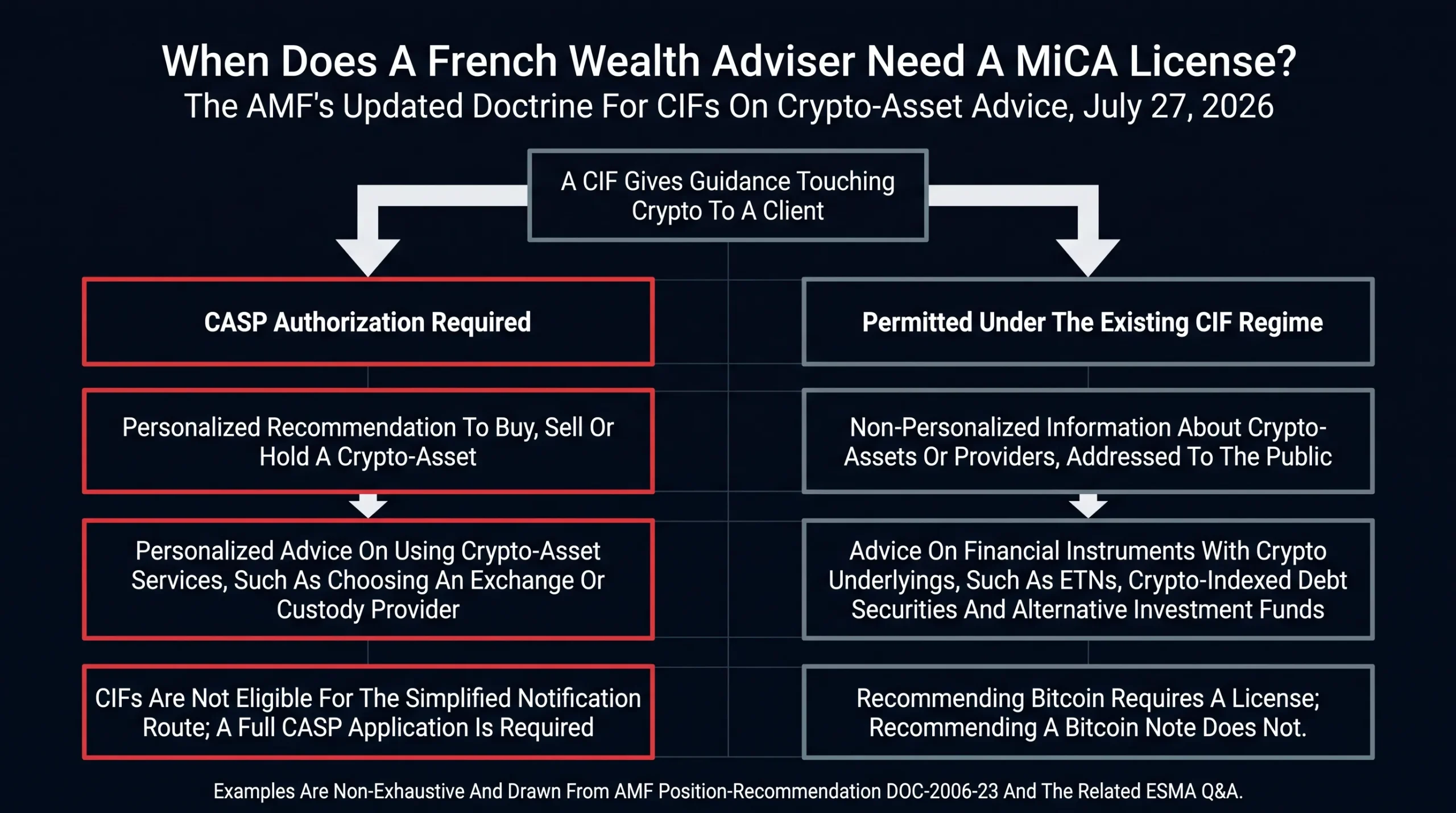
The distinction the AMF draws is precise, and it will reshape how crypto reaches French savers. Advising a client to buy bitcoin, or even which exchange to use, now requires a CASP license. Advising the same client to buy a bitcoin exchange-traded note, a crypto-indexed debt security, or an alternative fund holding digital assets does not — that remains advice on financial instruments, squarely within the existing CIF regime. The doctrine does not just restrict who may advise on crypto; it quietly routes an entire distribution channel toward wrapped exposure.
The 2022 Side Door That MiCA Closed
The update replaces guidance the AMF issued in 2022, when France’s national framework under the PACTE law still governed digital assets. In that world, advice on digital assets carried an optional license: a CIF that obtained the voluntary PSAN advisory approval operated under those rules, while one that did not could still counsel clients on crypto as part of “other wealth-management advisory activities,” subject only to the CIF regime’s organizational and conduct standards. Crypto advice, in other words, was something a French adviser could simply do.
MiCA ended that architecture. Advice on crypto-assets is now a regulated service requiring mandatory CASP authorization across the EU, and the AMF states plainly that its 2022 clarifications are obsolete. The regulation does offer a fast track — entities that already hold certain licenses, notably investment firms, can add crypto advice through a simplified notification procedure rather than a full application. CIFs are explicitly not eligible for that route. The national adviser status that was sufficient for two decades of French retail wealth management confers no head start at all under the European regime: a CIF that wants to keep advising on actual crypto-assets must file a complete CASP application like any startup, with the capital, governance, local compliance staffing and IT-security requirements that entails.
A Wider Net Than MiFID Ever Cast
The scope question is where advisers are most likely to stumble, and the AMF’s new Q&A — added to its long-standing CIF doctrine, position-recommendation DOC-2006-23 — leans on a recent ESMA clarification to spell it out. Under MiCA’s definition, crypto-asset advice covers personalized recommendations not only on transactions in crypto-assets but on the use of crypto-asset services. That is deliberately broader than investment advice under MiFID II, which attaches to transactions in financial instruments. The practical consequence: an adviser who never recommends a single token but tells a client which custody provider to trust or which platform to open an account with is providing regulated crypto advice, and needs the license.
The AMF pairs the expanded perimeter with two safe harbors. Distributing non-personalized information about crypto-assets or crypto providers to the public stays outside the regime — commentary, education and generic market views remain free. And advice on financial instruments remains CIF territory even when the underlying is entirely crypto: the regulator’s own examples include alternative investment funds and crypto-indexed debt securities. For an industry that advised 2.73 million clients in 2024, that second carve-out is the operative instruction. The compliant way for a French wealth adviser to put crypto in a portfolio is now a securities wrapper — an outcome that favors the issuers of European crypto ETNs and structured notes over direct-holding platforms, and that keeps advised savers one legal layer away from the assets themselves.
A 6,700-Adviser Channel Meets A Single-Digit License Count
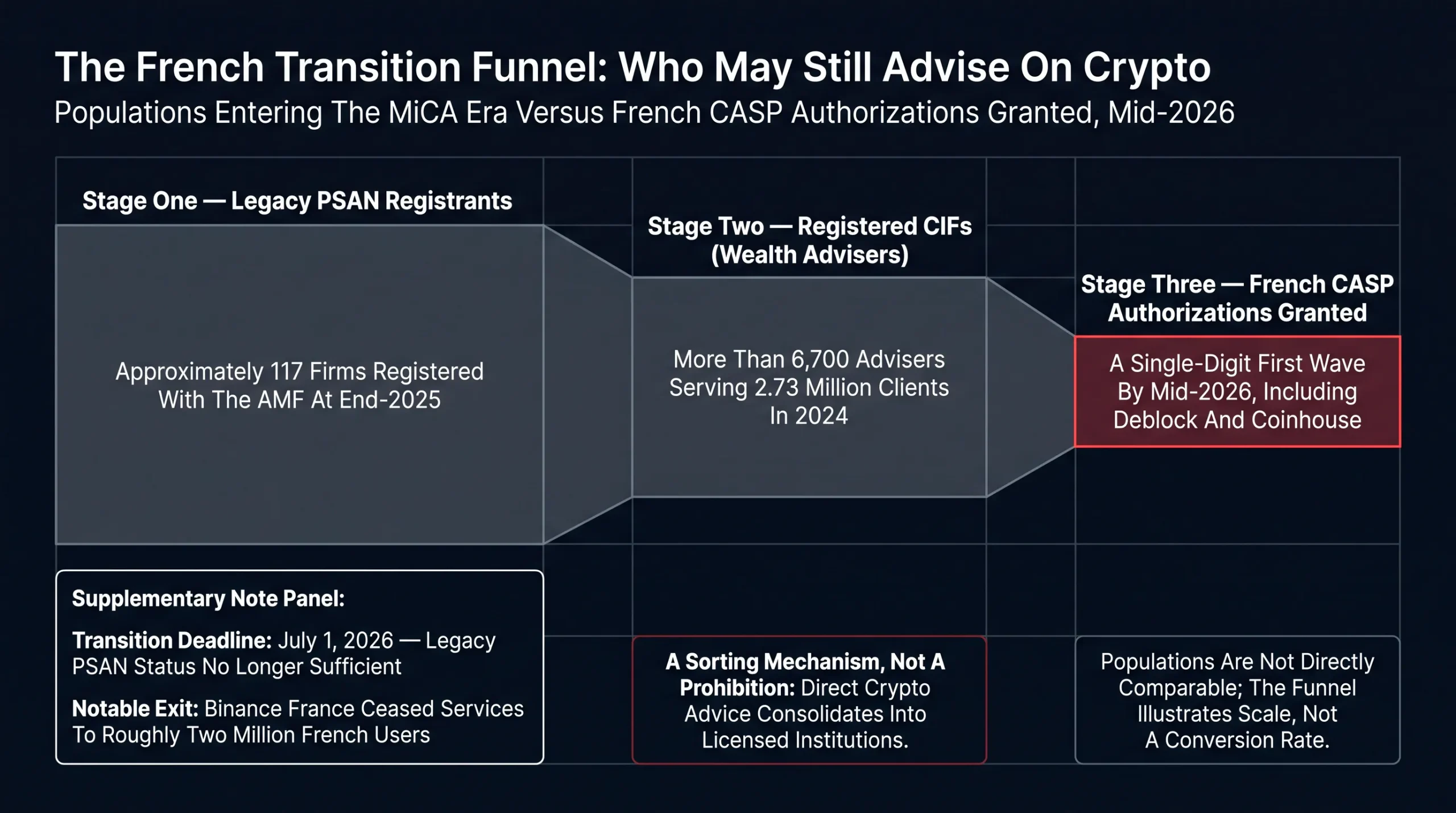
The arithmetic of the transition explains what happens next. France counts more than 6,700 registered CIFs, a population that generated roughly €918 million in advisory-specific revenue in 2024. On the other side of the ledger, the country entered 2026 with about 117 legacy PSAN registrants, of which only a small first wave — names like Deblock and Coinhouse — had converted to full French CASP authorizations by the July 1 deadline, while others fell back on passports from elsewhere in the EU and Binance France shut off services to its roughly two million French users entirely. If firms whose entire business is crypto found the CASP bar demanding, the notion that independent wealth advisers — typically small firms with a handful of staff — will clear it for a sideline service is not realistic, and the AMF surely knows it.
The doctrine therefore functions as a sorting mechanism rather than a prohibition. Direct crypto advice for French clients will consolidate into the institutions that already hold or can notify their way into CASP status — banks, investment firms and the licensed platforms — while the independent advisory channel either exits the subject or migrates to wrapped products. Neither the AMF nor ESMA frames it this way, but the effect is a two-tier market for crypto guidance: bundled with regulated institutions at the top, and reduced to generic public information everywhere else.
There is an unresolved tension at the bottom of this design. MiCA’s advice rules exist to protect retail investors, and France’s savers hold crypto in growing numbers whether or not anyone is licensed to guide them. By setting the bar for personal crypto advice at a level most human advisers cannot reach, the regime steers the mass market toward two destinations: securitized wrappers selected by an adviser who may not discuss the underlying asset’s direct form, or self-directed accounts on platforms with no advisory duty at all. The savers most likely to need someone to talk them out of a bad crypto decision are precisely the ones the new perimeter leaves talking to no one — and that gap, more than any license count, is what French regulators will eventually have to answer for.