


Content
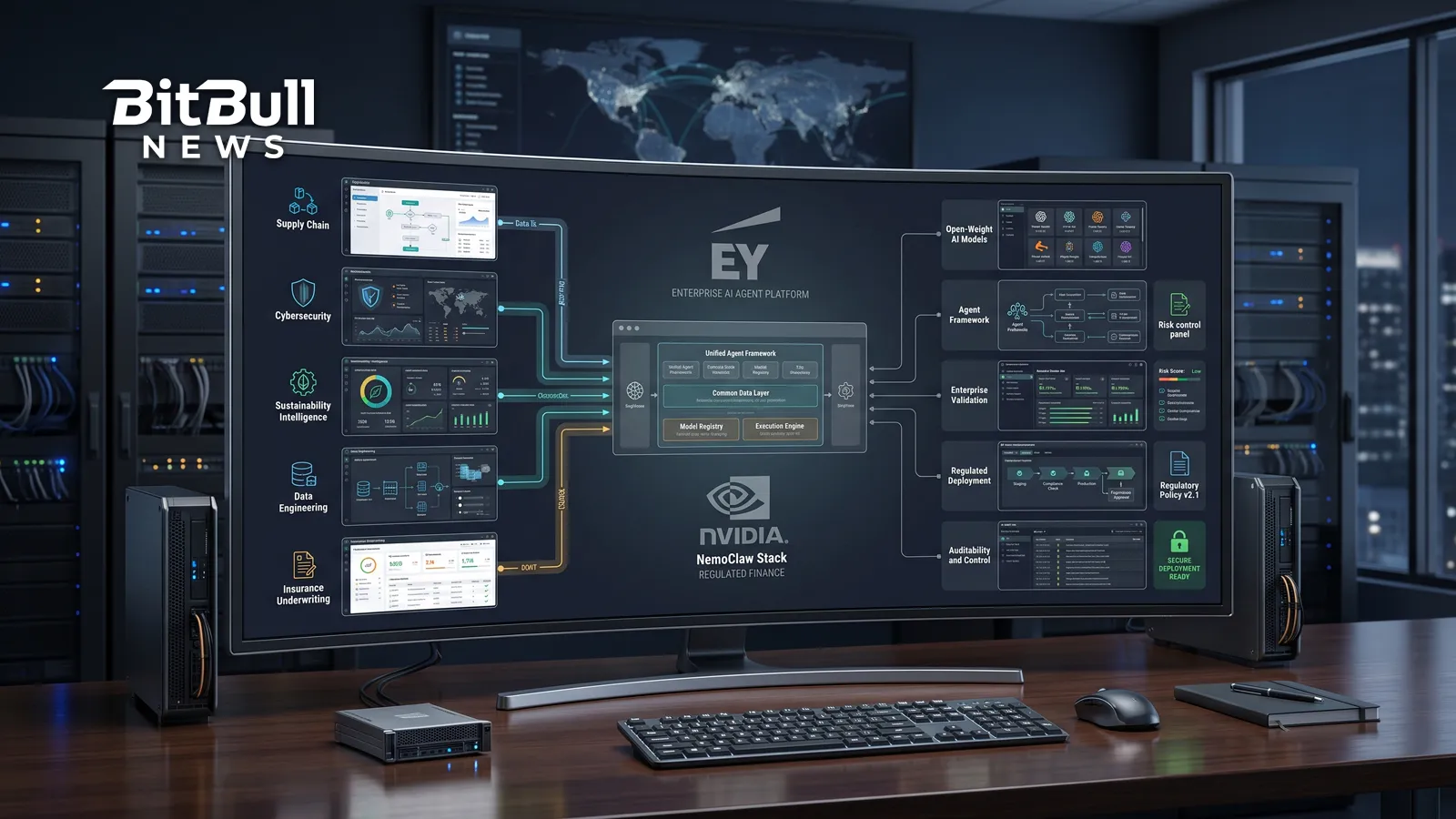
Nineteen days after NVIDIA and LangChain published an open reference architecture for enterprise AI agents, EY has become the first professional services firm to run its own products on it. The firm announced on July 27 that it has validated five EY.ai agentic solutions on the NVIDIA NemoClaw for LangChain Deep Agents blueprint, re-platforming systems that span supply chain, cybersecurity, sustainability intelligence, data engineering and insurance underwriting onto a common stack built around open-weight models.

The announcement reads like an infrastructure story, and for financial markets that is exactly what it is. EY audits a large share of the world’s listed companies and advises much of its financial sector; where it standardizes its machine labor is a leading indicator of what regulated institutions will accept. The bet embedded in this validation is specific: that banks, insurers and asset managers will not run consequential AI agents on closed, rented stacks, but on open architectures they can inspect, govern and deploy on infrastructure they control.
What EY Validated — And Where The Numbers Come From
Working with NVIDIA, EY teams adapted five existing EY.ai solutions to the blueprint and built working demonstrations across all three layers of the architecture, with what the firm describes as gains in agent autonomy, reasoning, consistency and execution under enterprise governance controls. The validated capabilities are available now, with early applications in regulatory and policy intelligence, supply chain operations, cybersecurity, data products and EY’s own service delivery environment.
The performance figures deserve careful reading, because the press release itself splits them into two categories. The first set comes from initial validation in a controlled lab setting: a 20% increase in agent task success and autonomous completion in smart logistics, a 30% improvement in retrieval accuracy for sustainability regulatory intelligence, and a 15–20% lift in autonomous completion rates for data engineering pipelines. The second set is explicitly labeled illustrative business impact — a 60–80% reduction in manual supply chain planning interventions, an 80%-plus cut in the effort behind executive regulatory briefings, incident triage in cyber anomaly detection accelerated by 66%, and data pipeline deployments compressed to two to three days.
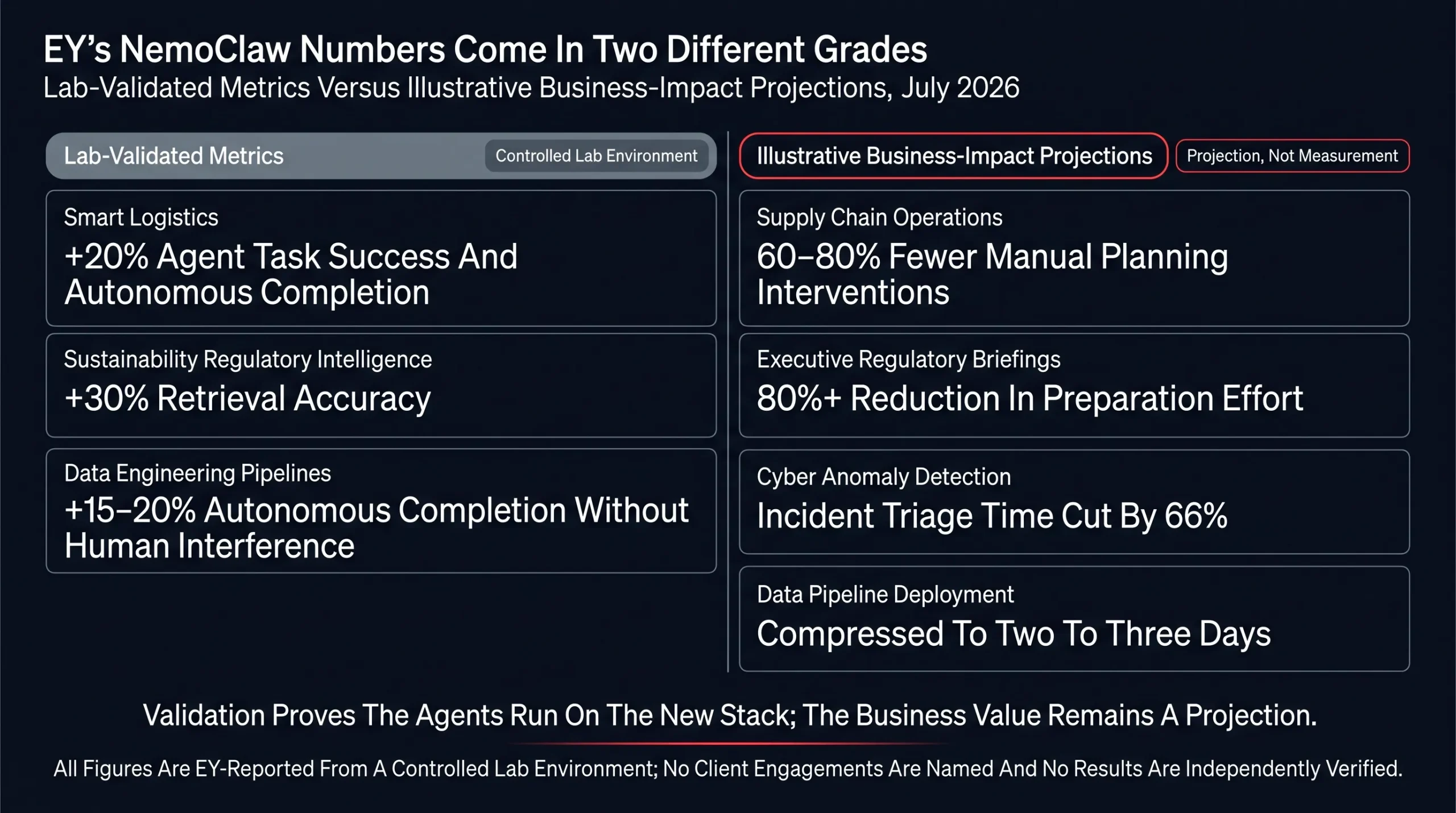
That distinction matters more than the numbers themselves. Lab validation proves the agents run and improve on the new stack; the business-impact figures are projections of what that could mean in deployment. No client engagements are named, and none of the results have been independently verified. The honest summary is that EY has demonstrated portability — its agents can be lifted onto an open architecture without breaking — and is now marketing what that portability might be worth.
Inside NVIDIA NemoClaw For LangChain: Model, Harness, Runtime
The blueprint EY validated against was launched on July 8 by LangChain and NVIDIA as a reference architecture for building open agent systems, with the headline claim of benchmark-leading performance at more than ten times lower inference cost than comparable closed stacks. It assembles three components: NVIDIA’s Nemotron 3 Ultra open-weight model, LangChain’s Deep Agents Code harness handling planning, tool use, memory and long-running task execution, and NVIDIA OpenShell, a secure runtime that sandboxes agents and enforces policies on how they touch tools, systems and data.
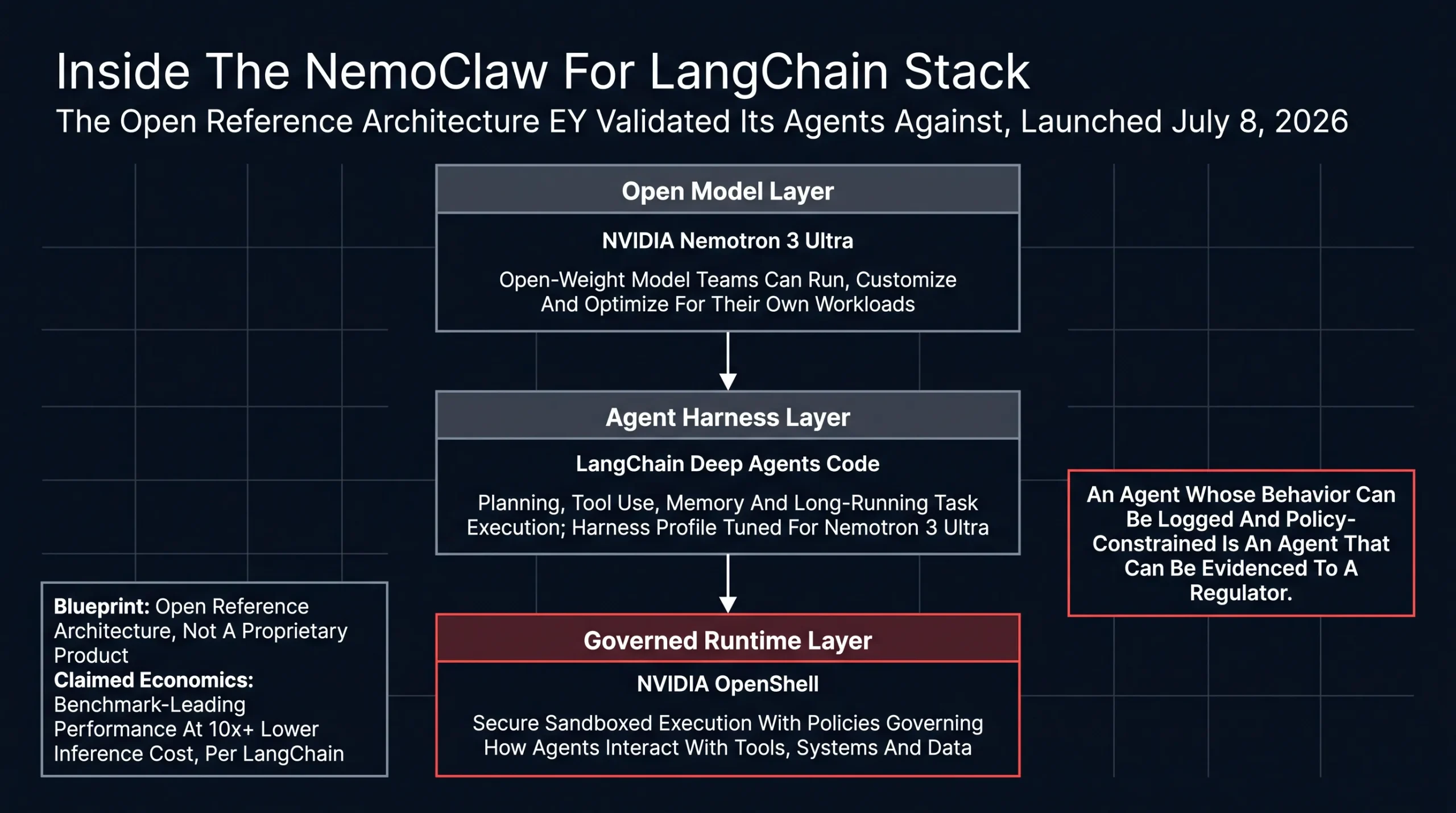
The design responds to a problem that has stalled enterprise agent adoption everywhere it has been tried: as agents move into production, the workflows, memory, traces, evaluation datasets and tuning built around a model become proprietary intelligence, and companies are reluctant to pour that IP into stacks they rent. Julie Teigland, EY’s global vice chair for alliances and ecosystems, said the validation shows agents can be “deployed on a common, open architecture without compromising governance, security or performance.” For regulated industries, the runtime layer is arguably the real product — an agent that can be sandboxed, logged and policy-constrained is an agent whose behavior can be evidenced to a regulator or an audit committee, which is the actual gating condition for AI touching financial processes.
There is an economic subtext, too. Agentic workloads fire many model calls per task, so per-call inference cost decides whether an agent is commercially viable at all. The blueprint’s cost claim places it in the same race that has defined 2026’s model market — from Chinese labs compressing active parameters to Western platforms tuning open weights for throughput — where the contested ground is no longer what a model can do but what each action costs.
A Two-Stack Strategy In The Big Four Agent Race
The validation extends an alliance that has been compounding for sixteen months. EY unveiled its EY.ai Agentic Platform with NVIDIA in March 2025, initially deploying 150 agents in support of 80,000 professionals across tax, risk and finance, then layered on risk-management agents in June 2025 and a physical AI platform with a dedicated EY.ai Lab in December. Deloitte launched its own NVIDIA-based agent platform in the same March 2025 window, and the Big Four have been in an escalating agent arms race since — one measured in platform announcements rather than disclosed client outcomes.
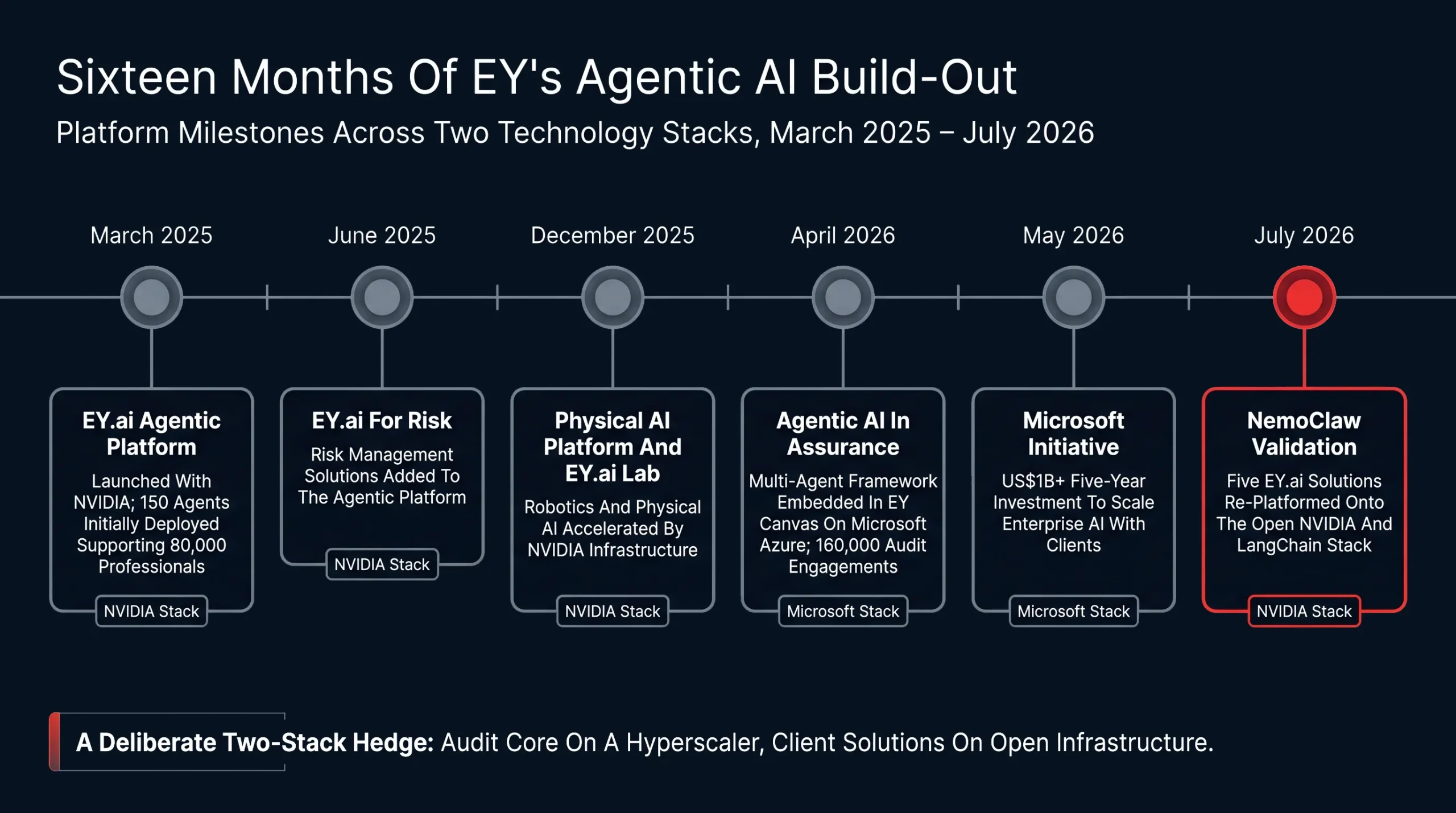
What distinguishes EY’s position is that it is deliberately running plural stacks. In April the firm embedded agentic AI across its global audit platform — EY Canvas, which processes more than 1.4 trillion journal entry lines a year across 160,000 engagements — on Microsoft Azure, Foundry and Fabric, and in May it announced a US$1b-plus initiative with Microsoft over five years. The audit core sits on a hyperscaler; the client-facing solution catalog now also runs on an open NVIDIA stack. That is not indecision. It is a hedge that lets EY sell agents into clients whose regulators, boards or sovereignty requirements point in different directions — and it quietly concedes that no single vendor stack will win regulated finance outright.
The Open-Infrastructure Thread Running Through EY’s Playbook
For readers of this publication, the pattern should look familiar. EY has spent years as the most public-blockchain-committed of the major audit firms, contributing its Starlight zero-knowledge compiler to the public domain and, in March, launching a web-based sandbox for building privacy-preserving smart contracts on public Ethereum-compatible chains. The logic there was identical to the logic here: enterprises will adopt shared, open infrastructure — public chains, open models — when the tooling lets them prove control, confidentiality and compliance on top of it. Zero-knowledge proofs play that role for public blockchains; governed runtimes like OpenShell are being positioned to play it for open AI stacks. An audit firm’s entire franchise is trust in systems it did not build, and EY is methodically extending that franchise to both of the decade’s open-infrastructure waves.
The unresolved question is whether validation converts into deployment. Every figure in this announcement was produced in EY’s own lab or projected from it; the distance between a validated blueprint and a bank running always-on agents against production ledgers is where enterprise AI initiatives have historically gone to die. The next disclosure that matters will not be another architecture announcement — it will be the first named financial institution willing to say its agents run on this stack, and the first regulator asked to accept the logs. Until then, EY has proven something narrower but still consequential: the agents themselves have become portable, which means the lasting moats in enterprise AI are shifting to the workflows, governance frameworks and domain data layered on top — precisely the territory a professional services firm intends to own.