


Content
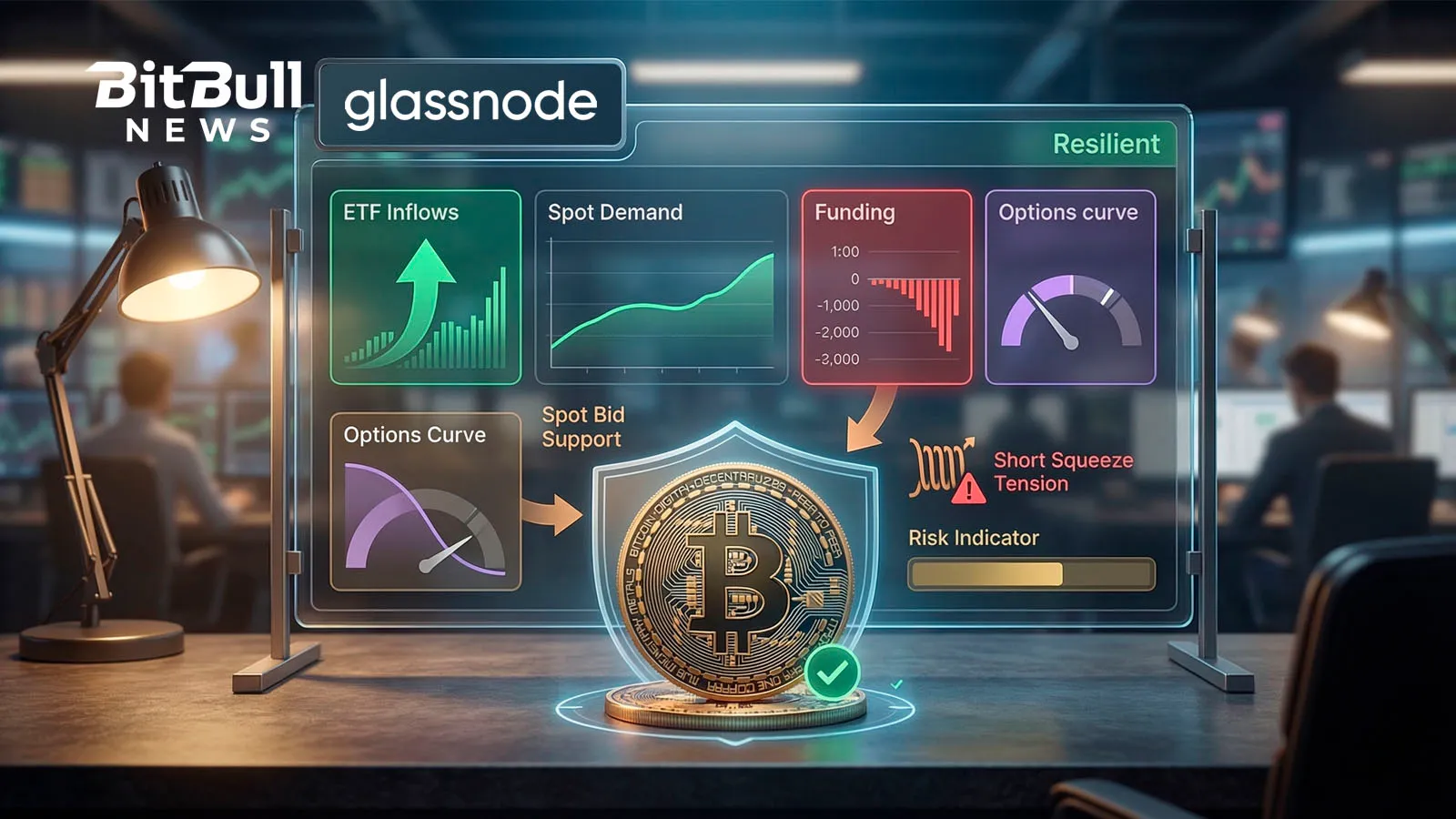
Bitcoin is showing early signs of stabilization, but Glassnode says the recovery still looks fragile. In its latest Week On-chain report, the firm argues that ETF inflows have turned positive again, spot demand is starting to recover, and derivatives positioning has become crowded on the short side. At the same time, on-chain data still points to a market with weak conviction and limited upside confidence.
The report’s main message is simple:
Bitcoin has handled recent geopolitical stress better than many traders expected, but it has not yet proven that it can break out into a stronger trend.
Bitcoin is still trapped in a broad range
Glassnode says Bitcoin has spent more than a month trading inside a $62.8k to $72.6k range, with repeated failures to hold above $70k. Each rejection, according to the report, has been accompanied by bursts of realized profit-taking, which suggests traders are still selling strength rather than chasing a breakout.
Glassnode also frames the current setup around two major cost-basis levels. The Realized Price sits at $54.4k, while the True Market Mean sits at $78.4k. The report says price is effectively stuck between those two anchors, and until Bitcoin can decisively reclaim the upper part of the range, the market remains vulnerable to downside pressure.
On-chain accumulation is there, but it is not strong enough yet
The report says an accumulation cluster is starting to form near the midpoint of the current range. That usually helps build a local support base, because it shows coins changing hands at similar levels and creating a new cost basis cluster.
But Glassnode is clear that this accumulation still looks weak compared with earlier phases that led to stronger price expansions. In plain terms, buyers are stepping in, but not with the kind of conviction that usually supports a durable breakout.
Newer buyers are still under pressure
One of the most important bearish signals in the report is STH-SOPR, which tracks whether short-term holders are spending coins at a profit or a loss. Glassnode says the 7-day EMA of STH-SOPR has stayed below 1 since October 2025 and currently sits at 0.985, meaning recent buyers are still selling at a loss on average.
That matters because markets usually need newer buyers to regain confidence before momentum can really improve. Right now, Glassnode says that is still missing.
ETF inflows are finally improving
On the constructive side, Glassnode says U.S. spot Bitcoin ETFs have started to stabilize after a long stretch of net outflows. The 7-day moving average of flows has moved back into positive territory, which the report describes as the strongest demand impulse since the correction began.
That does not automatically mean institutions are fully back, but it is one of the clearest signs in the report that demand conditions are no longer deteriorating.
Spot demand is starting to recover
Glassnode also points to improving cumulative volume delta, or CVD, across major exchanges. The report says spot order flow had been dominated by aggressive selling during the recent decline, but buyers are now starting to absorb that liquidity more effectively.
The key detail here is breadth. Glassnode says this improvement is visible across broader exchange aggregates, not just on one venue, which makes the rebound in spot demand look more credible. Still, the report stresses that buyers will need to stay dominant for longer before the recovery can be trusted.
Derivatives are setting up for a squeeze
Glassnode says perpetual futures funding has turned negative, which means short sellers are paying to maintain their positions. That usually signals growing downside consensus in the derivatives market.
But that can also work the other way. If spot demand keeps improving, heavily crowded short positions can fuel a short squeeze, forcing traders to cover and pushing price higher faster than expected. Glassnode says that asymmetry is now one of the more interesting features of the current setup.
Options traders are becoming less defensive
The report says short-dated implied volatility has started to ease, especially at the front end of the curve. Near-term implied vol has fallen back toward the mid-50% area, which Glassnode interprets as a sign that immediate event risk is fading.
At the same time, 25-delta skew remains negative, which means puts are still more expensive than comparable calls, but the defensive tone has started to soften. Glassnode says 1-week skew has tightened to about 10% put skew, down from a recent high of 31%. That suggests traders are still cautious, but much less aggressively hedged than before.
Call buying is picking up
Glassnode says the largest options trades over the last 24 hours were heavily concentrated in call buying, which made up 40.3% of total activity. Over the past week, call buying was already the largest flow at 27.8%, and the report says that trend has now accelerated.
That is an important shift. The market is not fully bullish, but traders are clearly becoming more willing to position for upside while keeping some protection in place.
The $75K zone is the big upside level
Glassnode says dealer gamma positioning looks relatively neutral around current price, but one level stands out above the market. Around the $75K strike, the report identifies roughly $2 billion of negative gamma, which could amplify upside if Bitcoin pushes into that area.
The report adds that about $1.8 billion of that positioning expires on March 27, which means the options landscape could shift meaningfully around quarter-end.
Why it matters for crypto
- Glassnode sees real signs of stabilization, but not enough evidence yet for a clean bullish turn.
- ETF flows and spot demand are improving at the same time, which is one of the strongest positive combinations in the report.
- Negative funding shows the short side is getting crowded, which raises the chance of a squeeze if buyers stay active.
- On-chain conviction is still weak, especially among newer buyers, which keeps the broader recovery story fragile.
- Options traders are becoming less defensive, and the $75K region is now the key upside level to watch.
What to watch next
- Whether Bitcoin can finally hold above $70k instead of getting rejected again.
- Whether ETF flows stay positive for more than just a short bounce.
- If spot CVD keeps improving across exchanges, confirming that buyers are really back.
- Whether negative funding turns into a real short squeeze if price pushes higher.
- How the gamma setup changes as the March 27 expiry gets closer.