


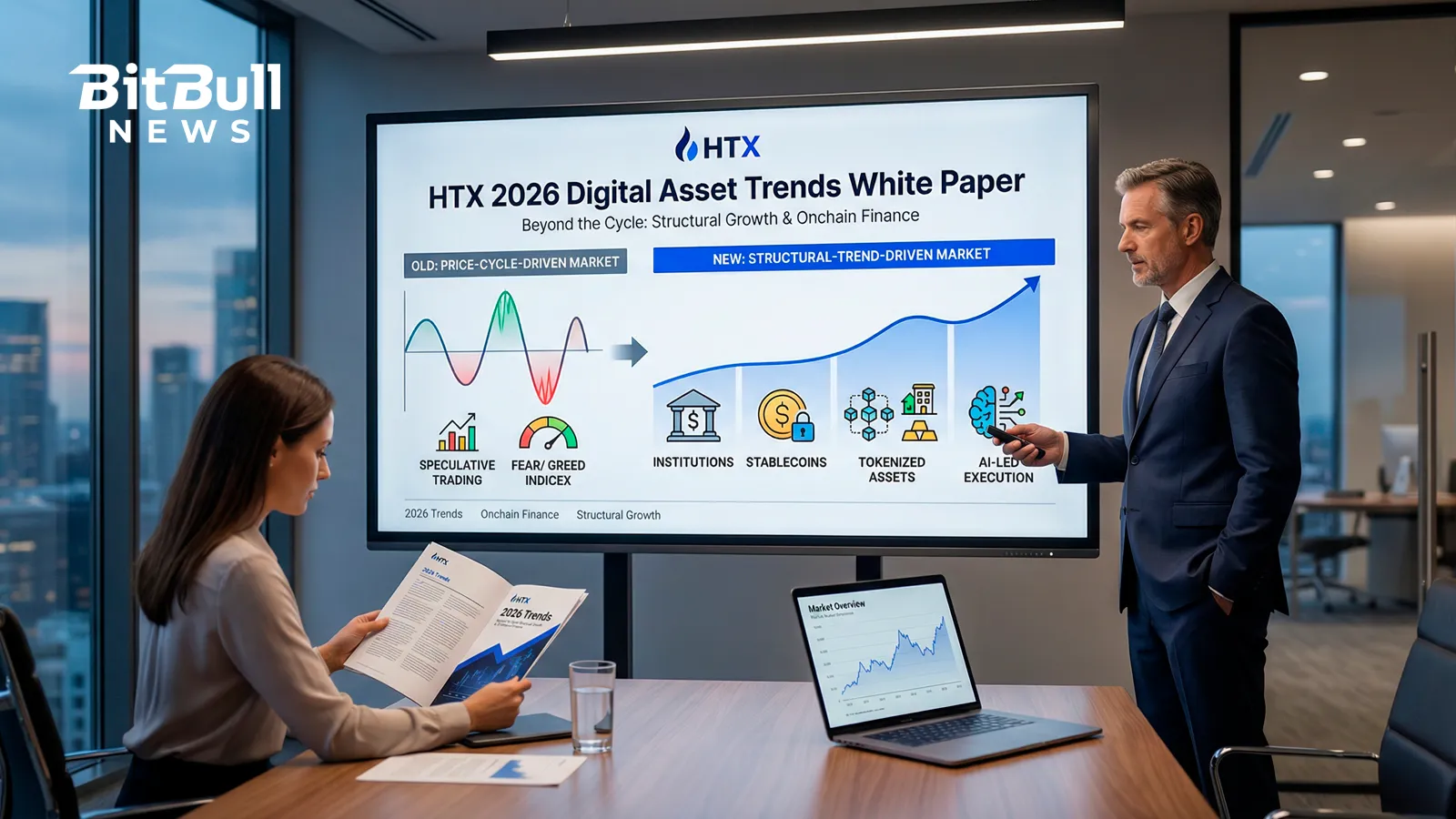
HTX’s new 2026 Digital Asset Trends White Paper makes a bigger claim than a normal market outlook. The report argues that digital assets are no longer mainly a “price-cycle-driven” market and are instead entering a “structural-trend-driven” phase, where institutions, stablecoins, tokenized assets and AI-led execution become the main forces shaping the next stage of growth. The paper was jointly released with several industry media and research partners, and HTX uses it to position 2026 as a turning point for onchain finance rather than just another speculative cycle.
That is the strongest news angle. HTX is not merely publishing ten predictions for the year ahead. It is trying to reframe the market narrative: crypto, in its view, is becoming part of core global asset allocation, with exchange competition shifting from traffic and hype toward trust, transparency, institutional services and AI-enabled infrastructure.
HTX’s main claim is that crypto is becoming an asset class, not just a trade
The white paper says digital assets are completing their historic establishment as an asset class and gradually moving from a high-volatility innovation sector into a core component of global asset allocation systems. In HTX’s framing, that means the market is leaving behind the old pattern where nearly everything was explained by one broad bull cycle and entering a period where structure matters more: who owns the assets, what yields they generate, how they settle, and how regulation shapes access.
That matters because it gives the whole report a clearer organizing logic. The paper’s themes are not random sector calls. They all support one larger thesis: digital assets are becoming infrastructure. Bitcoin becomes macro collateral, Ethereum becomes a yield-bearing core asset, stablecoins become a settlement rail, RWAs bring cash flow onchain, and exchanges increasingly have to prove they are trustworthy enough for long-duration capital.
The macro section says Bitcoin hardens into “digital gold” while stablecoins become the dollar rail
HTX says 2026 will bring a “rebalancing” phase in global monetary policy, with interest-rate differentials between the Federal Reserve and emerging markets no longer moving in sync. In that environment, the paper argues, Bitcoin will solidify its role as “digital gold,” with pricing power shifting further toward medium- and long-term capital rather than short-term speculative flows. The same section says Ethereum is positioned to become the core yield-bearing asset because of its staking and DeFi base, describing ETH as an “on-chain Treasury bond.”
The more concrete forecast in the same section is stablecoins. HTX says stablecoin supply will move above $300 billion and that their role has already expanded beyond trading into global cross-border payments and settlement. In other words, the paper is arguing that a dollar-based onchain settlement layer is no longer an emerging idea but something already taking form.
Institutions and RWAs are the center of the white paper, not the side story
One of the clearest parts of the report is the institutionalization argument. HTX says institutional participation will continue to rise while retail-led volatility slows, and it identifies three main routes into the market: direct asset allocation, yield enhancement through staking and RWAs, and infrastructure participation through equity exposure to exchanges and custodians.
The RWA section is where the paper gets more specific. HTX says global RWA volume has already exceeded $340 billion, with US Treasuries, gold and even commodities such as electricity and soybeans being digitally represented on blockchain rails. The report’s implication is that tokenization is no longer mainly a future promise. It is already becoming a source of onchain yield and a bridge for long-term capital to treat crypto infrastructure more like part of mainstream financial plumbing.
The same logic extends to derivatives. HTX says perpetuals and options are increasingly moving onchain and that institutional participation will help mature pricing mechanisms. That matters because the paper is not presenting derivatives growth as a retail leverage story. It is presenting it as part of a broader institutional market structure shift.
The infrastructure bet is Ethereum plus modular chains plus AI agents
The report’s technology view is aggressive. HTX says Ethereum’s protocol-level integration of zkEVM could resolve most proof bottlenecks and push the network into a new “10-gigabit” or “terabit-scale” Layer 1 era, while modular blockchains become the dominant architecture. It also says value is shifting away from base protocols and toward “fat applications,” with custom L2s and super-dApps taking a larger share of the stack.
But the more distinctive section is AI. HTX argues that AI agents are becoming the primary execution layer for trading, yield management and risk control, and says agent-generated economic output had already reached hundreds of millions of dollars by March 2026. The paper says the market is moving from manual execution to intent-driven systems, where users describe goals and software carries out the work.
This is important because the paper treats AI agents as a structural market actor, not just a productivity tool. In HTX’s view, the rise of AI-driven execution changes both who participates onchain and how value is created, which is why the company also uses the report to promote its own HTX AI Skills product as part of that shift.
The exchange story is really about trust, transparency and regulation
The last major section of the paper is less about the market and more about what HTX thinks the exchange business will become. The report says platform competition is moving from traffic acquisition to “trust competition,” with transparency no longer a bonus feature but a baseline for survival. HTX points to proof-of-reserves normalization and compliance resilience as the core features it thinks will define the next round of exchange competition.
That is a meaningful point because it connects the market thesis to HTX’s own positioning. The company is effectively arguing that if crypto is becoming part of global capital markets, then exchanges will increasingly be judged like infrastructure providers, not just like fast-moving consumer platforms. This is also why the paper ends with four strategic keywords for 2026: stability, transparency, institutionalization and AI empowerment.
What the white paper does not prove
The report is ultimately a market thesis document, not neutral research. Many of its most important claims are forecasts or directional judgments rather than independently verified outcomes. It gives a strong picture of how HTX thinks the market is evolving, but it does not prove that stablecoins will definitely clear $300 billion, that ETH will function as the dominant onchain yield asset, or that AI agents will become the primary execution layer across the industry.
Why it matters for crypto
- It shows how one major exchange wants investors to think about 2026: not as the next speculative cycle, but as the year crypto becomes more deeply embedded in global capital allocation.
- The paper puts institutions, stablecoins and RWAs at the center of the story, which reinforces how far the market narrative has shifted away from pure token-price speculation.
- It also treats AI agents as a real execution layer for onchain markets, suggesting the next competition may be over interfaces, automation and intent-based trading rather than only over blockspace.
- For exchanges, the message is clear: trust, proof-of-reserves, institutional servicing and regulatory clarity are becoming part of the product, not just compliance overhead.
What to watch next
- Whether the stablecoin market really pushes above the $300 billion level HTX highlights and whether that growth comes from payments and settlement rather than trading alone.
- Whether RWA growth continues at the pace implied by the report and brings more Treasuries, commodities and fixed-income products onchain.
- Whether AI agents become a durable execution layer with measurable market share rather than a fashionable narrative attached to a handful of tools.
- Whether exchanges actually start competing more on transparency, compliance and institutional tooling than on retail flow and listing velocity.