


Content
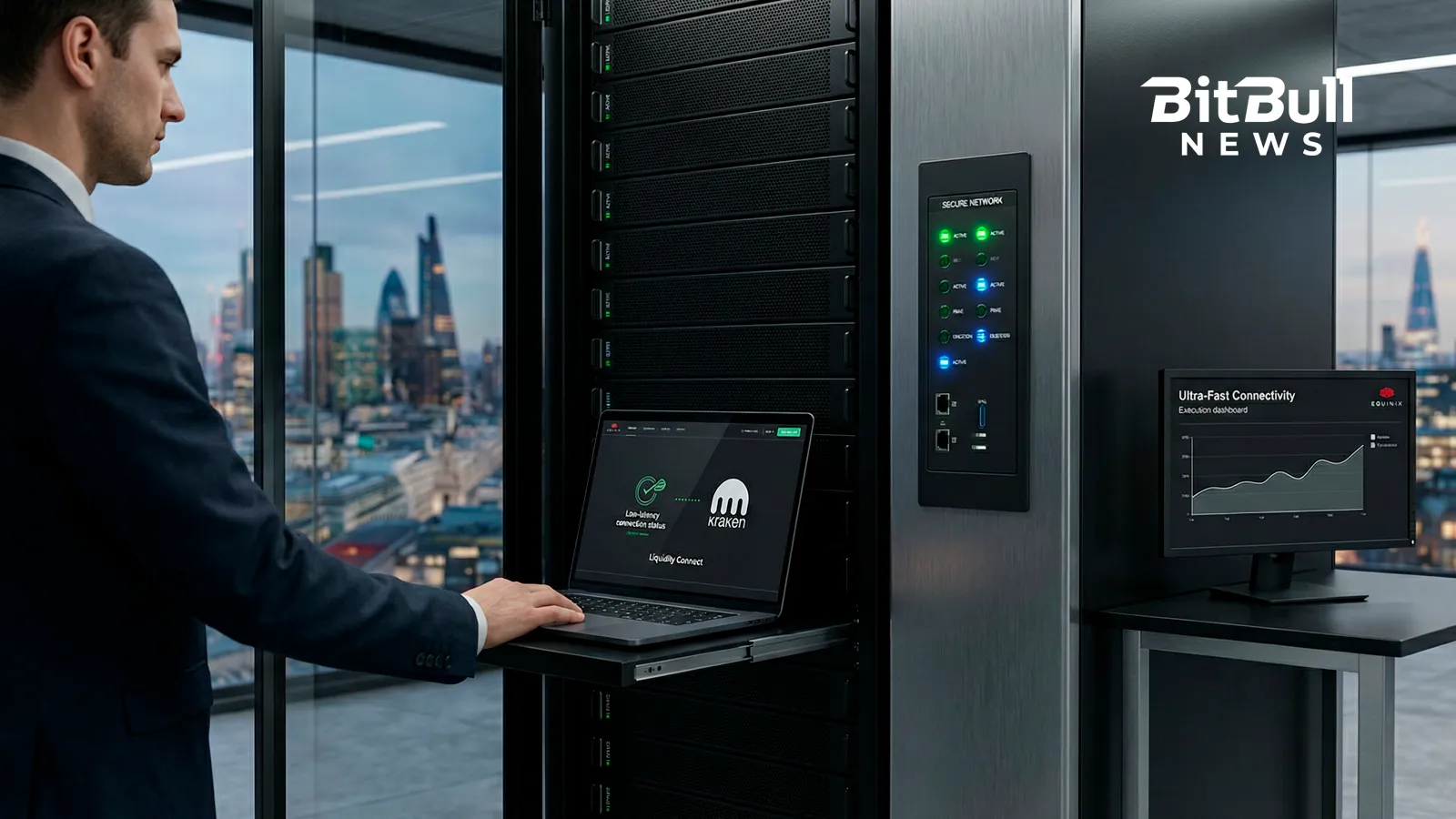
Kraken is moving deeper into professional trading infrastructure with a new colocation cross-connect service built through Liquidity Connect. The exchange said the setup gives traders direct access to Liquidity Connect’s virtual private servers and bare metal dedicated servers hosted at Equinix London, one of the world’s main financial connectivity hubs.
The practical point is speed. Kraken says institutional and individual traders can now connect to its trading environment with sub-millisecond latency, making the service relevant for firms and active traders running latency-sensitive execution strategies. That makes this less of a routine product update and more of a market-structure move aimed at the kind of users who care about microseconds, deterministic connectivity and infrastructure quality, not just exchange fees or token listings.
Kraken is giving traders a direct line into its matching environment
The new service is built around direct fiber cross-connects into Kraken’s infrastructure through Liquidity Connect’s setup in Equinix London. Kraken says the arrangement is designed to provide faster and more deterministic connectivity than ordinary internet-based access, which is why the announcement sits much closer to institutional market plumbing than to retail product design.
That matters because colocation has long been standard in traditional financial markets, where serious firms place trading systems physically closer to exchange infrastructure to reduce latency and improve execution consistency. Kraken is clearly signaling that more of crypto trading is now demanding that same standard of connectivity. This is an analytical conclusion based on the service design described in the release.
The target user is the trader who treats infrastructure as alpha
Kraken says both institutional and individual traders can use the service, but the use case is clearly tilted toward more advanced participants. The exchange highlights sub-millisecond latency and explicitly says the offering is meant to support efficient execution and latency-sensitive trading strategies.
In plain English, this is for users who already think about market access as part of their trading edge. If you are running algorithmic strategies, market-making systems or other execution models where speed consistency matters, this kind of product matters a lot more than it would for a casual spot trader. That second point is an inference from Kraken’s emphasis on latency-sensitive trading.
Liquidity Connect is selling ready-made deployment, not just raw rack space
One of the more important details in Kraken’s announcement is how the deployment works. The company says traders can connect through Liquidity Connect’s VPS or bare metal server products and deploy from an existing LIQC setup without needing additional infrastructure. It also says VPS infrastructure can be provisioned in as little as 30 minutes.
That lowers one of the usual barriers to colocation. Instead of requiring every participant to build a more complex physical presence from scratch, Kraken and Liquidity Connect are pitching a faster route into exchange-grade connectivity. This makes the service more accessible than a pure institutional colo model limited only to the largest firms. That is an analytical inference from the modular deployment language in the source.
Kraken is pairing speed with the usual institutional infrastructure promises
The exchange also leans hard on operational resilience. Kraken says the Liquidity Connect offering includes dedicated IP addresses, DDoS protection, redundant power systems and 24/7 managed support from LIQC engineers.
Those details matter because low latency alone is not enough for professional trading firms. A serious connectivity product also has to reduce downtime risk, provide stable network conditions and offer round-the-clock support when something breaks. Kraken is clearly trying to frame this launch as enterprise-grade infrastructure rather than as a niche speed feature.
Kraken is making a bigger statement about where crypto market structure is going
The most revealing paragraph in the post is the one where Kraken says professional traders increasingly require the same high-performance infrastructure available in traditional financial markets. The company adds that the framework is meant to support high-performance connectivity while preserving fair and transparent market access.
That is the broader takeaway. Kraken is using this launch to argue that digital asset markets are maturing into a more traditional market-structure model, where exchanges compete not only on listings and liquidity, but also on access quality, infrastructure partnerships and execution environment. This is an analytical conclusion based on Kraken’s own framing of the product.
Why it matters for crypto
- It shows crypto exchanges are increasingly competing on traditional market infrastructure, not just token access and retail features.
- It brings a more TradFi-style colocation model into Kraken’s exchange environment for latency-sensitive users.
- It suggests the next phase of institutional crypto trading will be shaped as much by connectivity and execution quality as by liquidity alone. This is an inference based on Kraken’s framing.
- It also signals that professional crypto trading is becoming more operationally demanding, with infrastructure itself turning into a competitive edge. This is an analytical conclusion from the launch.
What to watch next
- Whether Kraken expands colocation and cross-connect services beyond London into more financial data center hubs. This is not announced, but it is the obvious next question.
- Whether rival exchanges respond with similar low-latency infrastructure partnerships for professional traders. This is an inference based on the competitive significance of the move.
- Whether Kraken starts disclosing adoption or usage data that shows meaningful demand from market makers and algorithmic traders.
- Whether this kind of product becomes standard for crypto venues trying to win more institutional flow. This is also an inference from the direction of the market.