


Content
A fragile but market-moving diplomatic breakthrough is giving crypto traders exactly what they wanted: less war risk, lower oil stress, and a cleaner path for risk assets to rebound. The United States and Iran have moved into a temporary two-week ceasefire framework, a headline that quickly changed the tone across global markets. What had looked like a dangerous escalation in the Middle East suddenly became, at least for now, a de-escalation story.
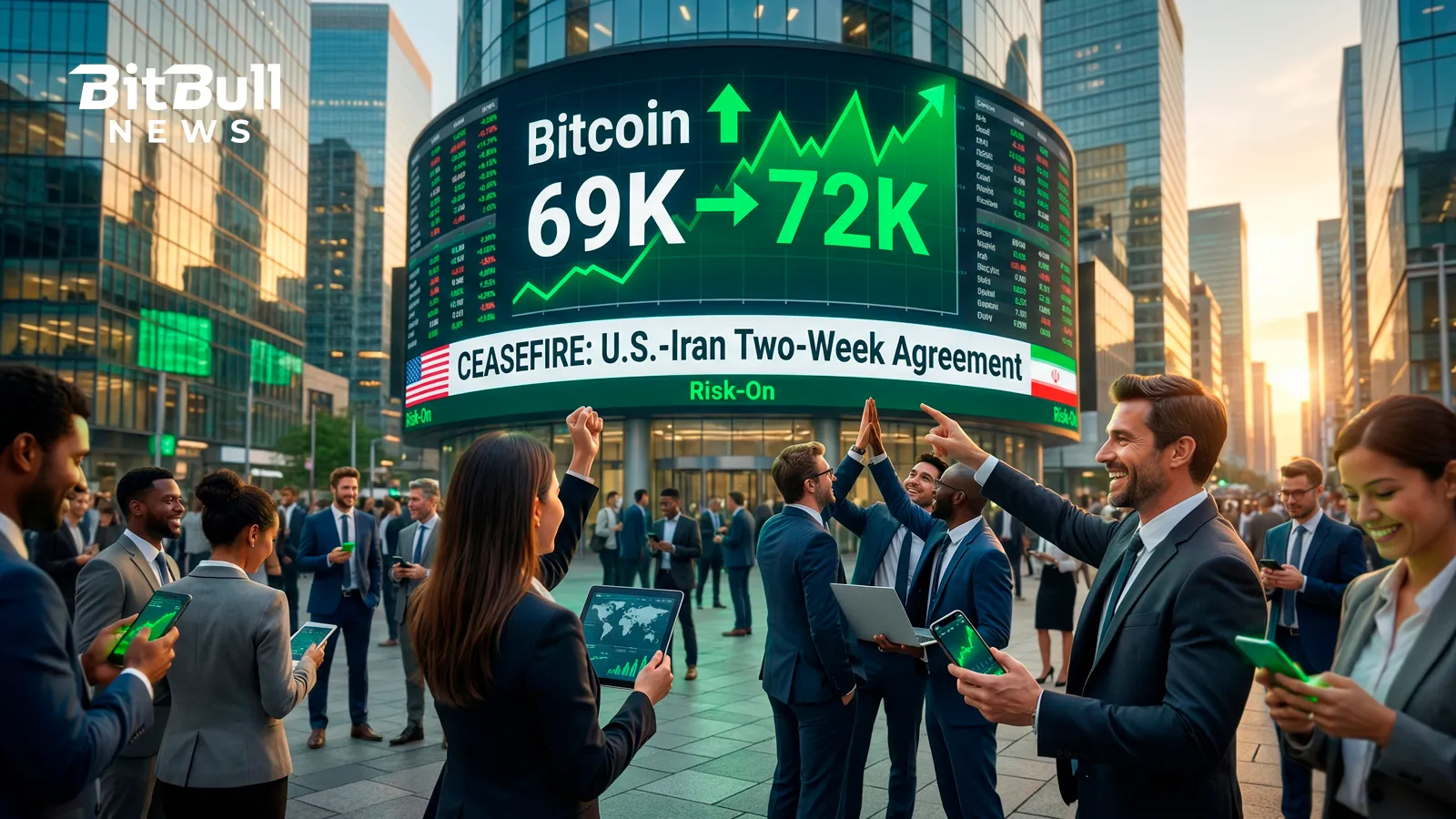
That shift mattered immediately for Bitcoin. Over roughly the last 10 hours, BTC moved from around $69,000 to the $72,000 area as traders priced out some of the geopolitical premium that had built up during the recent standoff. The move was not just a crypto-only reaction. It fit a broader relief trade across macro markets, with investors rotating back into risk as the probability of an immediate regional energy shock appeared to fall.
What was agreed
The key point is that this is not a permanent peace treaty. It is a short-term ceasefire arrangement designed to pause further escalation and create room for formal negotiations. That distinction matters. Markets are treating the agreement as a temporary stabilizer, not a final resolution of the conflict.
Still, even a limited agreement can have outsized market impact when the alternative is a widening regional crisis. The biggest near-term significance of the ceasefire is that it lowers the risk of further disruption around the Strait of Hormuz and the broader Gulf energy corridor. For traditional markets, that means less fear of an oil spike. For crypto, it means one of the biggest macro threats hanging over sentiment suddenly looks less immediate.
Why Bitcoin reacted so fast
Bitcoin’s rally makes sense when you look at how the asset trades during major geopolitical events. In long-term ideology, BTC is often framed as an alternative to the traditional financial system. In real-time market behavior, though, Bitcoin still acts like a highly sensitive macro asset. When traders fear war, higher energy costs, tighter financial conditions, and broad market stress, BTC often sells off or stalls with the rest of the risk complex. When those fears ease, it can rebound faster than stocks because of its liquidity, volatility, and round-the-clock trading structure.
That is what today looked like. As the ceasefire headlines spread, traders moved quickly to cover shorts and reprice risk. Bitcoin’s move from roughly $69,000 to $72,000 was a classic relief rally: not necessarily driven by a new crypto-specific catalyst, but by a sharp improvement in the global macro backdrop.
There is also a sentiment component here. Crypto had been trading in a market that was increasingly nervous about oil, military escalation, and the possibility of broader contagion across traditional assets. Once that worst-case scenario softened, Bitcoin became one of the fastest instruments through which traders could express a bullish, risk-on view.
Why this is good for the crypto market
The most obvious benefit is lower macro pressure. If the ceasefire holds, even temporarily, it reduces the chance of another immediate oil shock. Lower energy stress can cool inflation fears, reduce panic hedging, and improve the tone for equities and digital assets alike. Crypto tends to respond well when investors feel less urgency to hide in cash, short-duration safe havens, or defensive positioning.
It is also good for liquidity sentiment. Crypto rallies are stronger when traders feel comfortable extending risk. A ceasefire does not magically improve blockchain fundamentals, but it does improve the environment in which capital flows into speculative assets. That matters because Bitcoin is often the first recipient of returning confidence, and once BTC stabilizes and moves higher, the rest of the market usually gets room to breathe.
A calmer geopolitical backdrop can also help altcoins indirectly. When macro risk fades, traders are more willing to move beyond pure Bitcoin exposure and re-enter higher-beta parts of the market. That is often how relief moves broaden: first BTC, then major large-cap alts, then selective rotation into more speculative names.
The deeper crypto angle
For the crypto market, this story is bigger than one daily candle. It reinforces how tightly digital assets remain connected to global macro conditions. Crypto is not trading in a vacuum. Energy markets matter. U.S. foreign policy matters. Middle East stability matters. When a geopolitical crisis threatens shipping routes, commodities, inflation, and central bank expectations, Bitcoin reacts alongside everything else.
That is an important reminder for traders who still try to separate crypto from the rest of the financial system. Bitcoin may be decentralized, but its price discovery is deeply entangled with global liquidity and institutional risk appetite. Today’s rally was another example of that relationship in action.
At the same time, there is a second interpretation that is quietly constructive for BTC. Bitcoin did not merely hold steady during a major geopolitical scare; it was ready to bounce hard the moment the pressure eased. That suggests the market was already sitting on strong underlying demand, just waiting for macro fear to step aside.
Why traders should still stay careful
The bullish read is straightforward, but it comes with an asterisk. This is a two-week ceasefire, not a comprehensive peace settlement. The agreement may reduce short-term risks, but it does not remove the deeper strategic disputes behind the confrontation. That means the market is celebrating a pause, not a final solution.
If talks break down, if military pressure resumes, or if the region sees a new flashpoint, the same macro logic that pushed Bitcoin higher today could reverse quickly. Oil would likely jump, risk appetite would weaken, and crypto could give back part of its move just as fast as it made it.
So the right way to frame this is not “all clear.” It is “meaningful relief, with unresolved risk.” For traders, that distinction is critical.
Why it matters for crypto
This ceasefire is good for crypto because it removes part of the fear premium that had been weighing on the market. It improves the background for Bitcoin, supports broader risk appetite, and reminds investors that macro stabilization can be just as powerful for crypto as any ETF, halving, or on-chain narrative. In the short term, peace is bullish because peace reduces panic — and reduced panic usually means more room for capital to move back into volatile assets.
The rally from around $69,000 to $72,000 shows that Bitcoin remains one of the fastest assets in the world to reprice geopolitical risk. That is a strength in moments like this. It means crypto does not need weeks to digest a macro shift. It can respond in hours.
What to watch next
The next phase is simple. Traders need to watch whether the ceasefire actually holds through the full two-week window, whether negotiations produce anything more durable, and whether oil stays calm. If those conditions remain stable, Bitcoin could keep the upper hand and the broader crypto market could continue to benefit from improving sentiment.
If not, volatility comes back fast.
For now, though, the market has made its call: a pause in conflict is a green light for risk, and Bitcoin was one of the clearest winners of that repricing.