


Content
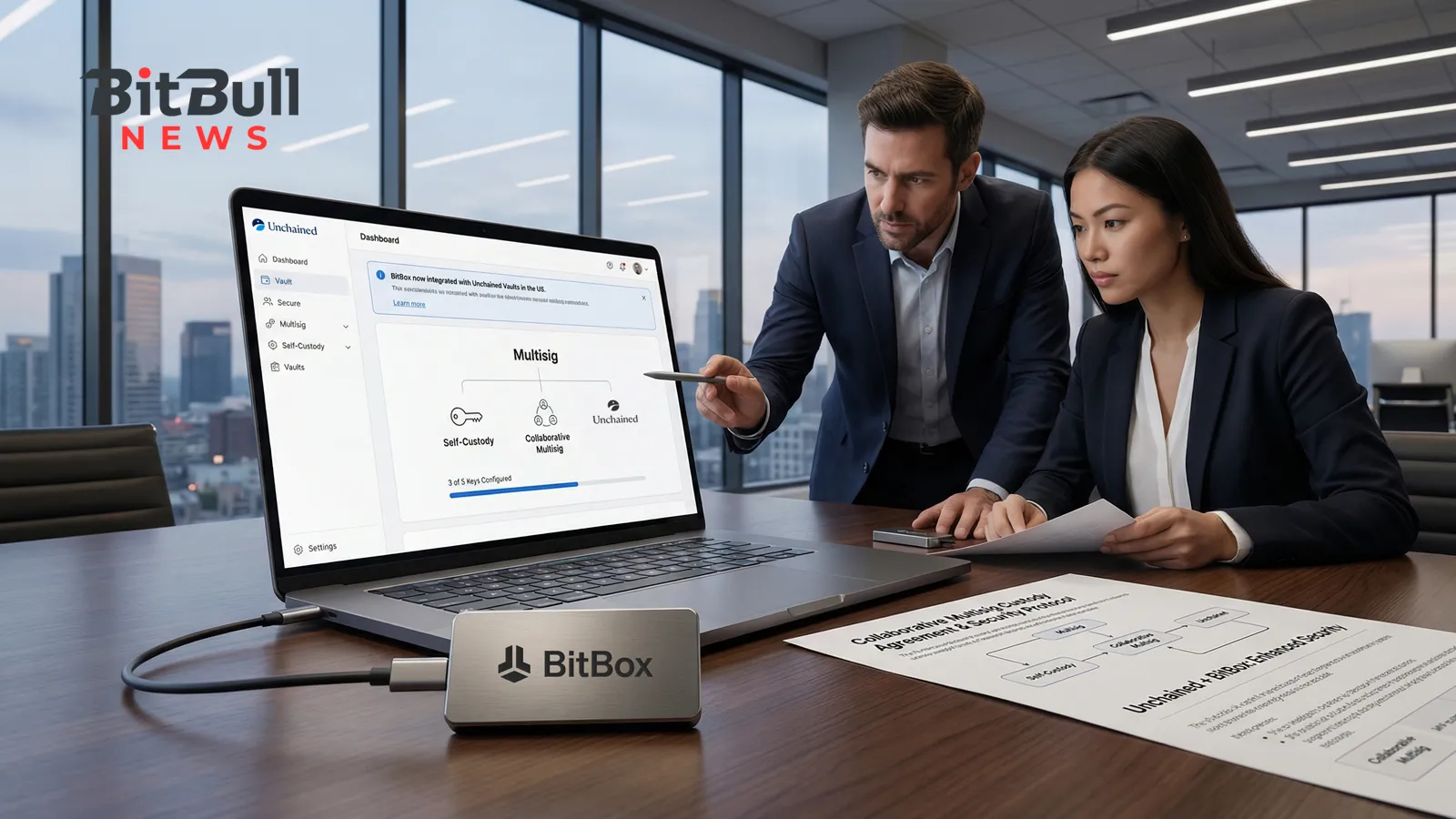
BitBox has partnered with Unchained to make BitBox hardware wallets compatible with Unchained vaults, adding a new collaborative custody option for Bitcoin users in the United States. The integration lets BitBox devices work directly inside Unchained’s multisignature setup, combining hardware self-custody with a structure designed to reduce single points of failure.
The announcement matters because it targets a specific stage in the self-custody journey. BitBox says many users begin with a single hardware wallet, but questions around redundancy, inheritance, recovery and business use grow more important as Bitcoin holdings increase. Unchained’s vault model is being positioned as the next step for those users rather than as a replacement for standard single-key self-custody.
BitBox plugs into Unchained’s 2-of-3 custody model
At the center of the integration is Unchained’s vault structure. BitBox says Unchained vaults typically use a 2-of-3 multisignature model in which the user controls two keys, Unchained holds one backup key, and any two keys are needed to move funds. BitBox devices can now be used directly as part of that setup.
That model is meant to solve a specific custody problem. Unchained cannot move a client’s bitcoin on its own, because it holds only one of the three keys. At the same time, the setup is designed to reduce the risk that one lost or compromised key becomes a catastrophic failure for the user.
A new option for users who have outgrown single-key storage
BitBox is clear that not every hardware wallet user needs multisig. The company says a straightforward single-key setup with strong backups is still an excellent solution for many people. But it also identifies several situations where a more resilient model starts to make sense: larger holdings, reduced reliance on one device or backup location, inheritance planning, family or business custody, and the need for guided recovery support without surrendering control.
That is the strongest news angle here. This is not a mass-market wallet feature aimed at everyday spending or entry-level crypto users. It is an infrastructure upgrade for Bitcoin holders who want a more formal long-term custody setup while still staying on the self-custody side of the line. This is an analytical conclusion based on the use cases BitBox highlights.
Why BitBox says the pairing fits naturally
BitBox’s pitch is that the two products solve different parts of the same problem. BitBox brings offline key storage and user-controlled signing devices, while Unchained adds risk distribution across multiple keys and a recovery path that does not require full third-party custody. The company also says BitBox is a strong fit for multisig because it supports multisig setup registration, which makes verifying setups easier and helps users notice unauthorized changes.
The integration also expands user choice inside Unchained’s ecosystem. BitBox says Unchained values hardware diversity in multisig setups, and that supporting BitBox gives clients more flexibility when deciding how to structure their vault.
The product is still Bitcoin-first in tone and design
BitBox uses the announcement to reinforce its own positioning. The company says the wallet is built in Switzerland, fully open-source in firmware and companion app, and available in a Bitcoin-only edition for users who want a more focused setup with less code and less attack surface. It also notes that this approach fits well with Unchained’s Bitcoin-first philosophy.
That matters because the partnership is not trying to create a broad multi-asset custody stack. The announcement is framed specifically around Bitcoin security, long-term storage, and collaborative custody for serious holders.
What this changes — and what it doesn’t
The integration gives BitBox users in the U.S. a new custody path, but it does not change the core nature of self-custody. Users still control their own devices and still need to understand how multisig works. The difference is that they now have the option to pair that self-custody model with Unchained’s collaborative structure and backup key arrangement.
It also does not mean multisig is now the default recommendation for everyone. BitBox says directly that collaborative custody is not for all users and should be viewed as one option within a broader set of self-custody tools.
What we don’t know yet
The announcement does not disclose usage targets, pricing changes tied to the integration, or whether BitBox support will expand beyond Unchained’s current U.S. availability. It also does not say how many BitBox users are expected to adopt vault-based collaborative custody rather than stay with single-device storage.
Why it matters for crypto
- It shows the self-custody market is maturing beyond simple hardware-wallet storage into more formal redundancy and recovery models.
- It gives larger Bitcoin holders another route between single-key self-custody and full third-party custody.
- It reinforces that inheritance, business access and long-term resilience are becoming bigger product categories in Bitcoin custody. This is an inference based on the use cases highlighted by BitBox.
- It suggests hardware wallet competition may increasingly be shaped by compatibility with collaborative and multisig services, not just by device design alone. This is also an inference from the partnership structure.
What to watch next
- Whether BitBox and Unchained publish adoption data showing how many users move into vault-based multisig through this integration.
- Whether collaborative custody becomes a more common next step for hardware-wallet users with larger Bitcoin positions. This is an inference based on the market need BitBox describes.
- Whether Unchained expands BitBox-related support beyond the U.S. over time. The current announcement ties availability to the United States.
- Whether more hardware wallet makers pursue similar integrations with multisig and inheritance-focused custody services. This is an inference from the strategic importance of the move.