


Content
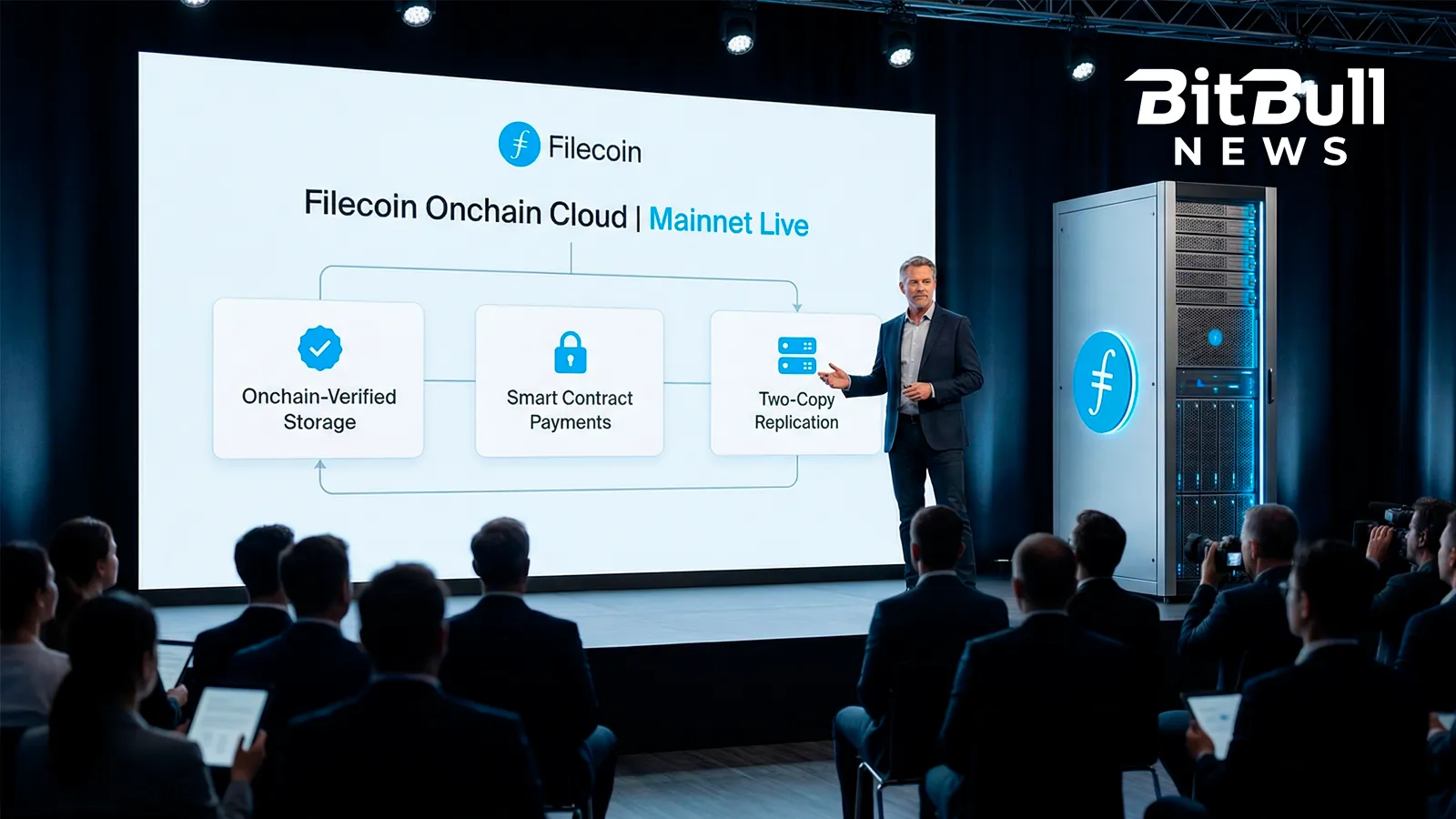
Filecoin has pushed its Onchain Cloud product from testnet to mainnet, turning what was an experimental storage layer into a live programmable cloud service for developers. The company says the system is built for AI agents, data pipelines and decentralized apps that need storage, retrieval and payment flows to be verifiable onchain rather than handled by opaque cloud infrastructure.
The stronger news angle is that Filecoin is no longer selling only cheap decentralized storage. It is now trying to sell a full “onchain cloud” model where storage proofs, payment enforcement and provider performance all sit inside a public, auditable system. Filecoin says those building blocks are live on mainnet today.
The product is live, and the first mainnet numbers are already in
Filecoin says Onchain Cloud is now running on mainnet with 49.41 TiB of data already stored across 478 active datasets, alongside 81 payer wallets connected onchain through Filecoin Pay. Those are still early numbers, but they show this is not a launch with zero usage behind it.
The company also says more than 100 teams started building during the testnet phase after the product launched last November. In practical terms, Filecoin is trying to show that mainnet is arriving after an early developer proving ground, not before one.
The biggest change is turning storage into an onchain service contract
Filecoin describes Onchain Cloud as a programmable storage and payments layer where data is verified onchain, payments are enforced by smart contract, and each action creates an auditable record. That is a more ambitious pitch than simple decentralized file storage. It means the product is being framed as cloud infrastructure with built-in proof, settlement logic and performance accountability.
That matters because the company is aiming at a growing problem in AI and machine-driven systems: storing data is no longer enough on its own. Developers increasingly want proof of what was stored, who stored it, whether it is still available, and whether the provider should still be paid. Filecoin’s answer is to make those questions part of the storage layer itself. This second point is an inference from the architecture Filecoin describes.
Two-copy replication is now live by default
One of the most concrete mainnet upgrades is two-copy replication. Filecoin says every upload made through the Synapse SDK now lands on two independent storage providers by default. The second provider pulls the data directly from the first, so the uploader’s bandwidth is not used twice, and each copy generates its own onchain proof.
That is an important feature because it gives builders immediate redundancy without having to manually manage multi-provider uploads themselves. Filecoin also says that if the secondary provider fails, the system automatically selects a replacement and retries.
Provider performance is being monitored like infrastructure, not just marketplace supply
Filecoin says production-grade storage providers have been onboarded, tested and approved for real workloads on mainnet. It adds that providers must meet three thresholds: storage success rates above 95%, PDP fault rates below 1%, and retrieval success rates above 95%. If a provider fails those thresholds, Filecoin says it is removed.
That detail matters because it pushes Filecoin away from the older image of a loose storage marketplace where quality varies widely from provider to provider. The company is clearly trying to present Onchain Cloud as a managed, performance-screened infrastructure layer rather than a simple open marketplace for capacity. That framing is an inference from the eligibility standards and removal mechanism it describes.
Proof of Data Possession is the core trust layer
Filecoin’s trust model here is built around PDP, or Proof of Data Possession. The company says PDP proofs verify data onchain every 24 hours, and that payments stop automatically if those proofs fail. It also says the new PDP Explorer lets anyone monitor proof status, provider fault history and performance in real time.
This is one of the most important parts of the launch because it answers the basic cloud question: how do you know the provider still holds exactly what it is being paid to store? Filecoin’s answer is that proof lives onchain and can be checked directly, rather than taken on trust.
AI is the clearest target market
The company is unusually explicit about who this is for. It says AI agents and autonomous systems need persistent, verifiable storage for data, logs and artifacts, and they need to pay for that storage programmatically without relying on credit cards or centralized accounts. Filecoin says it now offers CLI and AI-agent skills that let agents manage wallets, datasets and storage providers through the Synapse SDK using natural language.
The product is also pitched at AI pipeline builders that need to prove what touched a dataset, model checkpoint or transformation stage and when. Filecoin’s claim is that those records become public and tamper-evident once the storage flow is handled through Onchain Cloud.
That makes the launch more than a storage story. Filecoin is trying to position itself as infrastructure for agentic software and verifiable AI pipelines, where storage, logs and payments all become machine-readable and audit-ready. This is an inference from the use cases and tooling the company highlights.
Decentralized apps are the second major use case
Filecoin also says Web3 apps and websites can use Onchain Cloud for user-generated content, application state and frontend assets. It points to Filecoin Nova as a proof of concept for hosting websites directly on the system.
That is important because it broadens the product beyond AI. Filecoin is trying to show that Onchain Cloud can function as a shared data layer for decentralized apps that want persistence and auditability without relying on centralized pinning services or standard cloud servers.
Pricing is aggressive, but the roadmap is still unfinished
Filecoin says storage starts at $2.50 per TiB per month per copy, with two independent copies enabled by default. That is the near-term commercial hook: verifiable replicated storage at low early pricing.
But the roadmap is not finished. Filecoin says what is live today includes two independent replicas, PDP proofs every 24 hours, automatic payment halts when proofs stop, the Synapse SDK, early access to Filecoin Pay and the PDP Explorer. It then lists future work including SLA hardening, fuller developer support channels, deeper agent tooling, payment-flow improvements, automated repair after faults, and later sealed backup copies through Proof of Replication.
What is still not fully answered
The launch explains the architecture well, but it leaves some commercial questions open. Filecoin does not yet disclose customer names for production workloads, long-term SLA terms, detailed mainnet retrieval volumes, or what share of early demand is coming from AI agents versus more traditional storage workloads.
Why it matters for crypto
- It shows Filecoin is trying to move up the stack from decentralized storage into a fuller onchain cloud model with proofs, payments and provider monitoring built in.
- It gives AI builders and agent developers a live mainnet product for verifiable storage and machine-native payment flows.
- It suggests the next phase of crypto infrastructure may be less about token narratives and more about replacing specific parts of cloud infrastructure with auditable onchain services. This is an inference based on Filecoin’s product framing.
- It also strengthens the idea that decentralized infrastructure can compete by offering verifiability and automation, not only lower cost. This is an inference from the PDP and smart-payment model Filecoin highlights.
What to watch next
- Whether Filecoin can convert early production testing into named enterprise or AI customers on mainnet.
- Whether automated repair and SLA hardening arrive quickly enough to make the platform more credible for larger workloads.
- Whether Filecoin Pay moves from early access into a broader production payment layer for storage-heavy applications.
- Whether AI agents become a real source of sustained demand rather than just the headline use case in early marketing. This is an inference based on the company’s positioning.