


Content
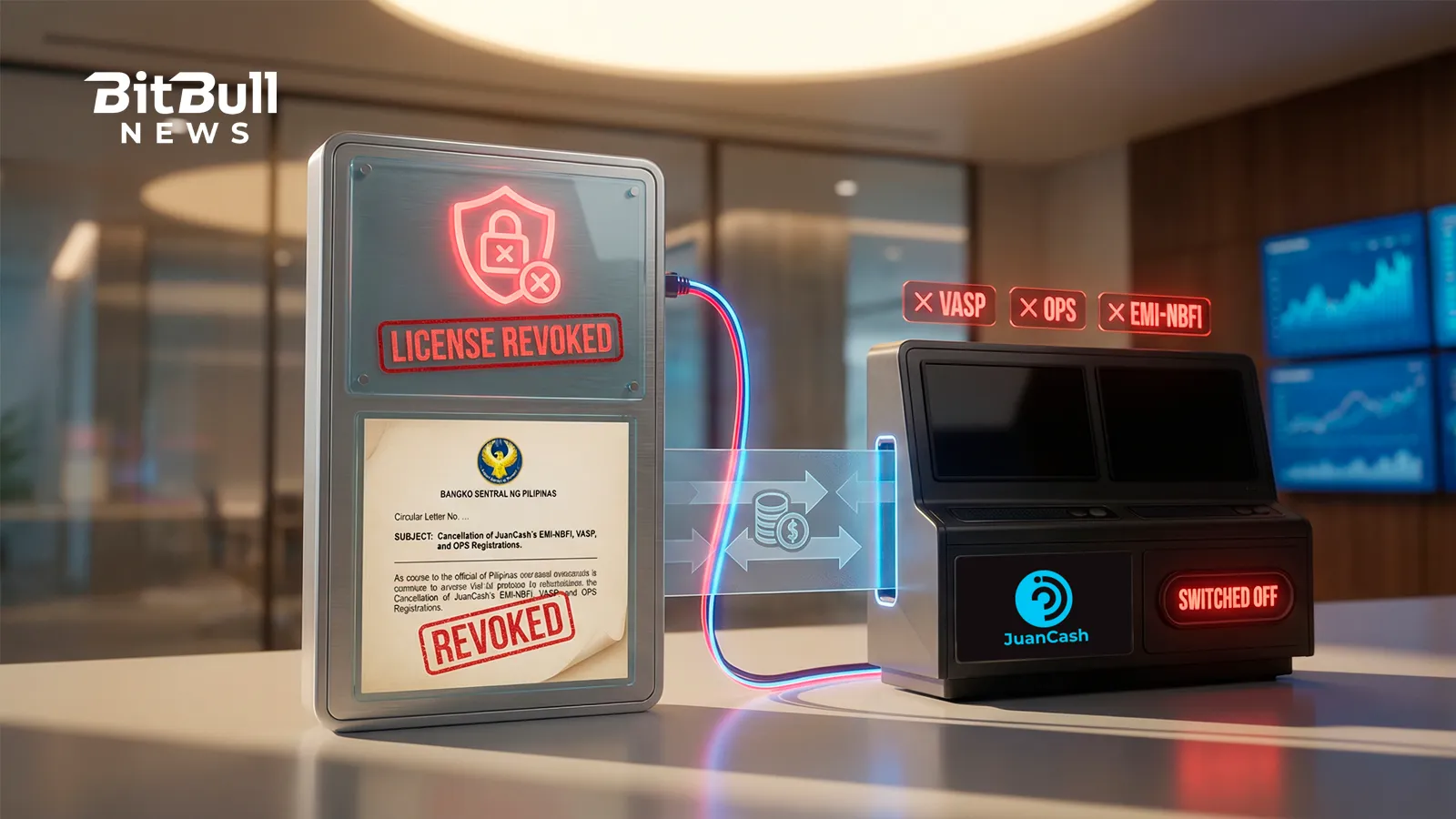
Bangko Sentral ng Pilipinas has formally revoked the Electronic Money Issuer-Non-Bank Financial Institution, or EMI-NBFI, license of Zybi Tech, Inc., doing business as JuanCash, and canceled its registrations as a Virtual Asset Service Provider and Operator of Payment System. The action was announced in Circular Letter No. CL-2026-013 dated March 17, 2026.
The circular says the Monetary Board approved the revocation and cancellations in Resolution No. 683.A dated July 3, 2025, and later denied with finality Zybi Tech’s motion for reconsideration in Resolution No. 154 dated February 26, 2026.
What the BSP announced
The BSP’s subject line is unusually direct. It says the central bank is revoking Zybi Tech’s EMI-NBFI license and canceling its certificates of registration as a VASP and OPS. The circular was addressed to all BSP-supervised institutions, which means the notice was framed as a formal supervisory update to the broader regulated sector, not just a company-specific memo.
In the text, the BSP also notes that the company had previously held a remittance and transfer company registration with Type “C” EMI with virtual currency exchange service, now referred to as a VASP. That wording reflects the regulatory transition in how the BSP classifies this type of activity.
What licenses and registrations were affected
The action covered three parts of JuanCash’s regulatory status. First, the BSP revoked Zybi Tech’s EMI-Others license, now referred to as an EMI-NBFI license. Second, it canceled the company’s certificate of registration as a VASP. Third, it canceled its certificate of registration as an Operator of Payment System.
That matters because this was not a narrow action affecting only one business line. Based on the circular itself, the BSP moved across the company’s e-money, virtual asset, and payment-system permissions at the same time.
What legal basis the BSP cited
The circular says the action was taken pursuant to Section 37 of Republic Act No. 7653, or the New Central Bank Act, as amended; Republic Act No. 9160, or the Anti-Money Laundering Act of 2001, as amended, together with its revised implementing rules and regulations; and Section 19 of Republic Act No. 11127, or the National Payment Systems Act, including the rules and regulations issued under it.
The BSP also footnoted Circular No. 1166, Series of 2023, and Circular No. 1108, Series of 2021. The circular does not explain the underlying conduct or factual findings in this one-page notice, but it does make clear that the action rests on banking, AML, and payments-law authorities.
Why this matters now
The practical significance is that the case is no longer in an interim stage. The BSP says the motion for reconsideration was denied “with finality,” which turns the July 2025 board action into a completed regulatory outcome rather than a pending dispute.
It also shows how closely e-money, crypto-related registration, and payment-system status can be linked under Philippine supervision. In this case, the BSP did not isolate one permission from the others; it moved across all three. That is a grounded inference from the scope of the circular.
Why it matters for crypto
- It shows the BSP is willing to take full-spectrum action against a regulated firm with virtual asset permissions, not just issue a narrow crypto-specific sanction.
- It reinforces that VASP status in the Philippines sits alongside broader e-money and payments supervision rather than outside it.
- It highlights AML and payment-system law as part of the enforcement foundation for crypto-facing businesses.
- For exchanges, wallets, and payment firms, it is another reminder that regulatory risk can hit several licenses at once when business models overlap. This last point is an inference from the structure of the BSP action.
What to watch next
- Whether the BSP releases a fuller explanation or related enforcement materials describing the underlying reasons for the revocation and cancellations. The circular itself does not provide that detail.
- Whether follow-up notices affect JuanCash customer services, payment access, or related partners in the local market. The circular is silent on operational transition steps.
- Whether the BSP uses similar multi-license enforcement more often for firms spanning e-money, payments, and virtual asset services. This is an inference based on the structure of this case, not a disclosed policy statement.