


Content
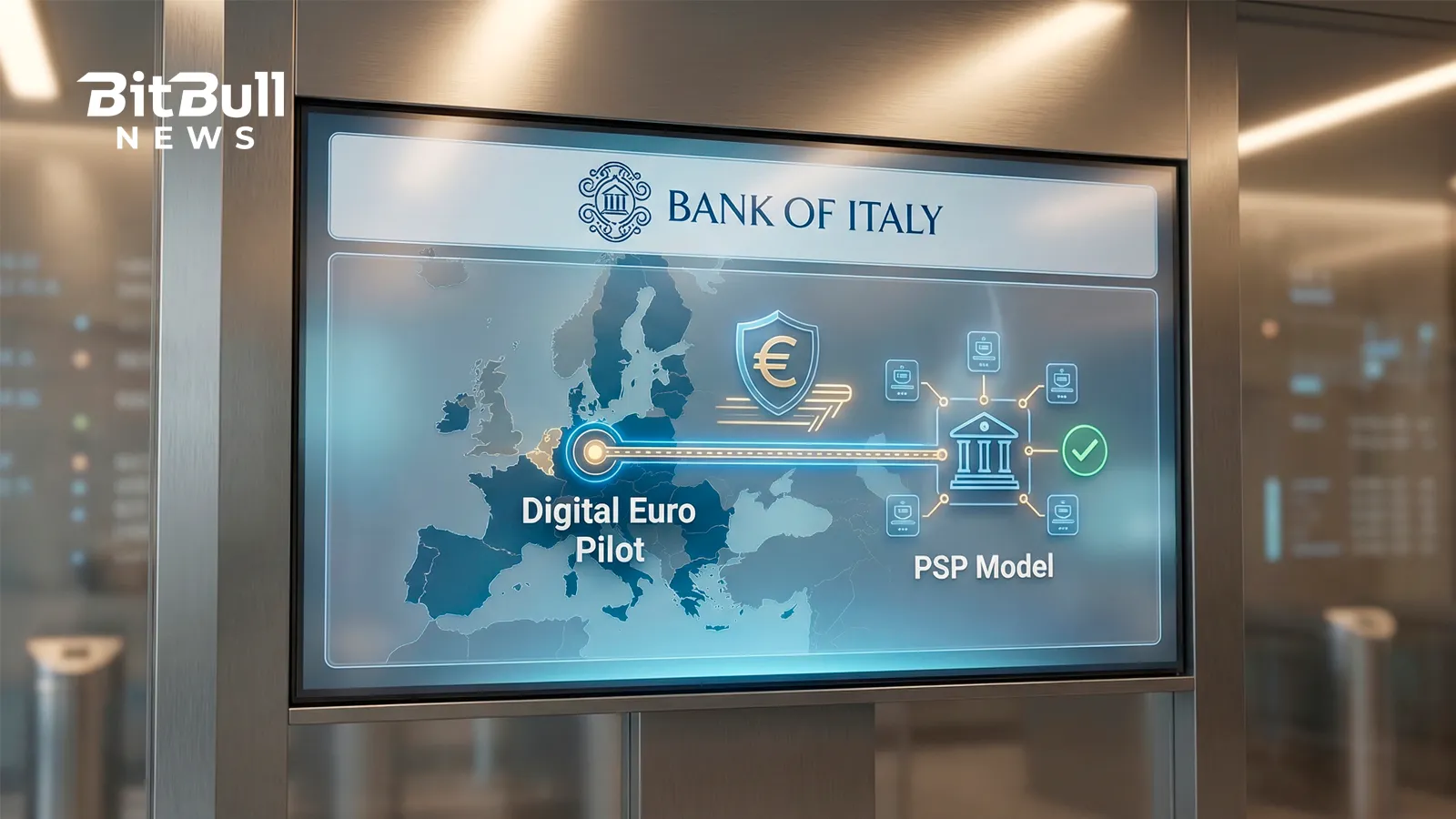
Bank of Italy has published a detailed seminar deck for payment institutions and e-money institutions that offers one of the clearest working snapshots yet of how the digital euro could be rolled out. The presentation says the current phase has been under way since November 2025, a pilot could begin in mid-2027, and a first issuance in 2029 remains possible only if EU co-legislators adopt the digital euro regulation this year.
The slides also make clear that the model remains firmly intermediated. The Eurosystem would not have direct relationships with end users; supervised PSPs would distribute the digital euro, handle customer relationships, and plug into a framework built around holding limits, no user remuneration, and automatic “waterfall” functions linked to commercial bank accounts.
What the seminar outlined
The presentation describes the post-November 2025 phase as a flexible and modular stage focused on three things: advancing technical preparation, intensifying market engagement, and supporting the legislative process. It also says a 12-month pilot with real transactions in a controlled Eurosystem environment could start in the second half of 2027, with a limited number of PSPs, merchants, and Eurosystem participants. PSP selection, according to the slides, is due to begin in the first quarter of 2026, and four use cases are expected to be tested.
That matters because this is not just another high-level digital euro update. The deck moves into practical design questions that affect how the product would actually work in market hands, especially for non-bank PSPs. It covers who would distribute the product, how users would fund and defund wallets, how holding limits would be calibrated, and how compensation between different PSP roles could work.
How distribution is supposed to work
The Bank of Italy materials say users would not hold a direct account relationship with the ECB or national central banks for digital euro payment services. Instead, users would establish a contractual relationship with PSPs that distribute the digital euro and open digital euro payment accounts. The deck repeatedly presents this as an intermediated model, with the Eurosystem owning the rulebook and infrastructure while market intermediaries handle distribution.
The same presentation says only supervised PSPs would distribute the digital euro and maintain customer relationships. It also says PSPs would have to provide users with at least one free interface for accessing digital euro services, while the ECB and national central banks would make an interface available to all PSPs as a fallback if a PSP does not offer one directly or if its interface is temporarily unavailable.
What this means for non-bank PSPs
The significance of this seminar is that it brings non-bank payment players deeper into the operational conversation. The audience was payment institutions and e-money institutions, and the deck shows the Eurosystem is actively discussing rulebook, pilot, interface, funding, and compensation mechanics with the wider payments industry rather than treating banks as the only relevant channel. That is a grounded inference from the seminar audience and the market-engagement sections of the presentation.
The safeguards around holding limits
A central theme of the deck is that the digital euro is not being designed as a high-yield store of value. The slides say wallets would not be remunerated, users would be subject to an individual holding limit, and the design is meant to preserve the balance between central bank money and commercial bank money so that the digital euro does not become a substitute for deposits.
The Bank of Italy presentation also outlines the methodology behind those limits. It says the holding cap must balance three objectives: usability as a means of payment, effectiveness of monetary policy, and financial stability. The slides add that the restriction should respect proportionality and be no more intrusive than necessary.
Under the Council-position text cited in the deck, the ECB would announce the issuance date at least two years in advance, publish a report at least one year before issuance recommending a maximum holding-limit value in agreement with the Commission, policymakers would then approve or modify that maximum within six months, and the ECB would finally set the actual limit below that approved ceiling.
Why waterfall and reverse waterfall matter
To make low-balance wallets more practical, the slides describe automatic funding and defunding features tied to commercial bank accounts. In the Bank of Italy’s explanation, “waterfall” works like an event-based automatic defunding function for incoming transactions, so users can still receive a payment even if the post-transaction balance would exceed the holding limit; the excess would then be transferred to a linked commercial bank account. “Reverse waterfall” works the other way for outgoing transactions, automatically funding the wallet from a linked account when needed.
The deck also says every digital euro account could be linked to one or more commercial bank payment accounts designated by the user. Consumers would have the right to hold one digital euro payment account per PSP, while legal persons and sole traders could hold one or more such accounts with the same or different PSPs.
The compensation model the market is being shown
The revenue and cost-sharing side is just as important as the wallet design. The slides say PSPs would charge merchants for digital euro payment services to cover operational distribution costs, while basic mandatory services for users would be free apart from the exception of cash funding and defunding. The Eurosystem, meanwhile, would bear the costs of its own infrastructure, much as it already does for banknote production.
The deck then contrasts today’s four-party debit card model with a proposed digital euro compensation model. In the digital euro version shown in the presentation, consumer-side and merchant-side PSPs would not pay scheme or processing fees, the merchant charge would be capped, and the inter-PSP fee would also be capped. That is a meaningful departure from card economics and suggests the Eurosystem wants the scheme layer to be lighter for intermediaries than many current card arrangements.
The open-funding wrinkle
The slides also outline an “open funding” case where the PSP providing the digital euro wallet is different from the PSP holding the linked commercial bank account. In that model, the consumer’s bank would not be obliged to enable the link if the wallet sits with another PSP, and compensation between the parties would have to be settled contractually. The service would still be free for the consumer, and the broader open-funding framework would be reviewed three years after issuance to assess the balance between strategic autonomy and competition.
Why this matters now
The broader strategic logic is visible across the deck. The slides say consumer payment habits are shifting toward cards, apps, and online commerce, while the European payment-services market remains fragmented and heavily influenced by non-European operators. One slide says roughly 70% of card payments pass through international card schemes with rising market shares and fees.
That is why the presentation frames the digital euro not only as a public-money project, but also as a market-structure project. The deck repeatedly ties the initiative to European strategic autonomy, open pan-European standards, and a payments infrastructure that would be European at the core while still allowing private operators to build on top of it.
Why it matters for crypto
- It shows that Europe’s CBDC model is still being built around intermediated distribution, with supervised PSPs – not central banks directly – at the user-facing edge.
- It confirms that holding limits, no remuneration, and automatic account-linked wallet mechanics remain central safeguards against deposit disintermediation.
- It suggests digital euro economics for PSPs will depend heavily on capped merchant fees, capped inter-PSP fees, and the Eurosystem’s willingness to absorb scheme and processing costs.
- It keeps the competitive-pressure story alive: the digital euro is still being positioned as a European response to fragmented payments and non-European scheme dominance.
What to watch next
- Whether EU co-legislators actually adopt the digital euro regulation on the timetable assumed in the slides, because the 2029 issuance path is explicitly conditional.
- Which PSPs are selected from early 2026 for the limited pilot expected to begin in the second half of 2027.
- How high the final holding limit will be, since the presentation describes only the process and methodology, not the number itself.
- How co-legislators settle the final fee rules, because the deck says merchant-side pricing principles are shown, but the actual payment-service charges will be decided by EU lawmakers.