


Content
One of the first questions serious beginners ask about Bitcoin is also one of the best: what gives Bitcoin value?
It is a better question than “Will Bitcoin go up?” and much better than “Should I buy now?” because it gets to the foundation. Before anyone treats Bitcoin as savings, speculation, digital gold, a payment rail, or a technological breakthrough, they need to understand why millions of people assign value to it in the first place.
That question is not as simple as it sounds. Bitcoin is not a company, so it does not produce cash flow like a stock. It is not a bond, so it does not promise coupons. It is not backed by a vault of gold. It is not issued by a state that forces people to use it for taxes. It is digital, volatile, globally traded, and controversial. To critics, that makes it look like a speculative bubble with no anchor. To supporters, that is exactly what makes it revolutionary.
The truth is more interesting than either extreme. Bitcoin has value because people believe its properties are useful, scarce, durable, transferable, and trustworthy enough to hold, trade, and use. Some of that value comes from technology. Some comes from economics. Some comes from network effects. Some comes from psychology. Some comes from real-world need.
This article explains where Bitcoin’s value comes from in plain English. It does not assume you already believe in Bitcoin, and it does not require you to become a Bitcoin maximalist by the end. The goal is to understand the actual value drivers, the weak points in the argument, and why this question remains one of the most important in crypto.
Why this matters to a normal person
Most people first encounter Bitcoin through price. They see headlines about all-time highs, crashes, ETFs, whales, institutional adoption, or governments talking about regulation. That creates an understandable impression: Bitcoin is a thing people trade.
But price and value are not the same thing.
Price tells you what the market is willing to pay right now. Value asks a deeper question: why is anyone willing to pay that at all?
That matters because people make bad decisions when they confuse the two. They chase price moves without understanding the underlying asset. They panic during downturns because they never formed a real view of why Bitcoin matters. Or they dismiss it too quickly because they only compare it to traditional assets and miss the unusual properties that drive demand.
Understanding what gives Bitcoin value helps people make better judgments about:
- whether Bitcoin is just speculation or something more
- whether its scarcity actually matters
- why some people treat it as long-term savings
- why institutions, companies, and governments pay attention to it
- what could strengthen or weaken its role over time
In other words, this is not just an academic question. It is the difference between seeing Bitcoin as a random number on a chart and seeing it as an asset with specific strengths, weaknesses, and economic logic.
In simple terms
Bitcoin has value because people believe it offers something useful that is hard to replicate: a scarce, portable, censorship-resistant digital asset that can be owned and transferred without relying on a central authority.
That sentence contains most of the answer.
Bitcoin is valuable to many people because it is:
- scarce
- digital
- global
- transferable
- divisible
- hard to censor
- independently verifiable
- not controlled by one company or government
Some people value Bitcoin because they see it as digital gold. Others value it as an alternative financial rail. Others value it because they want an asset outside the traditional monetary system. Others simply value it because they believe more people will want it in the future.
A useful beginner definition is this:
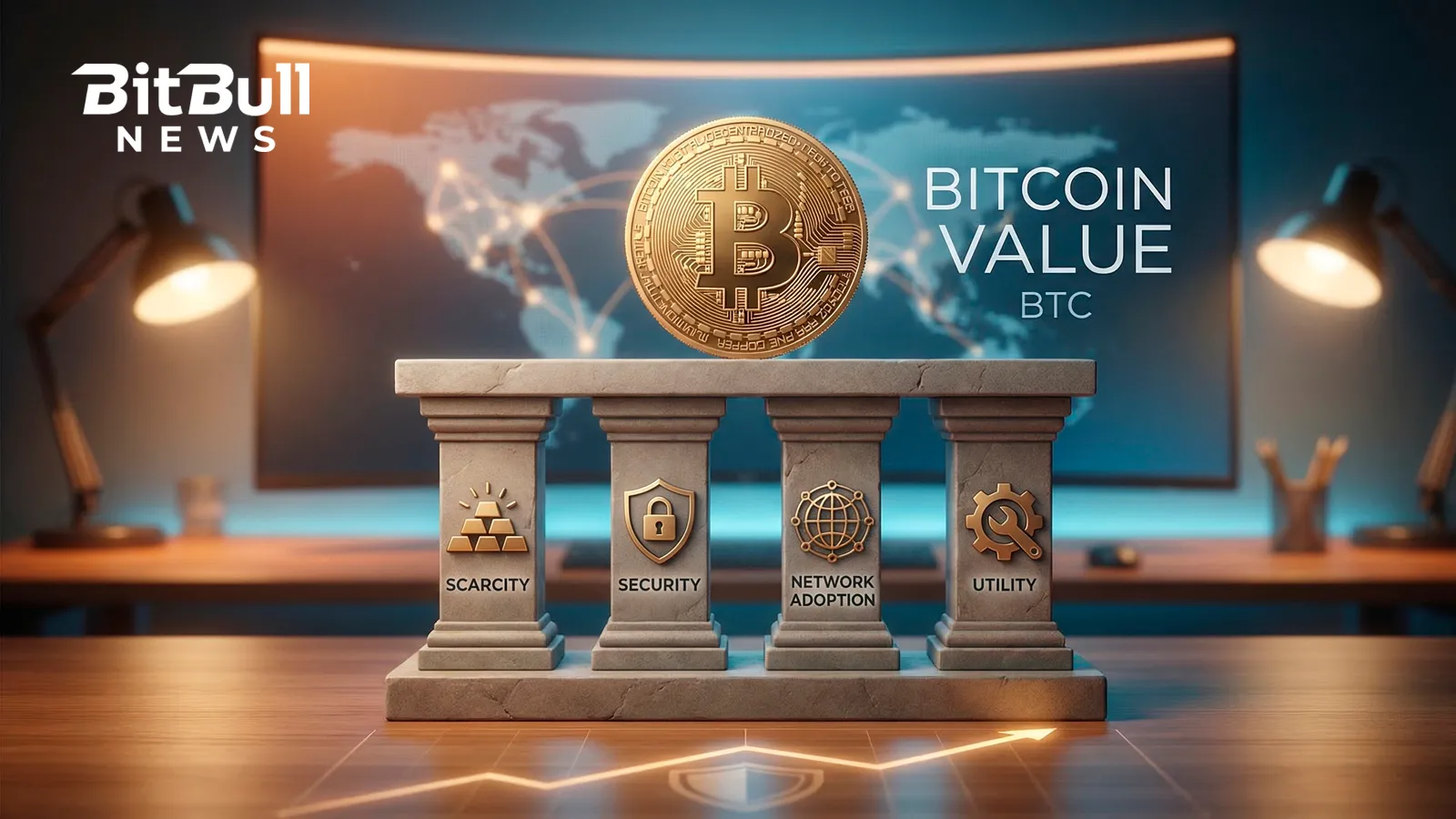
Bitcoin’s value comes from a combination of scarcity, trust in its rules, network effects, utility, and market demand.
That does not mean Bitcoin’s value is guaranteed or stable. It is not. But it does mean the value argument is based on identifiable properties, not pure randomness.
The first big mistake: thinking value only comes from physical backing
A lot of people ask what backs Bitcoin, and behind that question is often an assumption: something has value only if it is physically backed by something else.
That assumption sounds reasonable, but it is incomplete.
Many valuable things are not valuable because of physical backing in the narrow sense.
For example:
- a brand has value
- software has value
- a patent has value
- a network has value
- access rights have value
- domain names have value
- art can have value
- government currency has value largely because of trust, legal structure, and economic use
Even fiat money is not “backed” in the old gold-standard sense. Its value comes from a complex mix of legal tender status, trust in the issuing state, tax obligations, economic activity, central bank credibility, and public confidence.
Bitcoin is similar in one important respect: its value is not based on a pile of metal sitting behind it. It is based on a system of trust, scarcity, utility, and collective belief in its properties.
That does not mean all such belief is equal. It means “not physically backed” is not, by itself, a serious argument against value.
Scarcity: one of Bitcoin’s core value drivers
If there is one feature most closely associated with Bitcoin’s value proposition, it is scarcity.
Bitcoin has a maximum supply of 21 million coins. That supply cap is written into the system’s rules, and new bitcoin is issued at a decreasing rate over time. Roughly every four years, the network goes through a halving, which reduces the block reward miners receive for creating new blocks.
This matters because scarcity is one of the oldest foundations of value in human economics.
Something does not become valuable merely because it is scarce. Plenty of rare things are worthless if nobody wants them. But if something is scarce and desired, scarcity can become a powerful driver of value.
Bitcoin supporters argue that its supply is unusual because it is:
- fixed
- transparent
- predictable
- difficult to change politically
- globally verifiable
That is very different from fiat currencies, where supply can expand over time according to policy decisions.
Bitcoin supply basics
| Feature | Bitcoin |
|---|---|
| Maximum supply | 21 million BTC |
| Issuance | New BTC created through mining rewards |
| Supply schedule | Programmed and predictable |
| Halving | Reward reduced roughly every 4 years |
| Smallest unit | 1 satoshi = 0.00000001 BTC |
This fixed-supply design is one reason people compare Bitcoin to gold. Gold is scarce because it is physically hard to extract. Bitcoin is scarce because its rules make it digitally hard to create more than the system allows.
That distinction matters. Bitcoin scarcity is not natural scarcity. It is programmatic scarcity. Its value depends on the market continuing to trust and care about that rule.
But scarcity alone is not enough
This is a crucial point that beginners often miss.
Scarcity by itself does not guarantee value.
You could create a token with a supply of only 100 units tomorrow. That would make it rare, but not necessarily valuable. For scarcity to matter, the asset also needs demand.
That means Bitcoin’s value is not explained by the 21 million cap alone. Scarcity matters because it interacts with several other things:
- demand
- trust in the rules
- network effects
- cultural significance
- liquidity
- perceived usefulness
- long-term credibility
A scarce asset that nobody wants is still worthless. Bitcoin’s importance comes from the fact that millions of people do want it, for different reasons.
Trust in the rules: why predictability matters
Bitcoin’s rules are one of its most important economic features.
Users can inspect how the system works. They can verify the issuance schedule. They can check the blockchain. They can see that supply is not being created arbitrarily by a central operator. They can run software that enforces the protocol’s rules.
That matters because trust in money is often really trust in the system behind the money.
With fiat currencies, users trust governments, central banks, financial institutions, and legal systems. With Bitcoin, users trust open-source code, distributed consensus, and the network’s social and technical resistance to arbitrary change.
This does not mean Bitcoin requires no trust at all. It does. But it changes the object of trust.
Instead of trusting a central issuer to behave responsibly, Bitcoin asks users to trust that:
- the protocol rules remain credible
- the network remains secure
- participants continue to enforce the system
- decentralization remains meaningful enough to resist capture
For many users, that predictability is valuable in itself.
Network effects: value grows when more people care
Bitcoin’s value is also deeply connected to network effects.
A network effect happens when something becomes more useful or more valuable because more people use it, recognize it, support it, or build around it.
This matters because Bitcoin is not just an asset. It is part of a broader ecosystem.
The more people who:
- hold Bitcoin
- accept Bitcoin
- trade Bitcoin
- build services around Bitcoin
- secure Bitcoin
- talk about Bitcoin
- allocate capital to Bitcoin
- regulate around Bitcoin
- study Bitcoin
…the more entrenched the network becomes.
This does not make Bitcoin invincible, but it does create momentum and resilience. A newcomer asset does not only need to be technically better to compete with Bitcoin. It often also needs to overcome Bitcoin’s existing liquidity, brand recognition, infrastructure, and cultural position.
Why network effects matter
| Network factor | Why it supports value |
|---|---|
| Global recognition | More people understand and trust the asset |
| Liquidity | Easier to buy and sell at scale |
| Infrastructure | Wallets, exchanges, custody, research, payments |
| Institutional access | Broadens demand and legitimacy |
| Media attention | Keeps Bitcoin in public view |
| Developer ecosystem | Supports ongoing maintenance and tools |
This is one reason Bitcoin stayed relevant across multiple market cycles. Even when prices collapse, the network itself often remains active, visible, and globally integrated.
Utility: what can Bitcoin actually do?
One of the strongest critiques of Bitcoin is that it has no intrinsic value because it does not produce income. That critique is partly fair, but it can miss the role utility plays in value.
Bitcoin does not need to generate cash flow to have utility. Its usefulness comes from what it allows users to do.
Bitcoin’s main forms of utility
Store of value
Many people use Bitcoin as a long-term savings asset because they believe its scarcity and durability will preserve value over time.
Transfer of value
Bitcoin can be sent globally without relying on the same banking rails as traditional finance.
Censorship resistance
Valid transactions cannot easily be blocked across the entire network by one single authority.
Self-custody
Users can hold Bitcoin directly rather than only through institutions.
Monetary alternative
For some people, Bitcoin offers an alternative to local currency systems they do not trust.
Collateral or reserve asset
Bitcoin is increasingly used in financial products, treasury strategies, and institutional allocation frameworks.
That does not mean Bitcoin is equally useful to everyone. But utility is part of the value case.
Example: why utility can matter more in some countries than others
Imagine two people.
One lives in a stable country with strong banking, low inflation, easy cross-border transfers, deep capital markets, and legal financial protections.
The other lives in a country with:
- high inflation
- currency weakness
- capital controls
- fragile banking
- political uncertainty
- limited access to global financial products
These two people will evaluate Bitcoin very differently.
For the first person, Bitcoin may look like a risky investment or a portfolio diversification play.
For the second, Bitcoin may look like:
- an escape valve from currency debasement
- a portable savings tool
- a cross-border transfer mechanism
- a hedge against domestic financial instability
This difference is one reason Bitcoin’s value argument cannot be reduced to a single Western financial lens. Real-world utility varies depending on local conditions.
Portability, divisibility, and durability
These are classic monetary qualities, and Bitcoin scores strongly on several of them.
Portability
Bitcoin can move across borders and across accounts without the same physical frictions as gold or cash.
Divisibility
One bitcoin can be divided into 100 million satoshis. That makes it usable at very small denominations.
Durability
Bitcoin does not physically decay. As long as the network remains active and access credentials are preserved, the asset can be held indefinitely in digital form.
Verifiability
Users can independently verify balances, supply rules, and transaction history through the network.
Monetary properties table
| Property | Why it matters | Bitcoin’s profile |
|---|---|---|
| Scarcity | Helps support value if demand exists | Strong |
| Portability | Easy movement across distance | Strong |
| Divisibility | Useful for different transaction sizes | Strong |
| Durability | Long-term preservation potential | Strong |
| Verifiability | Users can check the rules themselves | Strong |
| Uniformity | Units are interchangeable | Strong |
These qualities do not by themselves make Bitcoin perfect money, but they do explain why many people see it as a credible monetary asset.
Security and decentralization: part of the value case
Bitcoin’s value is also connected to its security model.
People do not only value the asset itself. They value the network’s ability to defend the asset’s integrity.
If Bitcoin were easy to manipulate, rewrite, counterfeit, or censor, its value proposition would weaken dramatically. Part of what gives Bitcoin value is the market’s belief that the network is robust enough to maintain credible ownership records over time.
This depends on several things:
- mining security
- node participation
- economic incentives
- software resilience
- geographic distribution
- social resistance to unwanted rule changes
Beginners sometimes underestimate this. They think Bitcoin’s value comes only from the coin. But the coin’s value depends heavily on the security and credibility of the system behind it.
Social belief and collective agreement
At this point, some readers may feel the answer still sounds soft. Scarcity, trust, network effects, and utility all matter, but do they ultimately reduce to one thing: belief?
In part, yes.
Money has always involved collective belief.
Gold has value partly because people across cultures agreed it was valuable. Fiat money has value partly because societies trust the institutions behind it. Stocks have value because markets believe future cash flows matter. Real estate has value because people want land, access, utility, and social meaning attached to it.
Bitcoin is no different in the sense that collective human belief still matters.
But not all belief is arbitrary.
A better way to say it is this:
Bitcoin’s value depends on collective belief in a set of real properties.
Those properties include:
- fixed supply
- decentralized operation
- secure settlement
- global transferability
- political neutrality relative to national currencies
- long-term survivability
- monetary credibility outside direct state control
That is very different from saying the value comes from nothing.
The role of speculation
A serious article about Bitcoin value must include speculation, because speculation is undeniably part of the story.
A lot of people buy Bitcoin not because they need censorship resistance or a global settlement rail, but because they believe the price will rise.
That speculative demand matters. It creates liquidity, attention, volatility, and momentum. It also introduces distortion. Price can detach from sober analysis in both directions. During bull markets, speculative excess can make Bitcoin look invincible. During bear markets, panic can make it look useless.
Speculation is not unique to Bitcoin. It exists in stocks, real estate, commodities, startups, art, and many other asset classes. But Bitcoin’s round-the-clock global trading and strong narrative culture amplify it.
What speculation does to Bitcoin’s value story
| Positive effect | Negative effect |
|---|---|
| Increases liquidity | Increases volatility |
| Brings new participants | Attracts hype and noise |
| Strengthens market depth | Can detach price from fundamentals |
| Expands visibility | Encourages short-term thinking |
The key beginner insight is that speculation may influence Bitcoin’s price, but it does not fully explain Bitcoin’s existence or long-term staying power.
Institutional adoption and legitimacy
Another factor that supports Bitcoin’s value is the expansion of institutional access and market infrastructure.
When major financial institutions, custodians, asset managers, public companies, and professional investors allocate to Bitcoin or build products around it, several things happen:
- market access becomes easier
- liquidity deepens
- public legitimacy grows
- research coverage expands
- portfolio inclusion becomes more normal
This does not prove Bitcoin is fundamentally sound, but it does strengthen the network effect and credibility loop.
For beginners, the important point is not “institutions are always right.” They are not. The point is that institutional participation changes how Bitcoin is perceived, priced, and integrated into the financial system.
Bitcoin vs gold: why the comparison keeps coming back
Bitcoin is often called digital gold. The comparison can be overused, but it exists for a reason.
Gold has historically been valued because it is:
- scarce
- durable
- widely recognized
- hard to produce
- difficult to fake
- outside direct government issuance
Bitcoin shares some of these traits in digital form.
Bitcoin vs gold
| Feature | Gold | Bitcoin |
|---|---|---|
| Scarcity | Limited but not perfectly fixed | Fixed maximum supply |
| Portability | Difficult at scale | Easy to move digitally |
| Divisibility | Possible but less convenient | Extremely divisible |
| Durability | Physically durable | Digitally durable |
| Verifiability | Requires testing and custody systems | Can be verified on-chain |
| Track record | Thousands of years | Relatively young |
The gold comparison helps explain Bitcoin’s appeal, but it also highlights a major difference: Bitcoin’s history is short. Gold’s monetary role was tested over centuries. Bitcoin is still proving itself in real time.
That means part of Bitcoin’s value is a bet that its monetary credibility will continue to strengthen over the coming decades.
The strongest arguments against Bitcoin’s value
To understand Bitcoin honestly, it helps to examine the critical side too.
Argument 1: It has no intrinsic value
Critics say Bitcoin has no cash flow, industrial use like commodities, or state backing, so its value is purely narrative-driven.
Argument 2: It is too volatile to function as money
If price swings are extreme, Bitcoin may struggle as a stable medium of exchange or unit of account.
Argument 3: Better technology could replace it
Some argue Bitcoin’s first-mover status is not enough and newer systems could outperform it.
Argument 4: Regulation could weaken demand
If governments heavily restrict access, usage, or taxation, demand could suffer.
Argument 5: It depends too much on belief
Some critics say Bitcoin survives only because people believe someone else will pay more later.
These critiques should not be dismissed. Some are serious and reasonable. But they are not necessarily fatal.
How supporters respond
| Critique | Common response |
|---|---|
| No intrinsic value | Monetary assets often derive value from trust and properties, not cash flow |
| Too volatile | Bitcoin is still maturing; volatility may decline over time |
| Better tech can replace it | Monetary networks benefit from trust, brand, and network effects, not only technical features |
| Regulation risk | Bitcoin is global and decentralized, making total suppression difficult |
| Pure belief | Belief is anchored in scarcity, utility, and verifiable rules |
This is why the debate persists. Bitcoin sits at the intersection of economics, technology, politics, and culture. Its value case is strong enough to attract long-term conviction, but unusual enough to remain controversial.
Example: how a beginner should think about Bitcoin value
Let’s imagine a beginner named Lucas trying to understand whether Bitcoin is worth taking seriously.
At first, Lucas looks at the chart and assumes Bitcoin is mainly a speculative trade. Then he starts reading about:
- the 21 million supply cap
- self-custody
- cross-border transfer
- the difference between fiat inflation and fixed issuance
- the size of Bitcoin’s infrastructure and liquidity
- why people in unstable economies use it differently than investors in wealthy countries
Now Lucas sees that Bitcoin’s value is not a single argument. It is a stack of arguments.
He still may decide Bitcoin is too risky for him. That is a valid conclusion. But now he is judging it on its actual properties instead of dismissing it as magic internet money or accepting it as inevitable digital gold without scrutiny.
That is the goal: clarity before conviction.
Expert view: the deepest source of Bitcoin’s value
At an expert level, Bitcoin’s value comes from something larger than price appreciation potential.
Bitcoin is the first globally recognized digital asset that combines:
- credible scarcity
- decentralized ownership
- open verification
- durable monetary rules
- political neutrality relative to national issuance
- permissionless access
- long-term survivability across jurisdictions
That combination is difficult to replicate.
A new crypto asset can copy code. It can change parameters. It can claim better throughput or cheaper fees. But it cannot easily reproduce Bitcoin’s history, brand, social consensus, infrastructure depth, or role as the first large-scale digital bearer asset with a credible global market.
This is why many experts argue that Bitcoin’s value is not merely technical. It is also historical, social, and monetary.
Bitcoin’s deepest value may be that it created a new kind of asset category: digitally scarce property outside direct state issuance and outside single-platform control.
Common mistakes
Mistake 1: Thinking scarcity alone explains everything
Scarcity matters, but without demand and trust it means very little.
Mistake 2: Assuming price proves value
A rising price may reflect enthusiasm, speculation, liquidity, or macro trends, not necessarily deep understanding.
Mistake 3: Expecting Bitcoin to look like a stock
Bitcoin is not a company. Judging it only by equity-style metrics misses the point.
Mistake 4: Ignoring the role of network effects
People often underestimate how much infrastructure, brand, and global recognition support Bitcoin’s value.
Mistake 5: Thinking “not backed by gold” means “worthless”
Many valuable assets are not physically backed in that sense.
Mistake 6: Believing the value argument is purely ideological
For many users, Bitcoin solves practical problems around savings, transfer, or financial access.
Mistake 7: Ignoring volatility and downside
Even if Bitcoin has strong value drivers, that does not make it low-risk.
A practical framework for judging Bitcoin’s value
A useful beginner framework is to evaluate Bitcoin across five lenses.
- Monetary properties
Is it scarce, durable, portable, divisible, and verifiable? - Security and credibility
Is the network secure and trusted enough to protect ownership over time? - Demand drivers
Why do people want it? Savings, transfer, speculation, reserve asset logic, macro hedge? - Network effects
How strong is the ecosystem around it? - Risk factors
What could weaken adoption, trust, or usability?
Simple evaluation table
| Lens | Key question |
|---|---|
| Monetary properties | Does Bitcoin behave like a strong monetary asset? |
| Security | Can the network credibly defend the ledger? |
| Demand | Why do people hold and use it? |
| Network effects | How entrenched is the ecosystem? |
| Risks | What could reduce value over time? |
FAQ
What gives Bitcoin value in one sentence?
Bitcoin gets value from a mix of scarcity, trust in its rules, network effects, utility, and market demand.
Is Bitcoin backed by anything?
Not in the traditional gold-backed sense. Its value comes from its properties, network credibility, and what users are willing to exchange for it.
Why do people compare Bitcoin to gold?
Because both are scarce assets that many people view as stores of value outside direct government money creation.
Is Bitcoin valuable only because people believe in it?
Partly, but that belief is tied to real features like fixed supply, portability, verifiability, and decentralized ownership.
If Bitcoin has no cash flow, how can it have value?
Not all valuable assets produce cash flow. Monetary assets can derive value from scarcity, trust, and utility.
Does scarcity guarantee Bitcoin’s value?
No. Scarcity helps only if demand exists and people continue to value the asset’s properties.
Why is Bitcoin so volatile if it has value?
Because markets are still relatively young, demand shifts quickly, and speculative trading plays a major role.
Can Bitcoin lose its value?
Yes. If trust, demand, network effects, or regulatory access weakened enough, Bitcoin’s value could decline significantly.
Is Bitcoin’s value mostly speculation?
Speculation is a major factor in price movements, but it does not fully explain Bitcoin’s long-term relevance.
Why do institutions buying Bitcoin matter?
Because institutional access can deepen liquidity, strengthen legitimacy, and expand the market base.
Does Bitcoin have intrinsic value?
That depends on how you define intrinsic value. Critics say no; supporters argue its monetary properties and utility create a real basis for value.
Is Bitcoin worth more because there will only be 21 million?
That fixed supply supports the value case, but it matters only because people also trust and demand the asset.
Final takeaway
Bitcoin’s value does not come from one magical property. It comes from a combination of features that reinforce one another.
- Bitcoin is scarce, but scarcity alone is not enough.
- Bitcoin is useful, but usefulness alone is not enough.
- Bitcoin is widely recognized, but recognition alone is not enough.
- Bitcoin is trusted by many users, but trust alone is not enough.
Its value case is strongest when these elements work together:
- credible scarcity
- open and predictable rules
- security and decentralization
- portability and divisibility
- global network effects
- real-world demand
- growing financial infrastructure
That does not make Bitcoin risk-free. It does not guarantee future price appreciation. And it does not end the debate about whether Bitcoin deserves its place in the financial system.
But it does explain why the answer to “what gives Bitcoin value?” is much more serious than “nothing” and much more nuanced than “everyone just agrees it matters.”
Bitcoin has value because enough people, across enough places, for enough reasons, believe its properties are worth owning. The more durable that belief remains, the stronger the value case becomes.
Related evergreen reads
What Is Bitcoin? A Simple Beginner’s Guide
Bitcoin vs Traditional Money: What’s the Difference?
What Is a Stablecoin?