


Content
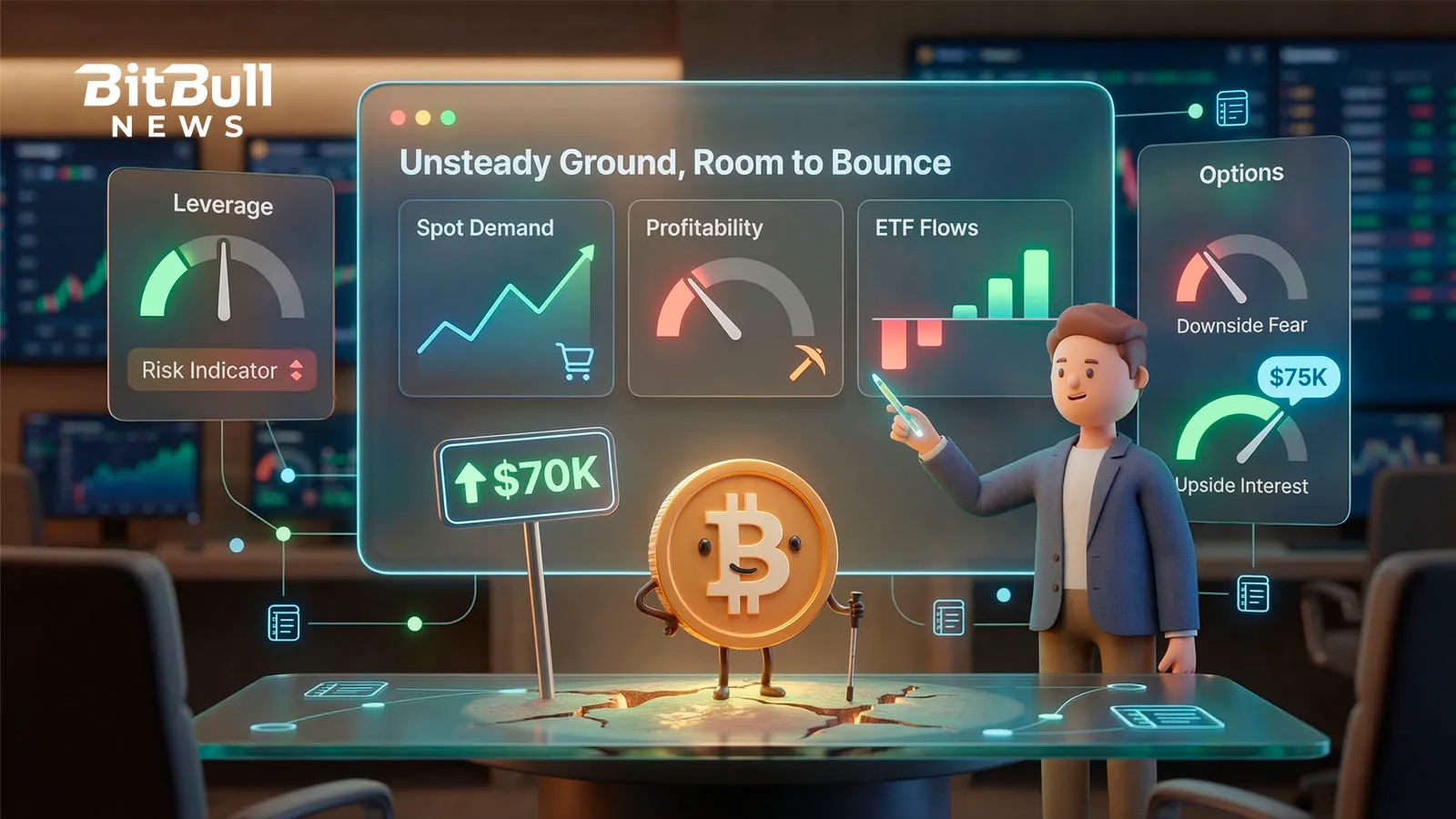
Bitcoin has pushed back above $70,000, but Glassnode says the market still looks shaky under the surface. In its latest Week On-chain report, the firm points to improving spot demand and early signs of ETF stabilization—while warning that profitability and “buy-side momentum” have materially weakened.
The result is a market that can bounce, but may struggle to build a durable uptrend without a clear return of sustained demand.
Buy-side momentum is fading, even as price pushes higher
Glassnode highlights a key tension: price is testing the $70K area again, but on-chain realized profit trends suggest fewer buyers are willing to transact at a premium.
The report notes Bitcoin has struggled to close above $70K since early February. Over that period, the 30-day moving average of realized profit contracted sharply—from above $1B per day to roughly $370M per day (about a 63% decline), which Glassnode interprets as a meaningful deterioration in demand momentum.
Profitability regime looks more “bear market” than “recovery”
Glassnode also flags a broad decline in profitability across the supply. The percent of supply in profit has fallen to around 57%, breaking below a -1 standard deviation threshold near 60%.
In the report’s framing, that puts the current regime in a historical context similar to early 2022 and 2018 bear-market phases—suggesting this consolidation may still be part of a larger adverse trend, not a clean break into recovery.
$70K is the overhead ceiling, not the breakout line
Even with room for short-term relief rallies, Glassnode argues $70K remains a heavy behavioral resistance zone.
The cost basis for short-term holders aged 1 week to 1 month sits near $70K, and the report calls the ±2% band (roughly $68.5K to $71.5K) a likely “distribution zone” where recent buyers may sell into breakeven or thin profits.
Spot and ETFs show early stabilization signals
On the “green shoots” side, Glassnode says the intensity of spot selling appears to be easing. It points to cumulative volume delta (CVD) improving at the margin—especially on Coinbase—while broader exchange flows remain weak but are no longer accelerating lower.
The report also says U.S. spot Bitcoin ETF flows are stabilizing after sustained outflows, with early renewed inflows appearing. Glassnode stops short of calling it a durable reversal, but frames it as a tentative improvement in institutional demand.
Derivatives stay cautious, options rotate toward upside
Glassnode says derivatives positioning still looks defensive, with the perpetual market directional premium continuing to compress—signaling subdued leverage and reduced bullish conviction.
Options markets, however, are described as normalizing after February’s volatility spike. The report says implied volatility is compressing, downside fear is fading as skew normalizes, and options flow has rotated toward upside exposure—highlighting a sharp drop in the put/call volume ratio since Feb. 28.
One standout level: Glassnode says the $75,000 strike has emerged as a “gamma magnet,” with concentrated negative gamma and rising call premium positioning that could pull price toward that level via dealer hedging dynamics.
Why it matters for crypto
- It’s a classic “bounceable, but fragile” setup: price can rally, yet demand indicators look structurally weaker.
- If $70K becomes an overhead distribution zone, upside may be capped until spot demand strengthens.
- Stabilizing ETF flows matter because they can provide real spot support when discretionary demand is thin.
- The options shift toward calls and the $75K “gamma magnet” can mechanically influence short-term price paths.
- Compressed perp premium suggests leverage is not driving a breakout—good for stability, but not a strong “risk-on” signal.
What to watch next
- Whether BTC can close above $70K consistently (not just wick above it).
- Signs of broad-based spot bid absorption across multiple exchanges, not only Coinbase.
- Continued ETF inflows (or a relapse into outflows) as the first real test of institutional demand stabilization.
- Whether skew and implied volatility keep normalizing, or snap back defensive on the next drawdown.
- Price interaction around $75K, as options positioning could amplify moves toward that strike.