


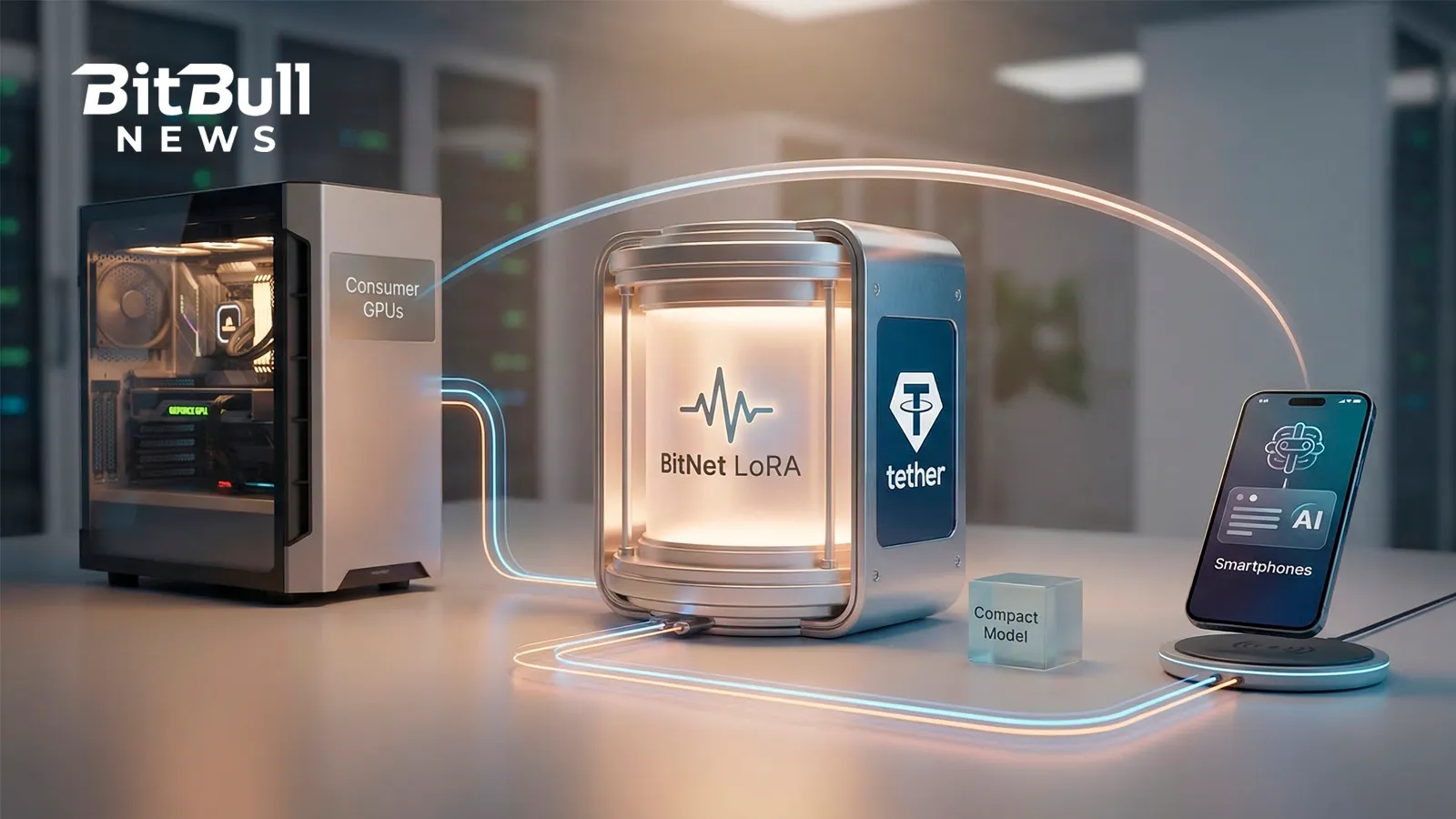
Tether said its QVAC unit has launched what it describes as the world’s first cross-platform LoRA fine-tuning framework for Microsoft’s BitNet models, aiming to make large-model AI training and inference possible on consumer hardware rather than enterprise-grade cloud systems. The company said the release is part of QVAC Fabric and is designed to cut memory and compute demands enough for use on laptops, consumer GPUs, and modern smartphones.
The pitch is straightforward: instead of relying on expensive centralized infrastructure, developers could fine-tune and run certain language models directly on everyday devices. Tether is framing that as a decentralization play for AI, not just a performance upgrade.
What Tether announced
Tether said the new framework brings cross-platform LoRA fine-tuning and inference acceleration to Microsoft’s BitNet family of 1-bit large language models. In simpler terms, the company is trying to make lighter-weight AI models easier to customize and deploy on hardware that most developers and users already have.
According to the announcement, QVAC Fabric now supports heterogeneous consumer GPUs, including Intel, AMD, Apple Silicon M-series chips, and mobile GPUs. Tether said that means users can train and customize AI models directly on local devices instead of depending on specialized NVIDIA systems or cloud-based infrastructure.
Tether also said this is the first time LoRA fine-tuning for 1-bit LLMs has been enabled on non-NVIDIA hardware, including mobile GPUs. That is a central part of the release because it shifts the message from raw model capability to broader hardware accessibility.
Key details on performance and device support
The company said its engineering team successfully demonstrated BitNet fine-tuning on mobile GPUs, including Adreno, Mali, and Apple Bionic. As examples, Tether said a 125 million-parameter BitNet model could be fine-tuned in about 10 minutes on a Samsung S25 using a biomedical dataset of roughly 300 documents, or about 18,000 tokens.
For a 1 billion-parameter model on the same dataset, Tether said fine-tuning took 1 hour and 18 minutes on a Samsung S25 and 1 hour and 45 minutes on an iPhone 16. The company added that its team pushed fine-tuning as high as 13 billion parameters on an iPhone 16, though the release does not provide the same level of benchmarking detail for that larger run.
On inference, Tether said BitNet models running through QVAC Fabric were between two and eleven times faster on mobile GPUs than on CPUs. It also said the memory savings were substantial, claiming BitNet-1B used up to 77.8% less VRAM than Gemma-3-1B in 16-bit form and 65.6% less than Qwen3-0.6B in 16-bit form across inference and LoRA fine-tuning workloads.
Why BitNet matters in this rollout
The technical hook here is BitNet’s 1-bit architecture. Tether’s argument is that these models can deliver meaningful training and inference workloads with far less memory overhead than more conventional formats, which in turn makes edge-device deployment more realistic.
That matters because memory, not just raw compute, is often the real bottleneck on phones and consumer hardware. Tether said the framework can fine-tune models up to two times larger on edge devices than Q4 non-BitNet models, which it presents as evidence of BitNet’s memory advantage.
Why this matters now
The broader message is bigger than one framework release. Tether is making a case that advanced AI development has become too dependent on centralized cloud infrastructure and that this concentration raises cost, access, and resilience concerns.
By pushing fine-tuning and inference onto consumer hardware, QVAC is trying to align AI infrastructure with the same decentralization logic that crypto companies have applied to money, payments, and data systems. Tether CEO Paolo Ardoino said the goal is to make AI more accessible, more local, and less dependent on a small number of cloud providers.
The release also hints at a longer-term roadmap beyond personal devices. Tether said the efficiency gains make federated learning more realistic in the near future, meaning model updates could be trained and shared across distributed devices while keeping sensitive data on-device. That is potentially important for privacy-sensitive or bandwidth-constrained use cases, though the release stops short of announcing a live federated system today.
Why it matters for crypto
- It extends the decentralization narrative beyond finance and into AI infrastructure, which fits Tether’s broader push into peer-to-peer and local-first systems.
- It points to a future where crypto-native companies compete not only in payments and stablecoins, but also in edge computing, private data processing, and distributed intelligence.
- It could lower the barrier for builders who want to run or customize AI models without relying on costly cloud providers or specialized NVIDIA hardware.
- It strengthens the case for on-device AI in crypto-adjacent applications where privacy, self-custody, and local control matter.
What to watch next
- Whether Tether publishes broader benchmark data beyond the examples in the release, especially for larger models and more varied real-world workloads.
- Whether QVAC Fabric gains adoption among outside developers, rather than remaining mainly a technical showcase from Tether’s internal engineering team.
- Whether the federated learning angle turns into a product roadmap with live tooling, partner integrations, or open deployments.
- Whether Tether expands this AI push into consumer apps, crypto infrastructure, or enterprise products that connect directly to its wider ecosystem.