


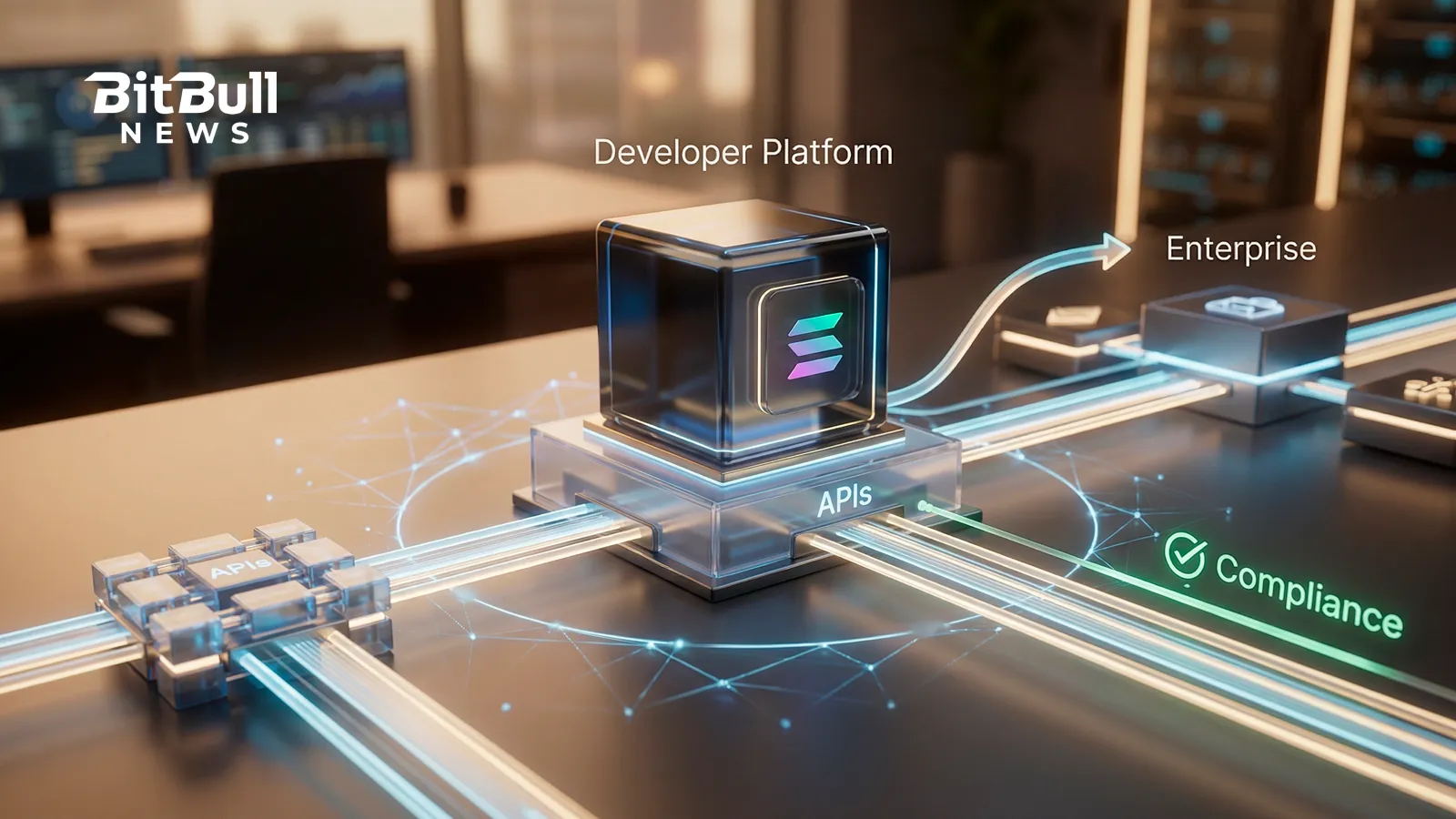
Solana Foundation has launched Solana Developer Platform, or SDP, an API-based product designed to help enterprises and financial institutions build financial services on Solana without stitching together infrastructure on their own. The platform is being pitched as an institutional gateway to tokenized issuance, payments, and, later, trading workflows.
The key detail is that this is not just a developer toolkit for crypto-native teams. Solana says SDP is built for enterprises and financial institutions, aggregates more than 20 infrastructure partners behind a unified interface, and is already being used early by Mastercard, Worldpay, and Western Union.
Solana is trying to package its ecosystem for institutions
At the center of the launch is a simple idea: large financial companies do not want to assemble a blockchain stack partner by partner before they can test a product. Solana says SDP bundles best-in-class node infrastructure, wallets, compliance tools, and payment ramps into a single API-driven interface so institutions can get to market in a more efficient, compliant, and scalable way.
That framing matters because the product is less about one new protocol feature and more about distribution. Solana is effectively trying to turn its ecosystem into an enterprise-ready operating layer that can be consumed through APIs rather than through raw blockchain integration work. That second point is a grounded inference from the way the platform is described in the launch post.
What is live today — and what is still coming
Solana says SDP has three core API modules. The issuance module lets users issue tokenized deposits, GENIUS-compliant stablecoins, or tokenized real-world assets. The payments module supports fiat and stablecoin flows, including on-ramp, off-ramp, and onchain stablecoin transactions for B2B, B2C, and P2P use cases. The trading module is meant to support financial flows such as atomic swaps, vaults, and onchain FX.
But all three are not live yet. Solana says the issuance and payments modules are available now, while the trading module is scheduled to follow later in 2026. That is an important distinction, because the launch is real, but the full three-part institutional stack is not complete yet.
The first use cases are practical, not theoretical
The early-user list gives the clearest picture of where Solana thinks demand exists. Solana says Mastercard is using SDP for stablecoin settlement, Worldpay for merchant payments and settlement, and Western Union for cross-border payments.
Those examples are important because they move the story away from general “enterprise blockchain” language. The use cases Solana chose to highlight are concrete financial rails: settlement, merchant flows, and remittances. That suggests the foundation sees payments as the strongest entry point for institutional adoption, at least in the early phase of the platform. That reading is an inference based on the specific early users and use cases named in the source.
The partner stack shows where the real product sits
SDP is not a closed Solana-native service. Solana says the platform pulls in outside providers across four categories: node infrastructure, wallets, compliance, and ramps. The named node providers are Alchemy, Helius, QuickNode, and Triton. Wallet and custody providers include Anchorage Digital, BitGo, Coinbase, Crossmint, Dfns, Dynamic, Fireblocks, Para, Paxos, Privy, and Turnkey. Compliance partners include Chainalysis, Elliptic, Range, and TRM. Ramp partners include Bridge, BVNK, Lightspark, Modern Treasury, and MoonPay.
That partner list answers one of the biggest practical questions around the launch: Solana is not asking institutions to rely on a single vendor for custody, compliance, or fiat connectivity. Instead, it is trying to make those choices available behind one interface, which should lower the cost of experimenting with different product setups. The factual partner categories come from the source; the strategic implication is a grounded inference.
This is also an AI-ready developer push
One detail in the announcement stands out because it points beyond traditional fintech onboarding. Solana says SDP can be used out of the box by AI coding platforms including Claude Code by Anthropic and Codex by OpenAI.
That makes the launch more than a financial infrastructure story. Solana is also trying to make its enterprise stack accessible to the emerging AI-assisted software workflow, where developers increasingly build and test products through coding agents rather than only through manual documentation and direct SDK work. That broader interpretation is an inference from the AI-platform compatibility Solana chose to emphasize.
What the launch still does not answer
The announcement is detailed on structure, but lighter on adoption metrics. Solana does not disclose commercial terms, client rollout timelines, pricing, transaction volumes, or how deeply the early users are already live in production. It also says SDP is available at launch in a sandbox built on Solana devnet, which means the platform is available, but not all activity described in the announcement should be read as large-scale production deployment today.
There is also still a meaningful gap between the product promise and the final institutional stack. The trading module is not live yet, and Solana does not say exactly when later in 2026 it will arrive or which institutions are expected to use it first.
Why it matters for crypto
- It shows Solana is trying to turn its ecosystem into a packaged enterprise product, not just a developer community or payments narrative.
- The launch strengthens Solana’s position in tokenized issuance and stablecoin payments, which are becoming core battlegrounds for institutional blockchain adoption.
- The inclusion of compliance, custody, and ramp partners suggests enterprise adoption will depend on integrated market infrastructure, not raw chain performance alone.
- AI-platform compatibility hints that future blockchain adoption may be shaped as much by developer workflow and software interfaces as by the chain itself.
What to watch next
- Whether Solana can turn early enterprise names like Mastercard, Worldpay, and Western Union into broader disclosed production deployments.
- When the trading module launches and whether it meaningfully expands SDP beyond issuance and payments.
- Whether the sandbox-to-production path is smooth enough for regulated institutions to move faster than they have with earlier blockchain infrastructure offerings. This is an inference based on the platform’s stated target market and current devnet availability.
- Whether Solana can use SDP to funnel more institutional activity into its wider ecosystem rather than just providing a simplified front door.